
Before You Head to the Beach: Hood Canal's Shellfish Scene, and What to Know Right Now
Hood Canal looks like a bay but it technically isn't. It's a fjord, which is a long, deep arm of saltwater carved out by glaciers during the last ice age. The water is cold and rich, the kind of cold that is very good for shellfish, which is why Mason County has become one of the best places in world to dig clams, eat oysters, mussels and geoduck. The farms and tideflats along the canal have supplied restaurants and raw bars for decades, and recreational harvesting has been a local tradition for even longer.
Hood Canal looks like a bay but it technically isn't. It's a fjord, which is a long, deep arm of saltwater carved out by glaciers during the last ice age. The water is cold and rich, the kind of cold that is very good for shellfish, which is why Mason County has become one of the best places in world to dig clams, eat oysters, mussels and geoduck. The farms and tideflats along the canal have supplied restaurants and raw bars for decades, and recreational harvesting has been a local tradition for even longer.
The Washington Shellfish Trail

If you want a guide to it all, shellfishtrail.org is where to start. The Washington Shellfish Trail is a statewide resource that maps out oyster farms, shellfish events, and self-harvest beaches across the state. The site includes links to WDFW licensing information if you're planning to harvest. To harvest shellfish or seaweed in Washington, everyone age 15 and older needs a Washington State Shellfish/Seaweed License. These are easy to get online through the Washington Department of Fish and Wildlife (WDFW) website or at sporting goods stores and many local shops. Be sure to bring your license along on your trip, it is required whenever you gather your own oysters or clams.
Check Before You Go: A New Beach Status Tool
The Shellfish Trail recently added a new feature at on its website. The live "beach status" page pulls daily harvest data from the Washington Department of Health and displays current open, conditional, or closed status for beaches across the state. It also includes a GPS-based tide tool that uses your location to provide upcoming tide predictions for the nearest NOAA station. It's a handy tool for anyone planning a harvesting trip. Conditions can change quickly, and having the current status makes planning easier.
Two Very Different Bodies of Water
Mason County is shellfish country, but not all of its water is the same, and if you're planning a harvesting trip, its important to learn the terrain. Hood Canal runs about 50 miles from its northern entrance near Foulweather Bluff all the way south and around the Great Bend to Lynch Cove near Belfair. It's deep, up to 600 feet in places, with an average depth of around 177 feet. That depth is a characteristic of a fjord. There's a shallow underwater ridge, called a sill, near the northern entrance that limits how freely deeper water can exchange with Puget Sound. The Skokomish River pours freshwater into the south end, creating a layer of lighter freshwater on top of denser saltwater below. Those two layers don't mix easily, so the deep water of Hood Canal can go a long time without being replenished with oxygen-rich water from the surface or from outside. That's a natural condition of a fjord. When algae blooms occur and produce toxins, those conditions can linger.

Hammersley Inlet and Oakland Bay, near Shelton, close to the canal as the crow flies, are almost entirely different bodies of water. Hammersley is a shallow, winding tidal channel -- about eight nautical miles of twisting waterway that connects Oakland Bay to the greater South Puget Sound. When the tide changes, all the water in Oakland Bay has to move through that single narrow passage, and it does so fast. Currents in Hammersley can run up to five knots. That tidal movement means the water flushes on every tide cycle, mixing and exchanging far more actively than the deep, stratified water of Hood Canal. Oakland Bay itself receives freshwater from Goldsborough Creek and several other smaller streams through Shelton, making it more of a true estuary, shallower and warmer with the tides.
That difference in water character is one reason these two areas can have different conditions at any given time. A closure on Hood Canal doesn't automatically mean Hammersley or Oakland Bay are affected, and vice versa. In fact, even when one area is closed, you might find that another nearby beach remains open for harvesting. The beach status tool mentioned above shows each growing area's status independently, so you can easily see which beaches are currently open. Checking by location lets you find alternative spots rather than assuming one closure covers everything.
Right Now: Hood Canal Is Closed for Recreational Harvest
On June 12, the Washington State Department of Health issued a warning after lab testing found lethal levels of Paralytic Shellfish Poison in shellfish samples collected near Union. As a result, all recreational shellfish harvesting in Hood Canal is currently closed, from Foulweather Bluff and Port Ludlow Bay south, including Port Gamble Bay, Quilcene Bay, Dabob Bay, and Mats Mats Bay. The closure covers clams, oysters, mussels, scallops, and other molluscan shellfish. Crab and shrimp are not included.

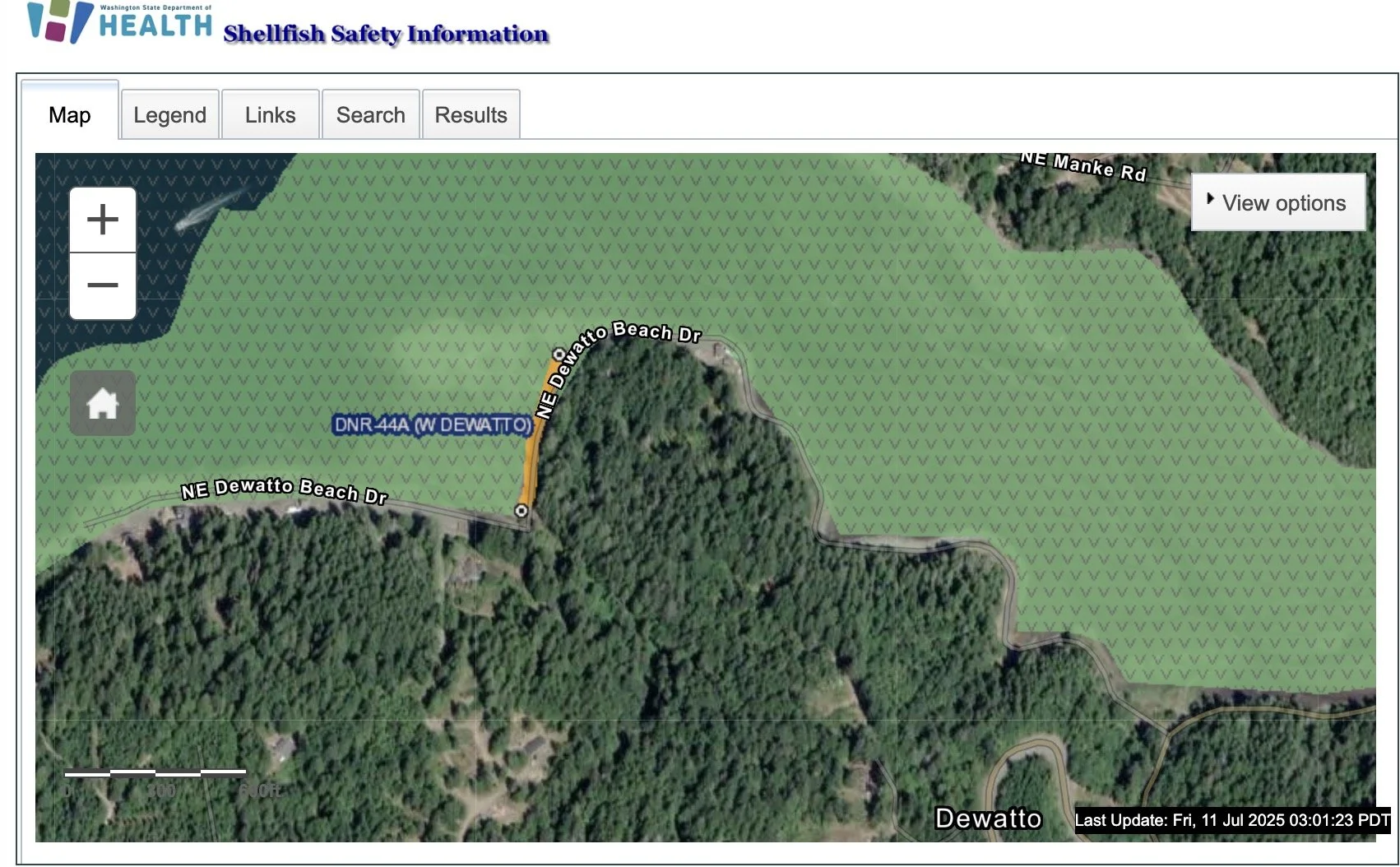
If someone has eaten shellfish from a closed area or starts having symptoms like tingling, numbness, dizziness, or trouble breathing after eating shellfish, call 911 right away. Paralytic Shellfish Poisoning can become serious very quickly, and it is important to get medical help immediately. Warning signs have been posted at public beaches in Mason, Kitsap, and Jefferson counties. PSP is caused by a naturally occurring marine toxin produced by certain algae. Shellfish accumulate it as they filter-feed, and there's no way to tell by looking, smelling, or tasting whether they are contaminated. Cooking doesn't destroy it either. Symptoms can come on within minutes to a few hours after eating affected shellfish and can be serious. The closure will stay in place until DOH testing confirms toxin levels have dropped to safe concentrations. Beach status is updated daily as new water and shellfish test results become available, so you can rely on recent information for planning your trip. The most current status is always available on the DOH Shellfish Safety Map (fortress.wa.gov/doh/biotoxin/biotoxin.html), or you can check the Shellfish Trail's beach status tool above. For the fastest updates, you can also sign up for email or text notifications on the DOH website to be alerted when conditions change.
Still Worth the Trip
A PSP closure is a sign that Hood Canal is a living, healthy ecosystem, and that the water quality here is monitored closely because people depend on it. The canal's fjord-like geography means it doesn't flush and refresh as shallower bays do, making it especially sensitive to conditions in the water column. That's also part of what makes it so productive when conditions are right. The beaches are still beautiful. The farms are still operating (commercial shellfish goes through a separate, federally supervised monitoring program). Kayaking, crab and shrimp fishing, swimming, and shoreline exploration are all unaffected. Keep an eye on the beach status page on shellfishtrail.org for updates -- and bookmark it for your next trip out to the water.
Crossing the Bar - McMicken Island
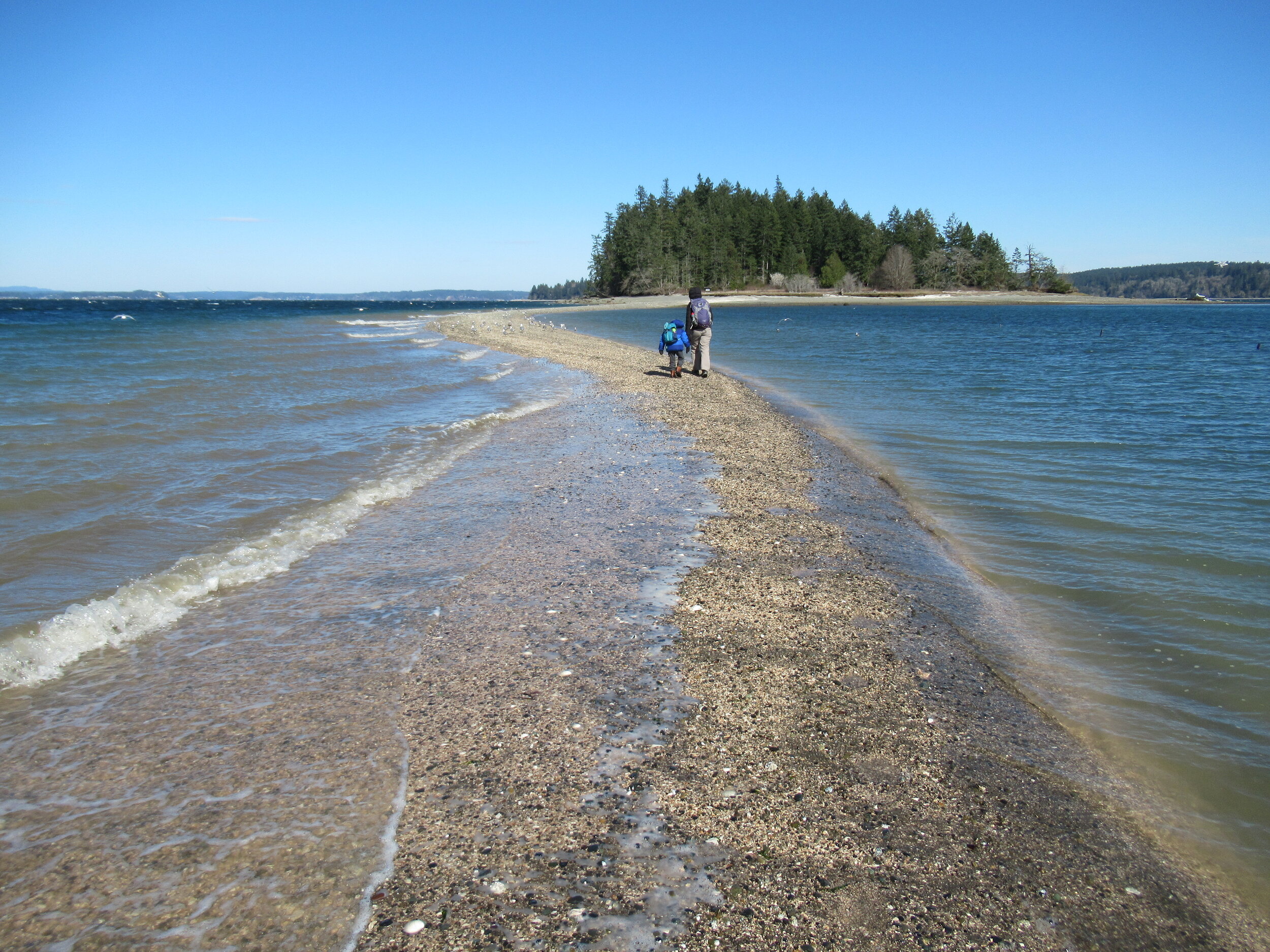
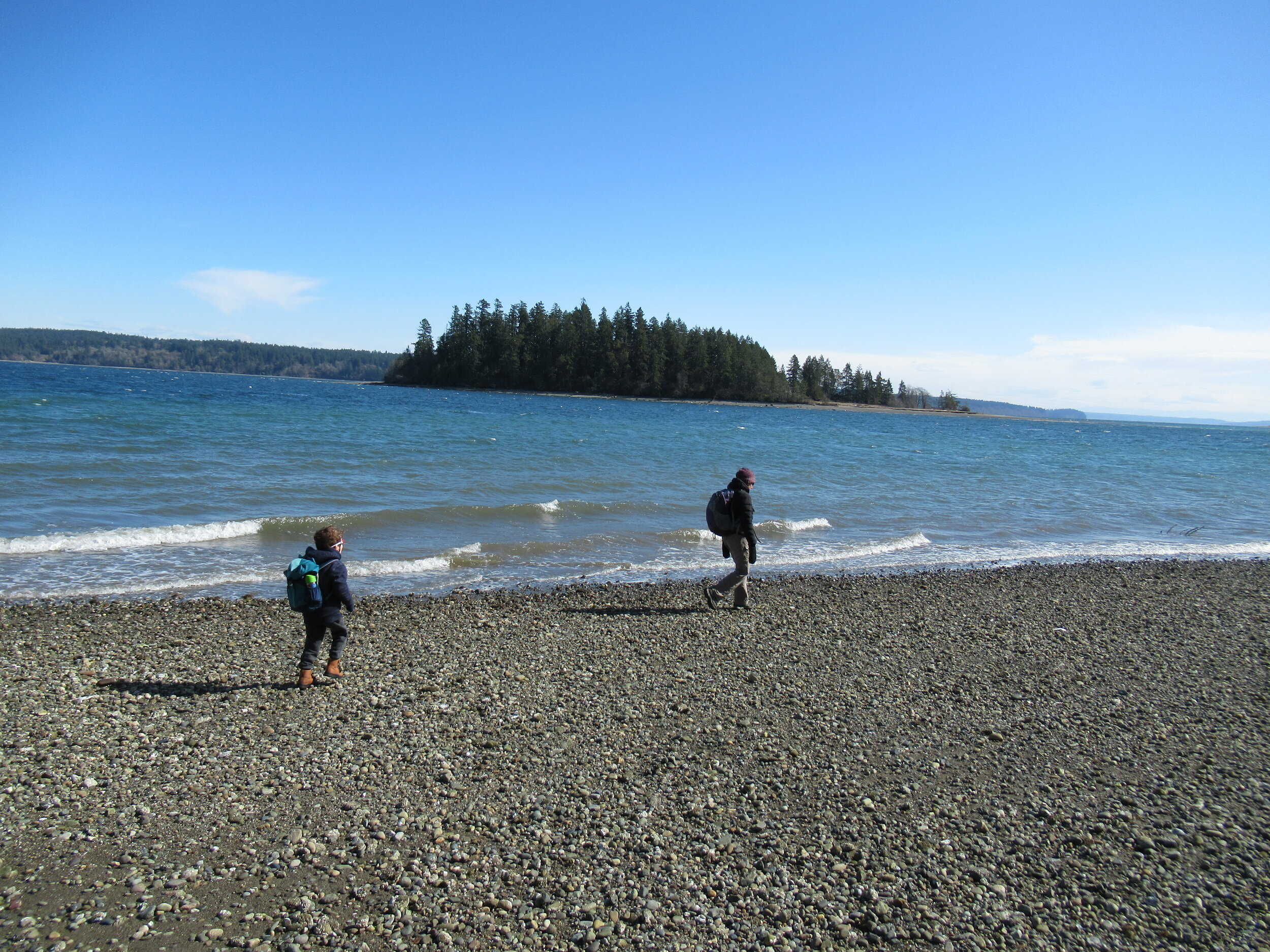
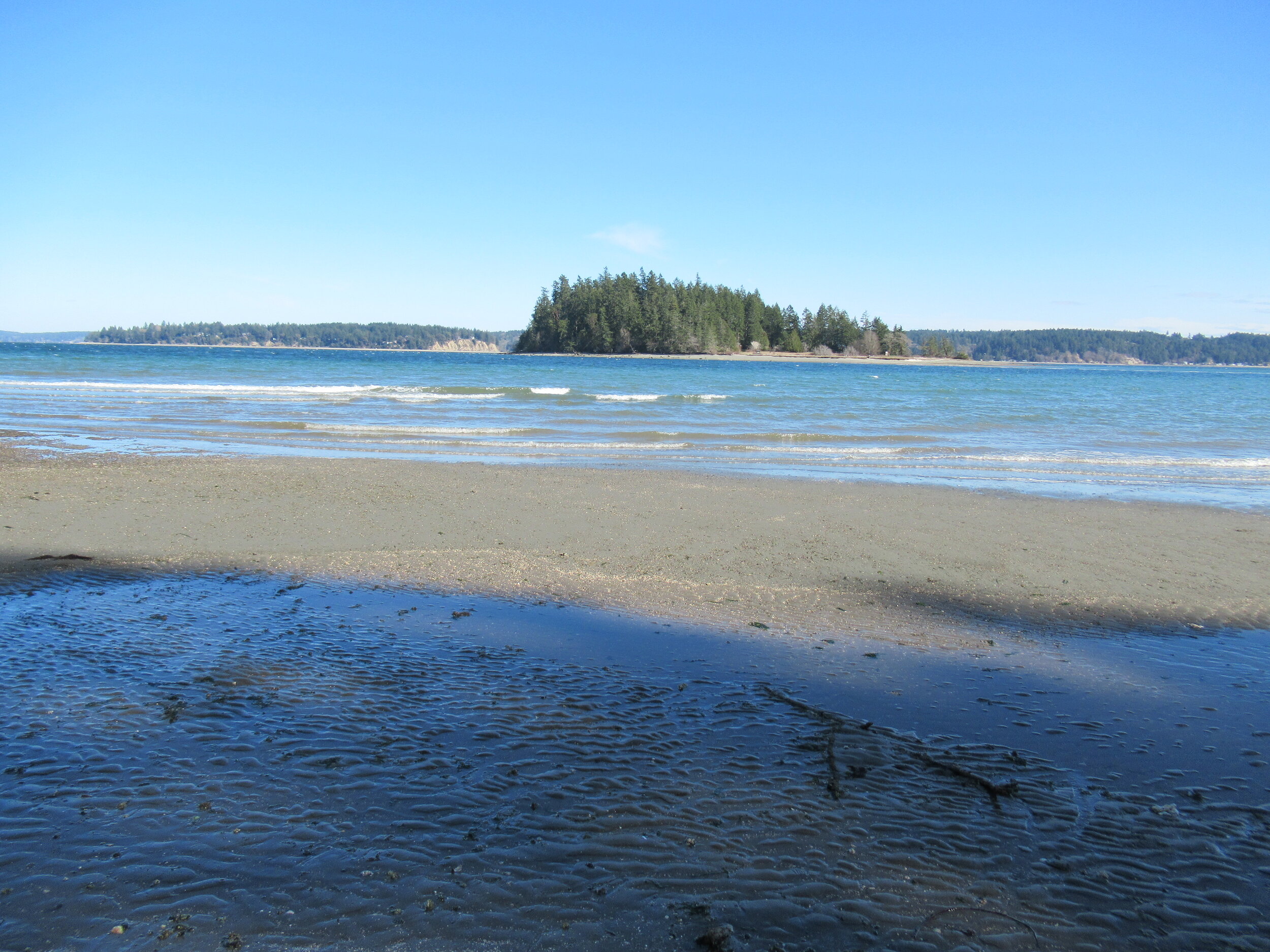
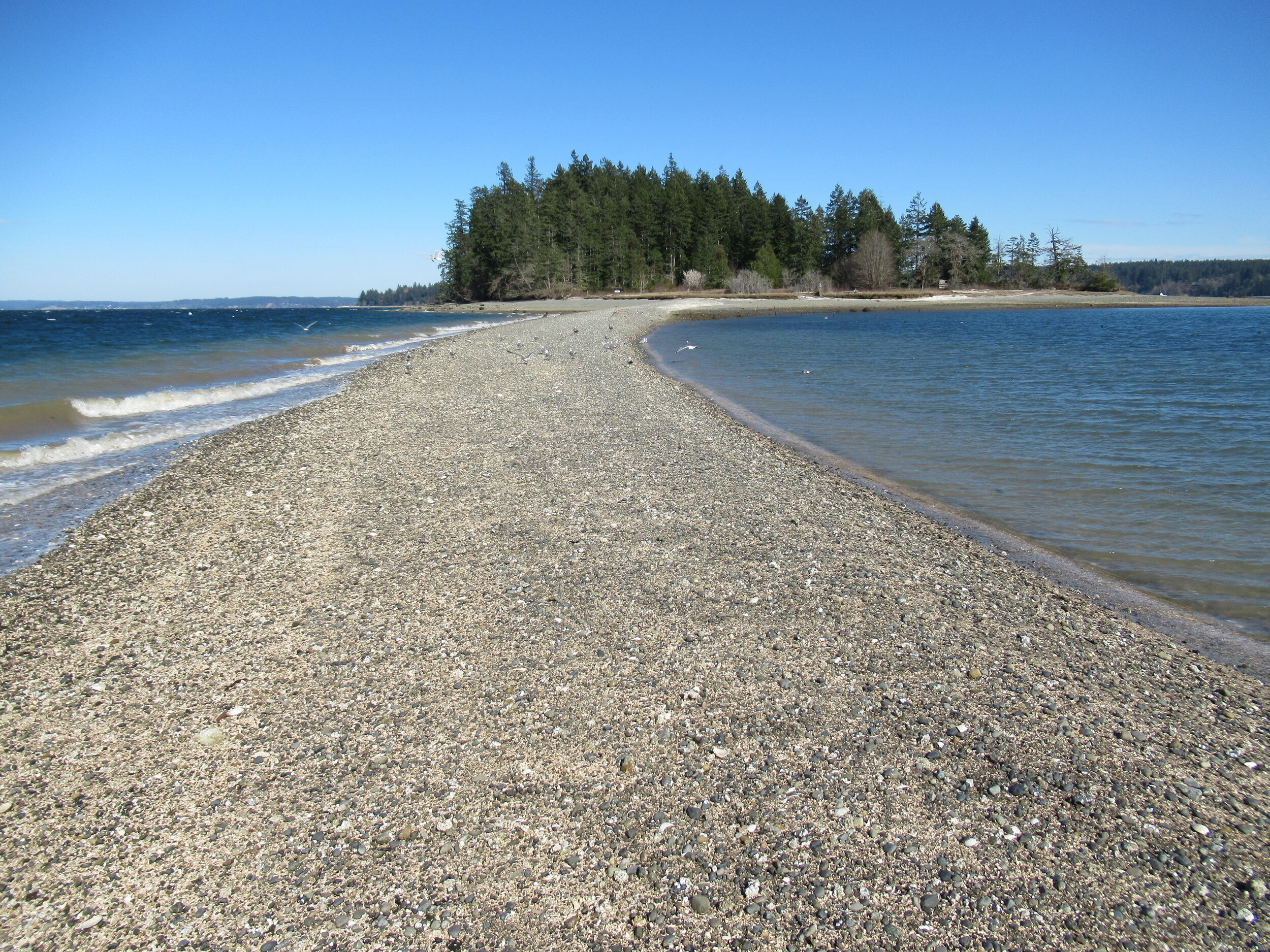
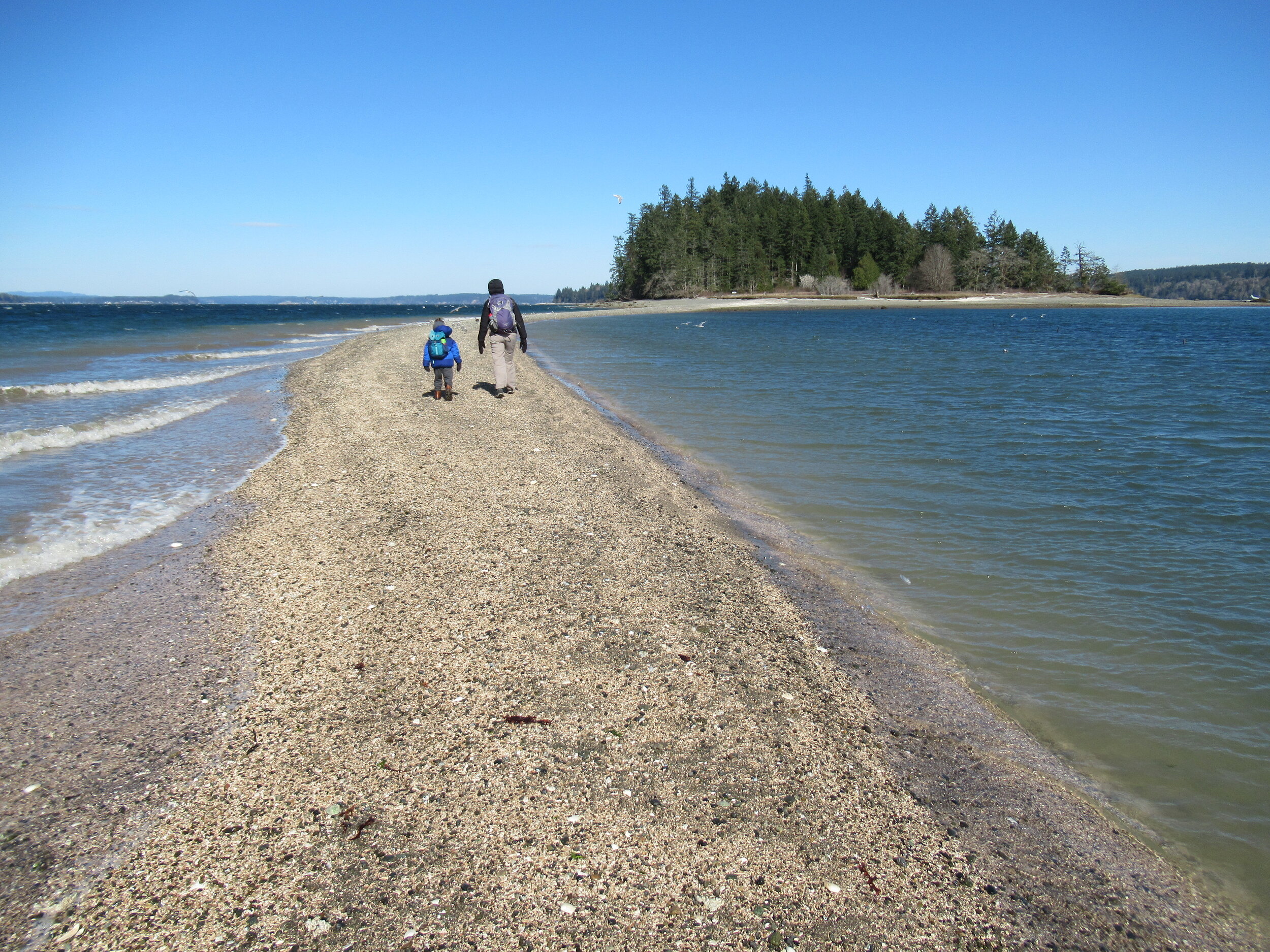
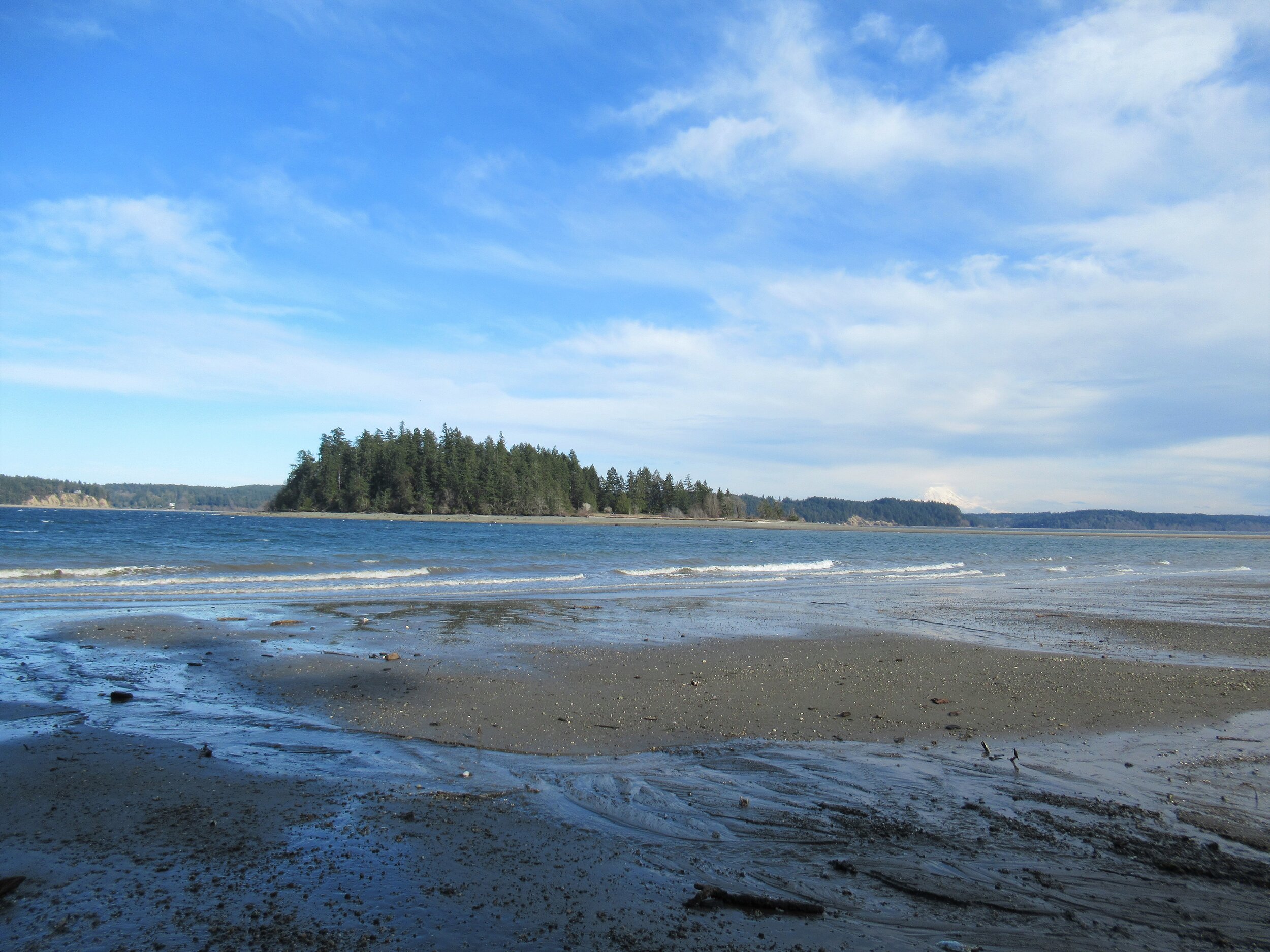
There are no bridges or causeways to little McMicken Island in Case Inlet. No ferry service either. But you don’t need a kayak or boat to visit. You can easily hike to this island which lies about 0.2 mile off of the eastern shore of Harstine Island. It’s all in the timing.
Craig Romano | Story & images
There are no bridges or causeways to little McMicken Island in Case Inlet. No ferry service either. But you don’t need a kayak or boat to visit. You can easily hike to this island which lies about 0.2 mile off of the eastern shore of Harstine Island. It’s all in the timing.

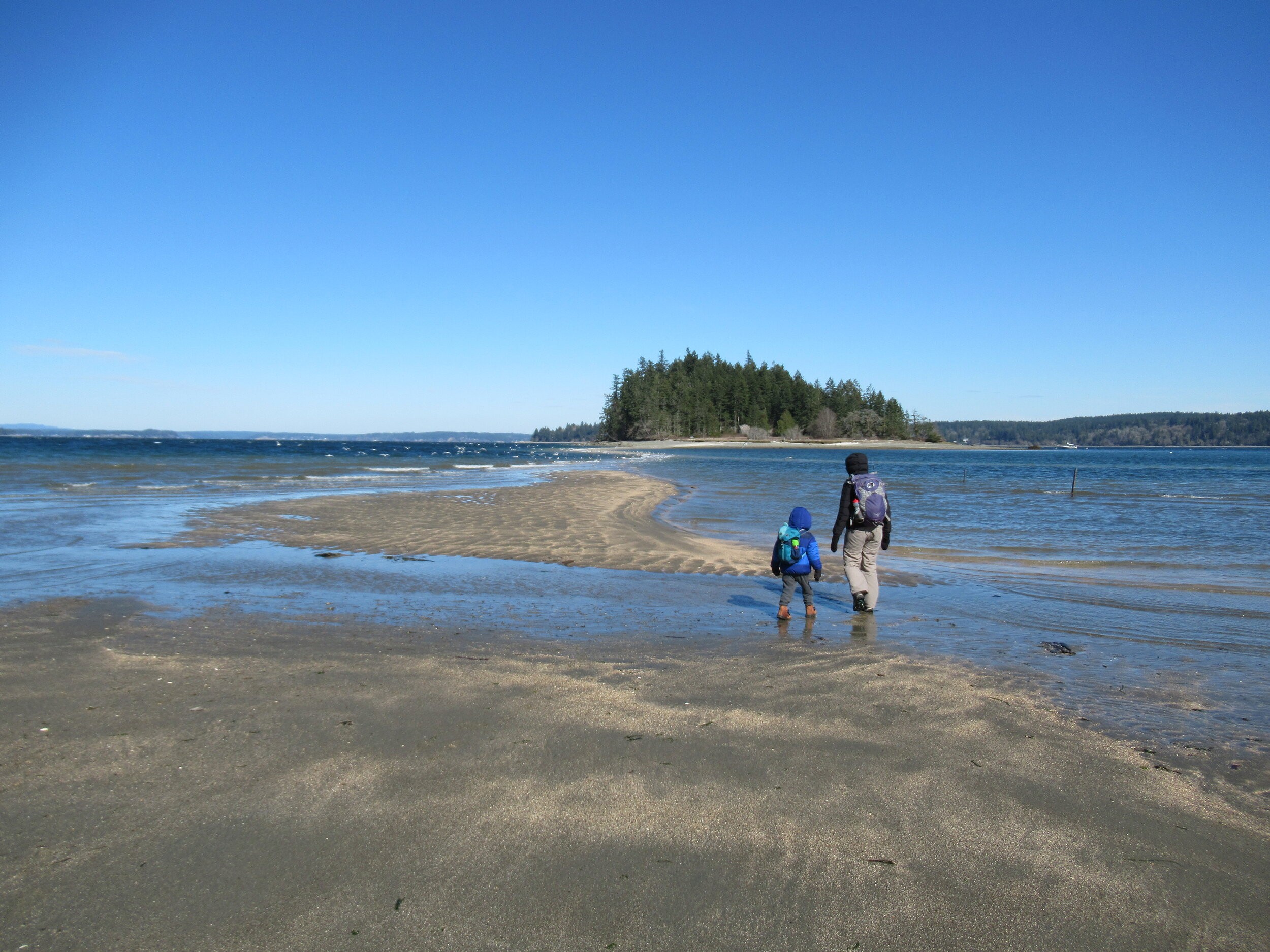
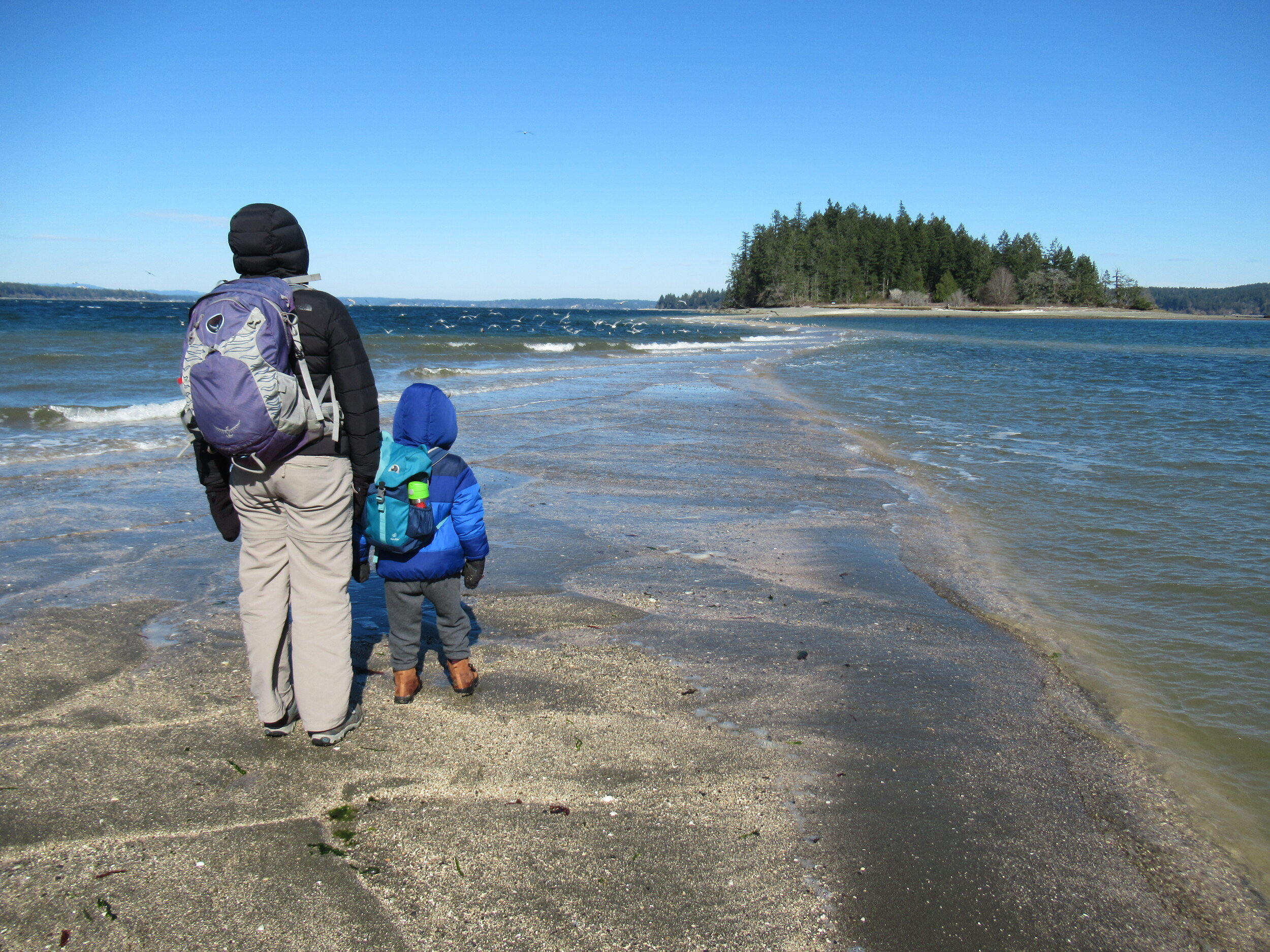
When the tide is low, a tombolo (a sandbar connecting the island to the mainland—or in this case another island) is exposed allowing you dry foot access to the island. You then can hike the island’s small half mile trail, picnic in its small meadow, or explore big barnacle-encrusted rocks in its intertidal zone. Just mind the incoming tide lest you make a big splash on your island exodus.


Hit the Trail
The hike to little 11.5 acre McMicken Island begins from the 300-acre Harstine Island State Park. A former Washington DNR property, most of the old timber was logged off, but small groves of old-growth remains on the property.
You want to head to the park’s beach reachable by the two trails taking off south from the parking lot. Take the one on the eastern end of the lot (away from the kiosk) for the more direct route.
The trail heads towards Case Inlet soon reaching the edge of a 100 foot high forested bluff. Continue along the bluff taking in glimpses of the remote beach below. The way then descends into a cool and dark ravine graced with big cedars and firs and reaches a junction.
The trail to the right loops back to the other main trail leaving the parking lot. Consider taking it upon your return from McMicken Island.
Head left through a row of big cedars and via a series of steps descend deeper into the ravine. After crossing a little creek the way emerges on a deserted beach. Look directly across Case Inlet to Herron Island and the Key Peninsula. Then look south and spot McMicken Island set against a backdrop of big beautiful Mount Rainier. If the tide is high, you’ll have to wait to hike the beach as overhanging trees prohibit passage. But in a low tide, a big wide easy to walk beach awaits your footprints.
Walk for more than a mile undulating between cobbles, mud and sand. Watch for sand dollars scatted across the tide flats. Look too for eagles, herons and a myriad of seabirds. Harstine is a wet place and plenty of side creeks fan out on the beach. You should be able to keep your shoes dry, but a pair of waterproof boots is not a bad idea. The entire way to the tombolo is on public tidelands. But there is a parcel of private property located between two large state park properties abutting the shoreline. Respect posted private property.
The tombolo is pretty distinctive in low tides—fairly wide and several feet raised above inlet waters. In high tides it’s completely submerged, although breakers will help you locate its position. It’s really fun to hike it when a receding tide first reveals it. Tap your inner Moses and part the seas watching the land bridge emerge as you amble along it.
Reaching the island
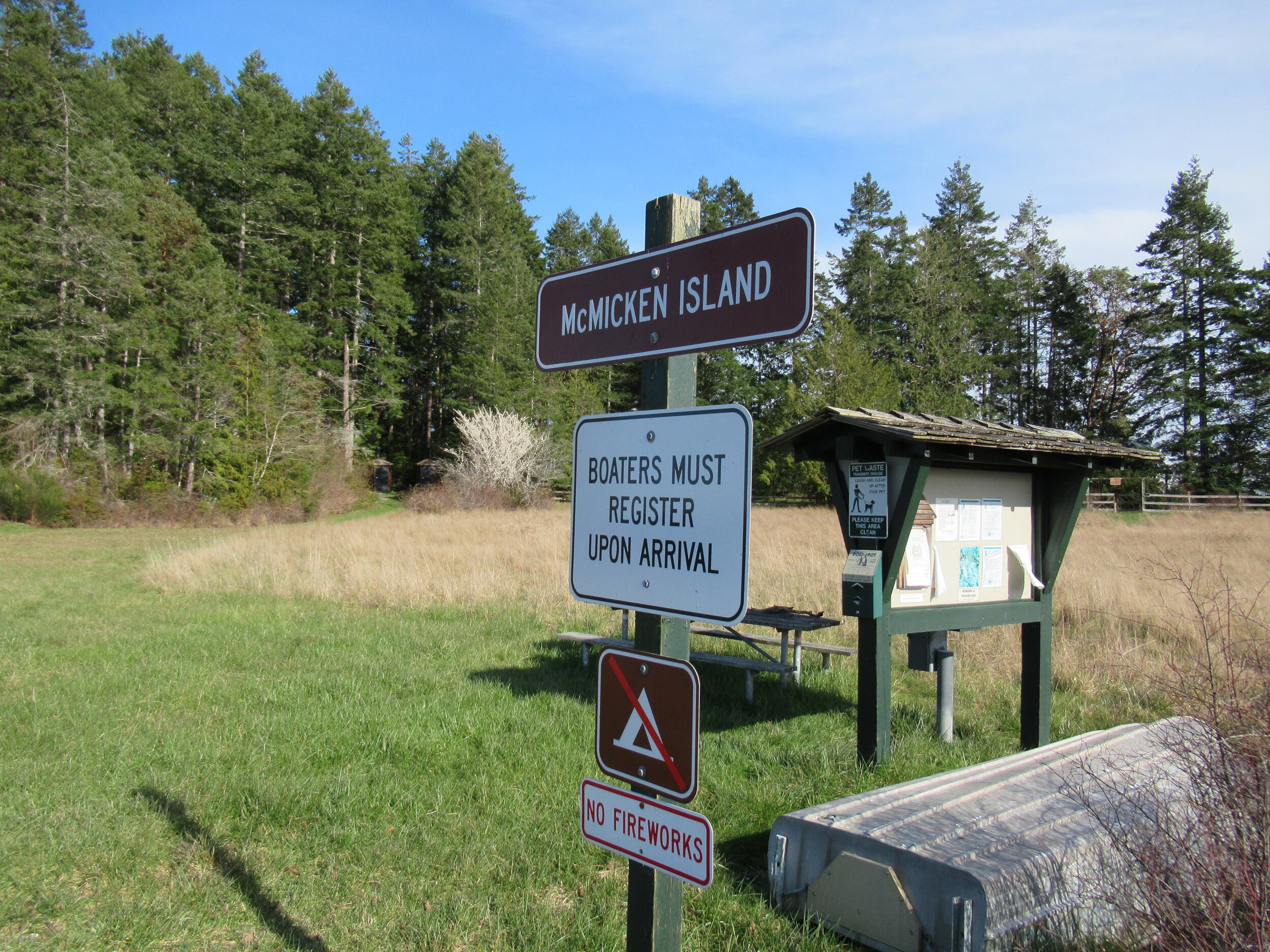
Once across the .2 mile sandy strip, reach McMicken Island. All of the little island except for a small fenced parcel with a couple of cabins is state park property. The private holding belongs to the family that once owned the entire island. They sold the island to the state withholding this small lot. Please keep out of it. The rest of the island however you are free to explore.
At the island’s western end is a small picnic area in a grassy opening. Here find some rare Garry oaks growing on a low bluff above the surf. Near a composting toilet at the eastern edge of the field is a small nature trail. Hike it! It weaves a half mile through towering firs and madronas to blufftop views on the eastern end of the island.
Be sure to explore the rocky tide flats surrounding the island too, and check out the large erratics scattered about. There is a particularly large one on the south side of the island. Enjoy your island wanderings and explorations—more than likely sharing it with no more than just a couple of other happy hikers. And be sure to keep track of the time and incoming tide so you don’t get trapped on the island.

Places to Stay
Waterfront cabin located on Harstine Is with beach access and a panoramic view of the Puget Sound, Mt. Rainier and McMicken island. Check availability
Hike back to Harstine Island State Park and call it a day or consider walking some more. The park contains three miles of trails. They traverse thick fir forests and swampy cedar groves and are family and dog-friendly.
McMicken Island Notes:

Forest Setting with Beach Access
Cross the bridge to Harstine Is. and enjoy a beautiful and quiet retreat in the woods. Relax in the comfortably furnished cabin or enjoy exploring the 5 acre property with meandering trails through a lovely forest. Check availability
Distance: 4.0 miles round trip
Difficulty: easy, pay attention to tides! Hike is only possible in low tides. Consult tide tables and plan accordingly. Dogs permitted on leash.
Trailhead Pass Needed: Discover Pass
GPS Waypoints: Harstine Island State Park Trailhead: N47 15.737 W122 52.236 McMicken Island Trailhead: N47 14.865 W122 51.780
Features: Kid and dog friendly, beach hiking, undeveloped coastline, small island reached via a sandbar, good bird watching, sublime views of Mount Rainier over Case Inlet.
Trailhead directions: From Olympia, head north on US 101 to Olympic Highway (SR 3) Exit in Shelton. Then turn and follow SR 3 east for 11.0 miles. Turn right onto Pickering Road (Signed for Harstine Island) and drive 3.3 miles. Then bear left onto Harstine Bridge Road and come to a T-junction upon entering Harstine Island. Go left on North Island Drive and after 3.0 miles turn right at the island community hall onto East Harstine Island Road. Proceed for one mile and turn left onto Yates Road. Continue 0.9 mile and turn right into Harstine Island State Park. Reach trailhead parking in 0.2 mile.
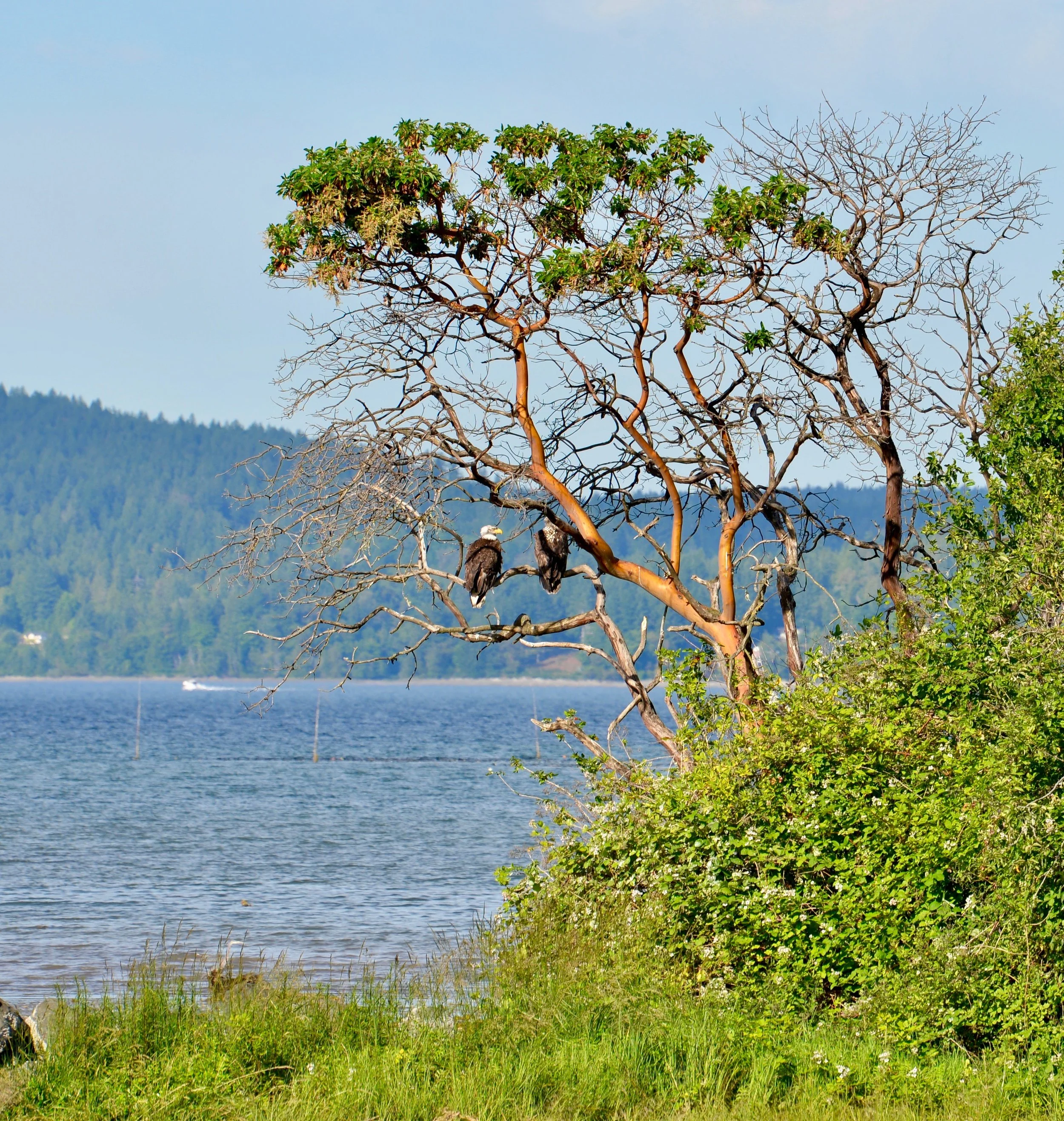
BIRDS OF A FEATHER FLOCK TOGETHER
Birding in the Pacific Northwest is more than checklists and binoculars. From wetlands and estuaries to forest trails along Hood Canal, this guide explores how modern birding blends technology, community, and quiet observation—highlighting local places in Mason County where birds and birders naturally gather.
H/T Tracing The Fjord | Winter ‘25 | STELLA WENSTOB | olympicbirdtrail.com
Those folks obsessed with bird identification? Yes, birders—and they’re far cooler than the stereotype suggests.
Once caricatured as binocular-toting nerds with overstuffed packs and dubious dried banana chips, today’s birders are more likely carrying a smartphone than a color-coded guidebook. Nerdy, it turns out, is in. Modern birding trades paper for sleek apps like iBird and iNaturalist, making it easy to identify, log, and even crowdsource sightings—all while contributing to real scientific understanding.
In the Pacific Northwest, with its remarkable variety of birdlife, birding is about far more than snacks and checklists. It’s an inviting way to slow down, look up, and connect with the natural world.
Getting Started
The Audubon Society is a great place to start if you’re just dipping your webbed foot into the vast waters of birding. Their website offers a free birding app, engaging articles, and access to hundreds of local chapters—five in the Olympic-Kitsap Peninsula area alone—that host birding classes, walks, and events.
One of those events is the longest-running bird census in the world: the Christmas Bird Count. Now entering its 125th year, the count gathers data from volunteer birders across North and South America. It was developed as a replacement for the old holiday “side hunt,” a competitive tradition among hunters that focused on the most game taken over the season.
Learning From the Nest
If the weather is too nasty to head outside, stay in your nest and feather it with avian knowledge. The Audubon Society offers online courses, including interactive Zoom lectures with local experts. The Cornell Lab of Ornithology provides more in-depth, accredited bird identification courses, along with plenty of solid free basics.
The Washington Ornithological Society and American Birding Association also offer a digital, up-to-date version of A Birder’s Guide to Washington. While it doesn’t help with identification, it provides an exhaustive list of where to find species and helps plan productive birding adventures.
Birding Mason County
If you’re ready to venture out in wintery weather, Mason County is teeming with migratory and year-round resident birds. Hit the trails and start scanning the skies, vegetation, and waterways.
Pack binoculars, a scope, digital camera, or smartphone (with iBird and Audubon maps downloaded). Old-school works too—just a notepad and pencil. Wear good walking shoes and weather-appropriate clothing.
Almost every green space—backyard or state park—offers birding potential. To honor the spirit of road trips and the hallowed practice of list-making, here are a few favorite local birding haunts.
For the Birds
Hilburn Preserve
The Capitol Land Trust Hilburn Preserve, just off Highway 101 west of Shelton, features an easy half-mile loop beside the lively Goldsborough Creek. The wooded habitat is ideal for spotting woodland birds such as Red-breasted Sapsucker, Hutton’s Vireo, Pacific Wren, and Cedar Waxwing.
Bayshore Preserve
Leaving Hilburn, head east on Railroad Avenue toward downtown Shelton, then north on Olympic Highway South. Turn right onto Highway 3 (East Pine Street), which follows Oakland Bay to the Bayshore Preserve.
This Capitol Land Trust property is part of the Great Washington State Birding Trail. Oak savannas border the shoreline and Johns Creek outflow. Peregrine Falcons have been spotted perched in the oaks, while Great Blue Herons frequent the open areas. Scan the bay for waterfowl diving in warmer waters.
Mary Theler Wetlands Nature Preserve
Located just outside Belfair (22641 WA-3), this 139-acre preserve protects estuarine habitat along the Union River delta. Marshlands, meadows, forests, and tidal waters support impressive wildlife diversity.
Five trails highlight different habitats, some with views of the southern Olympic Mountains. The River Estuary Trail—built atop breached dikes—offers sightings of river otters, Belted Kingfishers, and Great Blue Herons. Pools host Northern Pintail, Green-winged Teal, Common Merganser, and a wide range of shorebirds. Bald Eagles are commonly seen.
Twanoh State Park & Skokomish River Delta
Backtrack along Highway 106 toward Hood Canal to reach Twanoh State Park. With over 182 acres of forest and shoreline, it offers both terrestrial and marine birding. The 2.5-mile inland trail is reliable for Red Crossbills and Brown Creepers.
Continuing through Union brings you to the Skokomish River delta, rich with waterfowl such as Mallard, Northern Pintail, Red-breasted Merganser, and large flocks of American Wigeon. Bald Eagles are frequent here.
Hood Canal Corridor
Heading north on Highway 101 keeps you alongside Hood Canal, with strong birding stops at Potlatch State Park, Lilliwaup Creek, Eagle Creek, and Jorsted Creek.
At Jorsted Creek, pilings from an old log dump serve as roosts for all three species of cormorants. Lacking water-repellent oils, these birds are often seen perched with wings spread to dry.
The Hamma Hamma River estuary is another productive area and home to a nearby Great Blue Heron rookery.
Dosewallips State Park
The final stop on this list, Dosewallips State Park spans more than 1,000 acres of river, estuary, shoreline, and mature forest. Known for Roosevelt Elk and curious seals offshore, it also supports a wide range of bird species.
The North Tidal Trail crosses marshes and offers excellent winter views of migrating Trumpeter Swans.
The parks and preserves of the Pacific Northwest offer outstanding birding opportunities. Birds of a feather flock together—and birders are never far behind.
For more information on fjord birding, visit olympicbirdtrail.com.
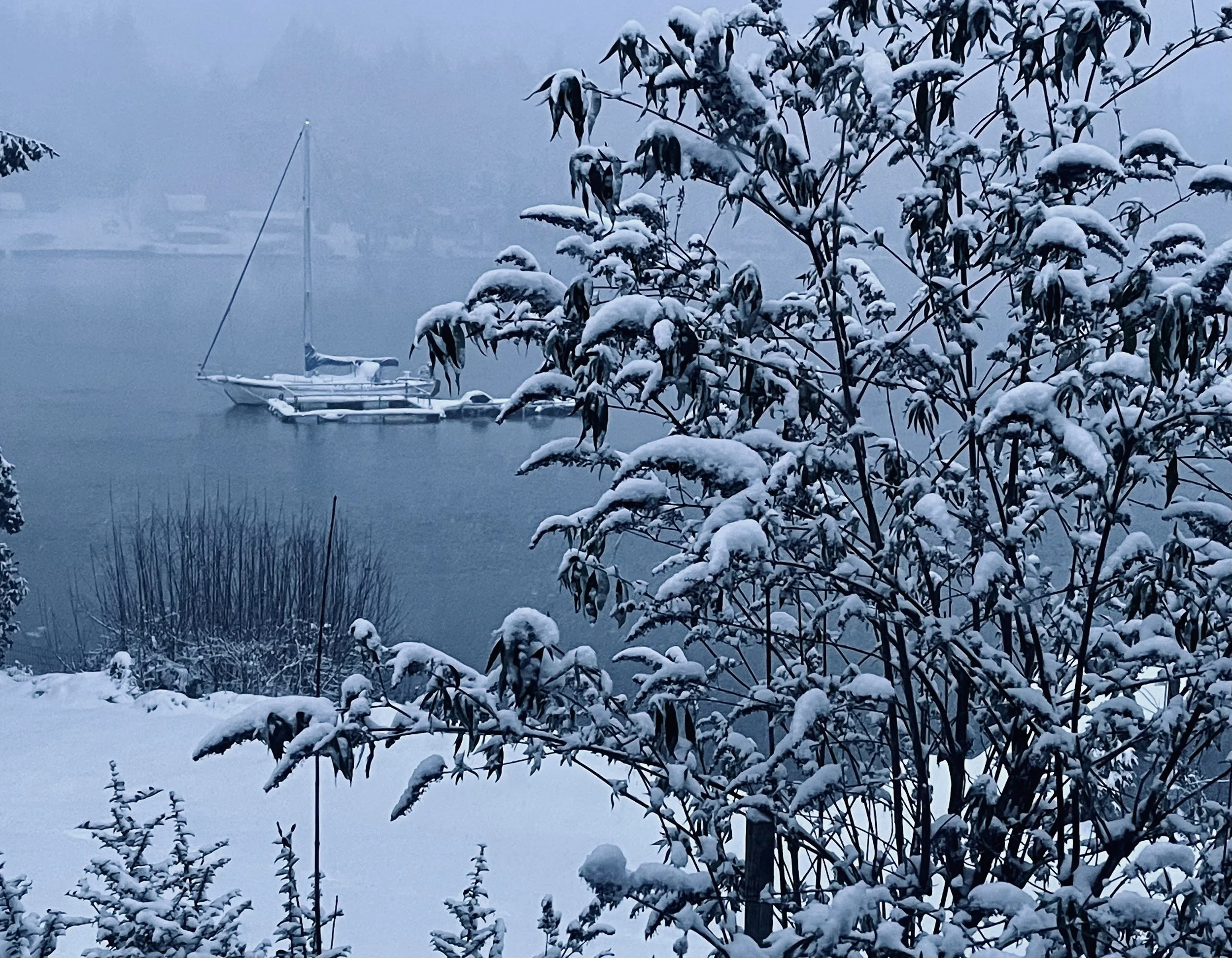
A Winter Guide to Our Local Tides
In winter, the tides along Hood Canal feel different. King tides push water higher than usual, low tides arrive before daylight, and currents move faster through familiar stretches of shoreline. Knowing how and why these tides shift can make winter outings safer and more rewarding.
H/T Tracing The Fjord | Winter ‘25
If you live or spend any time along Hood Canal or in the South Sound, you get used to checking the tides. They shape when people head out for recreation, plan a boat launch, or keep an eye on their waterfront. But the names we use for tides can feel a little mysterious until you break them down.
Tides are the rise and fall of the ocean caused by the gravitational pull of the moon and the sun. As the Earth turns, our area passes through these gravitational pulls, which is what causes the highs and lows we notice along the shoreline. Most of the Pacific Coast, including Hood Canal and South Puget Sound, experiences what’s called mixed semi-diurnal tides, meaning two highs and two lows every 24 hours. Still, each one is a little different in height. Regular tide-chart watchers recognize that pattern right away.
You’ll also hear terms like spring tides and neap tides. Spring tides aren’t tied to the season. They happen when the sun, moon, and Earth line up, which creates higher highs and lower lows. Neap tides are the opposite. They arrive when the sun and moon are at right angles to each other, pulling the water in different directions and producing milder highs and lows.
Another term that comes up often in winter is king tide. It’s not a scientific label, but a common nickname for the year’s highest tides. These happen when the moon is closest to Earth and lines up with the sun. Around Hood Canal, king tides can raise water levels several feet above normal. People may notice when the shoreline creeps inland and low-lying roads collect water.
In winter, tide shifts carry a different rhythm. Many of the lowest tides show up in the early morning or evening, long before daylight. Boaters and paddlers will see water levels changing faster through the Great Bend or around Ayock Point. Homeowners might keep an eye on their docks and pilings, since deep lows can expose more structure than usual.
Shellfish growers around the canal monitor winter tides too, since cold air paired with low water can stress their crops. And for anyone heading out to collect shellfish on local beaches, those low tides can be inviting—just make sure you have the proper license and check harvest openings before you go.
A better understanding of the tides helps explain what we see every day along the Canal. And for anyone heading out in the winter months, a quick tide check remains one of the easiest ways to stay safe and make the most of the season.
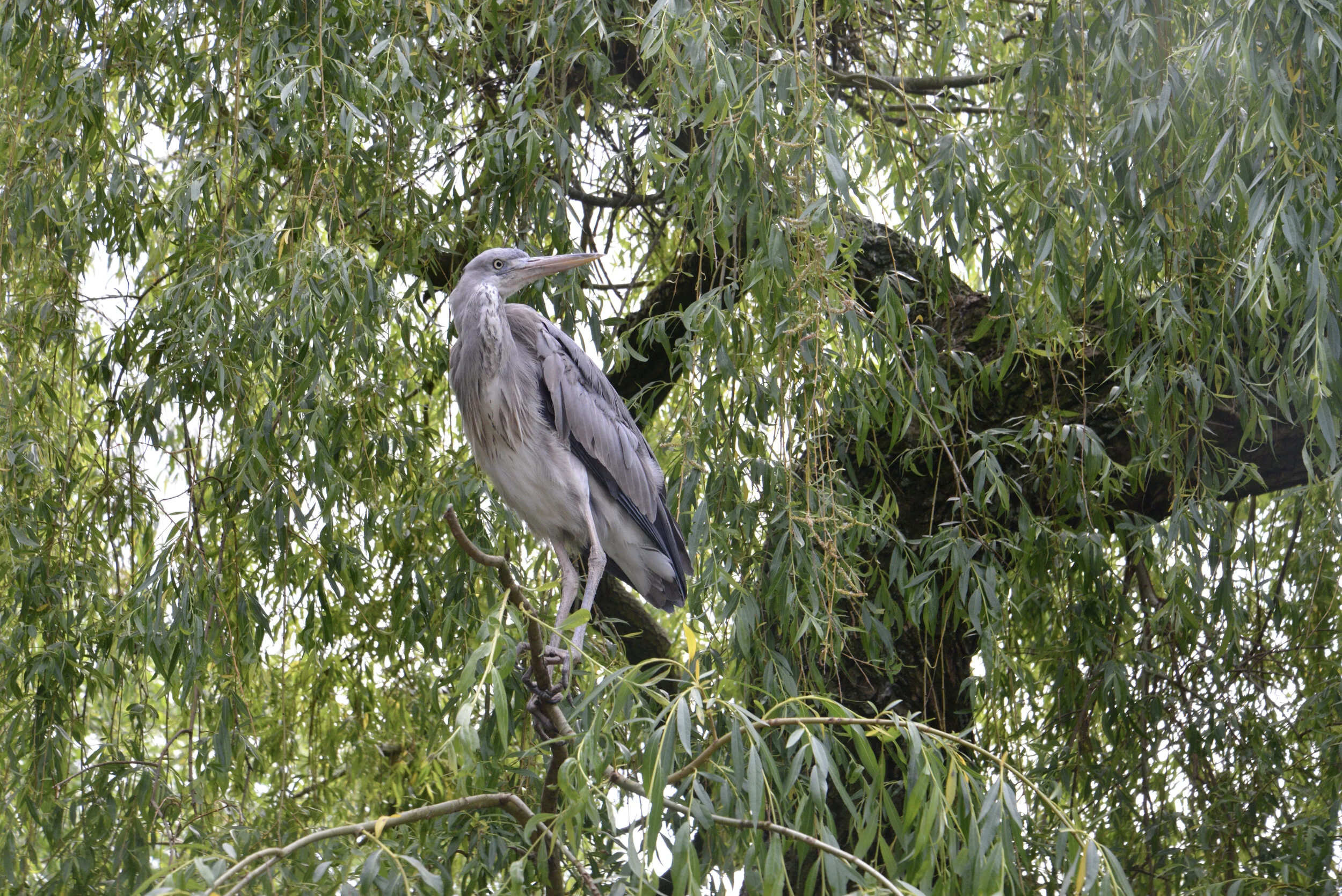
10 Myths & Facts about Great Blue Herons
It’s a common sight to see the “lucky” great blue heron patiently hunting on the shores of Hood Canal and South Puget Sound. Largest of the heron species, up to 4’ in height, they actually only weigh between 5-6 pounds. Here are a few things you may not have known about these iconic Northwest birds.
It’s a common sight to see the “lucky” great blue heron patiently hunting on the shores of Hood Canal and South Puget Sound. Largest of the heron species, up to 4’ in height, they actually only weigh between 5-6 pounds. Here are a few things you may not have known about these iconic Northwest birds.
MYTH
Great blue herons only eat fish.
Great blue herons dine mostly on fish but they will also stalk everything from insects to small mammals and even other birds. In Washington, mice and voles making up a major portion of their winter diet when they choose to hunt on land.
2. FACT
Herons spend about 90 percent of waking time stalking prey.
Great blue herons grab prey in their strong beaks or use their dagger-like bills to impale. This action is known simply as a ‘bill stab’. They shake the prey to break spines before gulping them down. Great blue herons can swallow fish that are much wider than their narrow neck and have even been know to catch small birds in flight. Patience and speed are the keys to their hunting success.
3. MYTH
Great Blue Herons are cranes.
A crane is totally different type of bird. You can tell them apart by looking at the beaks and the way they fly. Cranes have shorter beaks and hold their necks straight when in flight, whereas herons curve necks into an S-shape. Herons are able to do this because of specially shaped vertebra. Great blues also fly with their legs ‘hanging” which is unique from most birds.
4. FACT
Herons are often called “Dinosaur Birds.”
Fossil records date them back 1.8 million years ago, but they are thought to have existed about 25 million years ago during the Cenozoic age. Maybe it’s also because of the prehistoric sounds they make as they take off with the giant 6’ wingspan flapping!

5. MYTH
Great Blue Herons can’t swim.
The great blue does many things that other herons choose not to do, including swimming in deep water with apparent grace and comfort. A quick search on the internet will show multiple accredited images of herons happily swimming in deep water. It’s not a common occurrence though, so consider yourself lucky if you catch sight of this phenomena. Swimming is a testament to the great blue heron’s incredible adaptability.
6. FACT
Great blue herons have adapted “bib” feathers to keep them clean.
Specialized feathers on their chest grow continuously and fray into a fine cleaning powder. This powder is used to help groom their entire body and clean off fish slime.

7. MYTH
Great Blue Herons are monogamous.❤️
Not technically. Great blues are known to be ‘serial monogamous’ — they have one partner for a year but choose a different one each mating season. Despite being territorial with other herons, they typically breed in nesting colonies at the tops of trees containing up to 500 breeding pairs. These colonies are called “heronries.” They obviously do not have any social distancing issues. Great blue herons generally return to the same breeding grounds each year although with different partner choices.
8. FACT
Mates work to build the nest, as well as incubate and feed their young –together.
When the mating pair is chosen, the male gathers sticks while the female weaves them into a platform nest lined with moss, grass, and small branches. She lays 2-6 blue eggs, and both parents take turns incubating them for 4 weeks until the young hatch. They also take turns feeding regurgitated prey to the young chicks.
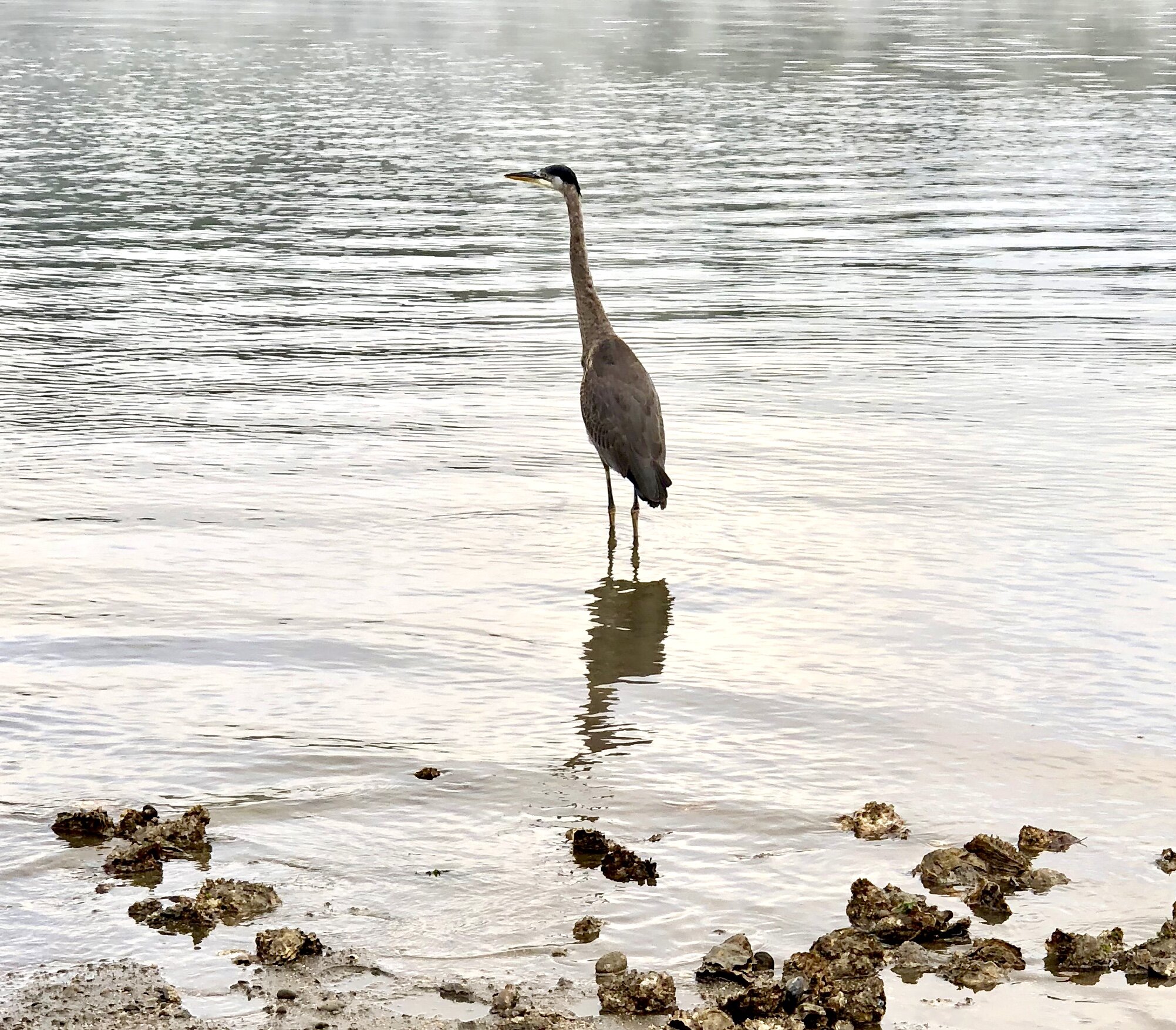
9. Myth
Heron chicks have yellow eyes when they are born.
Heron chicks have gray eyes when born that become bright yellow when they are adults. The parents continue feeding the nestlings for a few weeks after fledging (leaving) the nest. Young herons will fledge at around two months.
10. FACT
Great blue herons’ colors can demonstrate age, sex, and mating season.
Adult males are larger and generally have brighter orange legs than a female. During breeding season, the lore (the lore is the region between the eye and bill) will turn a bright blue, the iris will turn reddish, and the yellow bill will take on an orange hue.

A couple other things you didn’t need to know about great blue herons:
To keep cool they flutter their throat muscles to increase evaporation.
It can take up to two weeks to build a nest.
Life expectancy of a great blue heron is 15-23 years
Despite their size they can fly as fast as 30 MPH.
An adult heron consumes up to one pound of fish per day.
Learn more
The Cornell Lab - all about birds
Audubon - Great Blue Heron guide
Olympic Bird Trail - Top birding locations on Hood Canal, South Puget Sound, Pacific Coast, and Olympic Peninsula







A Hood Canal Road Trip
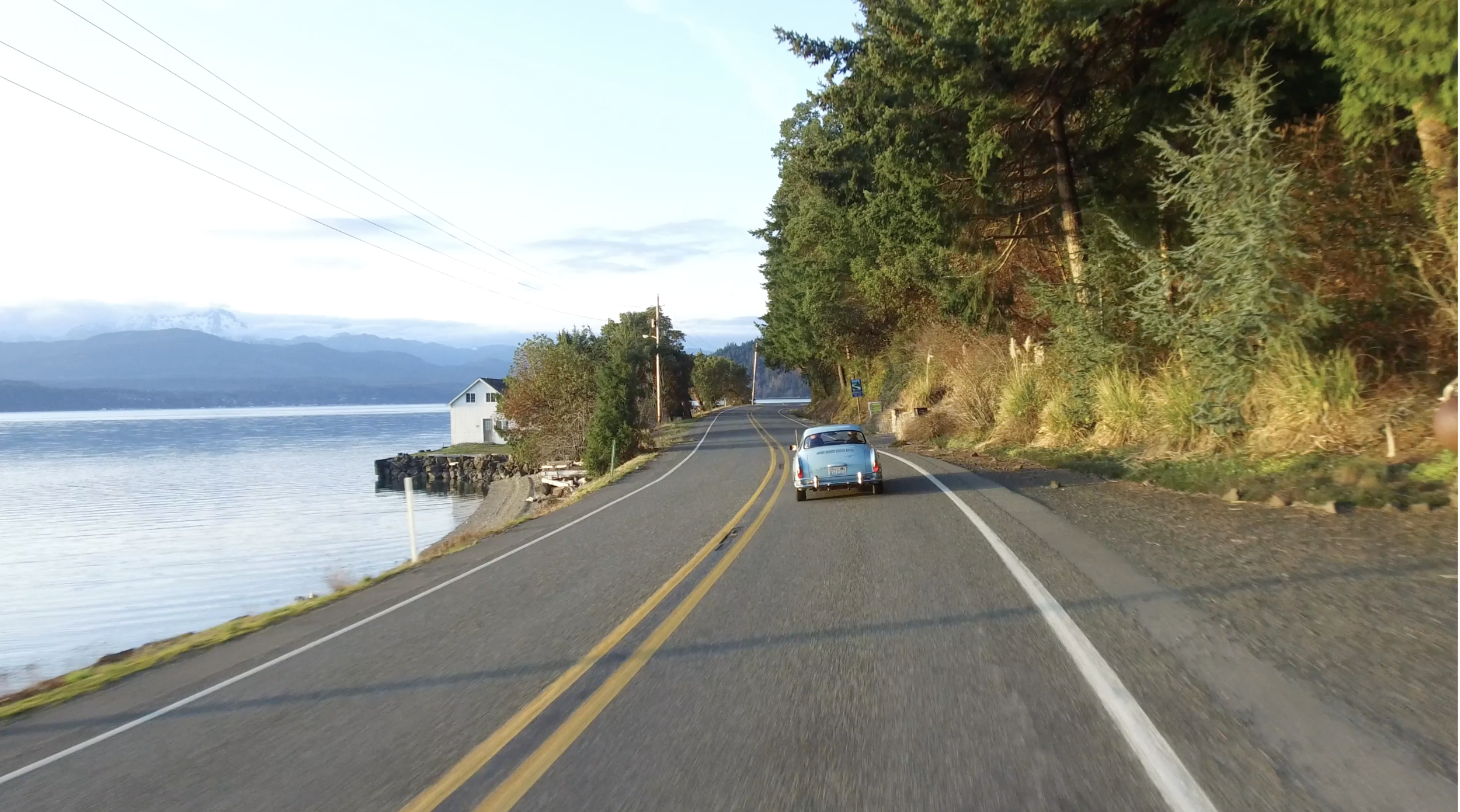
Ahh... road trips –there’s nothing that holds more appeal than the classic road trip – discovering new places, trying new things. Getting away from it all is as easy as heading to the South Sound via the Tacoma Narrows Bridge or by catching the Bremerton ferry for the 22 minute drive to Belfair, WA at the head of Hood Canal.
Ahh... road trips –there’s nothing that holds more appeal than the classic road trip – discovering new places, trying new things – Here's a sample itinerary to get you dreaming about discovering your adventures on Hood Canal.
Getting away from it all is as easy as heading to the South Sound via the Tacoma Narrows Bridge or by catching the Bremerton ferry for the drive to Belfair, at the head of Hood Canal.
Belfair, WA ( 22 minutes, 14 miles | Via SR 3 S)
Nestled between the North Bay of the Puget Sound and the southern hook of Hood Canal, Belfair is a great place for road trip supplies or to have lunch before heading off to explore the 130+ acre birder's dream wetlands, Theler Wetlands Nature Preserve. visit local craft brewery, Bent Bine Brew Co, to try their new brews. Hankering for wine? Check out the award winning Mosquito Fleet Winery, also calling Belfair home.

Twanoh State Park includes 3,167' of saltwater shoreline.
Twanoh State Park (14 minutes; 9.2 miles | via SR 106 W)
Twanoh State Park's 182 acres include 3,167 feet (965 m) of saltwater shoreline and 2.5 miles of inland hiking trails. Gather shellfish off the public beaches (when open) or simply take a walk on one of the many trails.

Alderbrook Resort & Spa (7 minutes, 5.2 miles | Via SR 106 W)
Since 1913, generations of visitors have enjoyed the rustic, albeit very luxurious, charm of this canal-side retreat on 88 acres, which include an 18-hole golf course. The 77 guest rooms are ideal for a rejuvenating escape, while the 16 cozy cottages are perfect for family fun. Complete with a waterfront restaurant, dock, and saltwater pool and spa, the Resort also offers access to boating from kayak rentals to multi-person cruises. Alderbrook Resort & Spa (Union, 10 E Alderbrook Dr, (360) 898-2200).

Union, WA (6 minutes, 2.4 miles | Via SR 106 W)
The spectacular views from Union are not to be taken lightly. Here is definitely the best vantage point to view the Olympic range. On the journey to Union's center, take a moment to admire the historic Dalby Water Wheel and stop in at Cameo Boutique for some great shopping of local items as well as the newly minted Hood Canale with a wood fire pizza and a spectaculr selection of wines. In Union check out the Union Country Store (5130 SR 106) for fresh bakery goods and all you need to continue on your adventure. Across the road, on the waterside, 2 Margaritas Restaurant serves Mexican food; while the Union City Market stocks everything from gifts and collectables to homemade candy and fresh oysters!

Hunter Farms (5 minutes, 3.4 miles | Via SR 106 W)
The drive along the Skokomish delta is simply perfect. As the road weaves it's path around the shoreline, you are treated to glimpses of the Olympics filtered through patches of arbutus clinging to the beach edge. Before the road forks west, you are greeted by an immense red barn. This is Hunter Farms. Stop and stretch your legs, check out the many animals and fresh produce as well as a selection of locally made products. Visit the onsite information kiosk –but most of all, get a generous cone filled with locally sourced (as in the Skokomish Valley less than 5 miles away!), Olympic Mountain Ice Cream. Amazing.

High Steel Bridge (26 minutes, 13 miles | Via W Skokomish Valley Rd
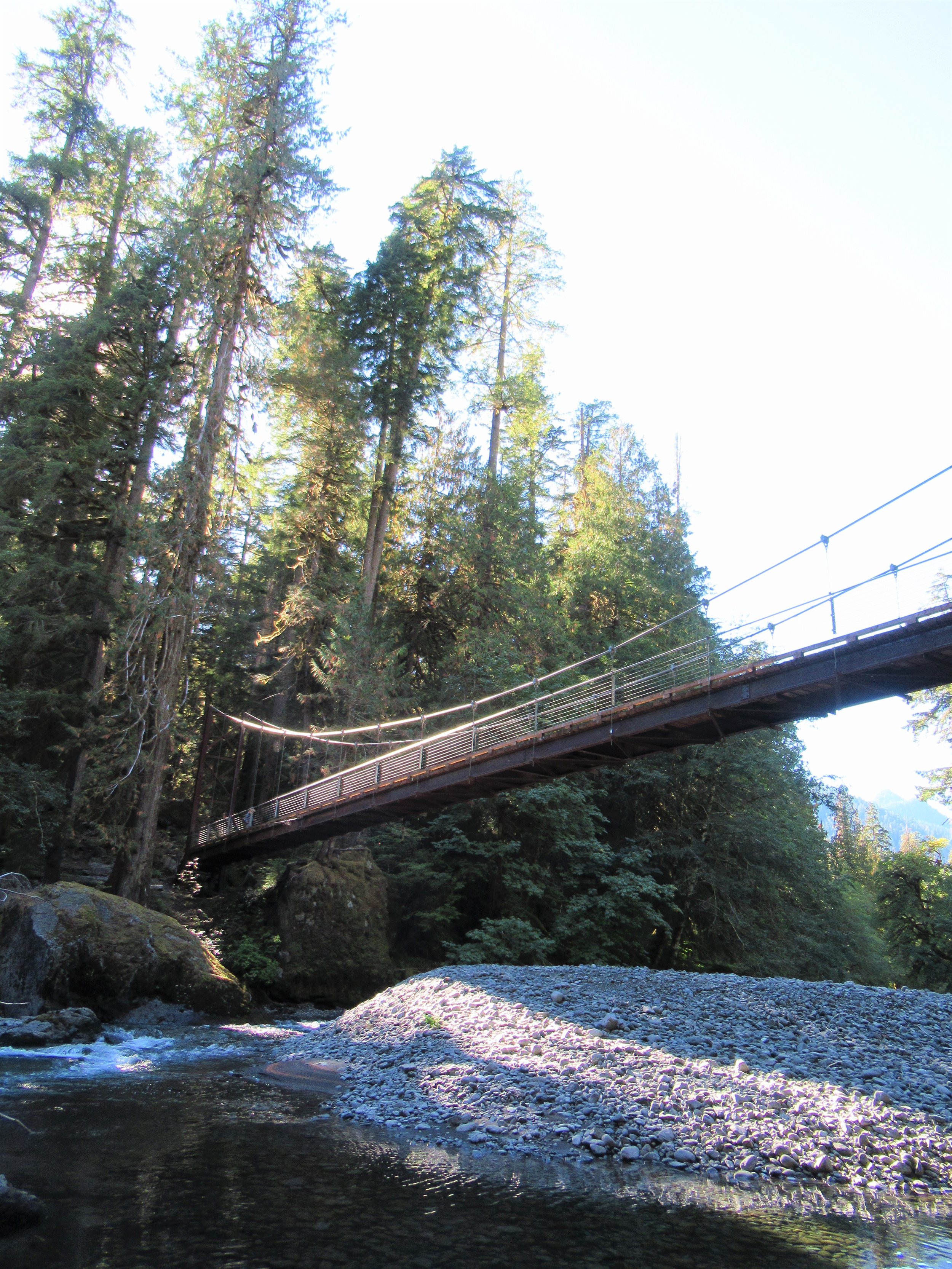
If you are up for a short diversion from the Hood Canal Loop, consider a trip to the historic High Steel Bridge that spans the gorge and sits a staggering 427’ above the mighty South Fork of the Skokomish River. Built in 1929, the vertigo-inducing Bridge (NF-2340) has an uncontested view of Vincent Creek Falls, and is easily accessed from Hwy 101. Use caution as the guardrails are decidedly short and the fall is a long way.
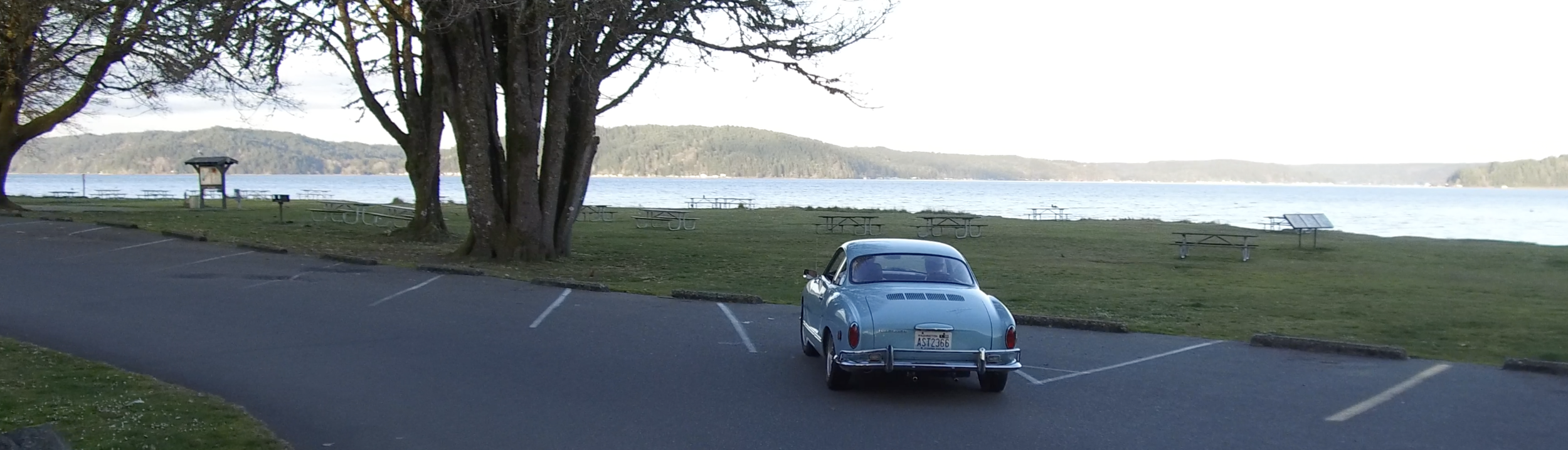
Potlatch, WA ( 5 minutes, 3.7 miles | Via WA-106 W and US-101 N)
Potlatch State Park is a 57-acre camping park with 9,570 feet of saltwater shoreline on Hood Canal. The park's grounds are home to a variety of activities, from interpretive programs for kids to boating and shellfish harvesting. Featuring clear, often calm waters, Potlach is a favorite with divers and kayakers, too.

Hoodsport, WA (5 minutes, 3.3 miles | Via US-101 N)
Hoodsport is a seaside town perched on the western shores of the Hood Canal beneath the shadow of the Olympic Range. Here you will find plenty of shops and dining as well as two wineries: Hoodsport Winery and Stottle Winery; as well as a distillery, The Hardware Distillery. Using water from the Olympic National Forest, The Hardware Distillery offers a variety of delectable hand crafted spirits and gorgeous view to enjoy while sipping away in their ambient tasting room. Hoodsport also serves as the gateway tp the Olympic National Park Staircase Entrance. At the foot of the hill, heading up to Lake Cushman, stop by the Hoodsport Information Center (N 150 Lake Cushman Rd) for great tips on road/trail conditions; permits and maps and friendly guidance.

Lilliwaup, WA ( 7 minutes, 4.5 miles | Via US-101 N)
Situated on the west shore of Hood Canal, Lilliwaup is a small town with a BIG history and a love of shellfish. Peppered with serene beaches and surrounded by endless hiking trails, Lilliwaup is all about relaxation and rejuvenation. Located in the area is Mike's Beach Resort. One of the oldest and most picturesque resorts in Hood Canal with a unique blend of the rustic look of the Northwest and the relaxed, cozy, and charming chalet style. A dock and mooring buoys as well as rowboats, paddleboat, and a ocean kayak are available for rent. Pet friendly. This is also the home to the Olympic Oyster Co. so you can be sure to enjoy some of the finest oysters on your stay! The Lilliwaup Store is also a great place to get your fill on Olympic Mountain Ice Cream.

Hama Hama Store and Oyster Saloon ( 8 minutes, 7 miles | Via US-101 N)
Family owned and operated, the Hama Hama Company has been harvesting oysters and clams on Hood Canal for four generations. Their store and outdoor restaurant, the Oyster Saloon, are located a shell’s-throw from the tide flats. A visit to the farm is the best way to experience Hood Canal oysters in their native habitat. Come during the week to see the shucking crew in action, and ask for one of their self guided tour maps to better explore the farm.

October is for Oysters in Mason County
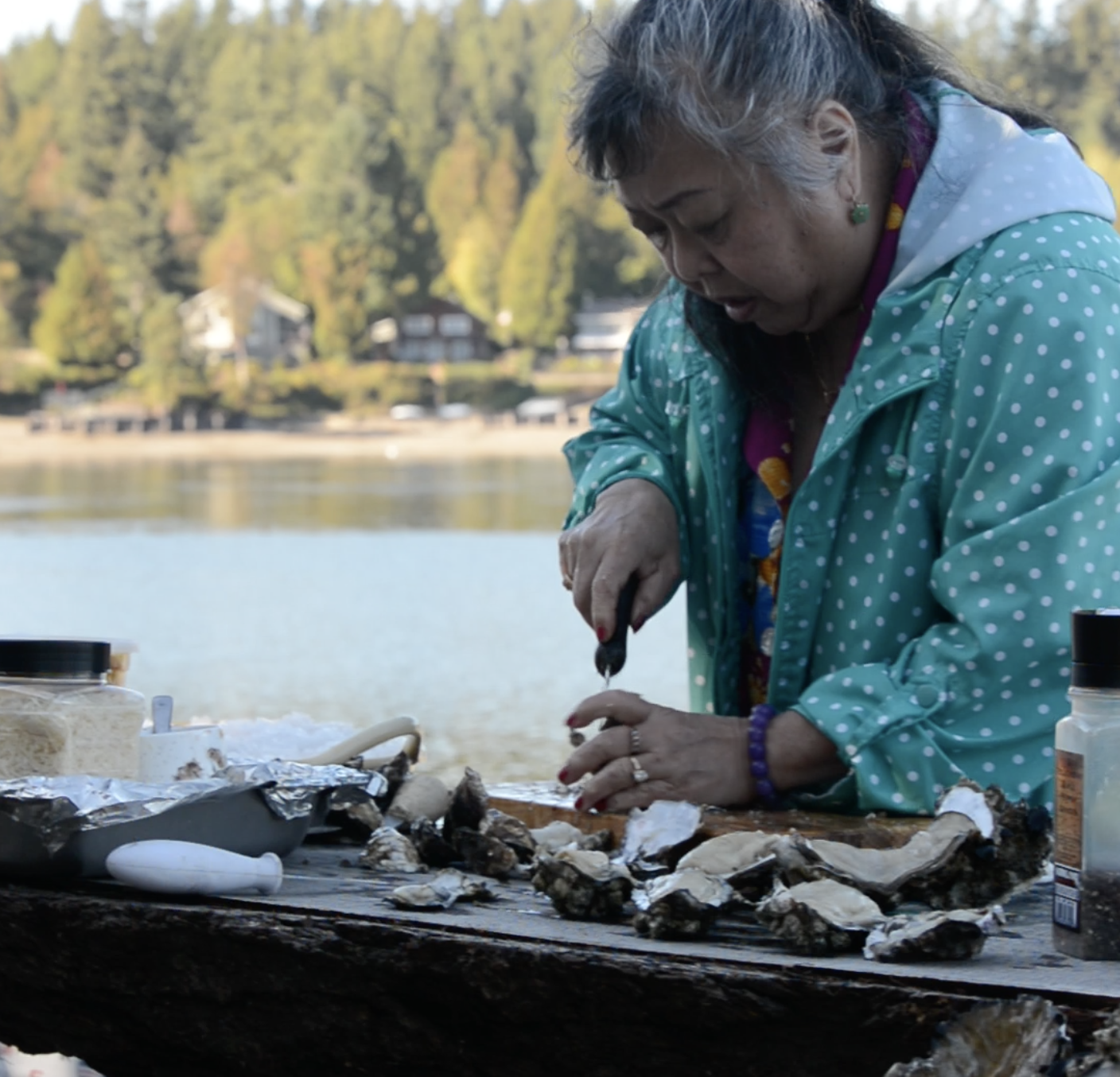
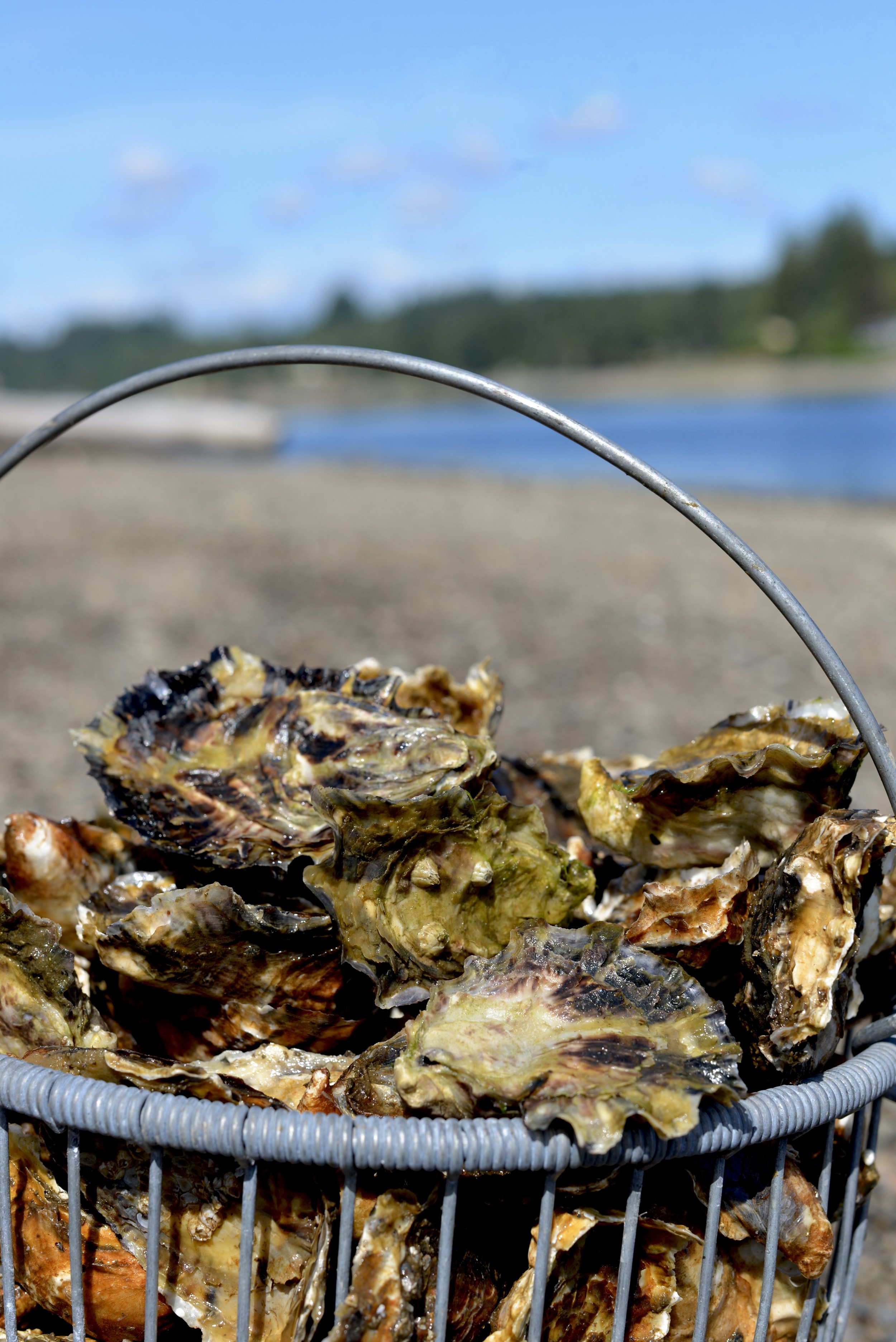
With OysterFest the first weekend of October, we know its a great time to harvest oysters! Many of Washington’s public beaches are open year-round, and all you need is to check the tides and open beaches — grab your bucket, gloves, shucking knife, shellfish license, and head out to the local beach! As Jeff heads over to Verle's LLC to pick up his license and get tips on the best beaches to visit, join local harvesters Michael and Charlotte as they head to Hood Canal’s Eagle Creek beach to fill their frying pan and demonstrate shucking techniques and a quick and easy recipe for a beachside cookout! Can’t get any fresher!
With OysterFest the first weekend of October, we know it’s a great time to harvest oysters! Many of Washington’s public beaches are open year-round, and all you need is to check the tides and open beaches — grab your bucket, gloves, shucking knife, shellfish license, and head out to the local beach! As Jeff heads over to Verle's LLC to pick up his license and get tips on the best beaches to visit, join local harvesters Michael and Charlotte as they head to Hood Canal’s Eagle Creek beach to fill their frying pan and demonstrate shucking techniques and a quick and easy recipe for a beachside cookout! Can’t get any fresher!
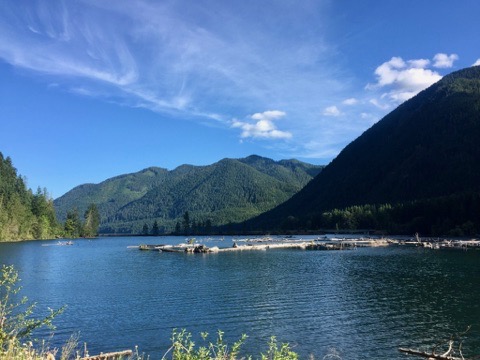
The Top 5 | Camping on and around Hood Canal
Whether you prefer the simplicity of tent camping or the comfort of RVs there are plenty of campgrounds on and around the Hood Canal to choose from. From your campsite you can take day trips to explore surrounding forests, rivers, and beaches or just relax under the trees and listen to the birds.

Whether you prefer the simplicity of tent camping or the comfort of RVs there are plenty of campgrounds on and around the Hood Canal to choose from. From your campsite you can take day trips to explore surrounding forests, rivers, and beaches or just relax under the trees and listen to the birds. For some inspiration to plan your Summer trip to the Hood Canal the staff at Hood Canal Adventures have made up their list of top 5 favorite drive-in campgrounds.
The Top 5
#1 Collins Campground
Collins Campground is located within the U.S. National Forest in the Brinnon area. Nestled under giant Bigleaf Maple trees and directly on the Duckabush River, it contains only 16 sites with no-hook ups: and this is why we love it! From here you are within only a few miles from some of the areas most popular hiking trails including Murhut Falls, Ranger Hole and Duckabush Trail. Shellfish can be gathered nearby at the Duckabush or Dosewallips tidelands when the season is open for clam and oyster recreational harvests. The campground is first come / first served and is open mid-May through September. Visit fs.usda.gov or call the USFS Hood Canal Ranger District (360) 765-2200 for details.
#2 Seal Rock Campground

Seal Rock is another U.S. Forest Service campground in the Brinnon area, however this one is located directly on the Hood Canal with beach access. Forty-one tent and RV campsites are shaded beneath the evergreen trees, some with water views. There are no RV hook-ups but the campground does have fresh water, flush toilets and electricity in the restrooms. Oysters litter the beach at low tide for you to harvest and cook up over your campfire. The campground has an area to walk-in your small boat or kayak for exploring the Hood Canal or harvesting Dungeness and Red Rock crab. Hood Canal Adventures of Brinnon will deliver your kayaks, paddle boards, and crab pots if you choose to rent. Seal Rock Campground is first come / first served and open April through late September. Visit fs.usda.gov for details.
#3 Twanoh State Park
Twanoh State Park really has it all! Located on the southern end of the Hood Canal just outside Belfair, you’ll enjoy 22 full hook-up campsites and 25 tent sites, a pump-out station, boat launches and a dock, showers, covered picnic areas, group sites, a staffed park office and store, and even kayak rentals. Over 3,000 ft. of marine shoreline offers shell fishing opportunities and warm summer waters are perfect for swimming and water play. A few campsites are open all year but the beachfront area is open April through mid-October only. Twanoh State Park is first come / first served. Visit parks.state.wa.us or call 360-275-2222 for details.
#4 Potlatch State Park
Potlatch State Park is a 57-acre camping park with 9,570 feet of saltwater shoreline on Hood Canal. The park's beautiful grounds are home to a variety of activities, from interpretive programs for kids to boating and shellfish harvesting. The park has 19 tent spaces, 18 utility spaces, one dump station, one restroom and two showers. Sites have no hook-ups. Maximum site length is 60 feet (may have limited availability). Two of the tent sites are for primitive use (hikers and bicyclers) only. The Park is divided by Hwy 101 so choose sites that are further away from the road if possible.
#5 Lake Cushman
OK, this isn’t actually a campground but the Lake Cushman area is stunning and well worth exploring. Lake Cushman is located near Hoodsport between the Hood Canal and the Olympic Mountains. Its clear blue waters are framed by beautiful forests and snowy mountain peaks. Popular activities include fishing, hiking, climbing, boating, kayaking, and swimming. There are several campgrounds at the lake but we couldn’t agree as to which is our favorite. Therefore, here's a short list to start you off: Skokomish Park Lake Cushman with 80 RV, tent sites, boat launch, and lake access; Staircase Campground with 49 tent and RV sites on the Skokomish River at the Olympic National Park’s most southern access point; and Big Creek Campground, a 64 site U.S.F.S. Campground which also serves as the trail head to several hiking trails.
The Hood Canal area offers opportunities for camping whether they be county, state, federal, or private campgrounds. There are many back-country and boat-in only camping areas to explore. Come find your favorite! To discover more campgrounds in the area click here.
Christina Maloney is owner of Hood Canal Adventures in Brinnon, a Fisheries and Marine Biologist, and a local outdoor enthusiast.

Hundreds of varieties yet only five species | Oysters explained
There are over 150 varieties of oysters harvested and sold in North America, yet they comprise a total of only 5 species of oysters.
How does your Oyster Grow?
Have you ever wondered how the same species of oyster can have such varied flavors or textures? How does an oyster grown on Hood Canal taste brinier than one from South Puget Sound? The word to remember for your next oyster social occasion is “merrior.”
Like different wines with a “terrior,” oysters have a merrior, illustrating the fact that growing area and method make all the difference when it comes to flavor profile for your next Pacific oyster.
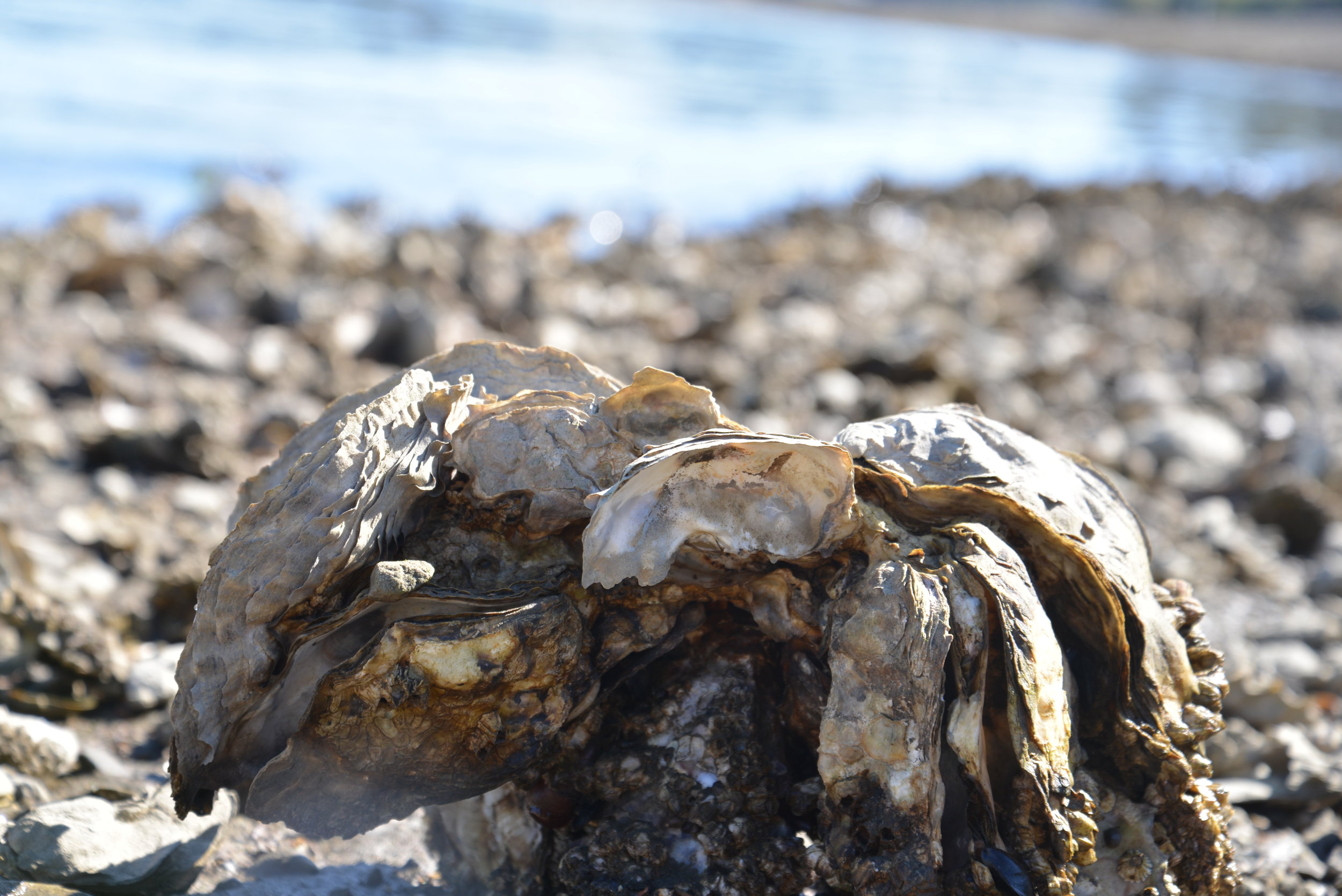
Not all beaches are created equal; some are muddy, some sandy, and some rocky. Each type of growing ground has opportunities and limitations for success. Muddy ground can inhibit the oysters’ ability to circulate water and food into their bodies. This had led to the adoption of culture techniques that suspend the oysters above the mud in long lines, stakes, nets or racks, and bags, while firm, sandy, or rocky bays allow for oysters to be grown right on the beach.
In addition to substrate type, location of the oysters on the beach will determine how long the oyster will take to achieve a marketable size. Oysters grown in the intertidal area are exposed to daily tidal inundation will have well developed adductor muscles and thicker shells thus being heartier for shipment. Oysters suspended in the water column for growing will have the benefit of a constant food source and thus grow quickly but will have delicate shells and be susceptible to the elements. Often times, suspended oysters are placed in the high energy intertidal environment for a few weeks prior to market to harden the shells for shipment and condition the oysters to hold their shells shut.
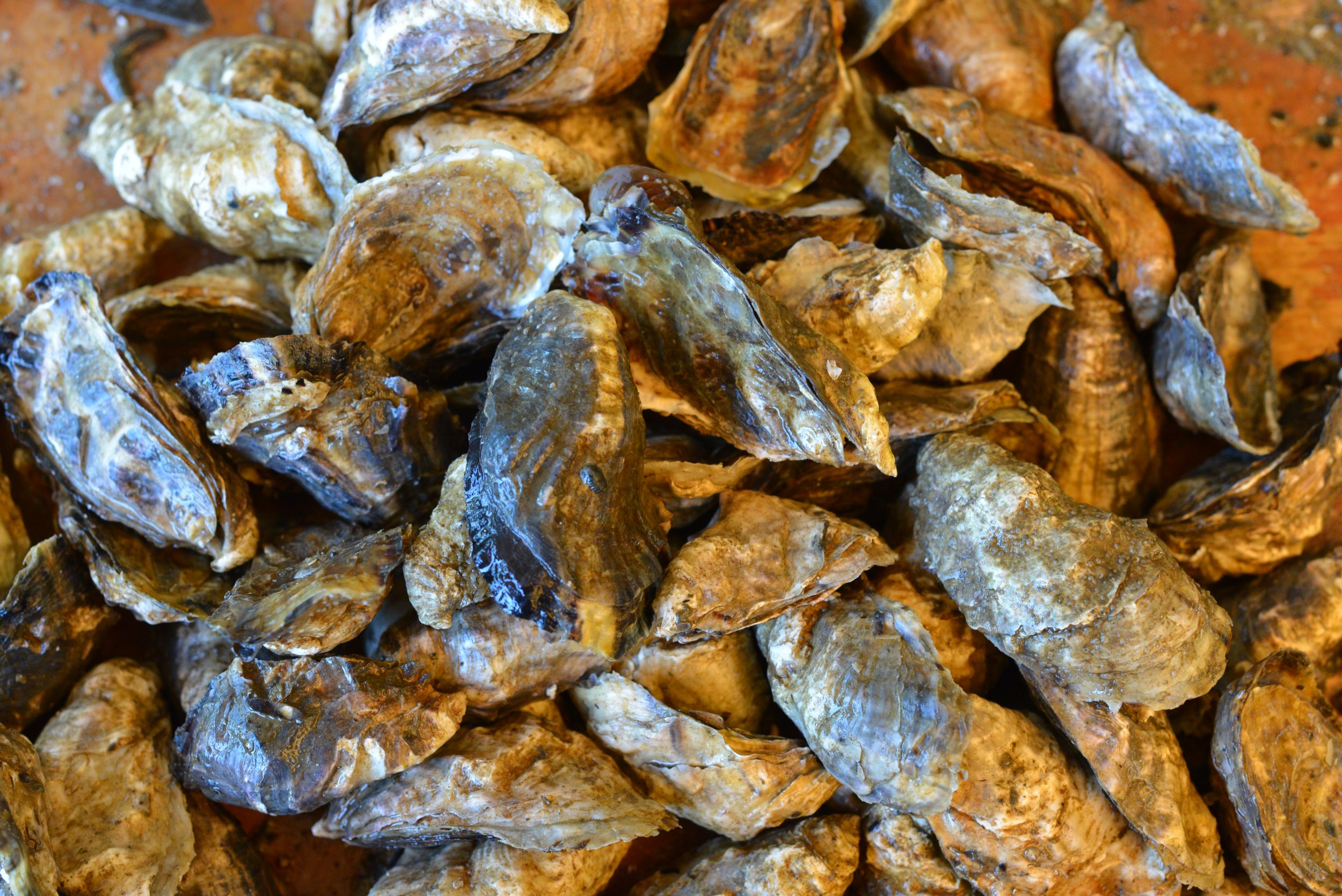
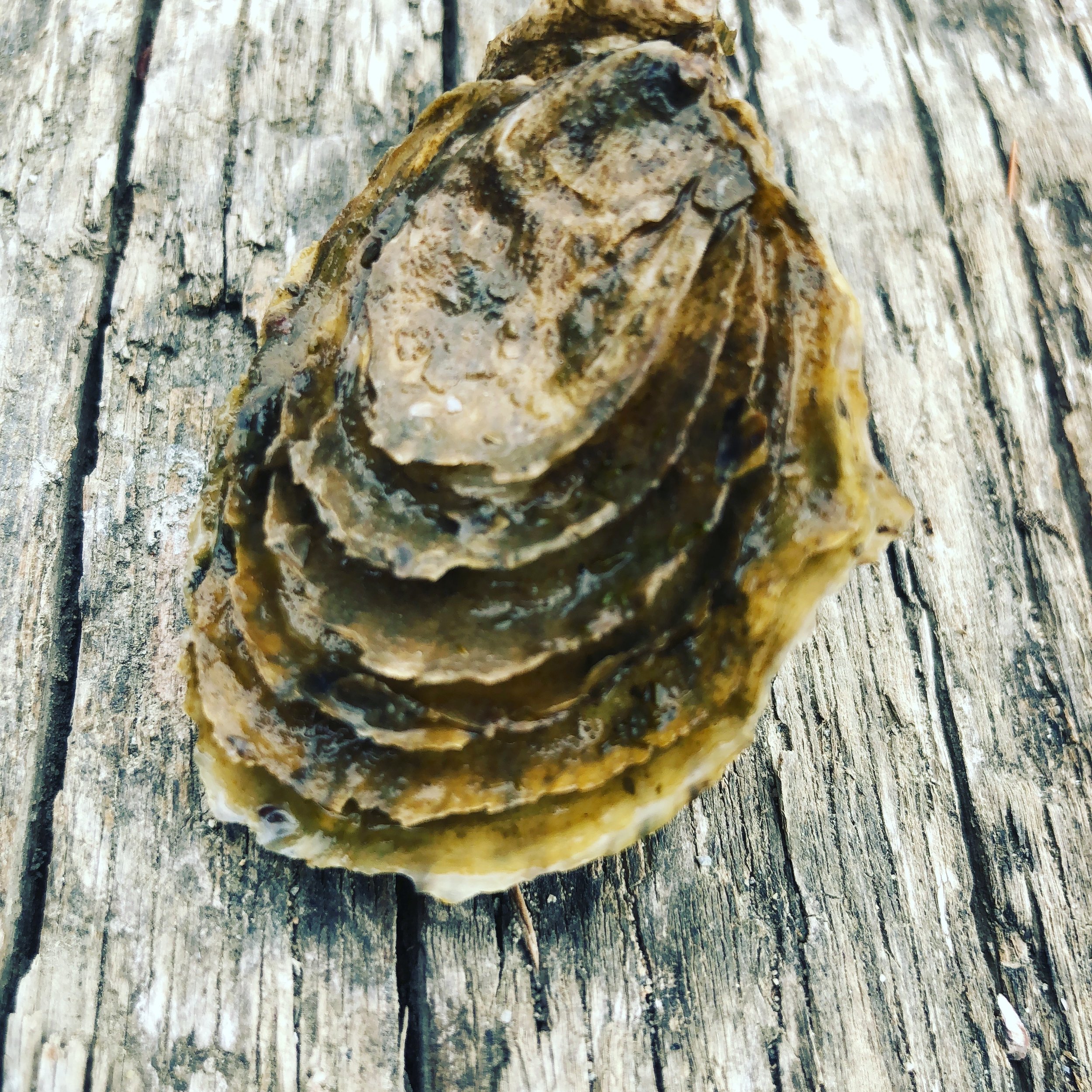
The method of growth can greatly change the shape of the oyster. A Pacific allowed to grow naturally on the beach will have a sturdy irregular shell with a great deal of frills. The regular exposure at low tide strengthens the shell protects the meat from heat and predators like sea stars and crabs. In Europe, where there is very limited tidal change, some farmers manually pull the oysters from the water for periods of time to mimic the tidal action.
The tumble bag creates an altered but very marketable shape for cultured oysters. Oysters are placed in the bag as small seed and the tide does the rest. The tidal flip and roll chip off the fragile lips and force the oyster to curve. The result is a deep cup in its lower shell.
“Eat shellfish to provide a healthy diet. Shellfish are low in saturated fats, containing the essential omega-3 fatty acids; are excellent protein sources; and are good sources of iron, zinc, copper and vitamin B-12.”
wsg.washington.edu
Each bay has its own selection of phytoplankton yielding oysters with different meat colors and flavors. Pacific oysters grown in Willapa Bay have a different merrior from those grown in Samish Bay. Hood Canal oysters are claimed to be more briny than the sweeter cucumber flavored bivalves grown in Hammersley Inlet or South Puget Sound waterways. Just like the well attuned vintners of the Rhone Valley, oyster connoisseurs are able to detect the subtleties of each bay by tasting the meat and observing the shell.

Know your oysters
There are over 150 varieties of oysters harvested and sold in North America, yet they comprise a total of only 5 species of oysters.
1. Olympia
OSTREA LURIDA /OSTREA CONCHAPHILA
The native oyster to Washington State, the Olympia oyster is a half dollar size with a metallic finish. The Olympia oyster fishery ran from the mid-1800s until about 1915 supplying California’s demand for oysters. The oysters were harvested from shallow bays of southern Puget Sound and Willapa Bay until pollution and over harvesting caused a collapse of the wild fishery.
2. Pacific
CRASSOSTREA GIGAS
Native to Japan, farmers began experimenting with the Pacific in 1904. Washington began importing commercial seed in the 1930’s and now it is now the most important commercial species on the West Coast. Beginning in the 1950’s researchers began to study Pacific reproduction to reduce the dependence on seed imports. Since the 1970’s local shellfish growers have relied on hatcheries for the production to meet the demand for Northwest oysters.
3. Virginica
CRASSOSTREA VIRGINICA
The decline of the Olympia oyster opened the door for the import of the Virginica from the east coast in the early 1900’s. The eastern oysters did not adapt well to local waters and experienced large die off when transplanted. There are still beds of Virginicas raised by WA shellfish farmers.
4. European Flats
OSTREA EDULIS
European Flats have smooth, round, saucer-like, flat shells with a shallow cup and seaweed-green color. They have a bold flavor with a meaty, almost crunchy texture, and intense mineral bite with a long-lasting seaweed flavor and gamey finish. There are not many farmers cultivating Flats.
5. Kumamoto
CRASSOSTREA SIKAMEA
The Kumamoto has a small deep cup and a sweet meat. Brought from Japan’s Kumamoto Prefecture, they are unable to reproduce in our cold waters so growers rely on hatchery stock. The prized cup of the Kumamoto and its limited supply has growers working with Pacifics to meet half shell demands. Growers use tumble bags to force the Pacific into a deeper cup. Oysters with names such as Kusshi, Shigoku, Sea Cow, Blue Pools, Chelsea Gems, and Baywater Sweets, are the result.

Why is it required to shuck oysters on the beach at public tidelands?
Oysters taken on public tidelands must be shucked on the beach and the shells left behind for the following conservation-based reasons according to the Washington Dept of Fish & Wildlife website, wdfw.wa.gov:
Oyster shells provide the best growing substrate for juvenile oysters. Removing the shells from a beach reduces the overall amount of setting surface. In addition, Pacific oyster shell provides an excellent setting surface for the native Olympia oyster. This is especially true in places like southern Puget Sound where the natural setting surface - Olympia oyster shells - was eliminated years ago by overharvest.
Another concern is that removing large Pacific oyster shells removes tiny oysters which are attached to the larger shells. Thus, removing a legal limit of 18 oysters may actually remove three to five times that number of oysters - young oysters which would otherwise remain on the beach and grow to edible size.
Removing oyster shells from beaches containing Japanese oyster drills (an oyster predator) may result in the inadvertent spread of these predators. Sport harvesters are unlikely to recognize these tiny predatory snails - or their egg cases - which attach to oyster shells and can survive long periods away from water. Once shucked, these shells often end up being returned to a nearby beach by well-meaning harvesters, potentially increasing the spread of the Japanese oyster drill in Washington by depositing the “hitchhikers” on a new beach.
Many public beaches already have these tiny predators, but the goal is to minimize the spread to other uninfected beaches. The surest way to prevent oyster drills or their eggs leaving an infected beach is to require oyster shells to remain on the beach.
So head to the beach and get shucking! You will need a shellfish license, an oyster knife and gloves. Adults may shuck a child's daily limit so long as the child participates in some way in the gathering. For illustrated details on two popular shucking methods, visit wdfw.wa.gov/fishing/shellfish.
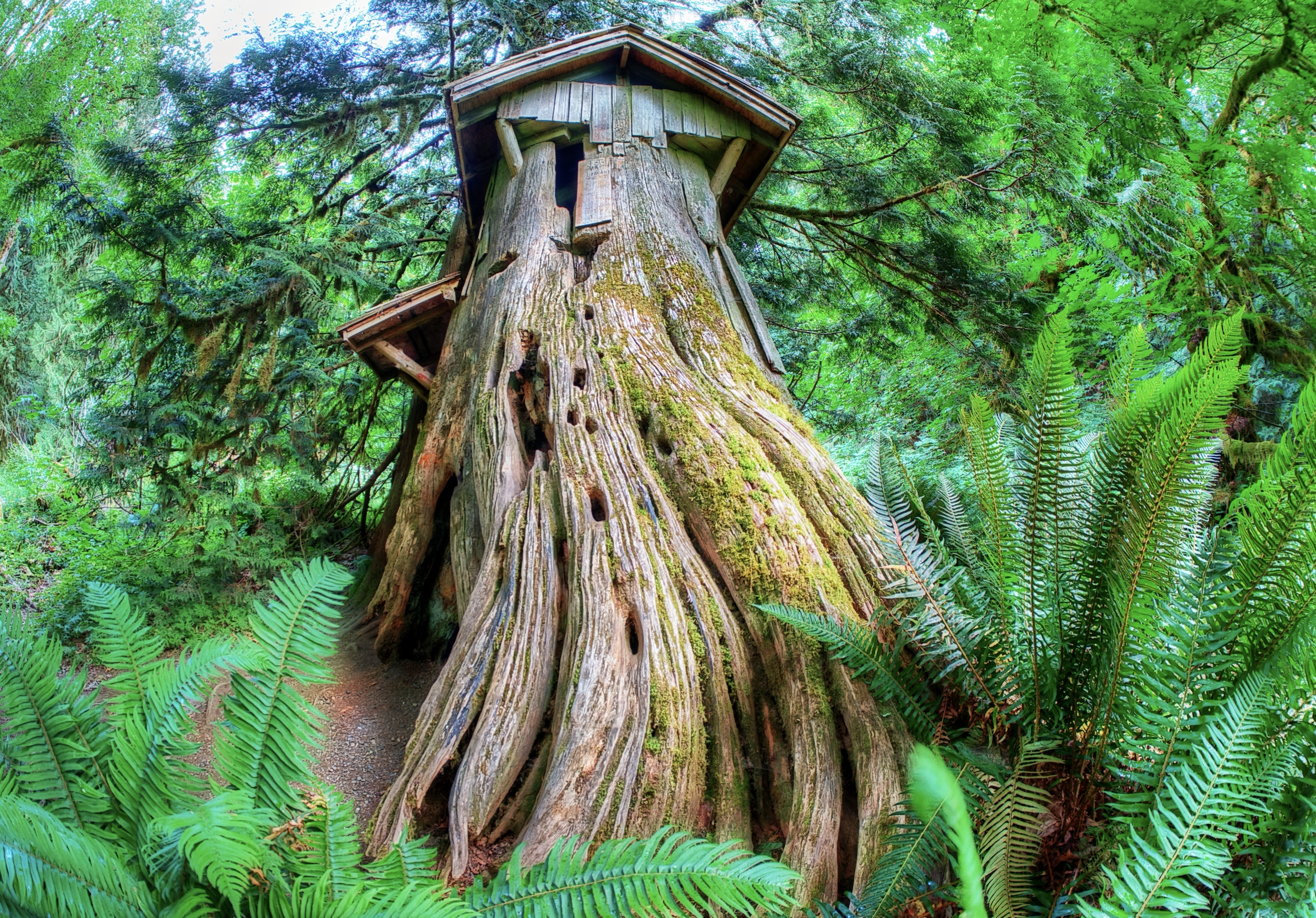
Discover magic in the Guillemot Stump House
Imaginations are inspired by the Stump House, a large hollowed out Red Cedar that has been outfitted with a door way, window openings, and a split-shingle roof.
Story: Stella Wenstob; Photos: George Stenberg
Nestled in a 200-year old maple grove, just 4.5 miles outside of Seabeck is a well-hidden gem, Guillemot Cove Nature Reserve. With several easy loop trails and beach access offering views of the Hood Canal and the Olympic Mountains, this park is a great place to bring the whole family!
“Imaginations are inspired by the Stump House, a large hollowed out Western Red Cedar stump that has been outfitted with a door way, window openings and a split-shingle roof.“
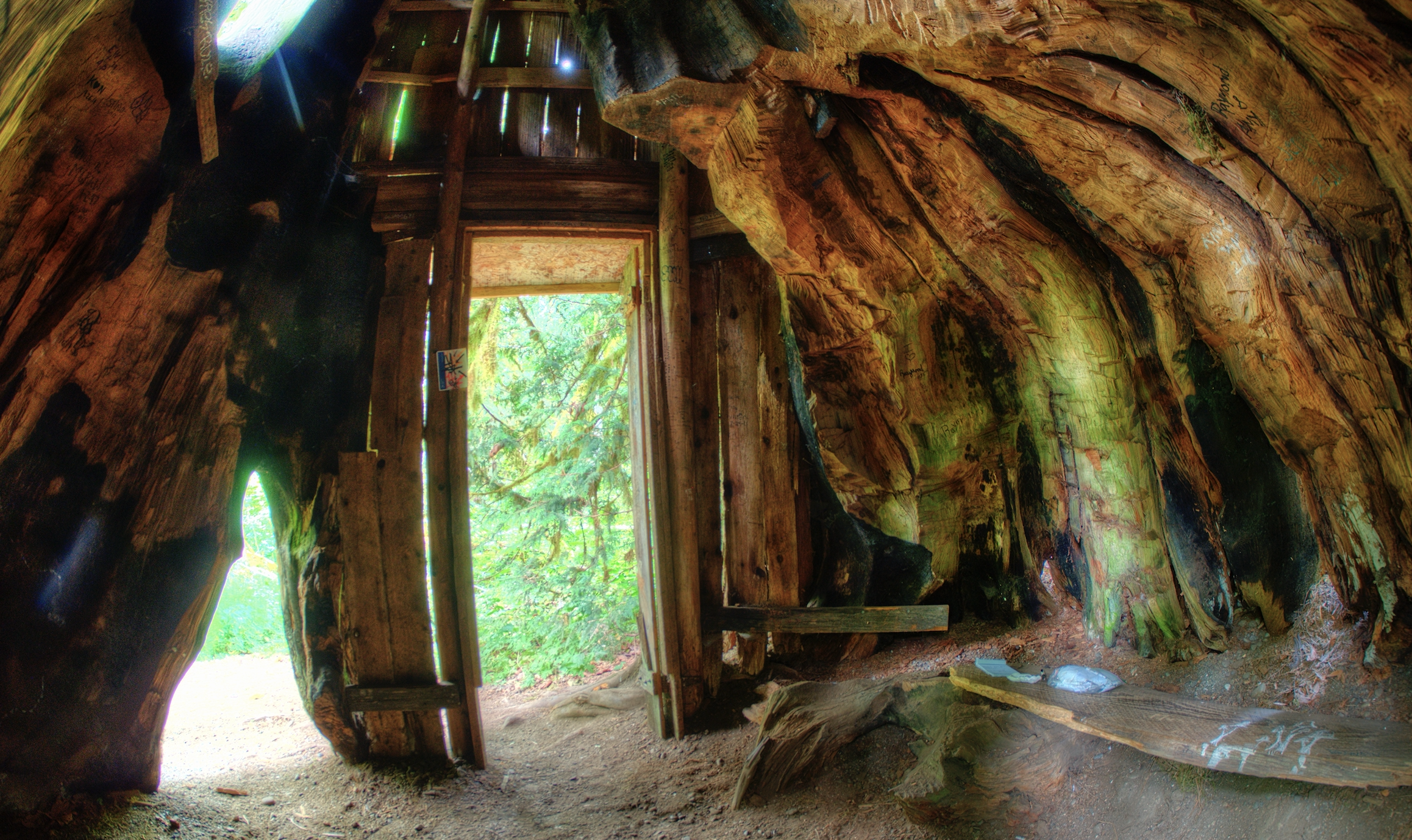
Inside the stump house | photo: George Stenberg
Local legend holds that the Stump House was originally built by Dirty Thompson an escaped convict. The notches carved in the large stump also gives evidence to springboard logging practices, which dates the stumps creation to the 1890s.
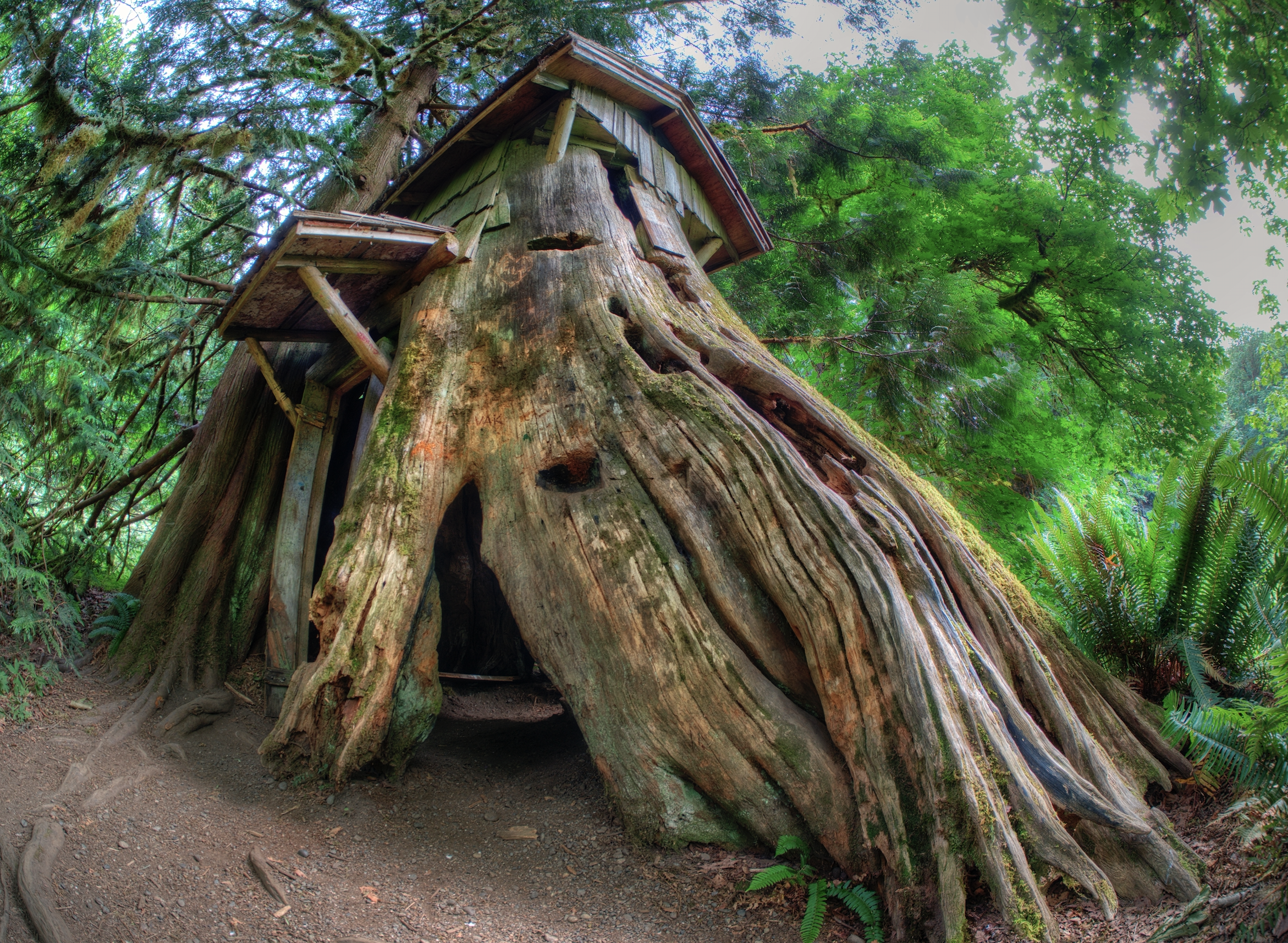
Stump house showing the springboard holes | photo George Stenberg
Loggers would carve notches in the tree to insert springboards above the flare of the roots on the tree so that they could stand on them while they laboriously cut the tree down with large handsaws.
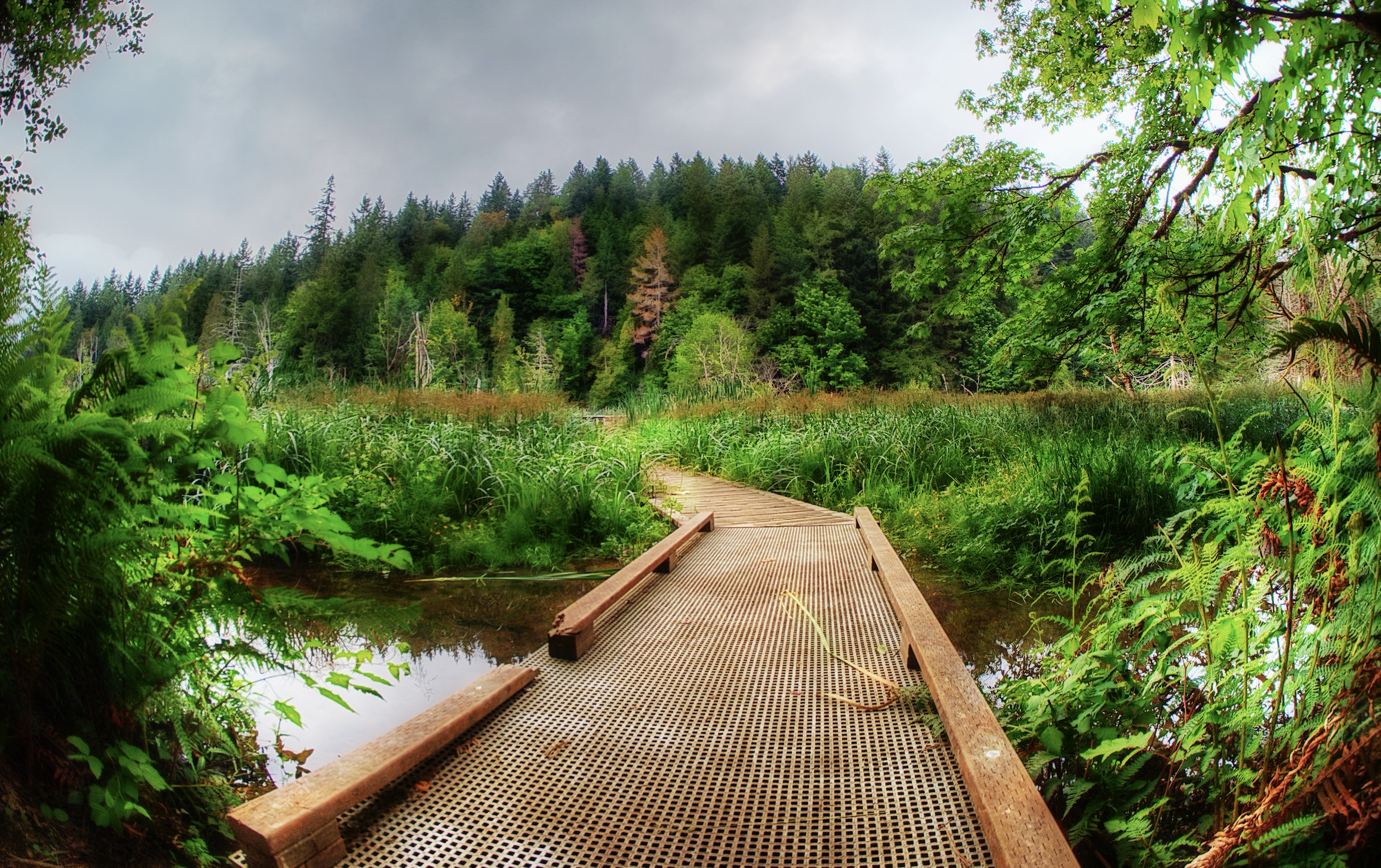
Boardwalks mark the trail to the Stump House | photo: George Stenberg
The park was originally a labor of love of the Reynolds family who bought the property in 1939. Avid bird watchers, the Reynolds renamed the cove “Guillemot” after the black and white birds that frequented the cove. In 1993, after many years of enjoying and caring for the land the family sold the property to the Trust for Public Land to preserve the natural beauty.

photo: George Stenberg
Planning your trip to the Stump House
The trails in the Guillemot Cove Nature Reserve are all natural surface trails. The 184 acre park can be found at 19235 Stavis Bay Road NW, Seabeck. The park feature saltwater beach access and walking trails. No restroom facilities available at this site. Dogs are not permitted. The Reserve has a “Pack it in – Pack it out” policy. Please bring a bag or other container for trash and take it when you leave.
Directions: From Hwy.3, take Newberry Hill exit; travel to Seabeck Holly Road; turn right. Drive to Miami Beach Road; turn right - drive to "Y"; veer left onto Stavis Bay Road. Drive 4.5 miles to the entrance and parking lot.

The Guillemot Cove Reserve is managed by Kitsap County Parks | Download map and trail guide












50 Ways to Fill Your Days on Hood Canal
You probably don't need any urging – just enjoying one of the many parks and beaches or watching the wildlife in the water is enough for most visiting Hood Canal. But just in case you need a few ideas that allow for “social distancing” as well – here's a “couple” to inspire you .

You probably don't need any urging – just enjoying one of the many parks and beaches or watching the wildlife in the water is enough for most visiting Hood Canal. But just in case you need a few ideas here's a couple MORE to inspire you – Check out things to do for even more great suggestions.
#1. Hit the Beach
Hood Canal to Hope Island, it’s surprising how many beach access options there are. Pack a picnic, you’ll want to explore a while.
#2. Take a Hike
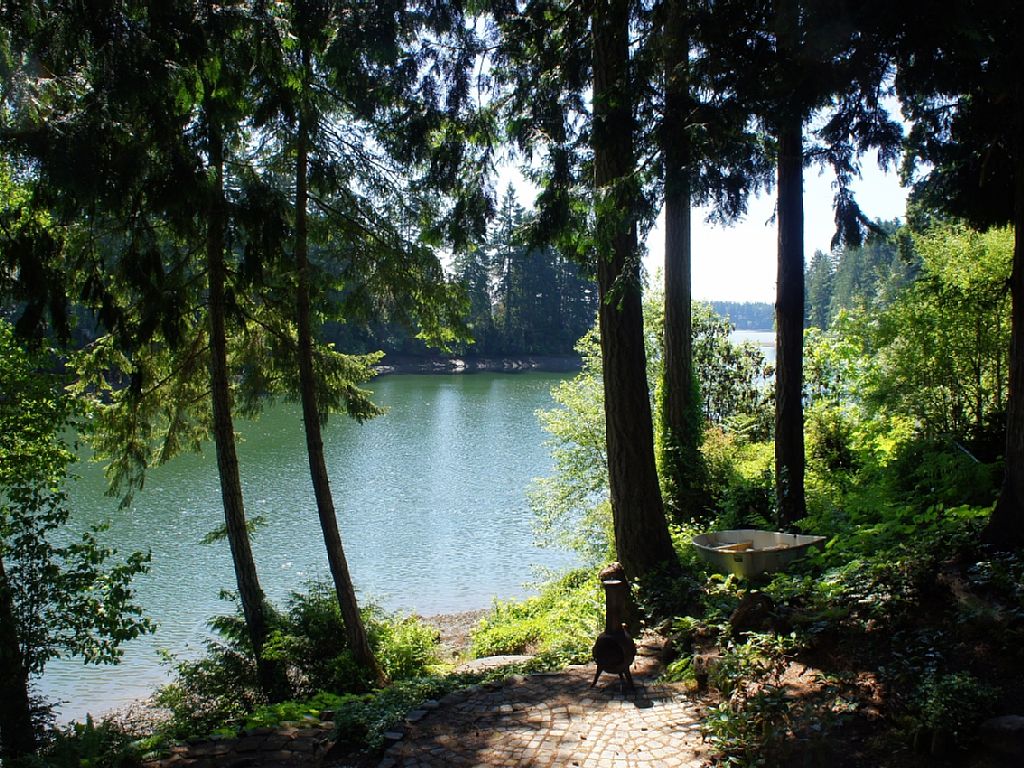
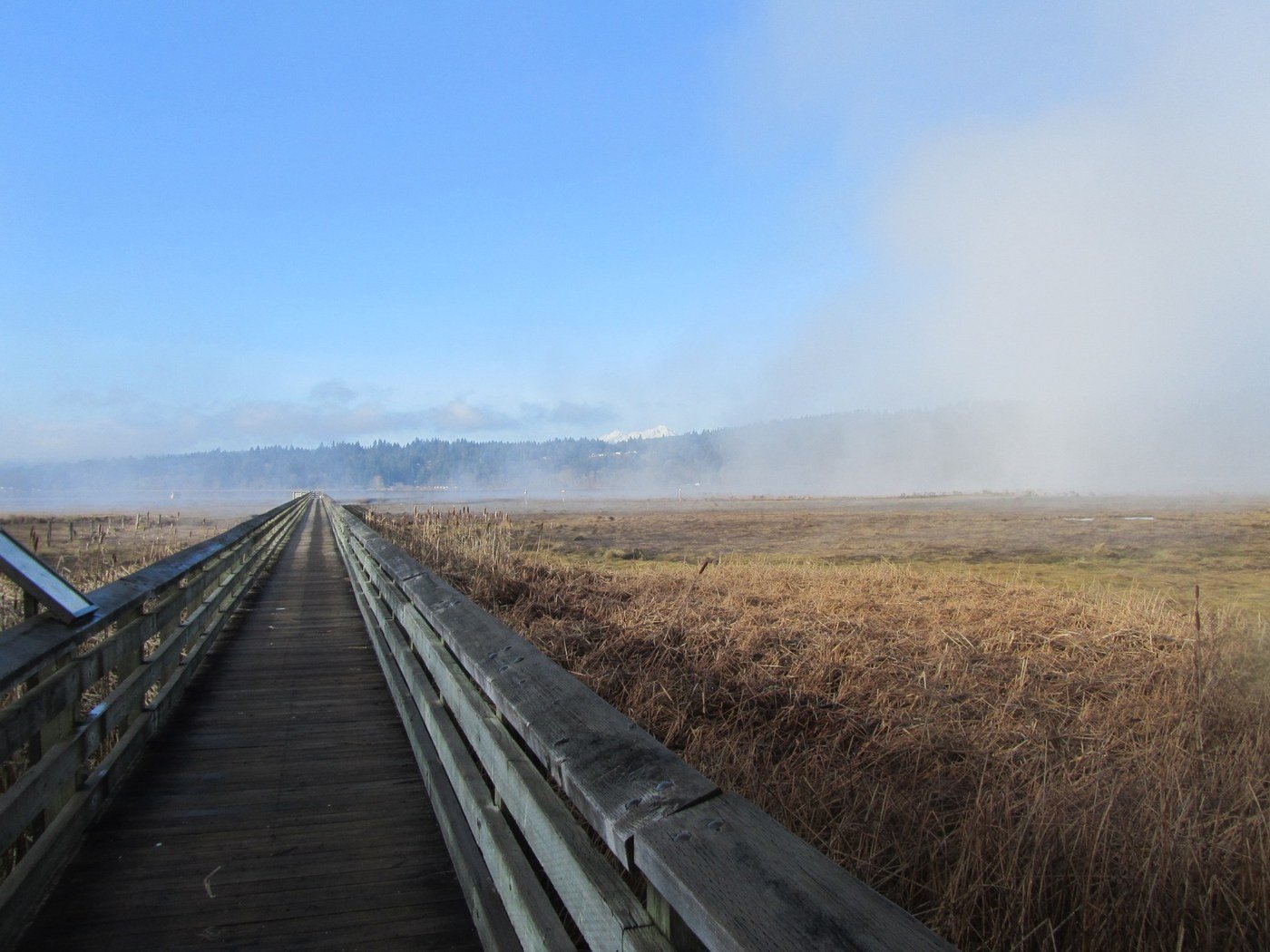
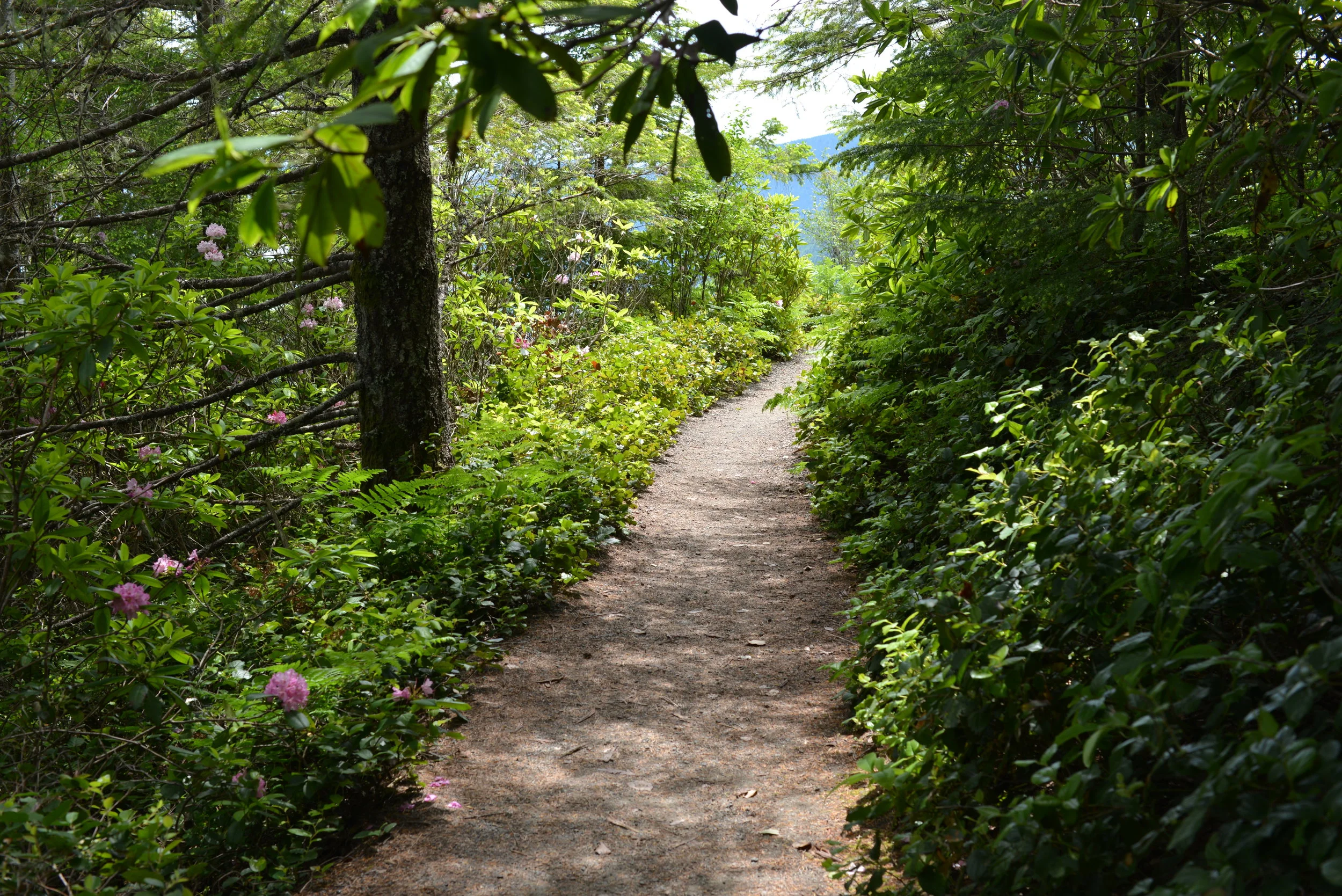
From a quiet city trail behind Shelton, forest walk at Twanoh State Park Trail (2.3 miles EASY) or Theler Wildlife Refuge (3.5 miles) where boardwalks over wetlands reveal flora and fauna. Here’s a list of great hiking spots around the Canal. Need a map? Try this link.
#3. Catch a Drift
Area lakes are stocked with trout and steelhead each Spring. Stop in at Verles for all the tips and tools. Fishing is the universal excuse to relax. Salmon season starts on Hood Canal and South Puget Sound in July and area lakes are stocked with trout and steelhead each Spring. Get your license at these local locations or online.
#4. Dive in the Canal
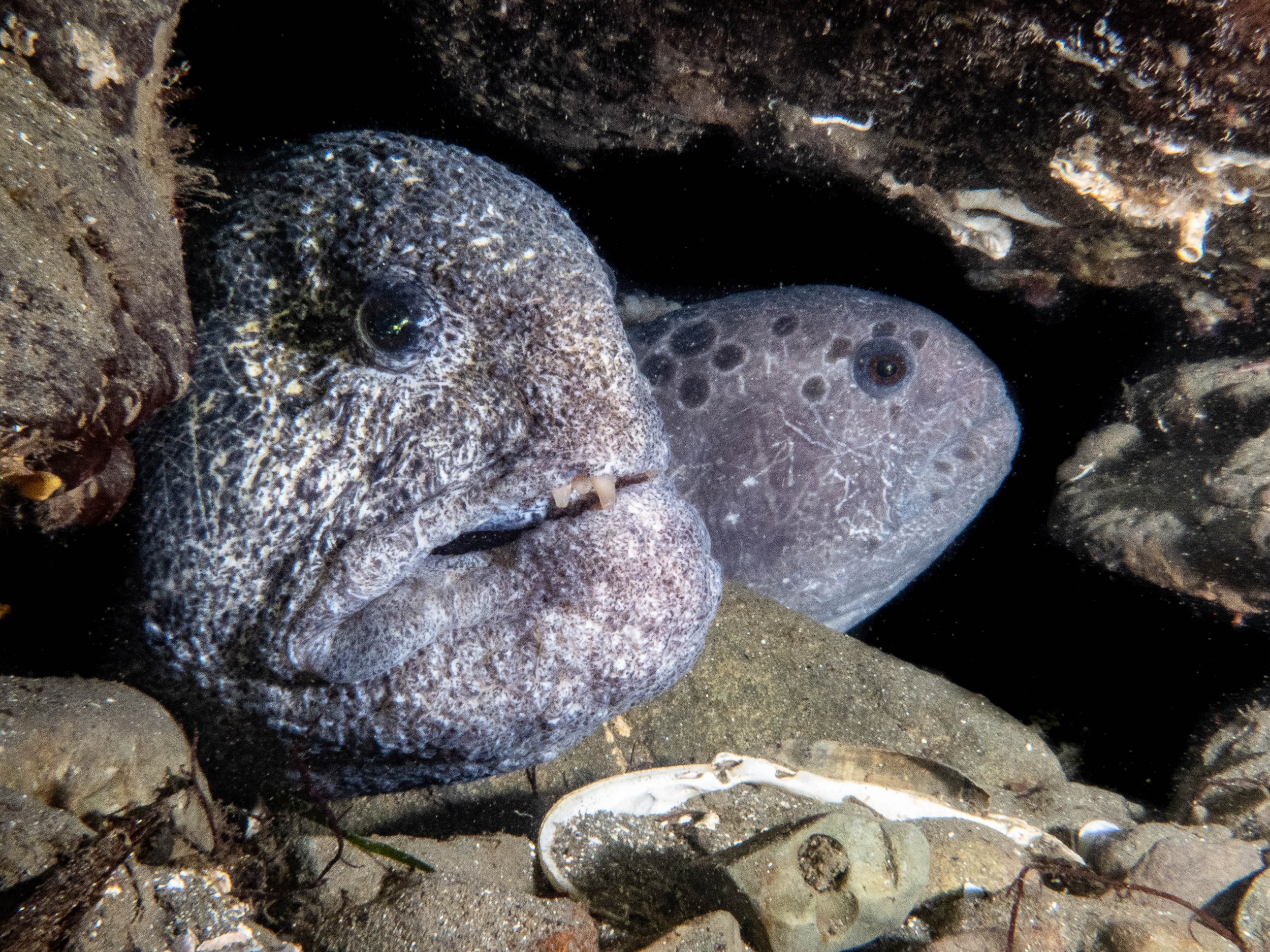
Giant octopi, friendly & curious wolf eels, and swarms of ancient rock cod add to the wonder of scuba adventures in Hood Canal. Scuba lessons, rentals (including air), and charters are available. The newly opened YSS diving in Hoodsport offers a whole series of certifications to "get your feet wet."









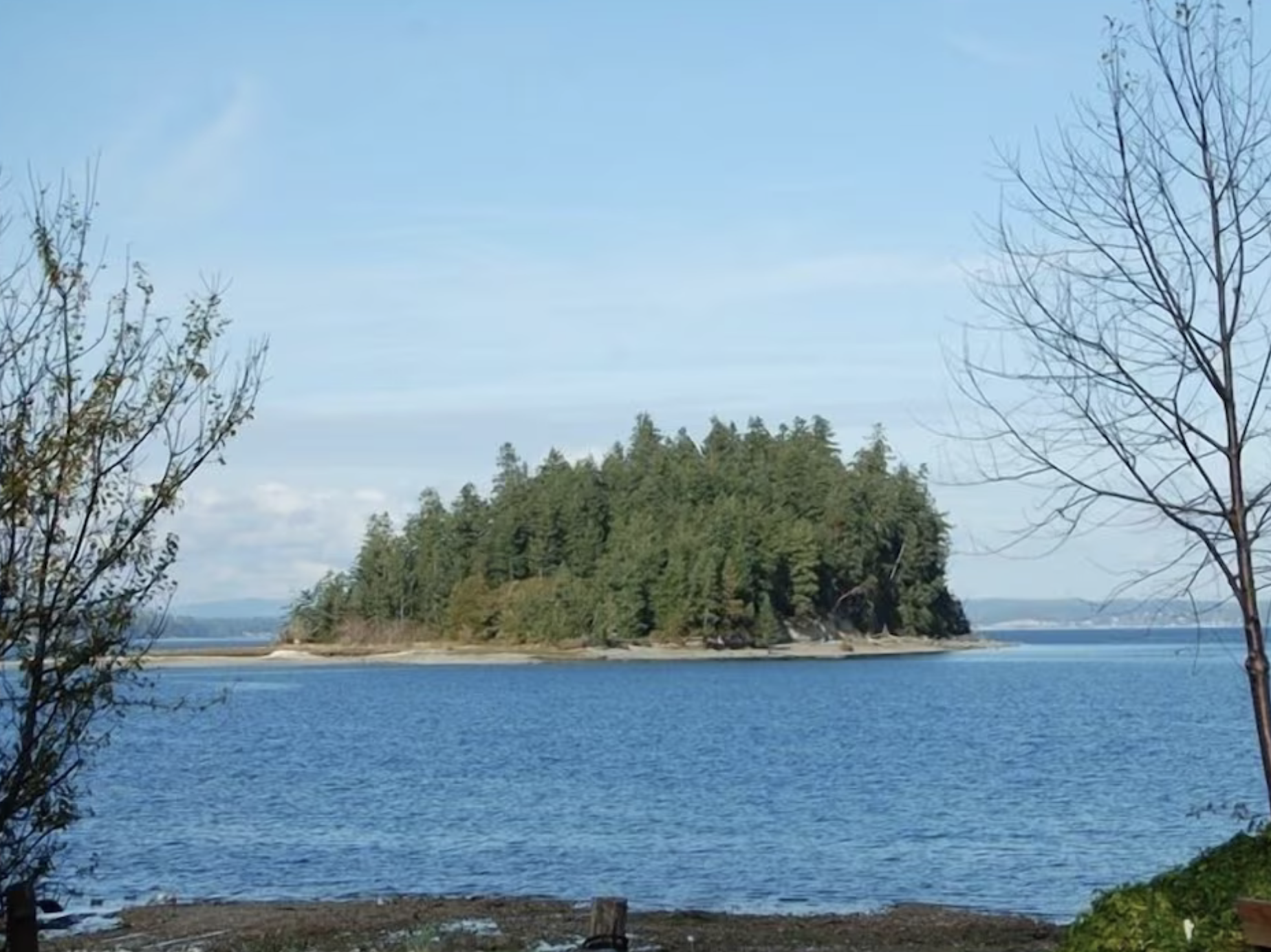
#5. Take the Leap
Views of the fjord and the Olympics and a seven minute free fall from 13,000 feet will change your perspective. Tandem flights $185-$215. Call Kapowsin Air Sports (360) 432-8000.

#6. Fly a Kite
Pick an afternoon low tide on Hood Canal and take advantage of the winds. The Port of Shelton (Hwy 101) has plenty of open fields.
#7. Dip your Paddle
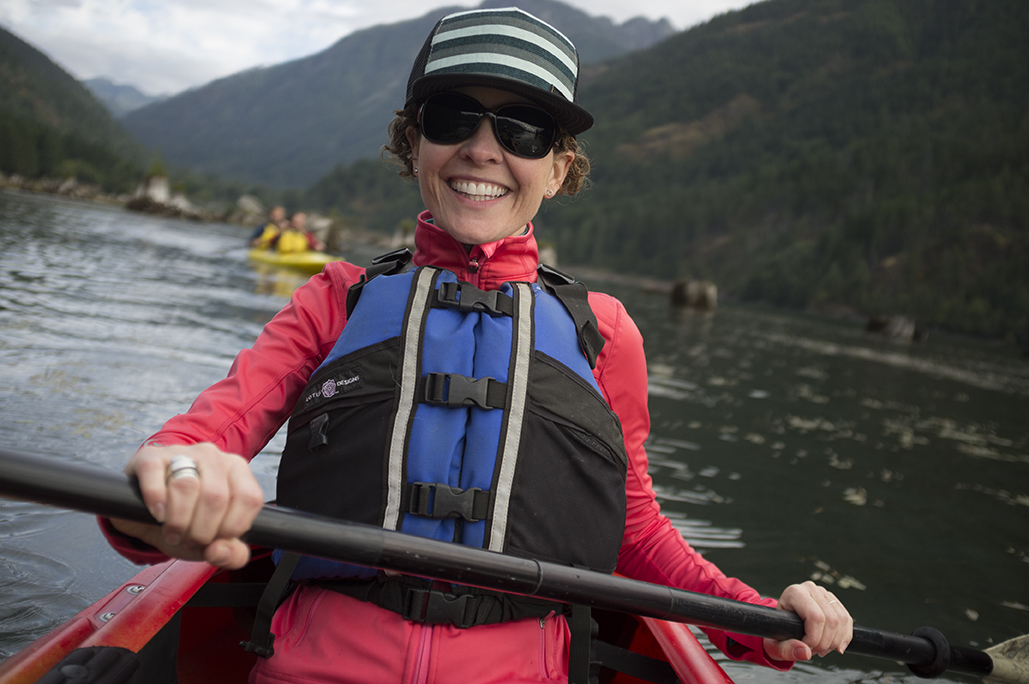
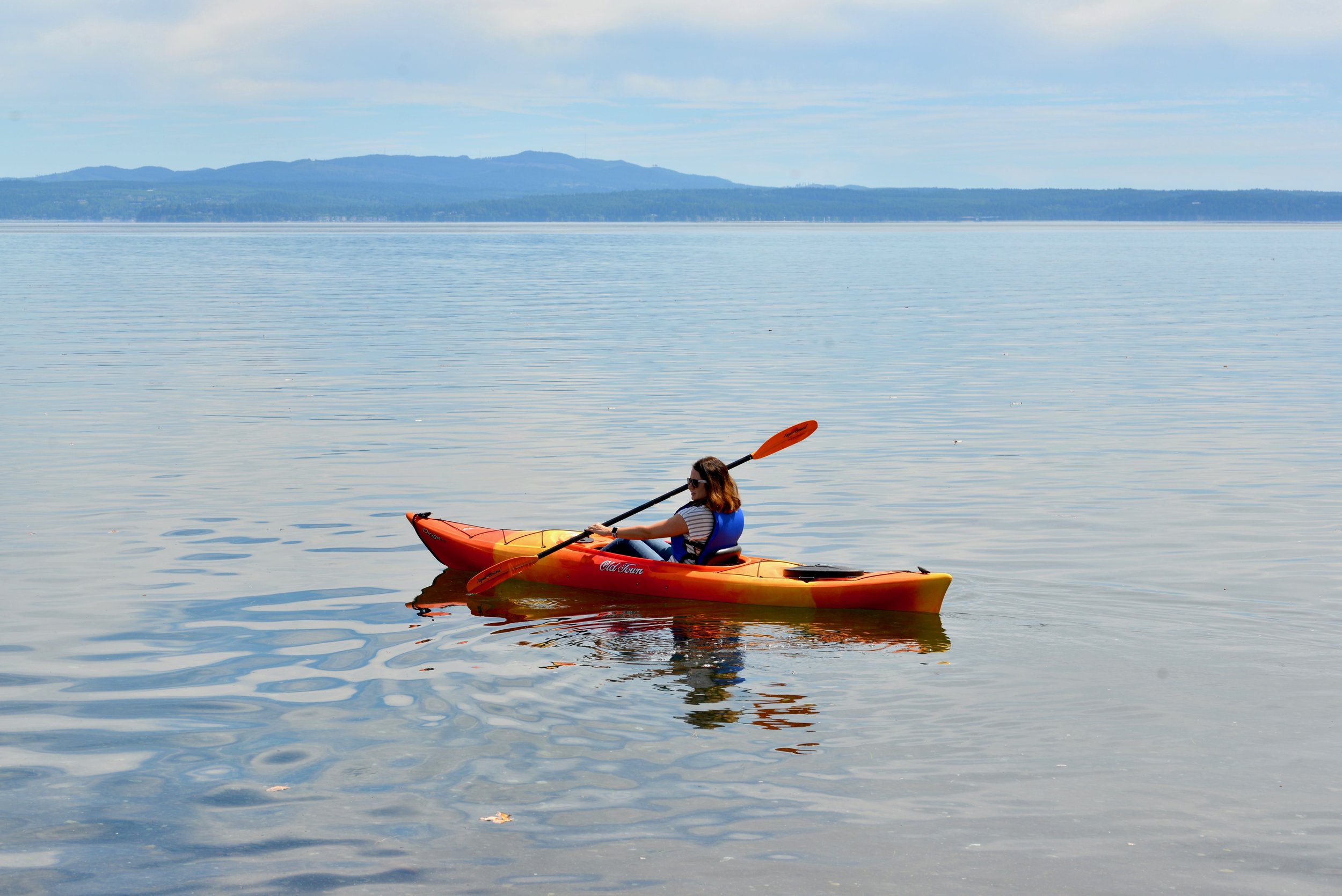
Hood Canal Adventure has kayaks for rent by the hour, day or week, and they'll deliver to your home or rental! and recently Mike’s Beach Resort teamed up with a local kayak company in Lilliwaup — learn more here.
#8. Low tide wonders
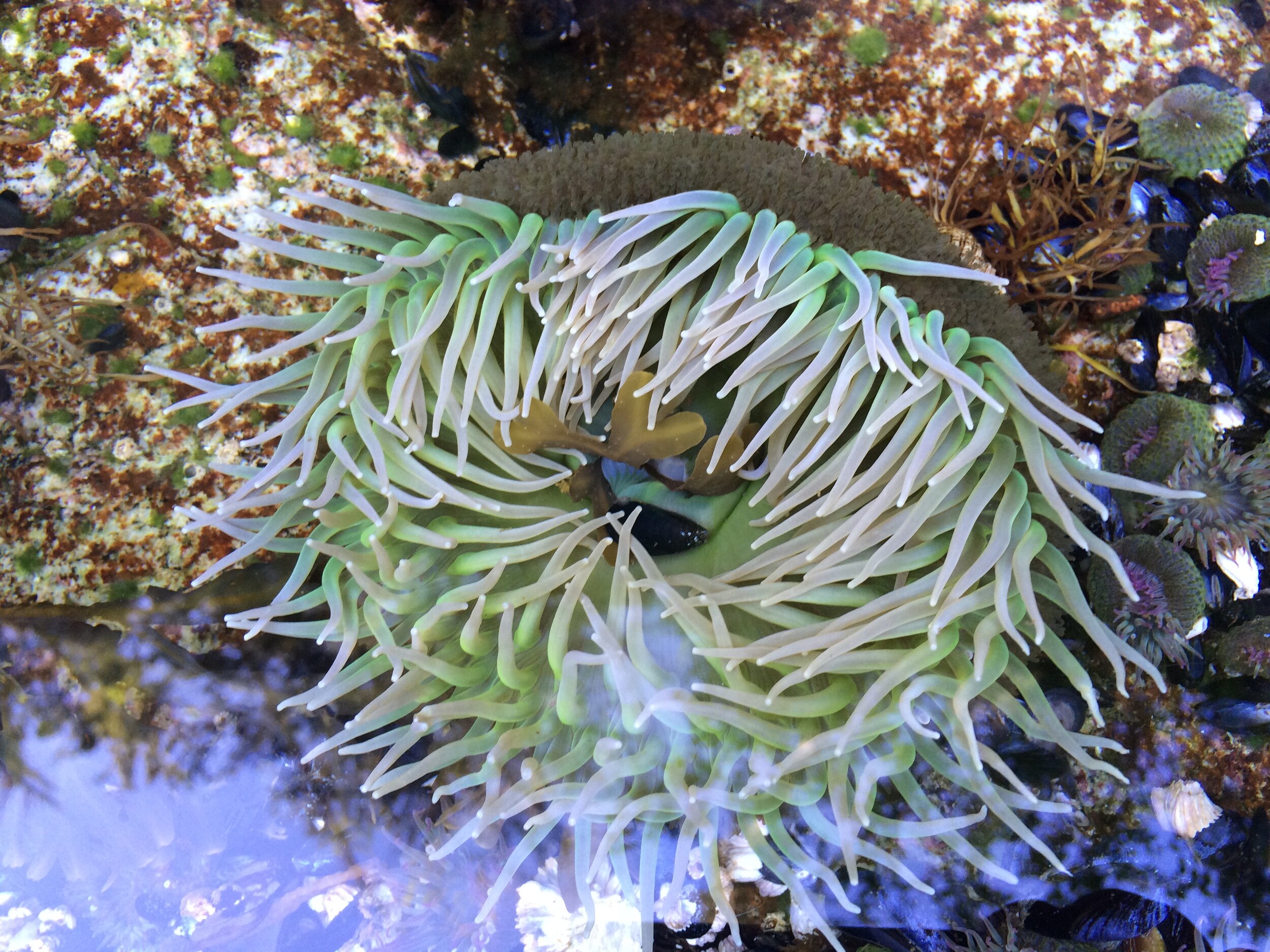
The Canal and South Puget Sound expose amazing creature wonders at low tide. Spring is an especially amazing time to make discoveries – remember to replace your rocks carefully after flipping — that’s someone’s home!
#9. Find a Fall
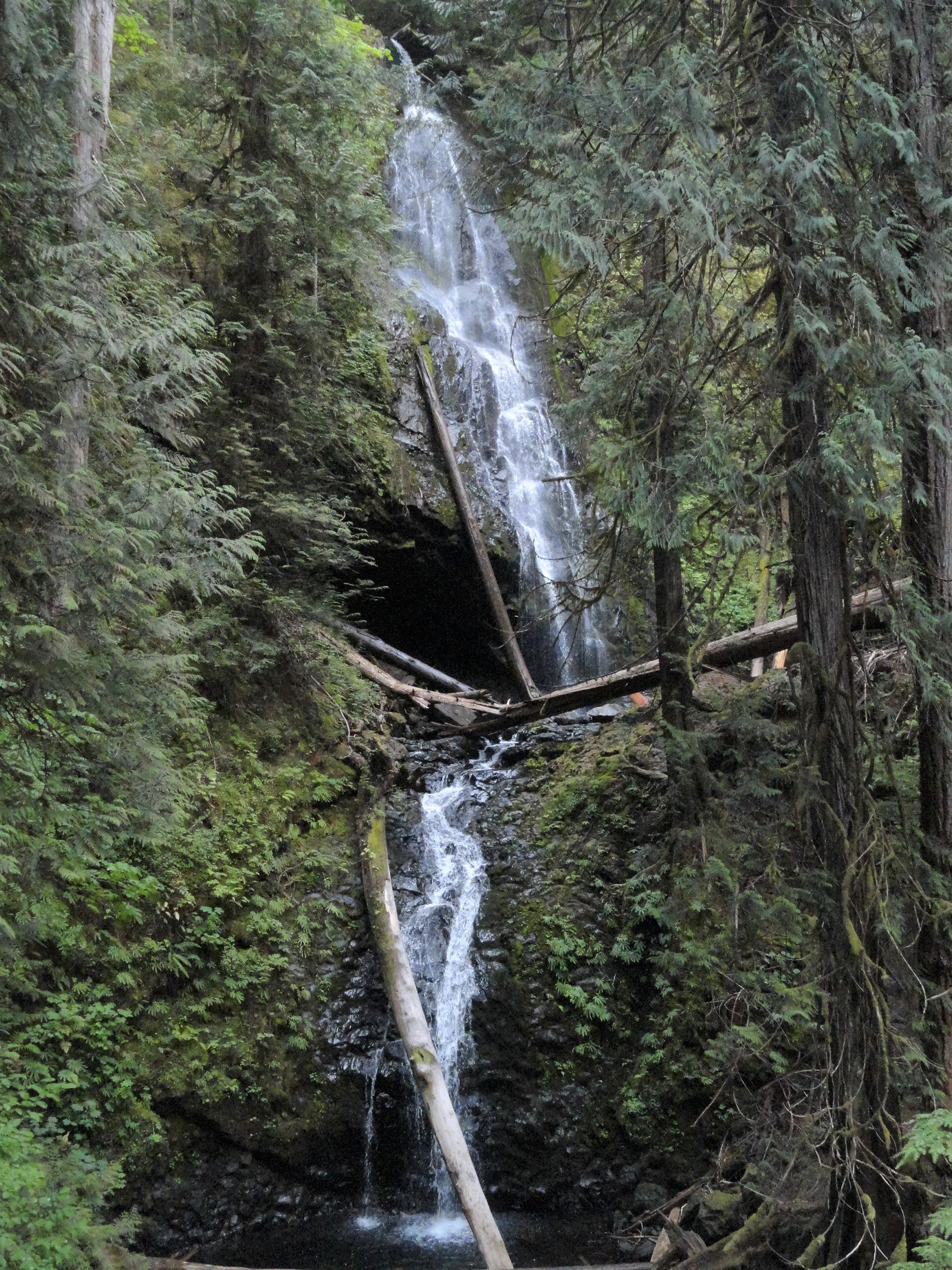
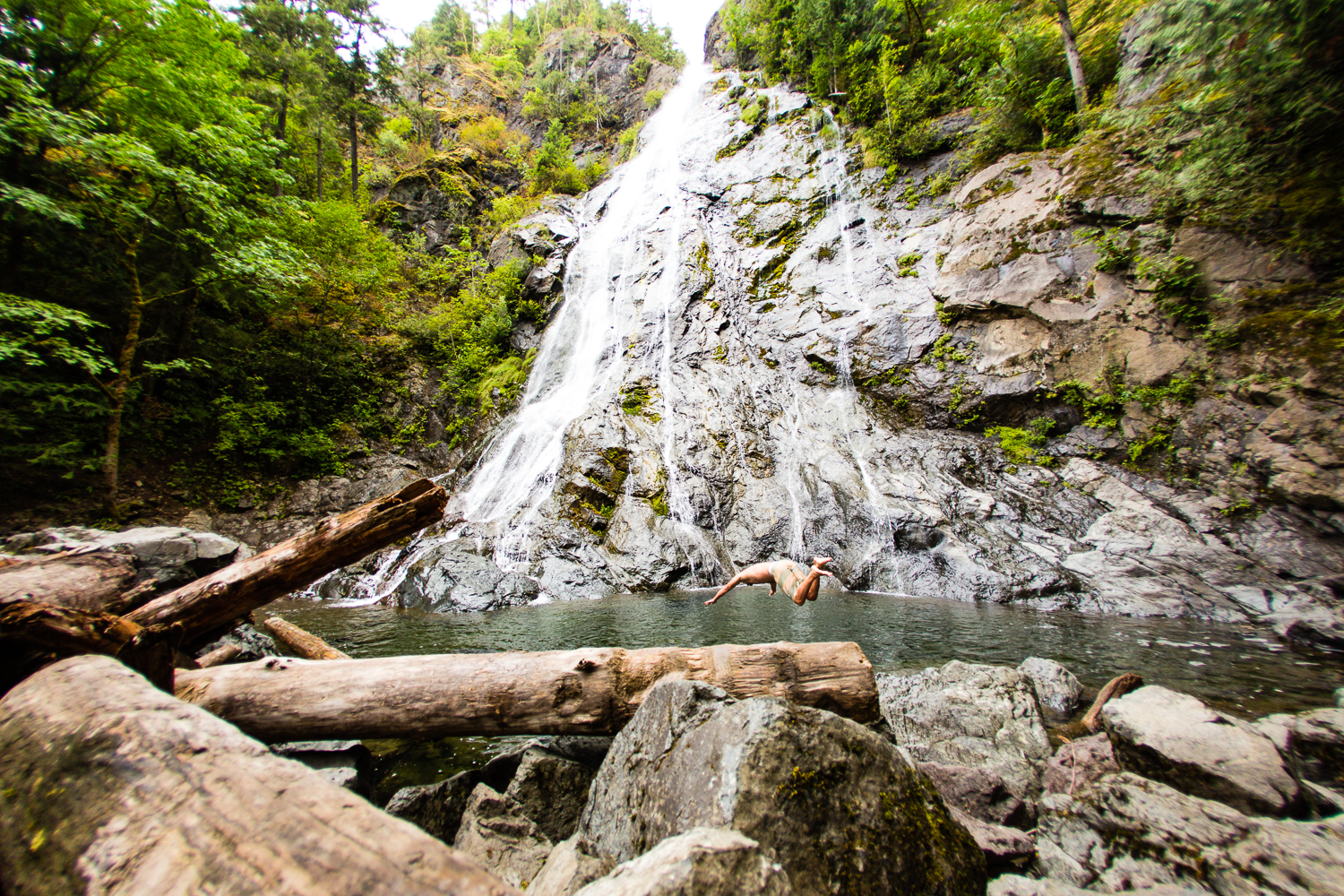
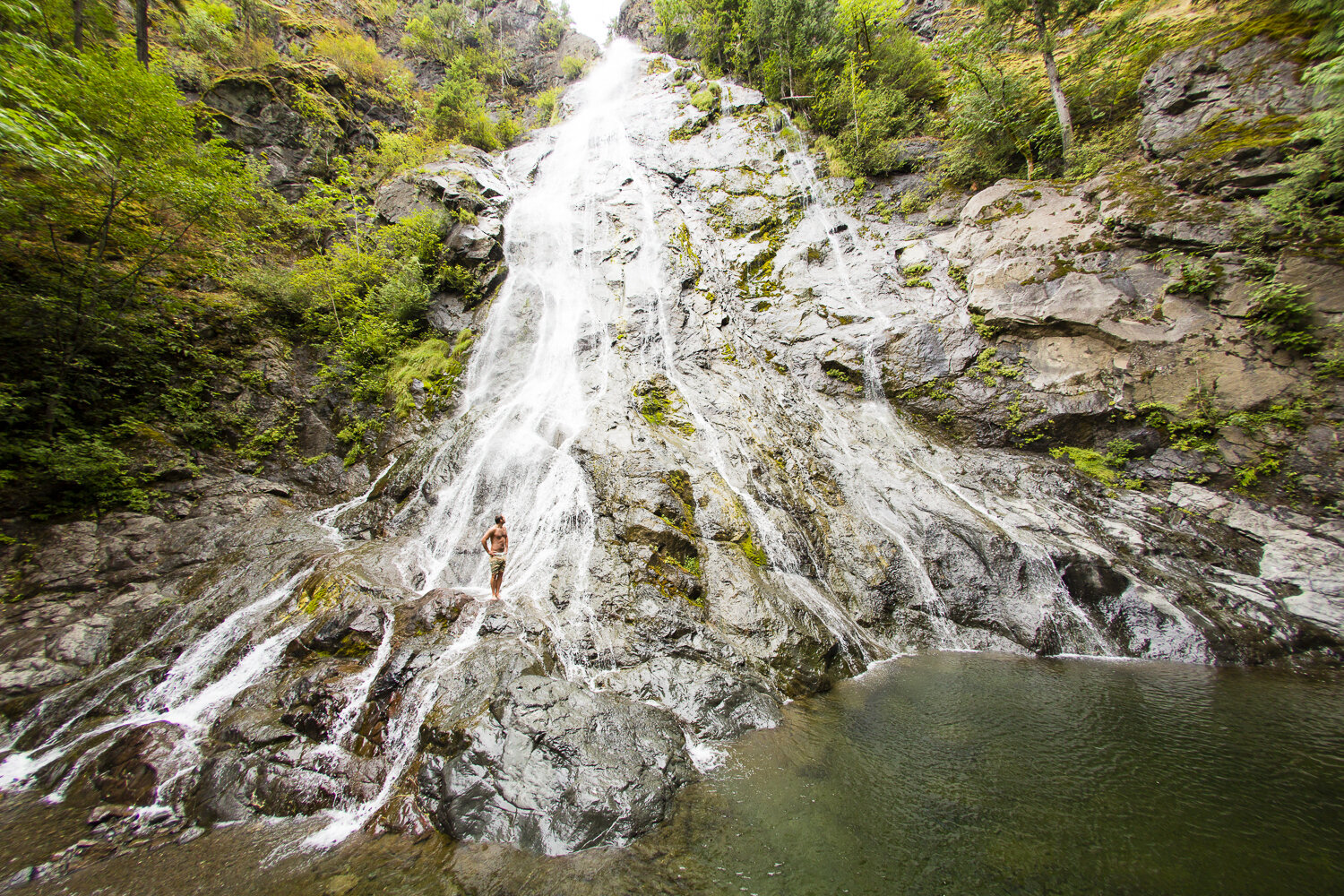
The waterfalls are delightful year round —and it’s fun to swim in the pools in warmer weather. Some waterfalls and rivers can be very dangerous with undertows; be aware of hazards and watch children or inexperienced swimmers.
Our favorites:






#10. Get a new View
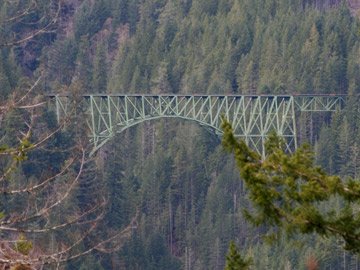
Soaring 420 feet above the Skokomish River, the High Steel Bridge (1929) is the highest steel truss arch in Washington. Follow Skokomish Valley Rd from U.S. 101 to bridge.
#11. Launch a Boat
Take the boat out and explore the islands and passages from Case Inlet on South Puget Sound, Hope Island near Arcadia Point Boat Launch and, of course through all the waterways and the Canal! Check out this list of boat launches and water access under fishing.
#12. Dine waterside
Our restaurants are back to normal with many having dining indoors and other offering take-out or curbside. Try the Hook & Fork at the nion City Market for fresh oysters and a changing seasonal with a GREAT view!
#13. Slurp!
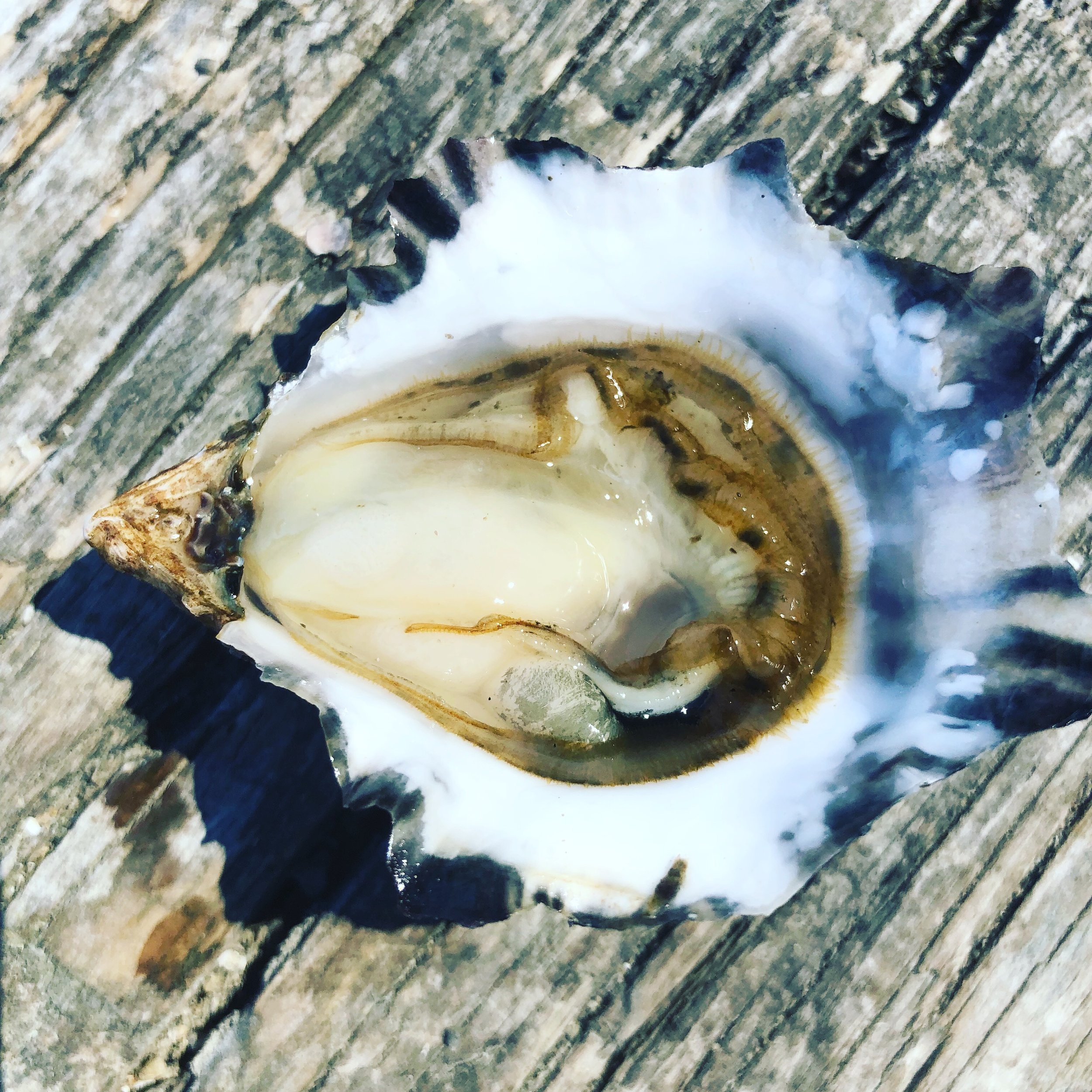
Hama Hama Oyster Co., north of Lilliwaup, is open year round. Eat oysters – raw, baked and grilled, or try the crab cakes! The views alone will excite you.
The Taylor Shellfish retail store, South of Shelton is open daily for clams, oysters, geoduck and mussels – all harvested fresh in local waters!
#14. Pick a Peak
The Olympic National Forest and the Olympic National Park offer great climbing for all skill levels. Up for a challenge? Try the less visited but fulfilling Wagonwheel hike.
#15. Take a Hike
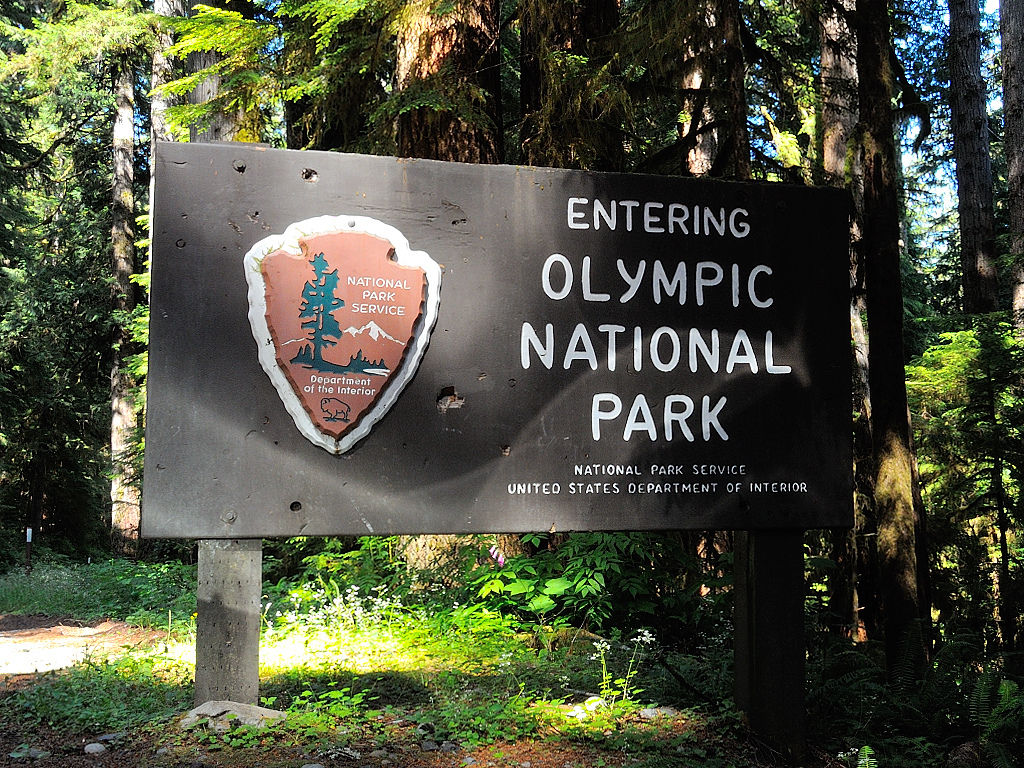
How about checking out the Big Loop Trail around Lake Cushman. Or if you are feeling more adventurous — check out Mildred Lakes.
#16. Run!
The Huff in Puff trail in Shelton is a great place to start but there are lots of beautiful trail run areas too. Consider participating in many of the seasonal runs that are back on the schedule again.
#17. Sip
Stottle Winery and Hoodsport Winery in Hoodsport; Mosquito Fleet Winery in Belfair; and Walter Dacon, Shelton, all have plenty of locally made beverages to go or to sip on site.
#18. Ice cream fix
For the perfect day include a scoop or two of locally made Olympic Mountain Ice Cream. Pick up a pint of Oly Mtn. Ice Cream fix at these Hood Canal & South Puget Sound locations.
#19. Bike the Fjord
Trails in the Olympic National Forest vary from challenging to easy gravel roads. Combine trails and roads to create loops that offer a variety of forests, streams and panoramic vistas.

#20. Ride the Current
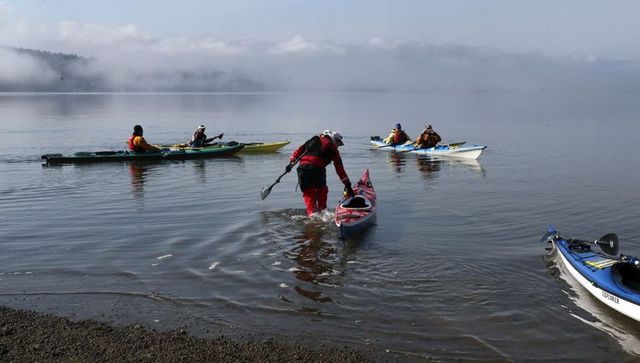
Launch a kayak at the Shelton Marina on outgoing tides and ride currents in Hammersley Inlet to Arcadia Point. Lunch at Hope Island Park and return with the incoming current!
#21. Canal views
From every spot on the road looping Hood Canal you will find inspiring and rejuvenating view of the mountains and maybe even catch a glimpse of a whale or seal.
#22. Shell Creations
Head to a Hood Canal beach for the whitest oyster and clam shells perfect for the guest room soap dish – ask before taking, but most won't mind!
#23. Find a Lake
There is no shortage of accessible and open lakes throughout the area. Lake Cushman has plenty of great swimming spots!
#24. Hole in One
From the award winning Salish Cliffs Golf Club in Kamilche, Alderbrook Golf & Yacht Club in Union, Lake Limerick, Lake Cushman Golf Course, and Lake Land Village Golf Course in Allyn – all offer majestic views of the area with plenty of space for everyone. Click here for golfing options.


#25. Ride the Rails
Peddle powered rail rides with Vance Creek Railriders. Opening in May, pedal the rails on the decommissioned Simpson Logging rail line for a 12-mile round trip work out! As you pedal the multi-seat "railrider" along the track you will have the opportunity to see wildlife, old growth and new forests as well as diverse meadows teeming with wild flowers, moss, and ferns.
#26. Motorsports
Navigate 23,000 acres of working forest, Tahuya State Forest, networked by extensive and winding trails,there's has something for every adrenaline junkie.
#27. Forage!
New amongst the many activities offered by Hood Canal Adventures is guided mushroom foraging.
#28. Glamp On
From Canal beach side glamour picnic, or an overnight trip - check out the glamping opportunities around Hood Canal!
#29. Geocache Hunt
Start at Alderbrook Resort and Spa, experience the high-tech treasure hunt as you explore the resort. Check out a clue book and a Garmin Handheld GPS and search for hidden containers leading to prizes!






#30. Read a Book!
Never out of style and great for some social distancing. Here’s a few ideas to get you going!
#31. Take a S'more Break
This should be #1... be sure to remember the chocolate, graham crackers and marshmallows -- wouldn't be the same without the S'mores!
#32. Run with the Salmon
Visit one of the many fish hatcheries on Hood Canal! Visit fws.gov for information on area hatcheries.
#33. Potlatch Brewery for a Pint
New to Hoodsport is the Potlatch Brewery. Visit their tasting room on Hwy 101 in the center of town to relax after a hike. High Steel Brewery in Shelton also has some local beers that are gaining high acclaims!
#34. Take your Dog on a Hike
Check out this list of area hikes where Fido is welcome to tag along.


#35. Gyro on the Canal
Sunset Beach Grocery & Deli near Belfair on SR 106 is claimed as being the best kept secret and great for a quick take out menu item.
#36. For the Birds
The Theler Wetlands, Skokomish Delta, Duckabush, Dosewallips and Hamma Hamma are great places to catch glimpes of our resident and visiting avian community! Check out the local birding spots.
#37. Sleep under the Stars
Around every corner you will find a great place to pitch a tent.
#38. Roast the Beans
Urraco Coffee in Shelton roasts all their beans on site in their quaint and friendly cafe on 7th and Cota. The drive through is quick and friendly. Coffee available by the pound as well. Urraco is also serving coffee at their location on Steamboat Island and in Hoodsport at the Fjord Café.
#39. EAT MORE oysters!
Oysters have high levels of zinc that helps our bodies fight viruses. Catch your own or visit Hama Hama and Taylor Shellfish and the Fjord Oyster Bank to pick up clams as well.


#40. Get a Carve On
Stop in at the Bear in A Box, Allyn for chainsaw artwork by George Kenny and his team. Feeling like a lumberjack? Sign up to learn how to sculpt a squatch with a chainsaw! Get the details here!
#41. Hydro Savvy
Check out the first hydroelectric wheel on the fjord. Dalby Waterwheel is located on SR 106 between Cameo Boutique and Alderbrook Resort.
#42. Chuck a disc!
The Shelton Springs Disc Golf Course in Shelton just recently recieved top ratings. Visit masoncountydiscgolfassociation for details on all the local courses.
#43. Pizza Attack
In Shelton call Dominos or Westide Pizza on First Street or head up the Railroad Taproom on Railroad Ave for some authentic Italian flavors and a huge selection of brews on tap. All offer take out and you can call head to get your order prepared ahead of time.
#44. Squatch Watch
With over 22 sightings in Mason County alone - chances of catching a glimpse get higher each year. Keep your eyes peeled and your camera ready for that money shot! Learn more
#45. Visit Tollie
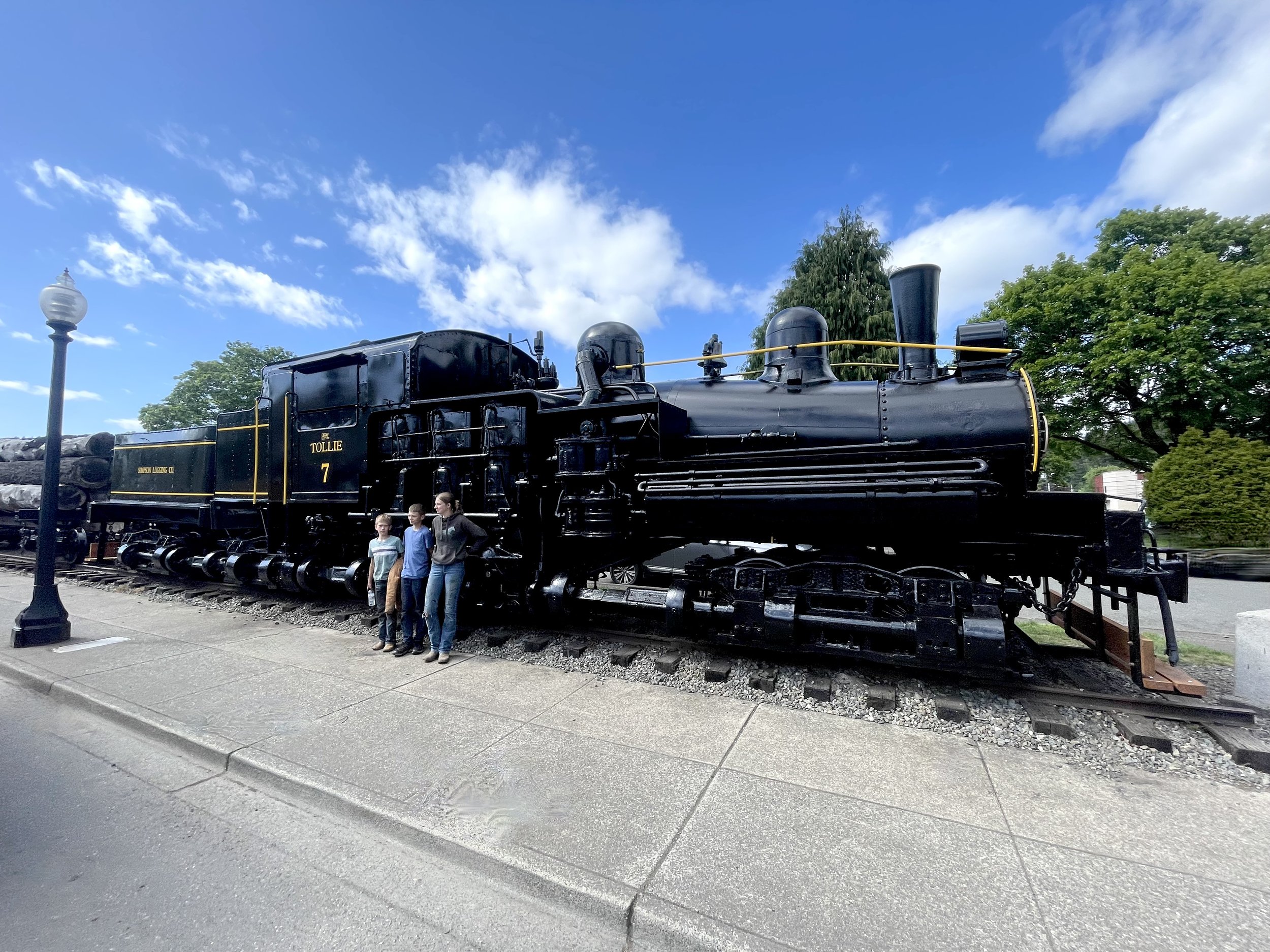
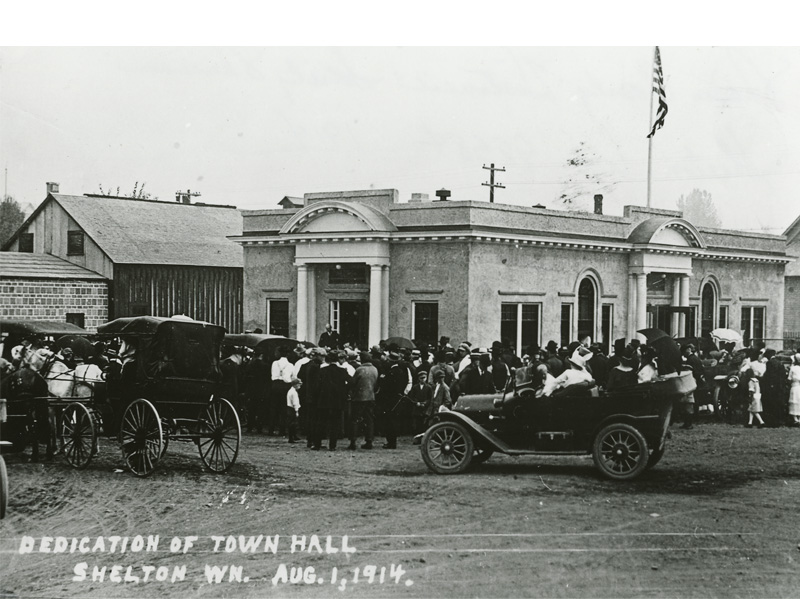
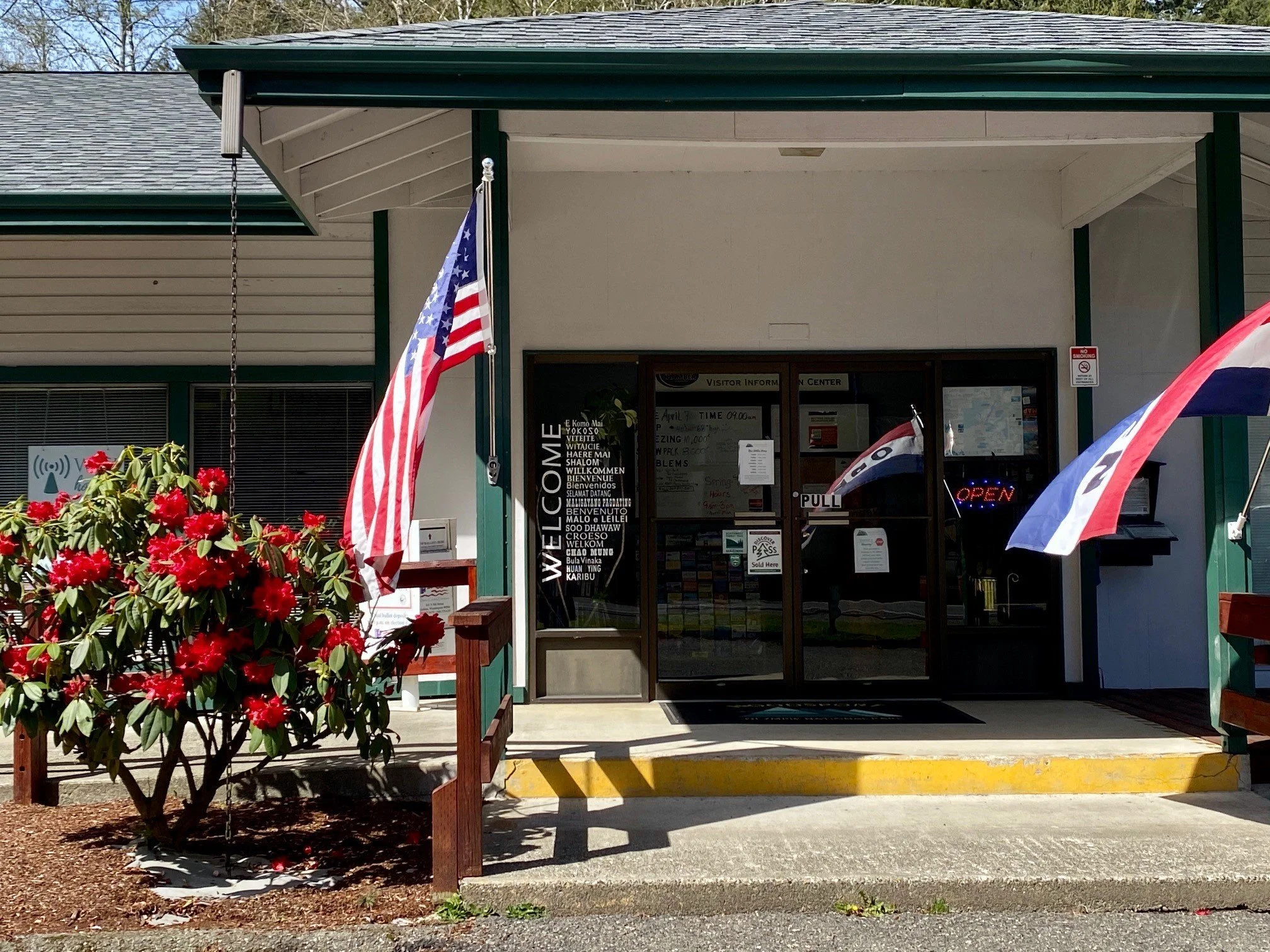
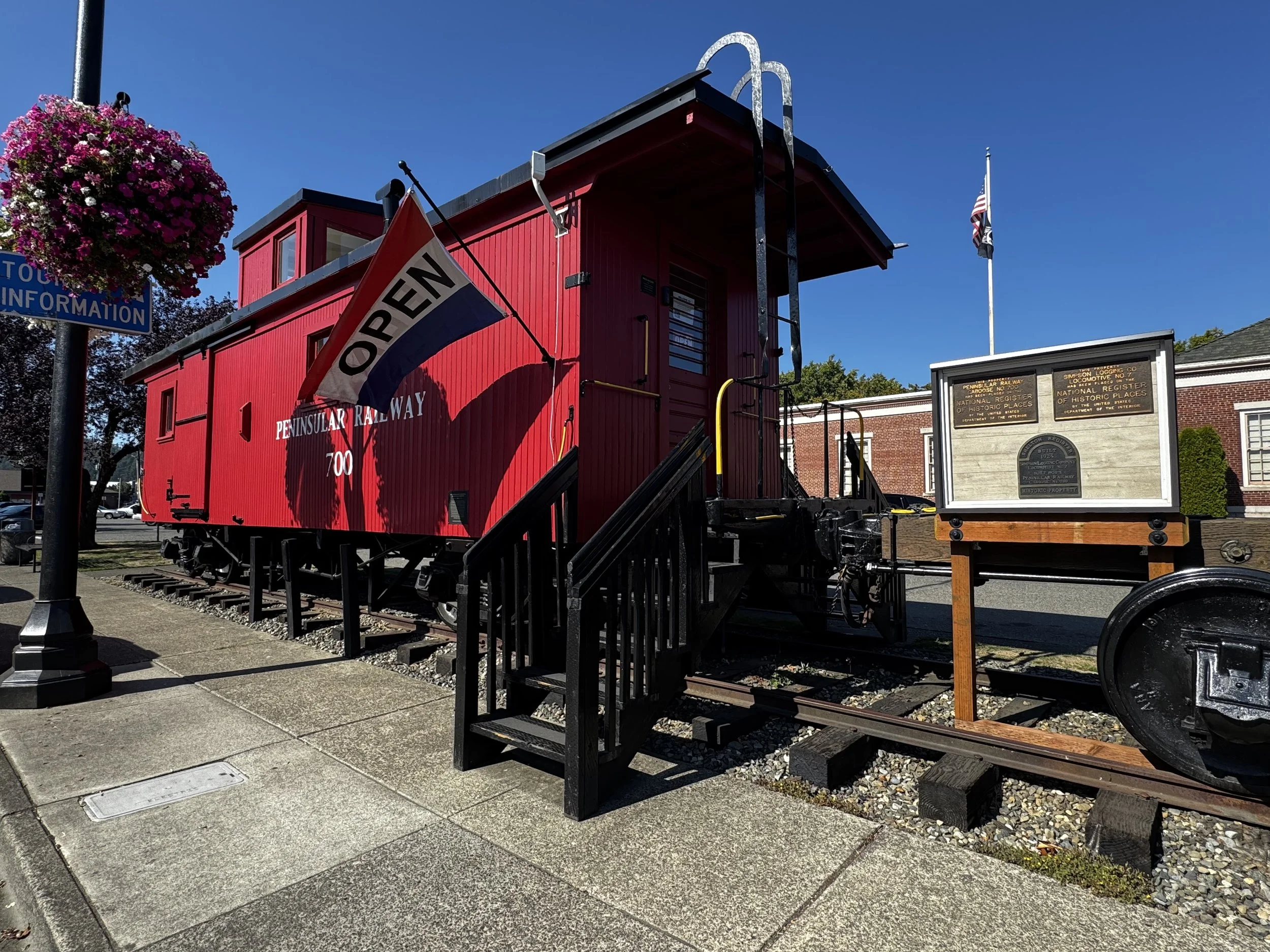
The Shelton Visitor Center is in at this historic timber train. It was recently restored by volunteers so stop by the unmanned Caboose for area maps and be sure to get your picture with Tollie the engine. A historic logging locomotive (1924) operated in Mason County for Simpson Logging. Designed by Ephraim Shay, the locomotive negotiated heavy grades and curves. Tollie is joined by Caboose No.700, a 1920s log car.
#46. What's 'Sup?
A great way to explore the canal.
#47. Experience the Fjord Spirit
Using water from the Olympics, The Hardware Distillery, Hoodsport, offers spirits in an ambient tasting room and if you want to swing by quick to pick up some great spirits — they will prepare your order in advance and meet you curbside.
#48. Watch for Whales
Each year Hood Canal and South Puget Sound enjoy visits from orcas and grays. Follow their arrivals on the orcanetwork online.
#49. Beach Walk
Gather up the family and the buckets and head to the low tide for a giant aquarium that beats any confined exhibit. You’ll et wet and muddy but will walk with memories to last a lifetime!
#50. JUST R-E-L-A-X!
We have some of the cleanest air and water in the country, friendly people and gorgeous scenery everywhere.


Head to the Shores
Prepare yourself with buckets, boots, license and check the tides & harvest map. Local State Parks support a healthy stock of clams and oysters for license holders – free for the taking!
Shellfish Gathering
With a salt water canal at its center and a myriad of lakes, waterfalls and streams surrounding the inner fingers of Puget Sound – this area is rich in aquaculture and water related opportunities. It’s time to start planning your outdoor adventures!

Click to download the Mason County Shellfish and Beach guide
If you harvest clams or oysters, make sure to keep them on ice or eat them soon after harvest. DOH advises that shellfish recreationally harvested from June through September, should be cooked thoroughly to avoid illness from Vibriosis. It is best practice to read posted warnings or call the Marine Toxins/PSP Hotline: 1-800-562-5632 for a recorded message that is updated regularly.
Visit the Shellfish Safety Map or the mobile friendly version of the map . Clam and oyster season are beach specific and may change annually. Always Check BEFORE you dig.
“Prepare yourself with buckets, boots, license and check the tides & harvest map. Local State Parks support a healthy stock of clams and oysters for license holders – free for the taking!”
Harvestable Beaches
Some of the following reflect adjustments from original 2020 seasons to make up for opportunity lost during the Stay Home, Stay Healthy-related closure:
South Puget Sound
Hope Island State Park – Boat access only.
Oysters are incidental at this site but clamming can be quite good. This beach is a very popular place to dig for geoducks. A tide lower than -2.0 feet is best for geoducks. Most of the oysters are on the west side of the island near the south end. The season is usually only open for the month of May but in 2020 owing too Covid -19, Hope Island State Park will be open for clams, mussels, and oysters Aug. 1 - 31.
North Bay – Abundant Manila clams and an enhanced oyster bed. The season here is short and locked into May and September under terms of a shoreline agreement.
Oakland Bay Tideland – Open year-round, good shore access with parking. Manila clams and oysters can be found here.
Hood Canal
Belfair State Park – Excellent beach for oysters and Manila clams can be found here. Clams, mussels, and oysters open two weeks early on July 15 and remain open through Dec. 31.
Potlatch State Park – Potlatch State Park and Potlatch DNR: clams, mussels, and oysters open June 8 and seasons are extended for two months to remain open through Sept. 30.
Lilliwaup State Park – Open year-round, excellent for oysters and native clams. Clamming is difficult due to the cobble substrate, but the beach is abundant with butter clams.
Rendsland Creek – Open year-round, excellent for oysters and a variety of clams can be found here although not in great densities.
Twanoh State Park – Open year-round for oysters and seasonally for clams, check season before harvesting. Good beach for Manila clams.
DNR 33, 47 & 48 – Boat access only beaches, open year-round for clams and oysters.
Eagle Creek – This is an excellent oyster beach. Opens June 8 for clam, mussel and oyster harvest. Clam and mussel seasons are extended by two weeks to close on Sept. 15. Oysters remain open through Dec. 31.
Triton Cove State Park – There is very little clam resource on this beach, but there are good numbers of year-round oysters. Opens June 8 for clam, mussel and oyster harvest. Clam and mussel seasons are extended by two weeks to close on Sept. 15. Oysters remain open through December 31.
Dosewallips State Park – This is an excellent beach for clams. The best areas are in the mid-upper tidal zone in mixed sand and gravel substrate. Opens June 8 for clam, mussel and oyster harvest. Clams and mussels close Sept. 30. Oysters remain open through December 31.
Productive digging is also found around and among the oysters, an area often overlooked by harvesters. Please take care not to cover oysters with sand and mud as this will potentially kill the oysters.

Celebrate Oysters on Hood Canal
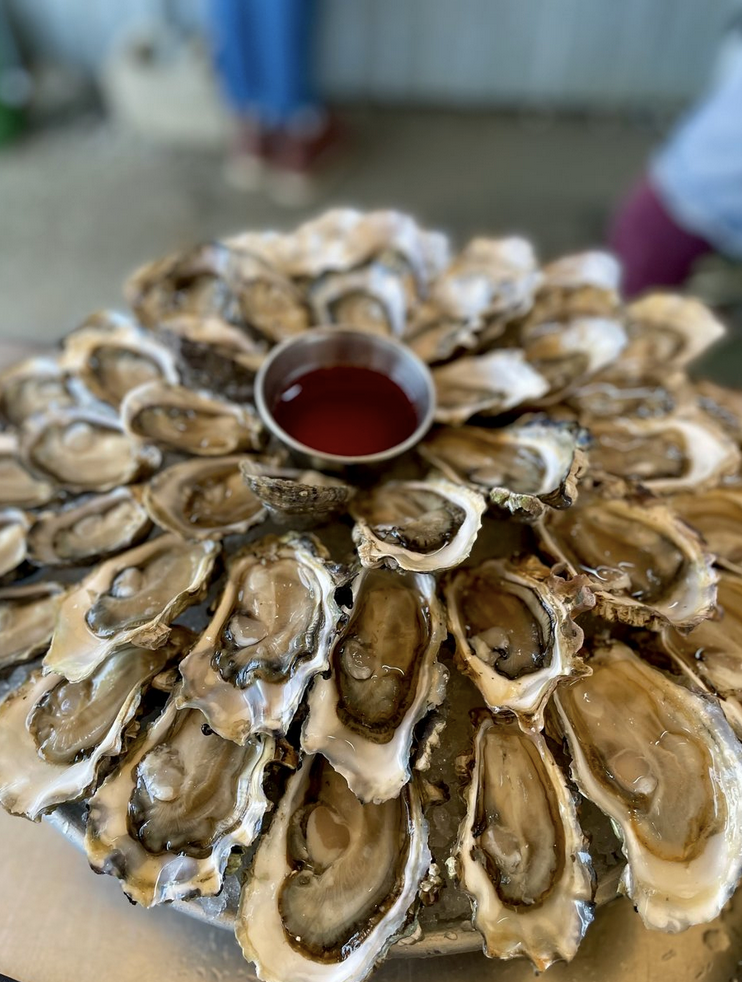
It's ok to be "shellfish" when your on Hood Canal. How about waking up to spectacular canal views for days filled with walks and beach treasure hunts? With spring weather on its way and the water warming up -t’s a great time to hit the Hood – and we’ve prepared a jam-packed customizable seafood itinerary for you.
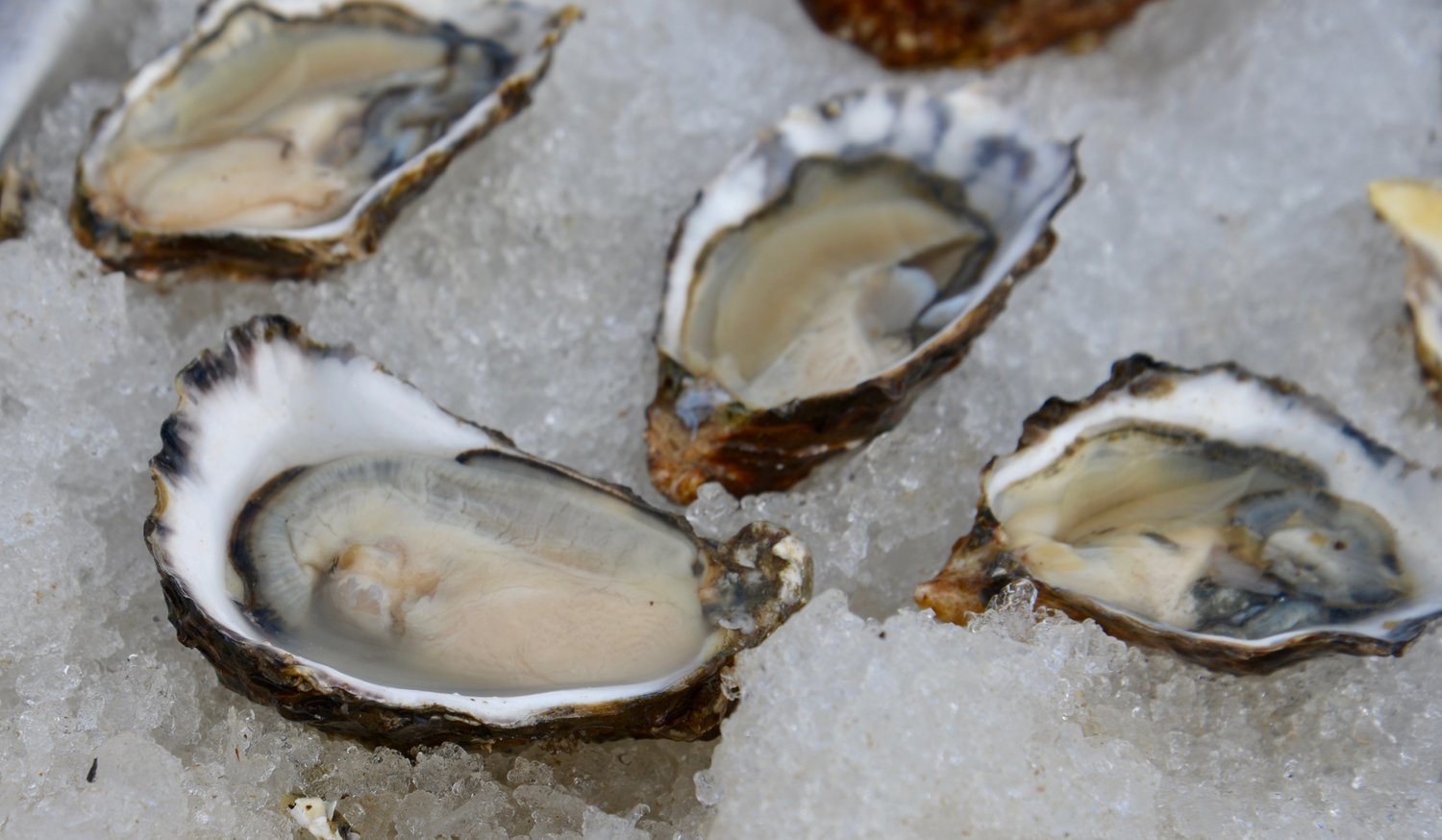
It’s a great time to head to Hood Canal and South Puget Sound and start enjoying fresh oysters on the beach.
We’ve got a few ideas to get you “shell-e-brating” as well as a recipe from Xinh Dwelley to make your mouth water for some oyster love!
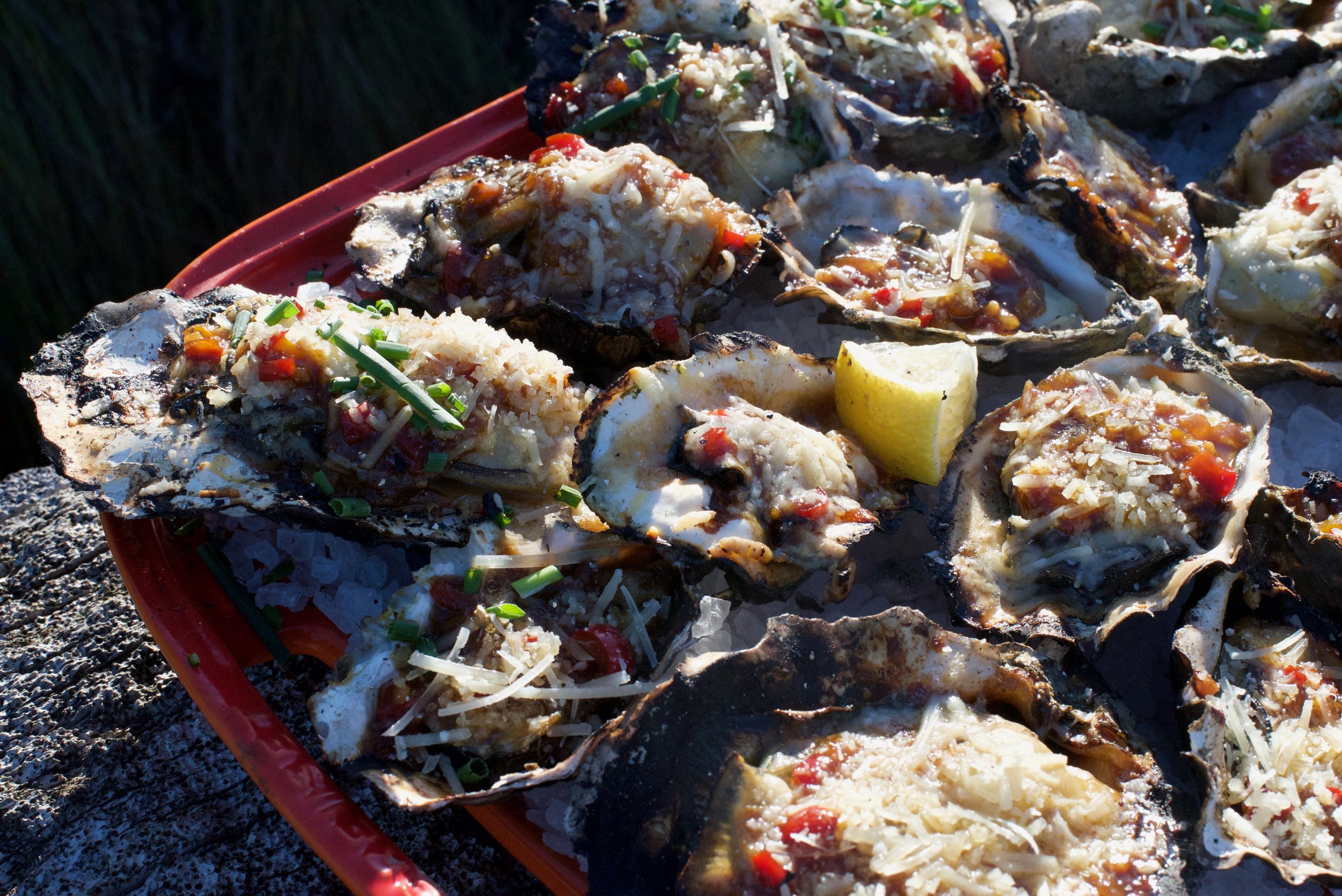
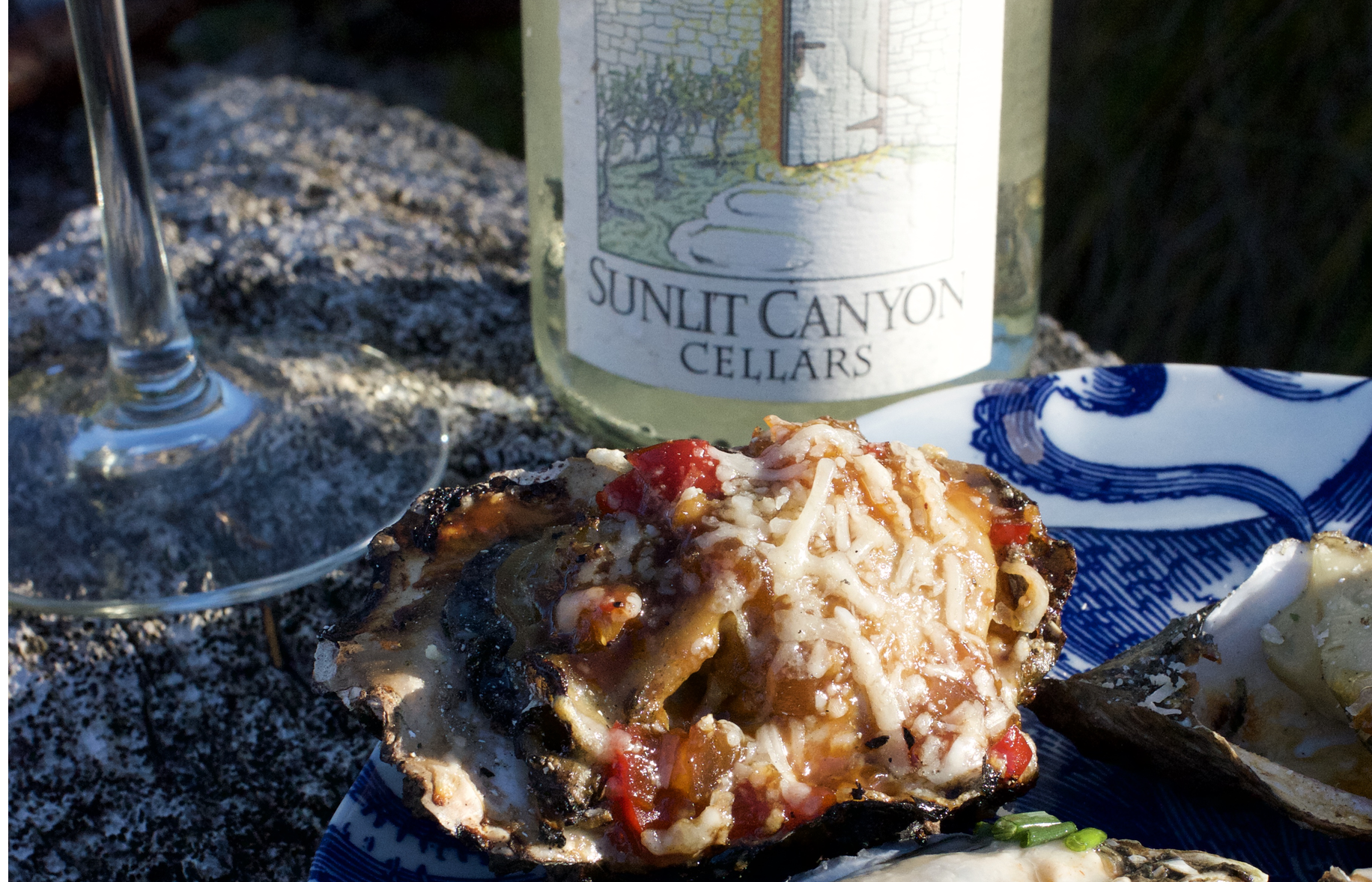
Xinh’s Grilled Oysters on the Half Shell
Recipe courtesy of Xinh Dwelley, celebrated seafood chef, Shelton, WA
(even the non-oyster eaters love these)
Prepare sauce in advance:
1/2 chopped red pepper, chopped
1/4 cup softened butter
1/2 cup chopped onion
Juice of 1 lemon
Salt and pepper to taste
2 tsp garlic, chopped
2 tsp soy sauce
1 tbsp hoisin sauce
1 tsp sugar
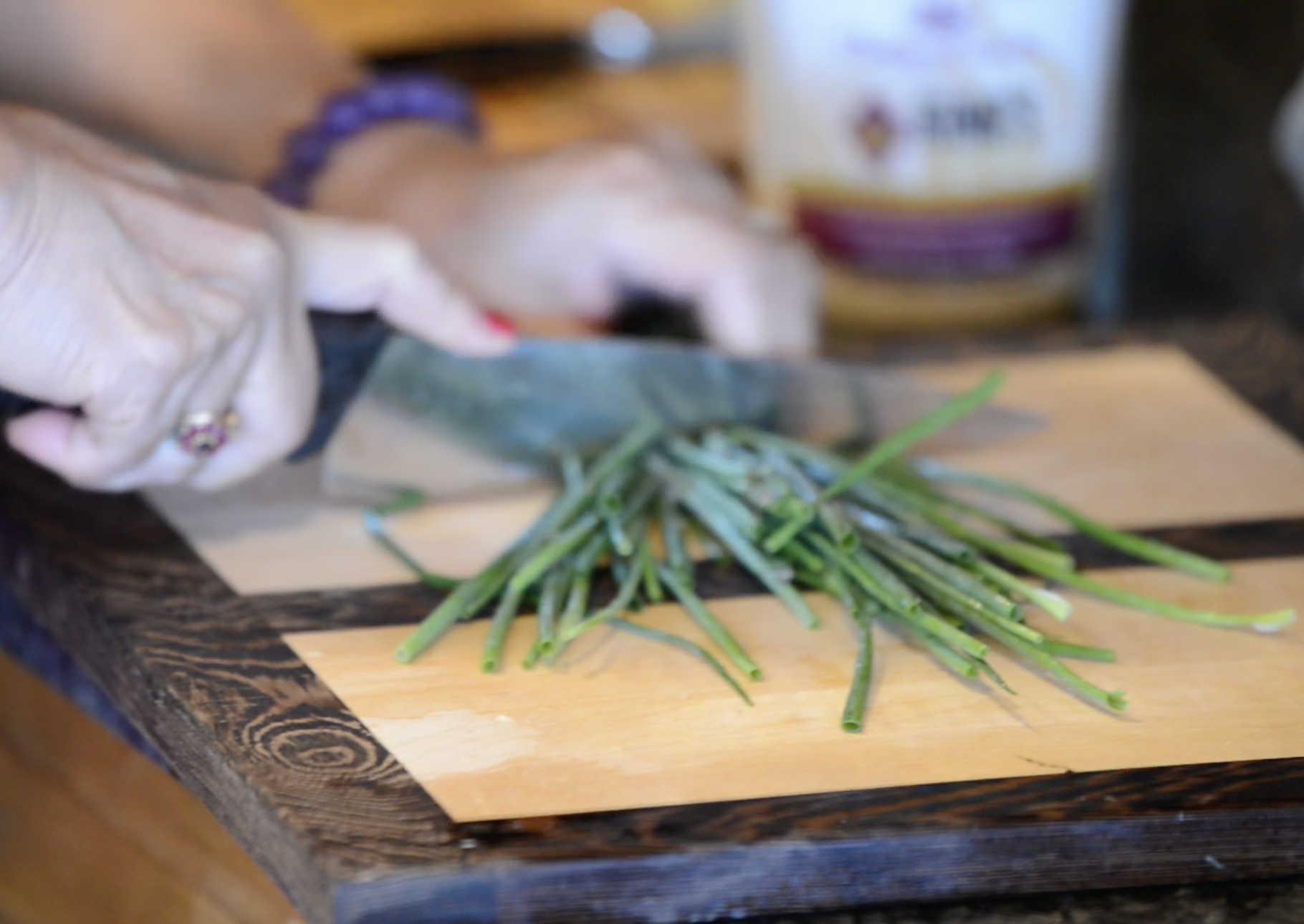
1/2 cup chopped chives
1/2 cup grated parmesan cheese
Combine ingredients in a blender and blend. Store in fridge until ready to prepare grilled oysters.
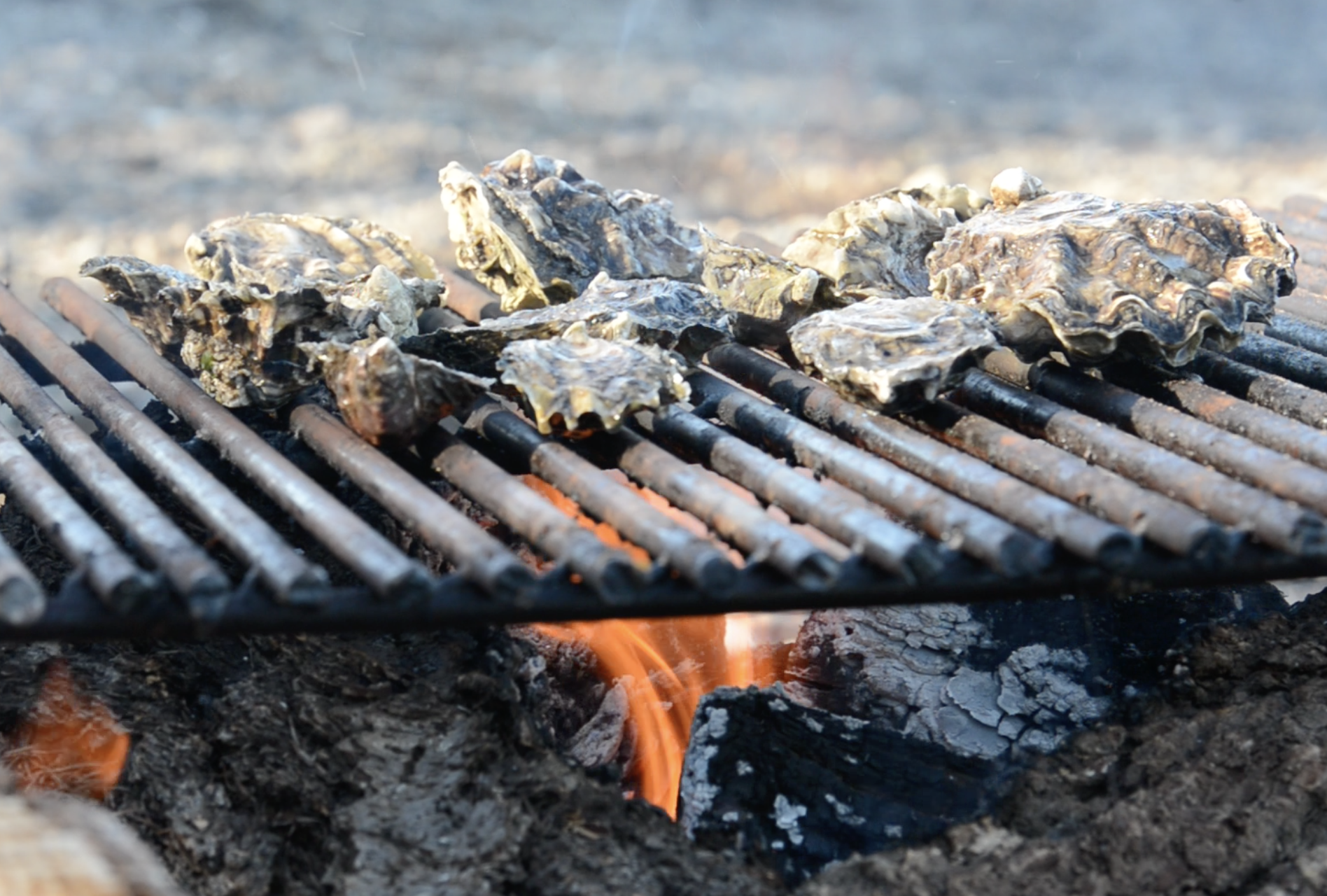
Place oysters on hot grill( 24-36 in shell). When shells begin to “pop” remove top with a heat-safe glove and top each with one teaspoon of mixture. Garnish with sprinkling of grated parmesan cheese ( about ½ cup total). Cook oysters are light brown and cheese has melted, 5-10 minutes. Serve hot.
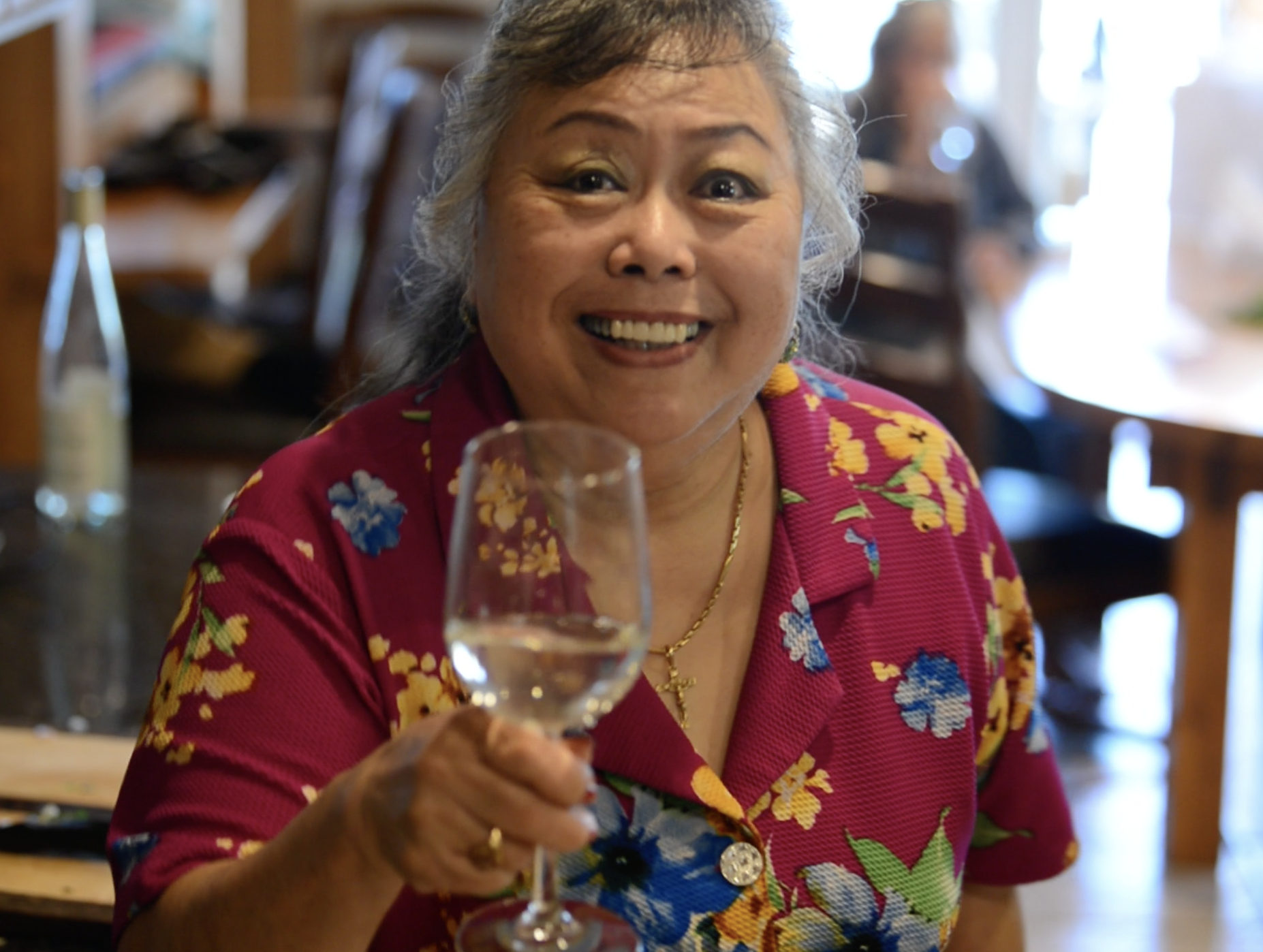
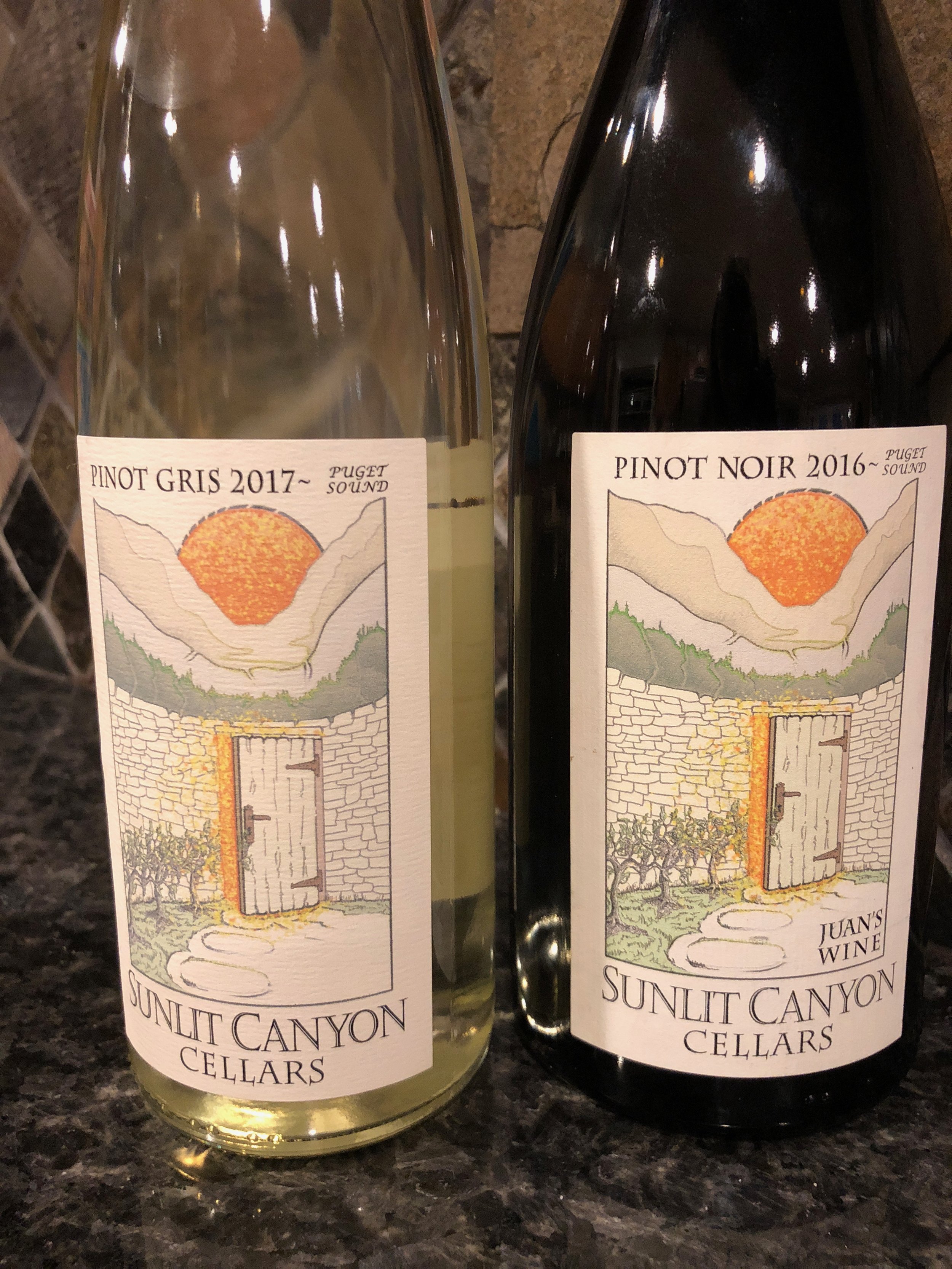
Oyster Pairing: Serve with Sunlit Canyon Cellars’s Pinot Gris ($22) available at Cameo Boutique in Union. Sunlit Canyon small batch wines are grown and bottled in Belfair WA overlooking Hood Canal.
Save some Clams & Visit Mid-week
Perhaps a few oysters will suffer, but who doesn't like to save a little money?
For great deals on lodging, not to mention more selection, consider heading to the Canal mid-week to enjoy activities you will not find anywhere else. Pack up boots, buckets and license and head to parks and DNR beaches that are regularly stocked with shellfish for the taking. Yes, taking! Check the tides before you head out. Another advantage to mid-week shellfish-gathering is you'll have the beach to yourself! Visit the DFO Shellfish Safety Map as seasons are beach specific. Always Check BEFORE you dig. We've prepared a handy list of area harvesting beaches here.
Alderbrook Resort & Spa is a great place to start a Oyster tradition - especially since April is their official Oyster Month! Not only can they harvest oysters right on their beach, serve some great Hood Canal oyster dishes on their daily menu in the restaurant.

Alderbrook Resort, view from the dock (left); view from 2 Margaritas' patio seating (top middle); Robin Hood Village Resort onsite restaurant (top right); Cedar Hill Cottage, Union (bottom middle); Hood Canal Marina & location of the Canal Cookout in Union (bottom right)
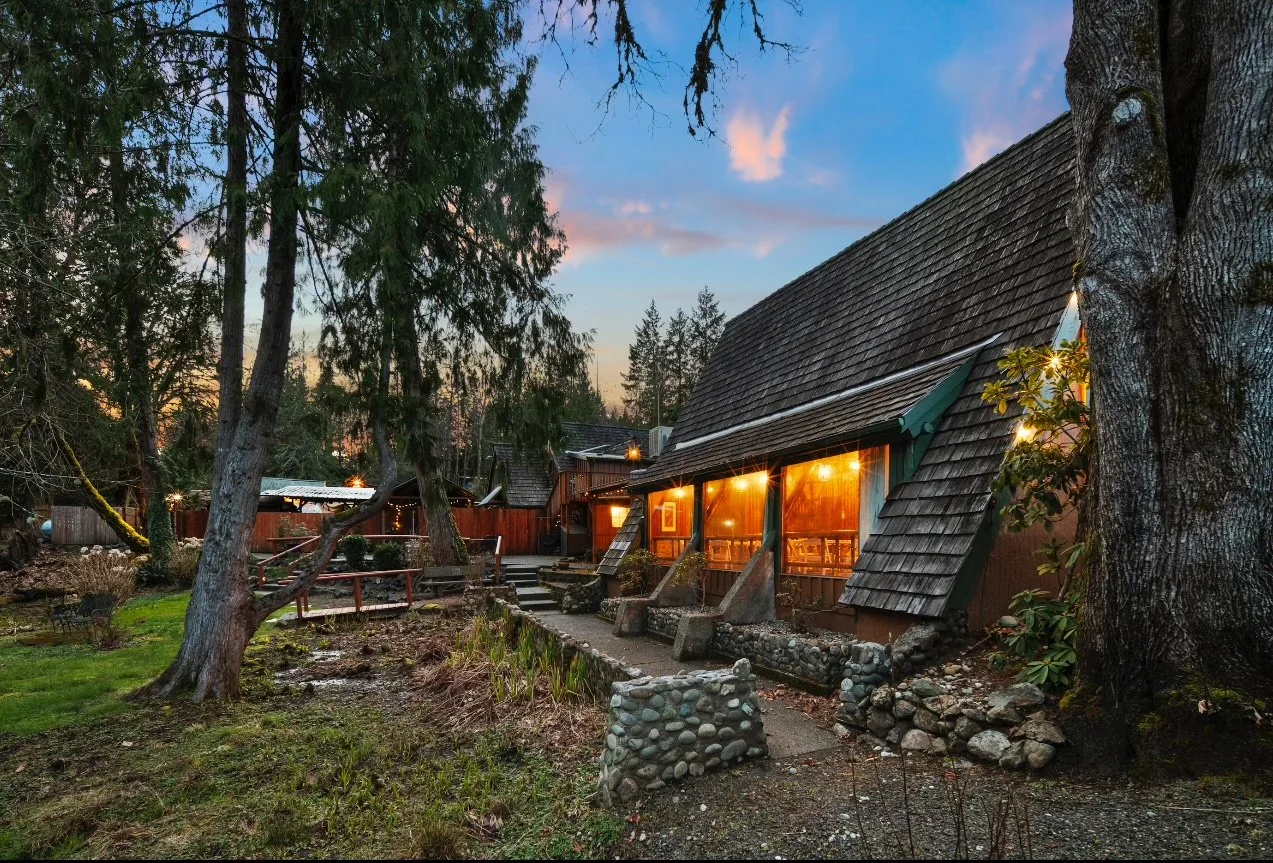
Want the house all to yourself? Consider snagging one of the great rentals that pepper coastal communities and woodland oases in the area. One of our favorites is the Cedar Hill Cottage in Union. This spacious shake home (two bedrooms) is perched on the hill above Union, and although it is technically not waterfront and nestled in the woods, there are glimpses of the Canal and the snow laden Olympics. Location is everything here. A short drive to Alderbrook Resort and just a quick walk to the heart of Union with coffee and bakery items at the Union Country Store, boutique shops, and waterfront dining at 2 Margaritas.
Farm visits
Heading into Shelton, stop in off Hwy 101 past Little Creek Casino & Resort at Taylor Shellfish's Retail Facility to take a look at their headquarter facility and visit their retail store. Taylor Shellfish is a huge supporter of the annual West Coast Oyster Shucking Championship (OysterFest) by supplying over 1200 oysters to the competition!
Hama Hama Oyster Company in Lilliwaup serves farm fresh oysters and clams in their streetside Saloon off Hwy 101. Check out the Oyster Saloon, an outdoor farm dining experience, Thursday through Sunday. The retail store is open daily.
One of the area’s most popular oyster growers is located just 30 minutes away in Lilliwaup, WA. Hama Hama Oyster Company's Store and Oyster Saloon (an outdoor restaurant) are located a shell’s-throw from the tideflats. Visit during the week to see the shucking crew in action, and ask for one of their self-guided tour maps to better explore the farm. Stop by the Saloon (Thursday though Sunday) for some great shellfish but don't miss the divine hand-packed Dungeness crab cakes. And we mean PACKED with crab! The crab cakes are also available the farm store where you can buy them to cook at home.
How ever you choose to Shell-e-brate oysters we know that you will have a blast exploring Hood Canal. Be sure to share your adventures with the bivalves with us at #wildsidewa!
See you on the beach!

Dog Friendly Fjord
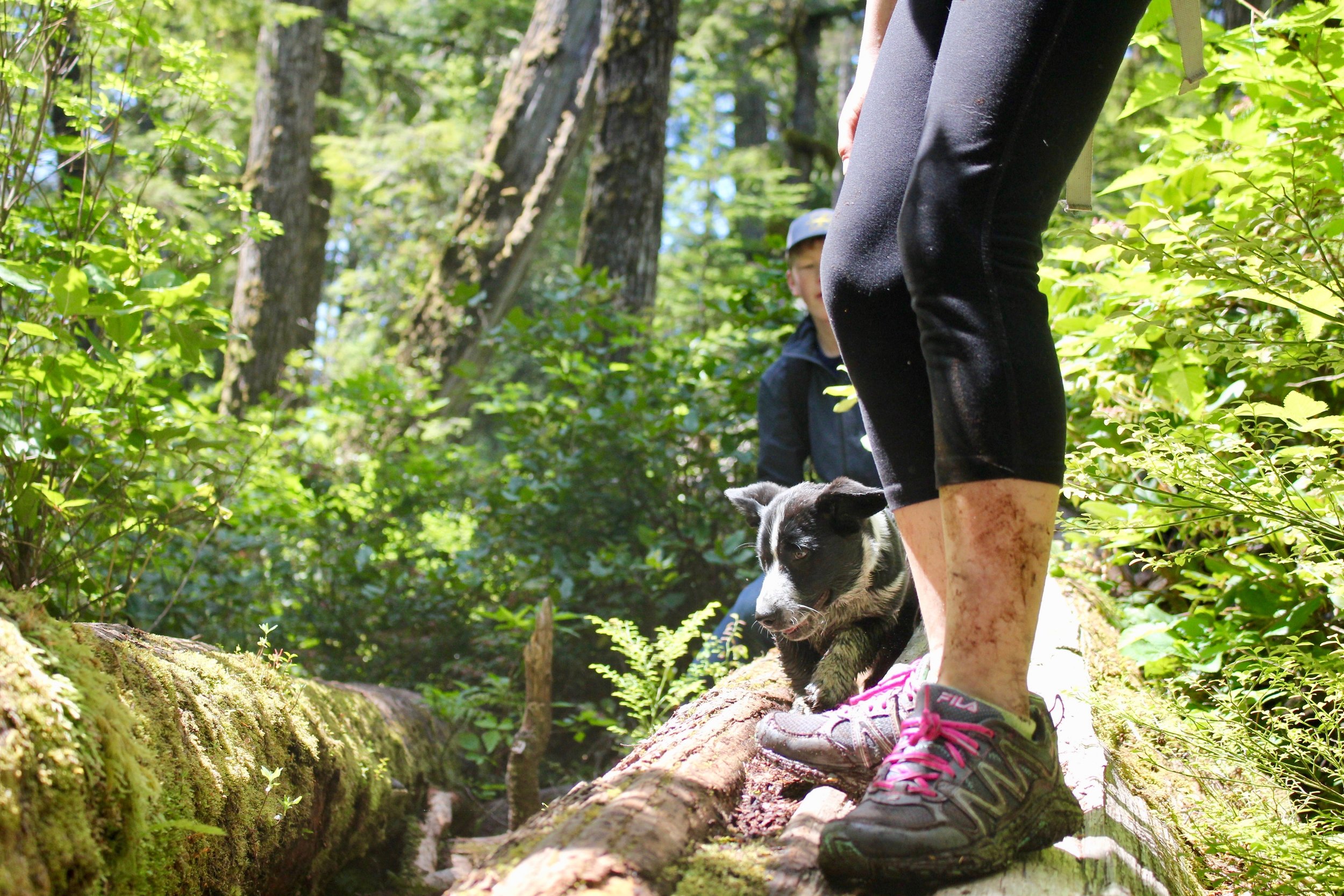
The dog days of summer are here, and our four legged friends around the region can’t help but wag their tails enthusiastically. After months of rain, wind, and snow, we need little excuse to take our dogs out into the wilds of the Hood Canal.
By Douglas Scott, The Outdoor Society
The dog days of summer are nearly here, and our four legged friends around the region can’t help but wag their tails enthusiastically. After months of rain, wind, and snow, we need little excuse to take our dogs out into the wilds of the Hood Canal.
While we are just as excited as our pets to hit the trails, sometimes it can be difficult to locate a dog-friendly destination. Luckily, the Hood Canal is full of incredible locations for us and our dogs– from an easy day out to a tongue hanging trek!
Location is the easiest way to know if a trail is dog-friendly or not. In Olympic National Park, dogs are not allowed on trails. If the trail is located in Olympic National Forest, DNR Land, or at a State Park, the majority of trails will be dog friendly. Remember that even if a trail is dog friendly, you are still responsible for keeping them on a leash and picking up after them. Not everyone on a trail is used to dogs, so please be conscientious of others. Also, never leave a bag of waste on the side of the trail, carry it with you, even if you are hiking back past it later. Finally, always remember to bring extra water for you and your dog, as water sources are not always readily available.
Easy Access Spots
Dosewallips State Park
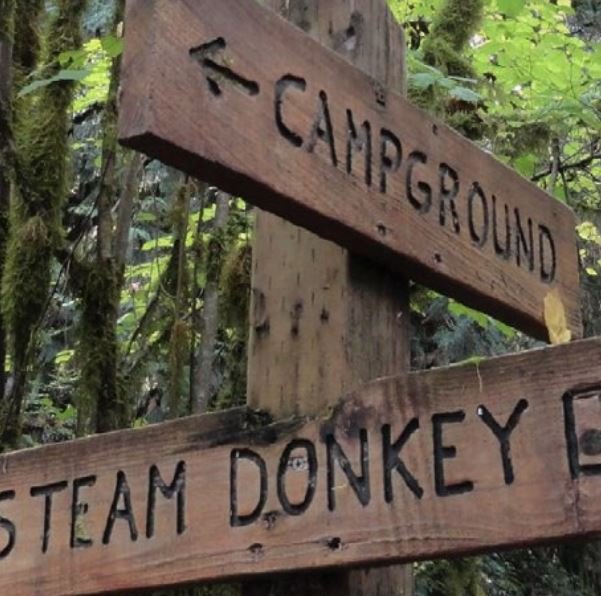
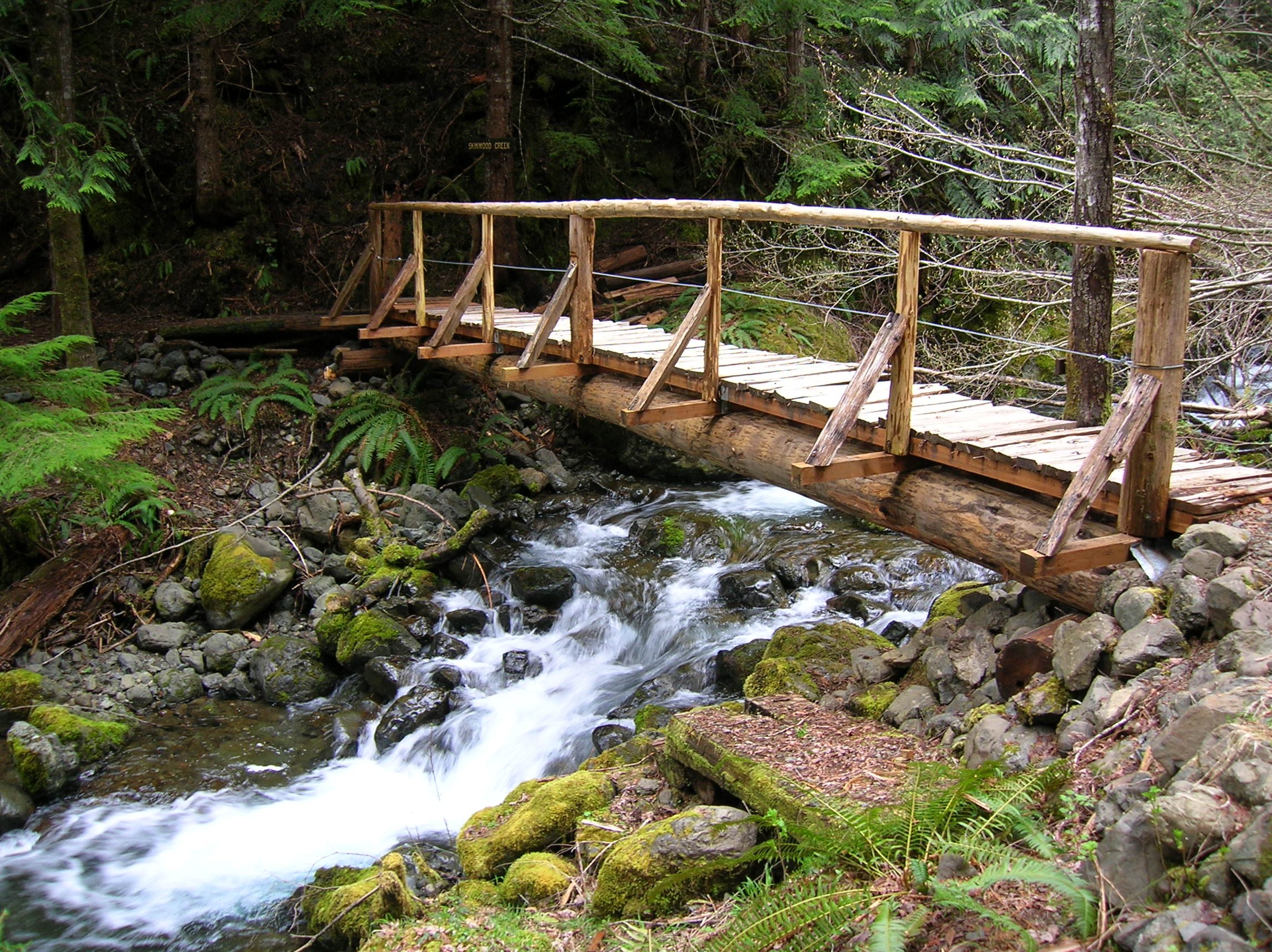
Found right off of Highway 101 and along Hood Canal, Dosewallips has a few hiking options, with a favorite being the fantastic Steam Donkey Trail. At just 3.5 miles in length and an elevation gain of 400 ', this trail reveals water cascades, bridge crossings, ferns and river views.Your dog will love visiting with other dogs and the endless sticks to pick up. Yes, this gentle dog-friendly hike will have the whole pack begging for more adventures.

Twanoh State Park and Trail
On the eastern side of Hood Canal, Twanoh State Park is yet another incredible dog-friendly destination. Situated right along the water, between Union and Belfair, Twanoh has a few miles of trails in the woods and along the shore, helping to making this one of the most dog-friendly locations on this stretch of Hood Canal. Your dog will love this for the beach and the water.
Ranger Hole
Twenty-two miles north of Hoodsport, the Duckabush River makes for a fun stop for you and your dog. The Ranger Hole Trail is just two miles in length but feels very remote. Passing through second growth timber, the trail leads to the Duckabush River, where you can watch the raging waters churn in white rapids. Dogs, kids, and families will love this short day hike. Your dog will love this trail for the walk, the trees and the many smells from the local wildlife.
Next Level Destinations
Upper South Fork Skokomish
Here, you and your dog can wander in pristine old-growth forests and enjoy this corner of Olympic National Forest. The trail crosses over bridges and through towering trees for nearly four miles before reaching the Olympic National Park boundary. The road here is closed to motor vehicles between the months of October and April, making it an ideal summer destination. Your dog will love this for the remoteness and the many chances to dip in the water.
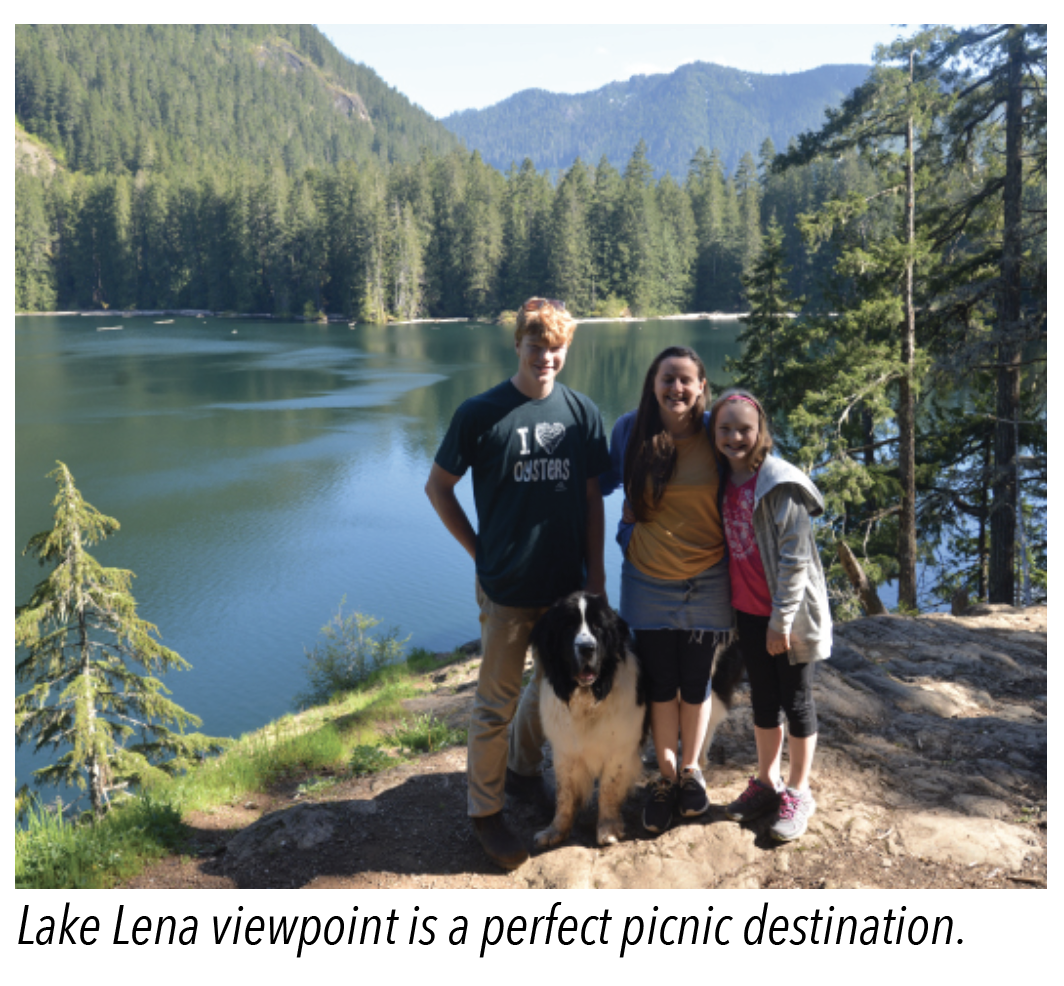
Lena Lake
Found along the Hamma Hamma River in the Olympic National Forest, this trail is for hikers and dogs hoping for a long day of hiking and exploring. At around seven miles round trip and gaining 1,300 ft in elevation, this hike can be hard for many people and pooches. Bring water and treats for all. Take your time while hiking through a mossy forest, over cool bridges and enjoy the stunning lake.
Memorable Canine Adventures
The Valley of Silent Men
Past Lena Lake, those hoping for an even more amazing adventure should hike into the Valley of the Silent Men. You’ll be hiking for 10 miles or so round trip, but this valley is a wonderland. Full of old growth, moss-covered boulders, and cascading creeks, you and your dog will be intoxicated with the beauty of this overlooked section of Olympic National Forest. Your dog will love this for the remoteness and the creeks to wade in.
Marmot Pass
Marmot Pass is a classic hike, and doing it with your dog makes it even better. At 11 miles round trip and gaining 3,500 feet in elevation, this is a trail for dogs and humans able to hike steep trails for miles on end. Starting in a forest, you’ll eventually climb to majestic views of the Olympic interior and even Hood Canal and Puget Sound. Your dog will love this for the varying terrain and seeing you happy!
Olympic Peninsula’s Dog Friendly Map

Check out this fantastic pet friendly map provided by our partners at Olympicpeninsula.org!
Download and pack a copy along with your leash and collapsible water dish!
6 Tips for Hike Savvy Canines
Like house-bound humans, dogs need a little prep time to get ready for the trail. Here are six tips to help you and Fido have a safe and fun adventure.
#1 Take it Easy : Start with easy trails and slowly build up stamina & strength.
#2 Care for Tender Paws: Make sure your dog's pads are toughened or purchase hiking booties and let him get used to them before heading into the wild.
#3 Yield to oncoming traffic: No matter how sweet Fido appears, its good practice to verbalize how friendly he is. Step off the trail when hikers pass and heel your dog.
#4 Leash Control: If the trail requires leashes or if if your dog might run into other hikers, keep him on a short leash (-6') since a long leash is more likely to get tangled on brush. Your dog should not be allowed to roam freely.
#5 Leave no trace: Bring bags to collect and carry out your dog’s poop. If you’ll be backpacking overnight, bury it at least 6” deep and at least 200 ' from walkways, camps, and water sources.
#6 Command Ready: Hazards in the woods differ than the cul de sac. Don’t let your dog stray. Some plants are poisonous, and some creatures bite and may host diseases. Irressistable smells will lure pooch away in a flash. Make sure your obedience training is on track.
Visit backpacker.com for more ideas on a safe and rewarding journey!
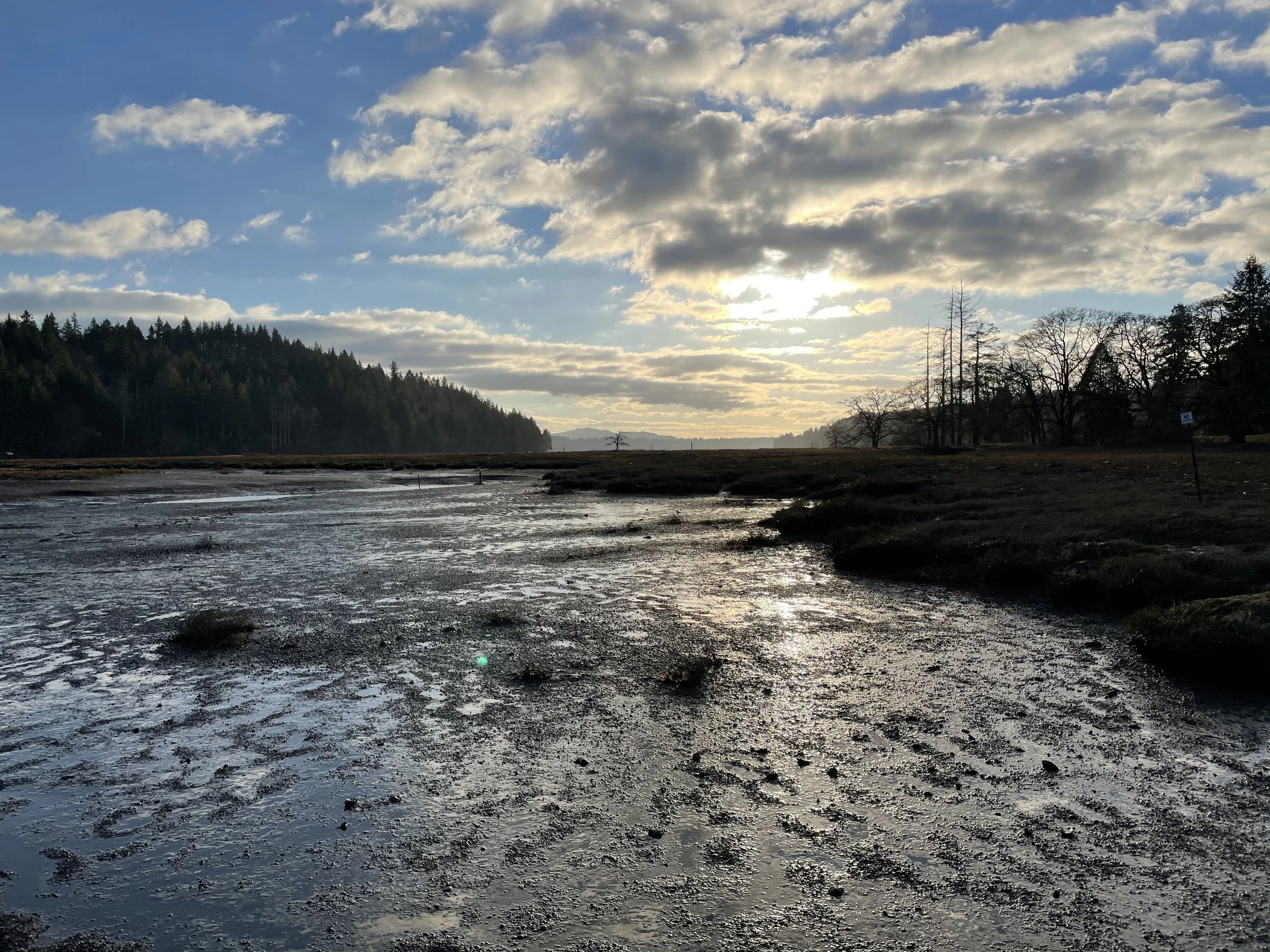
Exploring Bayshore Preserve Near Shelton
Occupying a peninsula on Oakland Bay at the mouth of Johns Creek, Bayshore Preserve provides exceptional wildlife habitat and several short delightful hiking trails. Once a golf course, this 74-acre parcel has been restored to a natural state on par with the state’s finest natural shoreline preserves.
Craig Romano
Occupying a peninsula on Oakland Bay at the mouth of Johns Creek, Bayshore Preserve provides exceptional wildlife habitat and several short delightful hiking trails. Once a golf course that heavily drew water from the salmon-spawning Johns and leached pesticides and fertilizers into the important shellfish rearing bay; now thanks to the Capitol Land Trust, Squaxin Island Tribe and a handful of other partners, this 74-acre parcel has been restored to a natural state on par with the state’s finest natural shoreline preserves.

Hit the Trail
From the trailhead immediately come to a kiosk with a map displaying the preserve’s interconnected short trails. There are about 1.5 miles of marked well developed paths traversing the property and they can easily be covered shortly in a brisk walk. However, Bayshore, with its salmon-spawning creek, salt marshes and mud flats, bird-flourishing prairie, and more than 4,000 feet of shoreline, calls out to be sauntered.
A quick inspection of the landscape before you reveals a land in flux. One that not too long ago sported well-manicured greenways fed by an irrigation system, a clubhouse and other structures, and a series of service roads. Those roads have since been converted into trails. The buildings have been removed, but a few vestiges of the irrigation system that is slowly being dismantled remain. And the greenways have been restored to native prairie grasses that wave golden in late summer.
Now sans golf clubs, putt along Bayshore’s trails watching for birds instead of scoring birdies. The Bayshore Peninsula located along the narrowest stretch of the slender and shallow Oakland Bay is far more important as wildlife habitat than as an altered manicured landscape for golfing.

The peninsula too is a special place to the Squaxin Island Tribe. It once housed one of their villages and according to several elders and historians, one of the largest longhouses on Puget Sound.
In 2014 the Capitol Land Trust purchased the Bayshore Golf Course and commenced with the Squaxin Island Tribe and other partners to restore this property to a natural state.

Restoring the peninsula was another albeit very important stage in the greater effort currently being employed to protect Oakland Bay—one of the least developed inlets and most important shellfisheries on Puget Sound. Oakland Bay’s preservation is not only important for wildlife, but also for sustaining the area’s fisheries and shellfish beds.
The Main Loop Trail travels triangularly through the property for 0.8 mile. It utilizes some of the old golf course’s service roads. Walk the path through native grasses and along colonnades of gigantic old Douglas firs and Garry (Oregon White) Oaks. The latter, the only native oak to Washington State once flourished in the area’s prairies. Washington’s First Peoples regularly set those prairies on fire to stimulate camas growth and favor other plants like oaks that thrive in savannas and other grassy environments. But as those prairies no longer saw regular burns, were overtaken by developments and invasive and hardier plants, the state’s Garry Oaks have become increasingly rare. These elegant hardwoods provide forage for a myriad of species. Bayshore contains some exceptionally large ones.

As you walk the loop be sure to deviate from it onto numerous spur trails. The 0.2 mile Lookout Trail crosses Johns Creek on a sturdy bridge and proceeds through a nice forest grove before skirting a prairie and ending along the creek bank. It’s an excellent trail to check out in November for its chum run.
The Johns Creek Trail is another fine choice for salmon watching. This path meanders along the edge of a riparian forest for .25 mile to link back up with the main loop.
The Johns Creek Estuary Trail leads a short distance to extensive tidal flats at a small estuary where Johns Creek flows into Oakland Bay. The trail leads to a fishing point on public tidelands.
Bayshore Preserve

Features: exceptional wildlife habitat on Oakland Bay, restored prairie, tall old Garry oaks and Douglas firs,
tidal mud flats, salmon-spawning creek and estuary.
Distance: 1.5 miles of trails
Elevation Gain: minimal; High Point: 40 feet
Difficulty: easy Snow free: year round
Trailhead Pass Needed: None
Notes: Dogs permitted on leash. Please stay on trails and respect all closed areas. Open from dawn to dusk. No removal of plants or fungi from the preserve.
GPS waypoints: Trailhead: N47 14.939 W123 02.655
Fishing Point: N47 14.707 W123 02.513
Contact: Capitol Land Trust, (360) 943-3012
Trail Map and Interpretive Guide available online

Trailhead: From Shelton, travel east on SR 3 for 3.8 miles to trailhead located on your right (directly across road from Bayshore General Store). Parking limited. More parking in adjacent WA Department of Fish and Wildlife’s Oakland Bay Recreational Area (Discover Pass required).
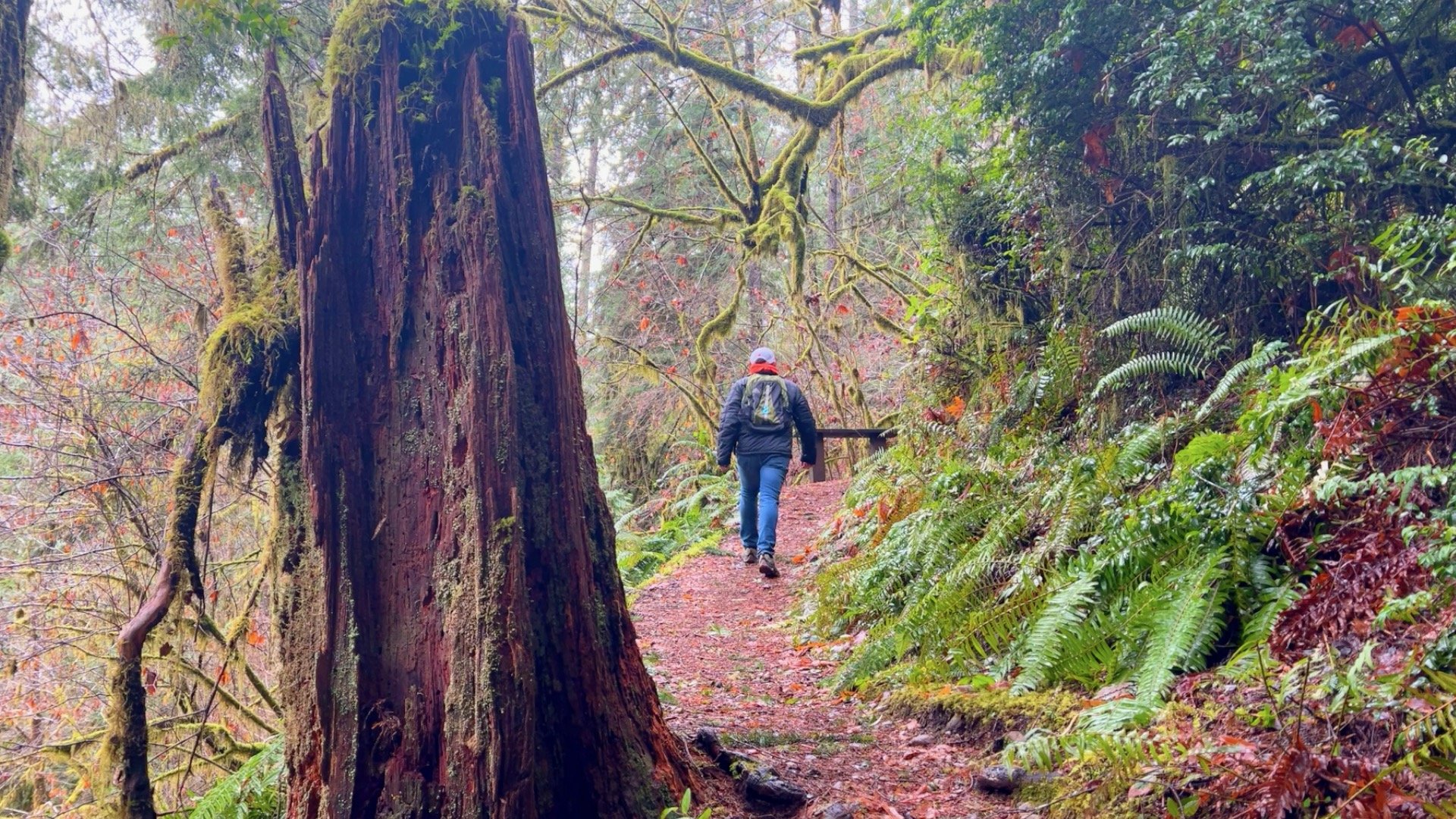
Twanoh State Park Trails -- Day hiking around Alderbrook Resort & Union
Number #2 on our best hikes around Hood Canal according to Craig Romano is Twanoh State Park’s hiking trails. Famous for its large beach on Hood Canal with some of the warmest salt water in the state, many who flock to this park, go straight to the beach or the campground, leaving the 182-acre park’s hiking trails pretty quiet.

Craig Romano
Famous for its large beach on Hood Canal with some of the warmest salt water in the state, many who flock to this park, go straight to the beach or the campground, leaving the 182-acre park’s hiking trails pretty quiet.
Locate the trailhead and start hiking on a wide trail through a cluster of rhododendrons. The way parallels gurgling Twanoh Creek which forms a small delta on the park’s beach. The trail soon comes to a junction.
Here a side trail crosses the creek on an attractive bridge and reaches the campground—an alternative start if you’re camping in the park.
The main trail continues straight through a tunnel of rhododendrons and a grove of big cedars. It then begins working its way up a small ravine cradling the small creek. While this ravine was logged in the past, the second growth forest here is now quite mature.
At .3 mile come to a junction for the loop.
While you can go either way, head left for a clockwise loop and a gradual ascent and transition out of the ravine. As you ascend out of the tight draw, the salal and evergreen huckleberries thin out.
It’s much drier on the ridge above the ravine. After two switchbacks, the trail reaches the head of the ravine. Now head right following an old woods road.
The walking is easy going. Slowly descending come to a group campsite. Then come to another junction. The old road continues straight leading back to the Day Use Parking Area and can be used as an alternative return.
The loop continues right on a switchback descent back into the ravine. Take it passing by a few big old Douglas firs and clusters of leathery-leaved rhododendrons. Reach the loop junction and head left back to the trailhead—and perhaps a trip to the beach.


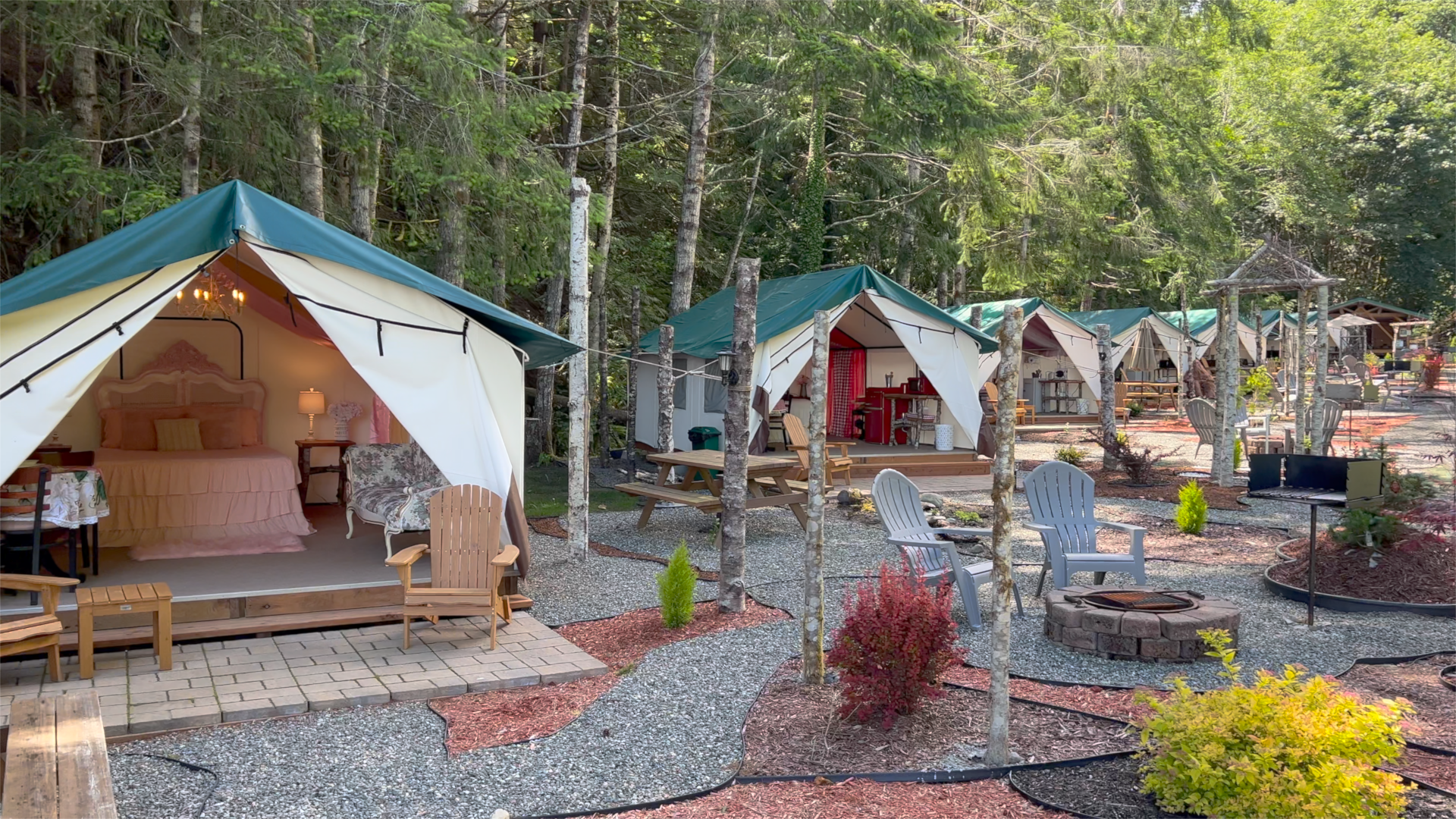
Two ways to "glamp" hood canal
The scenic stretch of Hood Canal between Hoodsport and Brinnon has recently seen the additions of some unique accommodations – glamping platform tents. Sund Rock’s platform tent at Sund Rock diving preserve is simpler than the newly opened Iliana’s Glamping village — but both elevate the camp experience and have spectacular scenery.
The scenic stretch of Hood Canal between Hoodsport and Brinnon has recently seen the additions of some unique accommodations – glamping platform tents. Near Hoodsport, the Sund family hosts couples at their private glamp tent at the Sund Rock Marine Preserve and this summer Mike’s Beach Resort in Lilliwaup converted their traditional campground into Iliana’s Glamping Village.

Sund Rock glamping tent open from May through September is perfect for couples looking for a unique Northwest experience.
What is glamping?
To many of us glamping sounds a little over the top. Even the word root – glamor – is decadent. Especially when combined with the most basic of accommodations – camping. But these places are anything but “basic.”
There are plenty of definitions of glamping. Some feel that cooking on anything beyond an open campfire is glamping. Or sleeping in a bed off the ground, or in a basic cabin or RV. Whatever your definition, glamping it is bringing a whole new level of interest to the camping scene. And with the pandemic, the idea of sleeping in a "tent" over a hotel has brought a certain attraction.
""During Covid some guests expressed hesitancy with coming even to a cabin even though we're not a traditional hotel with a lobby or elevator. Our tents are a great option for those who are interested in getting back out into the world but maybe not wanting to be in a building like a hotel. Everybody is able to get to their own private facility and there's plenty of moving air."

Iliana’s Glamping Village
Sara and her family recently opened the tent glamping village at their resort on Hood Canal. The traditional Mike's Beach Resort included guest rooms and cabins but this network of ten glamping tents and all their amenities tucked into the woods below shadow of the Olympics creates a whole new vibe.
Mike’s Beach Resort converted their 70+ year old campground area to accommodate the ten platform tents complete with fire-pits, showers and flushing toilets, and affectionately coined it Iliana's Glamping Village.

The private recreation at Sund Rock
Further down the Canal the Sund family has found a way to share the experience of their property to more people. Most of the year The Sund Rock Marine Preserve is clamoring with scuba divers hoping to catch an encounter with Giant Pacific Octopus or wolf eels. As the water warms, July through September, plankton and algae blooms make the visibility nil for divers. This is a perfect time to open the area up to visitors to the glamping tent. A little simpler than Iliana's Glamping Village (no chandeliers hanging from the ridge pole and you need to bring your own linens) at Sund Rock you’ll find a queen-sized bed, heat, power, and the views from this private beach getaway are unparalleled.
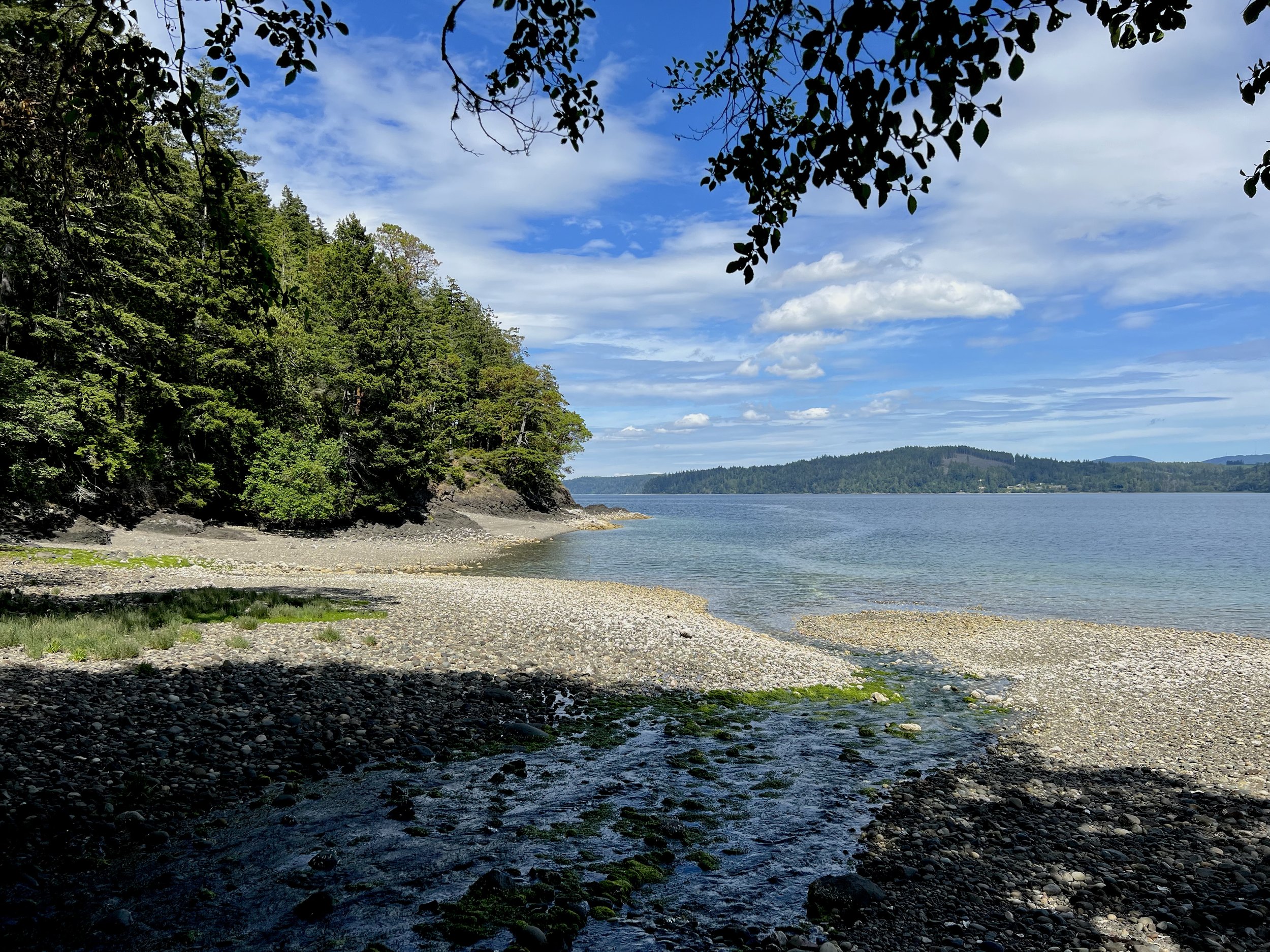
The view from Mike’s Beach Resort overlooking the Canal and oyster beaches
Lodging Profile #1:
Iliana’s Glamping Village
Lilliwaup, WA
For nearly seven decades, the Shultz family has owned and operated their waterfront rustic and welcoming Canal getaway, Mike’s Beach Resort. Mike and Iliana have recently passed on some duties to daughter, Sara, and her husband, Matt, who also raise oysters on the Resort’s tidelands. We recently caught up with Sara to learn a little about the history of Mike’s and their expansion into the glamor-camping market.
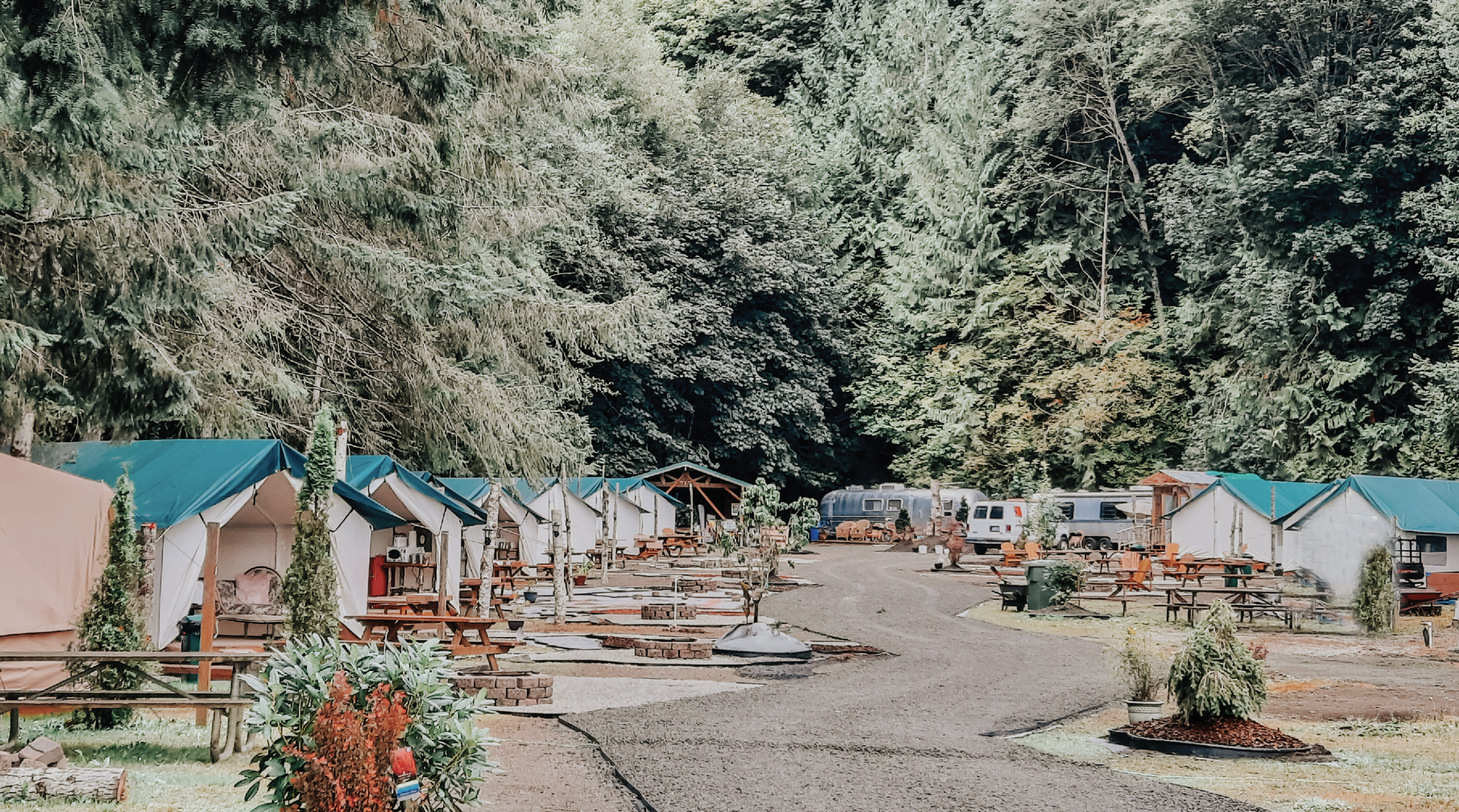
“Mike's Beach Resort was built by my grandparents in 1951,” recounts Sara in the tour of the facility, “they named it after my father, Mike. They started off with a few cabins on the Hood Canal and kept building more every few years.” Along with the recent addition of the glamping village the resort features fully equipped cabins and even a 1969 Airstream trailer with outdoor hot tub. Many of the units are pet-friendly and, along with the beach providing hours of distraction, there are walking trails and a playground. The resort also hosts a launch, dock, moorage, kayaks and paddle boards for rent, and air for scuba visitors. Mike’s is very popular with dive groups with numerous famous cold water dive sites in the area. Many guests return annually to enjoy the shrimp, crab, and salmon seasons on the Canal.
Following the curve of the valley and arranged to provide privacy and views of the Canal below the road, the cluster of platform tents at Iliana’s Glamping Village offer a unique experience that rivals the amenities of a luxury hotel. Each tent is elevated and lined to protect guests from the elements and include electricity, comfortable queen- and king-sized beds, dining areas, coffee makers, toasters, outdoor BBQs, lawn chairs, fire pits as well as access to warm showers and flushable toilets.
Many of the units include fold out futons for additional guests and all the units are custom furnished with a theme. And yes, there are even chandeliers and fans!

Each cabin at the glamping village is custom themed
"As a bonus-bonus," Sara states proudly as she gestures to the bay below, "we have an oyster farm right in front." Their oyster farm is open during low tide for harvest and guests can grill fresh from the beach at their private tent.
During the summer Mike's Beach Resort plans to feature live music and outdoor grill with oysters and burgers on Saturday nights – but any night will be an experience!
Visit mikesbeachresort.com for details and reservations.
Lodging Profile #2:
Sund Rock gets you close to nature
Sund Rock Marine Preserve Glamp Tent | Hoodsport, WA
Colbein John Sund, a young seafarer from Scandanvia staked his homestead claim on Hood Canal in 1888, ten months before Washington became a state. It was while sailing through Puget Sound and seeing the narrow inlet of Hood Canal that he was reminded of the fjords at home in Norway. He explored the shores of Hood Canal and found an abandoned cabin in a quiet valley. He decided that this was the perfect place to start his family’s history on Hood Canal.
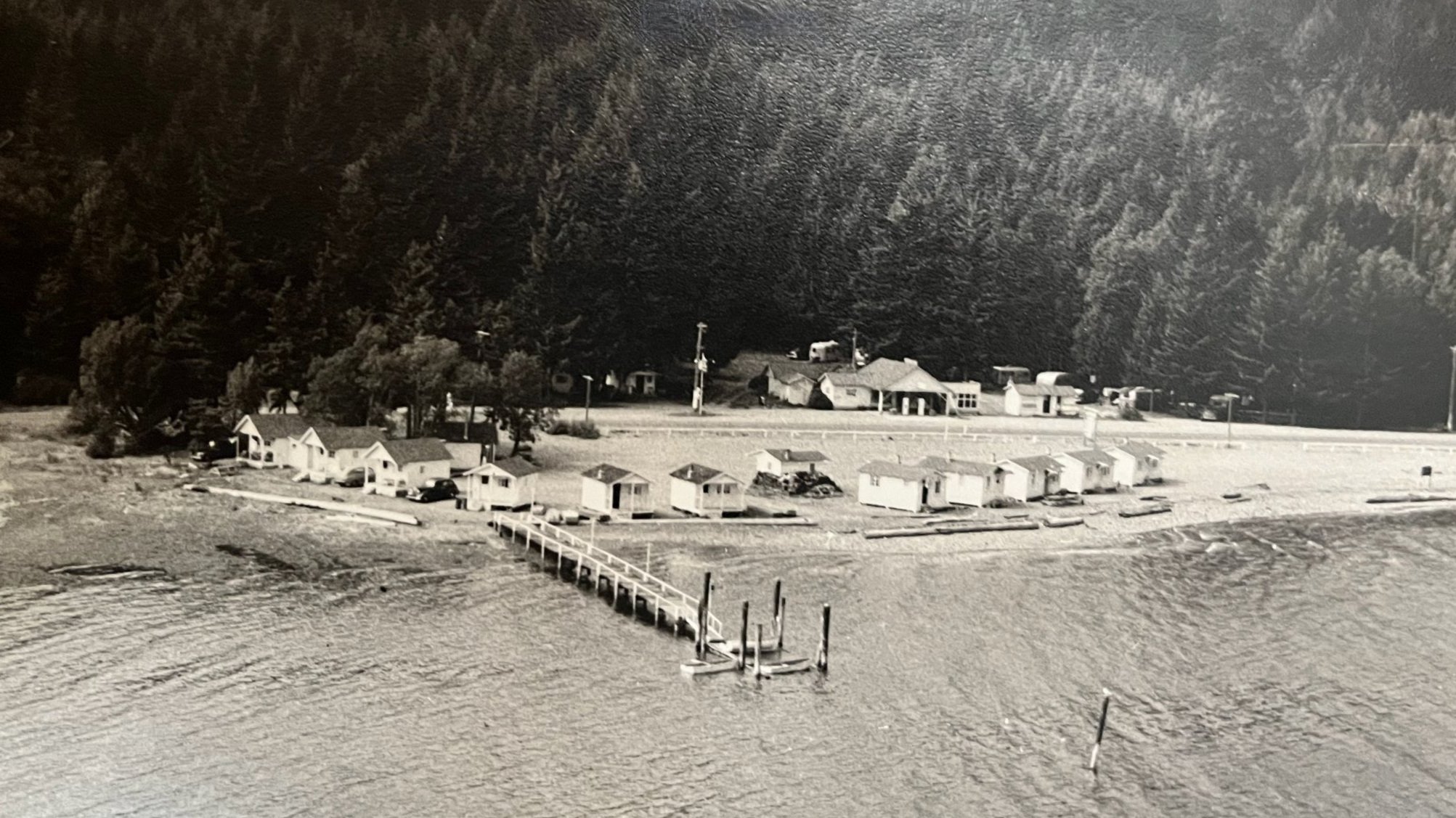
Sund Resort (circa 1930) - Mason County Historical Museum photo
Sund had no idea that his decision would help shape the path of Hood Canal. On that very special and remarkable point lies the present day marine preserve beloved by scuba divers, Sund Rock. Here Colbein built Sund Resort with his wife. It is here too, where his grandson, Robert, eventually managed to establish the marine preserve, Sund Rock, famous for its giant ling cod, Great Pacific Octopus and wolf eels.
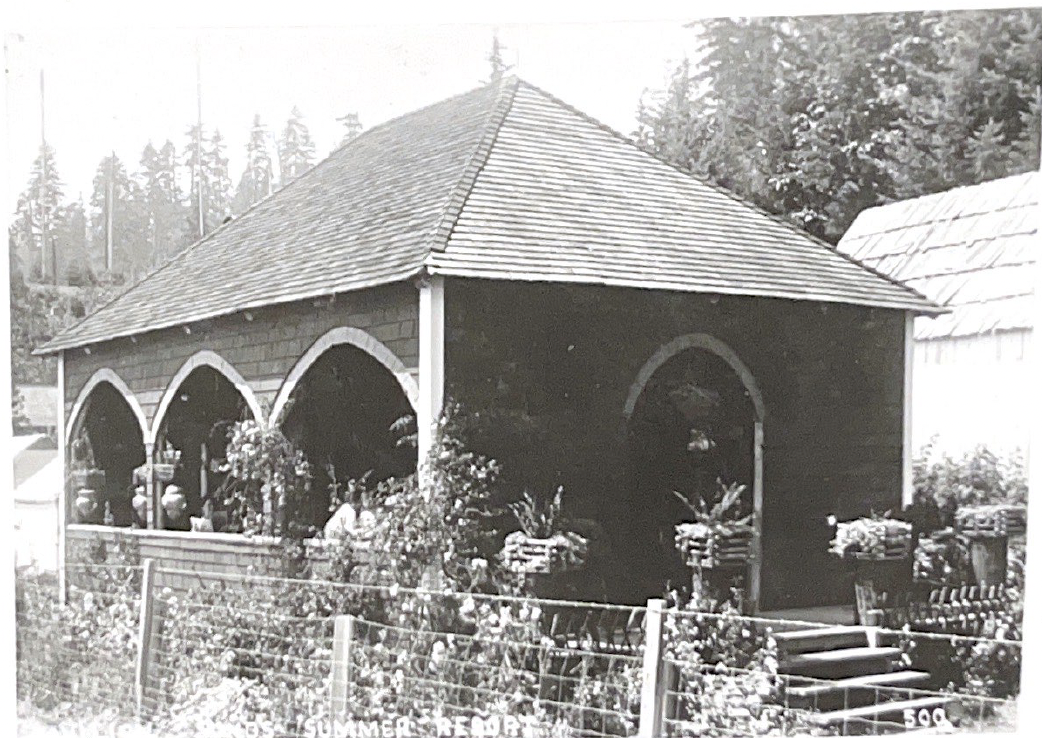
Former Dance Pavilion at Sund Resort (MCHM)
The original Sund Resort was a series of platform tents and included a dance hall. Today the resort and dance pavilion are long gone (present site of Rest-A-While RV Resort) but adventurers can celebrate, because once again there is a platform tent for guests to continue to enjoy this special place.
Colbein John Sund’s great-granddaughter, Cindy Sund, shared the experience and a little bit more about her family’s connection to the Canal. “I love being able to maintain it for family as well as we've really developed a kind of clientele that comes to the glamping and diving that respect the property. it's an underwater preserve with organisms that are unique and special. The Giant Pacific Octopus is a big draw. The wolf eel, ling and rock cod population are coming back. It's really a diverse area. I feel honored to be a steward.”
The generations who have enjoyed this property have developed a strong sense of place and a fierce desire to protect it for future generations to continue to create memories and share this special place with all who wish to visit. For the last four years, Cindy Sund has opened the glamping tent for guests to enjoy. “My parents wish,” she continues, “is that this property remain in the family for as long as possible. So when they moved into assisted-living, it was sort of my responsibility to make sure that that happened. I started the diving and glamping business to help subsidize property taxes and all the expenses that go along with owning a piece of property, and also help with my parents assisted-living. It's working out really well so far.”

Sund Rock glamping tent
Sund’s glamping tent has composting toilets and, since COVID, guests are required to bring their own bedding. However, a soft queen-sized bed, lights, heat, small refrigerator, propane bbq, propane fire pit, and a shower by the privy definitely set this beyond sleeping in an REI tent. And you’ll appreciate the phone charging ports by the bed for the hundreds of photos you’ll be taking because despite its small environmental footprint, this experience will leave a lasting experience on all who visit.
Beach access to Sund Rock dive site below is shared with scuba divers who are allowed limited access by the Sund family. Glamping guests are encouraged to bring their own beach towels, swim floats or kayaks to enhance the beach experience. There is also plenty of hiking in the area and amenities like groceries or restaurants available in nearby Hoodsport. Cindy meets each guest upon arrival, providing a tour of the property and instructions on how to use the facility. Members of the Sund family are available if needed as they also live on the property, but allow guests their privacy to enjoy the space.

Mid-September the tent is removed and stored indoors until May. “The diving operation goes year-round,” reflects Cindy, “we're busier in the winter than we are in the summer because the temperature of the water drops and you get less plankton bloom so your visibility is better.” November is often the busiest month for Sund Rock with the glamping in the summer providing opportunities for other adventurers to Hood Canal.
To reserve the Sund Rock glamping tent, learn more about the preserve and the family history, visit sundrock.com. There is a minimum stay of two night and most of the weekends are booked through September although there is plenty of mid-week availability (which honestly, is a much better time to visit Hood Canal in the summer). This site is not designed for children (more suited to a couple), but pets are allowed. Rates begin at $114/night and every guest that left a review, yes 100%, gave the experience a 5 star rating.
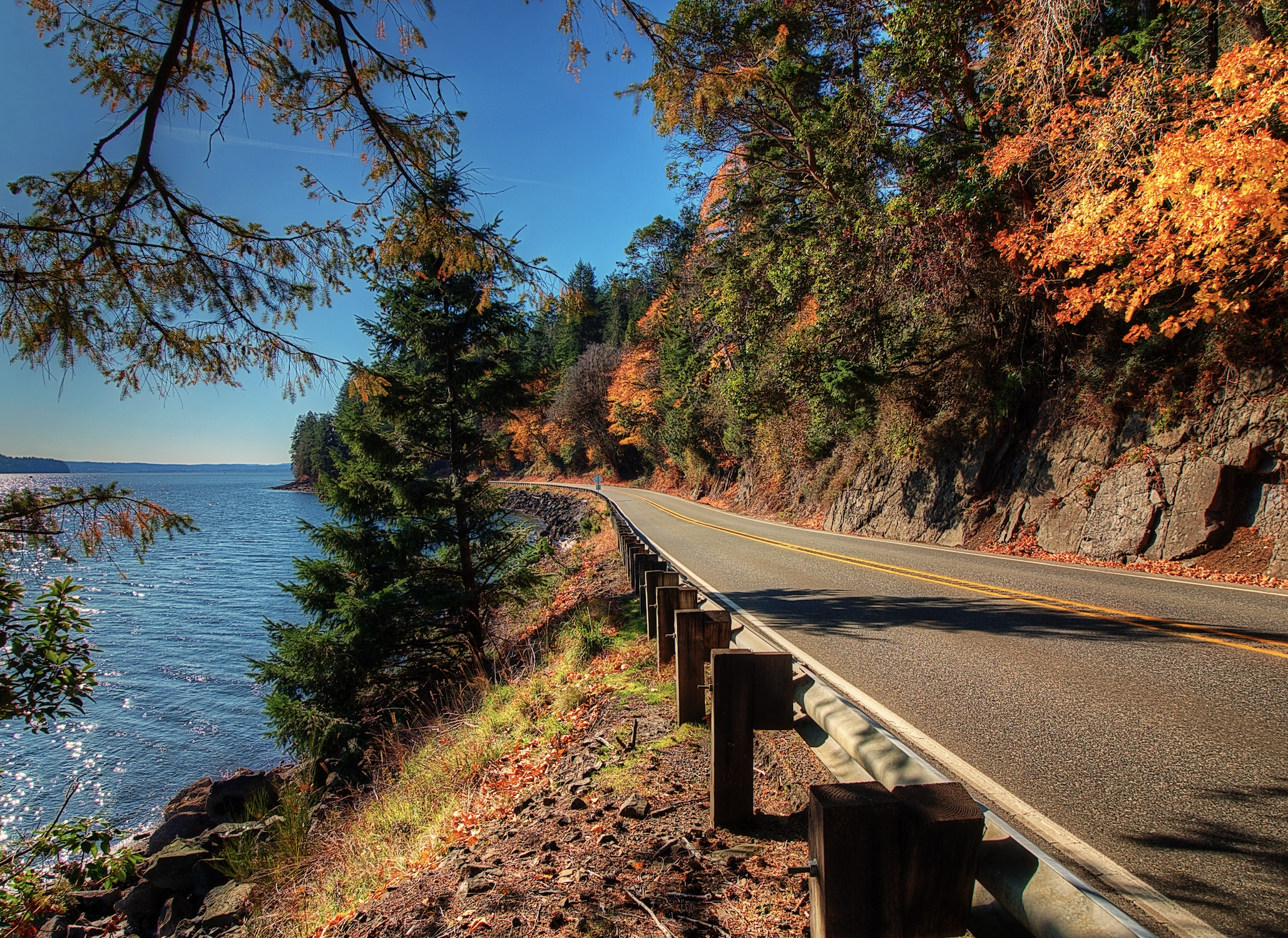
Fall for an adventure on Hood Canal
Want to create some positive vibes? Hop in your vehicle and head out to Hood Canal. The waterside loop makes for an unparalleled Northwest drive with just the right mix of water, mountains, and fall colors – not to mention some great spots to stop and stretch your legs.
Vibrant fall colors, sparkling waters, and a spectacular dusting of snow coating the Olympic range – it’s the perfect time to grab the loved ones and load the car for an inspiring road trip adventure exploring Hood Canal. Here’s a few ideas to get you inspired!


Sometimes it’s a little harder to plan off season but fall is a great time to get better rates on lodging and to have the trails and beaches to yourself.
Waterfalls, oysters, restaurants, scenic pull outs, fun hikes and a touch of shopping are all the hallmarks of a good day on the Hood for the whole family.

Shelton is small enough to be charming (especially at Christmas when it takes on an impressive mantel to befit its “Christmastown, USA” title); but big enough to have nearly everything you need.
Shelton To Potlatch
(20 minutes | 12 miles)
There’s plenty of reasons to exit 101 and take a detour through Shelton, an iconic snapshot of mill-town America. On Shelton’s waterfront—hidden by a hive of industry—stands an active mill. On a clear fall day you can drink in the scent of freshly cut boards as you walk through town. Be sure to visit the old Simpson logging “Shay” and caboose in front of the Post Office. The caboose hosts the Visitor Information Center where you can gather an assortment of maps, brochures, and insight.

Get your spook on at one of the many Halloween community events in Mason County this year
Looking for Halloween adventuring? Look no further than Shelton!

Mason Health is hosting a fun and safe drive-thru Trunk or Treat 2 to 5 PM on Oct. 29. RSVP at masongeneral.com/.../drive-thru-trunk-or-treat
There’s plethora of spooky events planned in this little hamlet! Check out the Shelton Chamber’s handy map showing all the local events including the Shelton merchant’s Sidewalk Spooktacular FRIDAY, OCTOBER 29, 4 PM – 6 PM.
Looking for a haunted house? How about a haunted trail? This scary evening walk in the woods, Haunted Huff N Puff Trail, FRIDAY/SATURDAY October 29/30 at the Huff N Puff is a fundraiser for the SHS graduating class. Over 50 volunteers are working together to design and create a ½ mile spine chilling walk through the forest. Early hours 5-7 PM are for younger (or more sensitive) spook-finders… 8-10 PM is for the strong at heart with volunteer spookers at each scare station through the woods.
During the day, don your best masks and head to the Shelton Cinemas (517 W Franklin Street) presents "HOTEL TRANSYLVANIA 3" (PG) on SUNDAY, October 31 at 12:30 pm. Doors open at 12:00 pm. The price of admission is a donation of nonperishable food items for our local food banks.


Through the Pumpkin Patch all October
North of Shelton
Be sure to make a fall visit to Hunter Farms. Along with an information kiosk they host wagon rides, a pumpkin patch, corn maze,photo ops and a general store that amongst other great treasures features locally made Olympic Mountain Ice Cream.

To reach Potlatch State Park (a 57-acre camping park with 9,570 feet of saltwater shoreline on Hood Canal) you will pass over the Skokomish River. The drive along the Skokomish delta is simply perfect. As the road weaves it's path around the shoreline, you are treated to glimpses of the Olympics filtered through patches of arbutus clinging to the beach edge.

Potlatch is a great spot to stretch your legs. The grounds are home to a variety of activities, from picnicking and ranger programs for kids to kayaking, scuba and shellfish harvesting.


Potlatch to Hoodsport
(5 minutes | 3 miles)
Hoodsport is a seaside town perched on the western shores of the Hood Canal beneath the shadow of the Olympic Range. Here you will find shops and dining as well as two wineries and a distillery: Hoodsport Winery, Stottle Winery; and The Hardware Distillery. Hoodsport also serves as the gateway to the Olympic National Park (Staircase Entrance). At the foot of the hill towards Lake Cushman, stop by the Hoodsport Information Center (N 150 Lake Cushman Rd) for great tips on road/trail conditions; permits and maps and friendly guidance.

Looking for a waterrfront getaway? Look no further than Glen Ayr Resort located just north of Hoodsport on Hood Canal’s shore. The image above shows the living room of their well appointed fully furnished cottage. This delightful treasure includes dining and living areas, 2 bedrooms, 1 1/2 baths and a kitchen with refrigerator/freezer, ice maker, range, dishwasher, microwave, coffee maker, and all the essentials of home. Amenities include cable TV with DVD player and a wood-stove. In the back is a small porch with a propane fireplace and sitting area. $179/night (sleeps 6).
Hoodsport to LILLIWAUP
(7 MINUTES | 4.5 MILES)
Situated on the west shore of Hood Canal, Lilliwaup is a small town with a BIG history and a love of shellfish. Peppered with serene beaches and surrounded by endless hiking trails, Lilliwaup is all about relaxation and nature. The Lilliwaup Store is a favorite stopping spot for a great value on Olympic Mountain Ice Cream cones. They have plenty of flavors to choose from and its just $3 piled high.
Family owned and operated, Hama Hama Company has been harvesting oysters and clams on Hood Canal for four generations. Their store and outdoor restaurant, the Oyster Saloon, are located a shell’s-throw from the tide flats and set up with sweet little COVID safe A-frames for outdoor private dining with a fantastic view. A visit to the farm is the best way to experience Hood Canal oysters in their native habitat.


LILLIWAUP to Brinnon
(25 MINUTES | 19 MILES)
Just outside the tiny town of Brinnon (some great restaurants here) is Dosewallips State Park. This 1,064-acre, year-round camping park hosts riverfront campgrounds, a boat ramp & 5,500 ft. of saltwater shoreline.The park's moss-carpeted forest and glacial river slope down to a shell-strewn delta on Hood Canal, a delight for clam-diggers, anglers, boaters, birders, and beach explorers. The park features hiking trails, riverside campsites, cabins and platform tents. The local herd of Roosevelt elk are known to frequent this area.

Grazing on campus are the Roosevelt elk. the third largest land mammal in North America. They are named after President Theodore Roosevelt, who created what is now the Olympic National Park.
Brinnon is also home to Hood Canal Adventures offering guided tours in the summer and early fall and kayaks for rent year round. Single and tandem kayaks and paddle board / kayak hybrids may be rented by the hour, full day, 24 hours, or for multiple days. If you are renting for a full day or longer you can have your kayaks delivered to you or pick them up yourself. The team will help you choose a route, provide you with a map, life vest, paddle, and an emergency water pump for your safety. For off season rentals call 360-301-6310 to make kayak rental arrangements. During crabbing season they also rent crab pots and crab cookers. Let it soak while your enjoying your paddle then cook them right on the beach or take them home for dinner!
Belfair to Union
(27 minutes | 16 miles)
Nestled between the North Bay of the Puget Sound and the southern hook of Hood Canal, Belfair is a great place for road trip supplies or to have lunch before heading off to explore the 130+ acre birder's dream wetlands, Theler Wetlands Nature Preserve. Visit the craft brewery, Bent Bine Brew Co, to try their locally made specialties. Hankering for wine? Stop in the tasting room at the award winning Mosquito Fleet Winery, they are open most weekends in the fall.
Halloween Belfair update: f you are in Belfair on SATURDAY, October 30, 6:30-9:30 PM head over to the HUB (111 NE Old Belfair Hwy Belfair,) for some spooky fun at the FREE All-Community Zombie Apocalypse Drive Thru.


TWANOH STATE PARK
(14 MINUTES; 9.2 MILES | VIA SR 106 W)
Twanoh State Park's 182 acres include 3,167 feet (965 m) of saltwater shoreline and 2.5 miles of inland hiking trails. Gather shellfish off the public beaches (when open) or simply take a walk on one of the many trails.


ALDERBROOK RESORT & SPA
(7 MINUTES, 5.2 MILES | VIA SR 106 W)
Since 1913, generations of visitors have enjoyed the rustic, albeit very luxurious, charm of this canal-side retreat on 88 acres, which include an 18-hole golf course. The 77 guest rooms are ideal for a rejuvenating escape, while the 16 cozy cottages are perfect for family fun. Complete with a waterfront restaurant, dock, and saltwater pool and spa, Alderbrook Resort and Spa Resort also offers access to boating from kayak rentals to multi-person cruises. During Halloween they are even offering onsite trick-or-treating for the kids!


UNION
(6 MINUTES, 2.4 MILES | VIA SR 106 W)

The spectacular views from Union are not to be taken lightly. Here is the best vantage point to view the Olympic range. On the journey to Union's center, take a moment to admire the historic Dalby Water Wheel and stop in at Cameo Boutique for some great shopping of local items. The restaurant at Robin Hood serves some of the best seafood dishes and hosts live music most weekends. Both Cameo and Robin Hood offer waterside lodging. Near Hood Canal Marina, 2 Margaritas Restaurant serves Mexican food; while the Union City Market stocks everything from gifts and collectables to homemade candy and fresh oysters! On weekends their pop up dining experience serves a la carte delicacies in an inspired dining space on the water.
Union is planning a Community Drive-Thru Trick-or-Treating Halloween night from 4-6 on Halloween night with special events at local business and the community church.

Whether you have a day or a week, Hood Canal and the surrounding communities are great places to reconnect and find new adventures. For a list of accommodations visit our lodging pages and check out the other great activities available while you visit our area.
The safety of our residents and guests is our highest priority. We are asking everyone to recreate responsibly to keep our beautiful forest, small towns and expansive waterways healthy—and fun—for everyone.
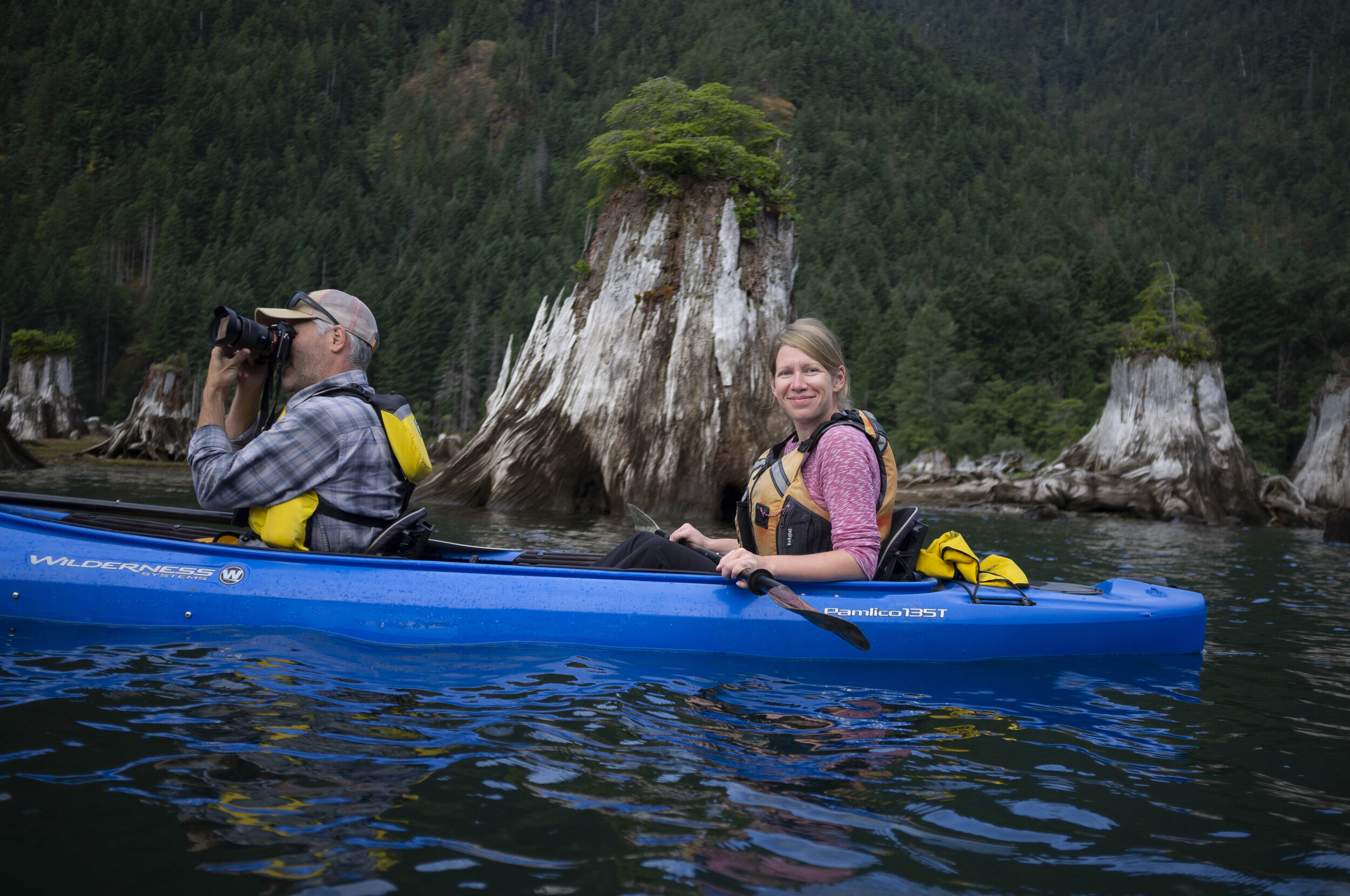
Its time to paddle
With balmier weather and longer days, it is time to get outside and explore the shores and waterways of Hood Canal and the inlets of Mason County. Kayaks, canoes and stand up paddleboards are a great way to be on the water without the expense or headache of a powerboat.
With balmier weather and longer days, it is time to get outside and explore the shores and waterways of Hood Canal and the inlets of Mason County. Kayaks, canoes and stand up paddleboards are a great way to be on the water without the expense or headache of a powerboat.
Get on the water
Whether you seek tide-ripped saltwater passages, challenging whitewater, or lakes big and small, Hood Canal is a kayaker, canoer, or paddleboarder’s ideal destination. Few places in the world can match the stunning scenery and easy access of the Hood Canal region. Sea kayakers can explore seemingly endless miles of pristine saltwater shoreline, cruise the reaches of lakes Cushman and Kokanee in the foothills of the Olympic Mountains, or ride the gentle currents of the Skokomish and Tahuya Rivers.
Wet your paddle with these adventure ideas:
Explore Skokomish River, using public put-in on Sunnyside Rd, just north of the Skokomish Valley Rd.
Launch at Shelton Marina or Walker Park and paddle (with the tide) out Hammersley Inlet to Hope Island. Ride the tide back for a little help with the paddling. There is a strong current in this passage that is difficult to paddle against but great to use to your advantage. It is necessary to be aware of the tides. If you miss the tide, head to the inlet shores to escape the prevailing currents. Hope Island can also be reached with an easy paddle from Arcadia Point boat launch. At the launch you will find plenty of parking and easy access to the water. Hope Island has sandy beaches all around the island for easy landing and plenty of trails to explore.

Hood Canal can be unpredictable with weather “outbursts” but generally putting it at Potlatch State park in early morning or in the evening after the afternoon breeze has settled can be rewarding.
Paddle the lower reaches of the Skokomish near Union, explore the shores of Hood Canal or explore any of the lakes.
A great Mason County destination is Lake Kokanee, or Lower Lake Cushman; this scenic lake channel wind, so watch the weather.

Rob Casey image | Salmon Bay Paddle Hammersley race.
An interesting two-hour paddle starts at the boat launch at Lake Isabella. At the far end of the lake, enter Mill Creek through a patch of water lily pads. Glide through the willows for half a mile before the stream drops and becomes too shallow to navigate.
The rivers of Olympic Peninsula are renown for their great beauty as well as their technically difficult white water rafting and kayaking routes. Placed high in the wilderness of the Olympics, the rivers that drain into Hood Canal are wild, steep and undeveloped. However, do you research before you go! Many are Class IV - V rapids and are not to be attempted by the novice paddler. For information on white water sites in the area, americanwhitewater.org provides excellent river classifications and descriptions. Gary Korb’s, A Paddlers Guide to the Olympic Peninsula (1997), is also an invaluable resource before attempting these rivers.

Case Inlet’s calm waters and sandy beaches are renown for paddling popularity
Kayak rentals
If you are just getting your paddles wet, or are a seasoned paddler, there are some great opportunities in Mason County for kayak or SUP rentals. Hood Canal Events offers organized excursions with catered meals. Hoodsport Kayak Rentals, offers hourly rentals and excursions with kayak or pedal boat drop off at nearby Kokanee Lake. Hood Canal Adventures, located in Brinnon, has a fleet of single and tandem vessels and offers biologist guided eco-tours by kayak or SUP.
Additional resources for rentals and guided tours available here.
Watch for paddling events
Hood Canal and South Puget Sound is often host to kayak and SUP races and events. SUPs, canoes, and kayaks lend themselves well to COVID sensitive planning with cute mottos like “keep a paddle distance apart.”
Salmon Bay Paddle recently included Hammersley Inlet in their paddling competition series this May complete with a sea kayak paddling clinic in their event held at Shelton, Hammer the Inlet.
Based out of Seattle, Salmon Bay Paddle is the leading provider of personalized one-on-one and small group stand up paddle board (SUP), kayak and surf ski lessons in the Pacific Northwest. Owner, Rob Casey, is the author of two paddling books and is considered a pioneer of stand up paddling by Stand Up Journal Magazine. Rob and his certified coaches travel the Northwest offering paddling skills and safety classes from beginner to advanced paddler. Salmon Bay Paddle’s event on Hammersley included guest speaker, ICF World Champion Fiona Wylde, hosting a SUP racing clinic at the Shelton Yacht Club; the Hammer the Inlet Race and on-site kayaking clinics.
Thirty-one paddlers participated including eighteen SUPs, eight kayaks, two rowers, an outrigger canoe, and one rowboat (romantically called Starlight). Beginning at Shelton’s Yacht Club, paddlers took the 1.9 knot ebb out from Shelton and the 1.4 knot flood current back up the winding picturesque inlet to where it empties into lesser Puget Sound.

Rob Casey Image | Hammer the Inlet Race 2021
Paddlers call this run the ‘Hammersley Shuttle’ for the tidal push allowing for a nice glide with the current. Back eddies and eddy-lines add a little spice or challenge around the various bends and curves at Skookum and Libby Points and Cape Horn. The fastest vessel to complete the grueling 15.3 mile Hammer the Inlet Race was a SUP that clocked in at 2:18:32.7. Participants faced a challenging race with strong 15 knot winds, cross current conditions, and a muddy, low tide finish line – resulting in some comical watercraft exits.
After the race, fourteen dozen local oysters were enjoyed from South Sound Mariculture. Part of the race proceeds were donated to the South Sound Restoration Project.
Be water smart:
Paddling events are a great way to share ideas on skills as well as water safety. Like the trails and parks filling to bursting, COVID restrictions have led to a rise in purchase of personal watercraft but perhaps not an increase in water safety awareness. Kayaks and SUPs, mass produced for the desperate consumers in dizzying shades of enticing colors, are available at every big box store promising a cheap and easy way to get freedom on Washington’s waterways. Although one can be delighted that sales surged and people got outdoors, the risk associated with little instruction on proper use offered by stores online or giants like Walmart or Dick’s has led to a much more disturbing fallout than litter and over-crowding in our parks.
Accidents and drownings statistics in 2020 were so alarming that a Bill was proposed to require safety certification for all people on the water — not just for those in powered boats over 15 HP.
The current rules are simple and common sense should prevail.
Wear a life jacket, understand your surroundings, educate yourself about winds, currents, tides, travel in groups and develop a safety plan. Take advantage of public events to educate yourself.
There are also plenty of useful online resources and books. Book yourself lessons with Salmon Bay Paddle and become a paddling pro –they even offer online courses, so you could learn some basics before you head out. Even if you aren’t using a watercraft with a 15 HP engine, the Washington State Boater safety course is only a short online course with an exam and costs $29.95 plus tax.
Additionally, the friendly staff at outdoor stores such as Verle’s, Hood Canal Adventures, and Hoodsport Kayak Rental can answer questions and make recommendations about water conditions, good local spots to check out and other queries you may have.

Hood Canal Travel Guide: Birdwatching
With its wealth of shoreline, fresh and saltwater marshes, mudflats, and bountiful forests, the Olympic Peninsula is a birders’ paradise.
A canalside Birding Itinerary
With its wealth of shoreline, fresh- and saltwater marshes, mudflats, and of course the bountiful forest, the Olympic Peninsula is a birders’ paradise. And whereas winter and spring aren’t the most popular seasons for human tourists (meaning less competition for lodging and dining), they happen to be the best for catching the avian crowds.
From soaring birds of prey to elusive divers, birdwatching is one more reason to get to Hood Canal when there aren't hordes of RVs cruising down HWY 101.

If you are looking for all the gritty details on Olympic Peninsula birding locations, check out Craig Romano’s list of the Top 25.
Whether it satisfies your ornithological cravings for the season or simply whets your appetite for much more, gear up (our suggestions are below) and follow along!
Theler Wetlands | 7am
If you only make one dedicated birding stop in the Hood Canal, Theler Wetlands, with its easily navigated trails, interpretive kiosks, and educational exhibits, should be it. More than two miles of interpretive walking trails through 39 acres of protected wetlands provide an excellent introduction to birdlife in the Hood Canal. Newbies and experienced birders alike will delight in views of bald eagles, green-winged teals, horned grebes, and more. You may even be able to spot otters in the freshwater marsh!

Photo courtesy of Clint Ferarra
Sunset Beach Deli | 10am
Whether you worked up an appetite for lunch or just need a quick coffee to fuel the next birding venture, the Sunset Beach Deli is a local favorite for gyros and Philly-style cheesesteaks. In the mornings, it’s also the go-to location for filling breakfast burritos. If you’re not quite ready to eat, have them wrap up a sandwich and take it to go.
Twanoh State Park | 1pm
Twanoh State Park is a favorite in the summer for swimming and watersports, but the quieter winter and spring months make it a great place for viewing wildlife and birds. Bring your binoculars to the shoreline for an eyeful of diving birds such as loons, mergansers, murrelets, and ruddy ducks with their distinctive upright tails. In the towering cedars and maples inland, listen for brown creepers and red crossbills.
Bonus: Between Twanoh and Potlatch, Highway 106 takes you right by the Skokomish River Delta. The overlook pull-off is a good spot to scope gulls, grebes, and goldeneyes.

Photo courtesy of Clint Ferarra
Potlatch State Park | 4pm
Like Twanoh, Potlatch bustles with humans in the summer and birds in the winter and spring. With 5,700 feet of saltwater shoreline, it’s a great place for viewing waterfowl, particularly during high tide. In the water, look for heron, scoters and scaups, and check the trees for fox sparrows and Steller’s jays.

Photo courtesy of Clint Ferarra
Dinner at 2 Margaritas | 6pm
Nothing works up an appetite quite like a day spent in the bracing sea air. Whether you’re celebrating new additions to your Life List or toasting to better luck next time, we recommend a margarita (or two) at the warm, colorful 2 Margaritas restaurant in Union. Generous portions in a cozy atmosphere make it the perfect cap to another beautiful day in the Hood Canal.
Need More inspiration?
Renowned guidebook writer and trail advocate, Craig Romano, shared 25 of his favorite bird viewing destinations with us. Start planning your trip now!
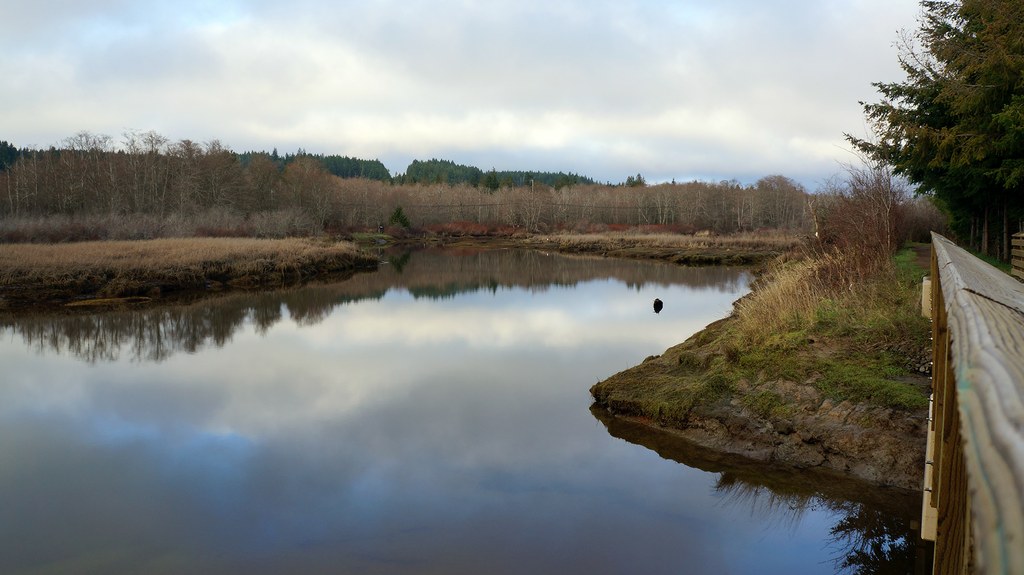
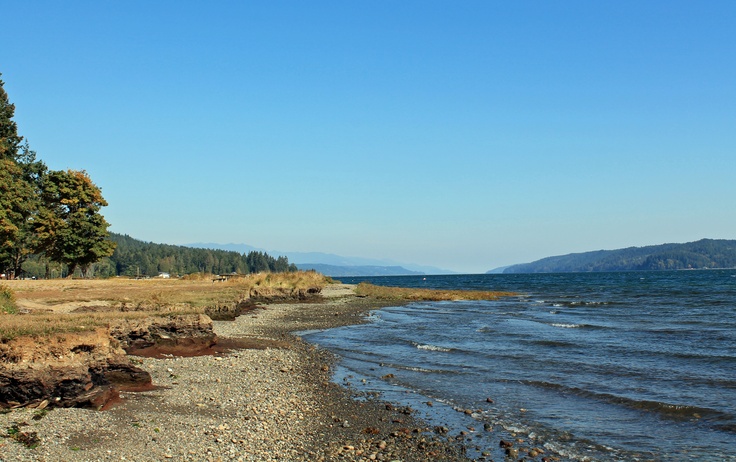
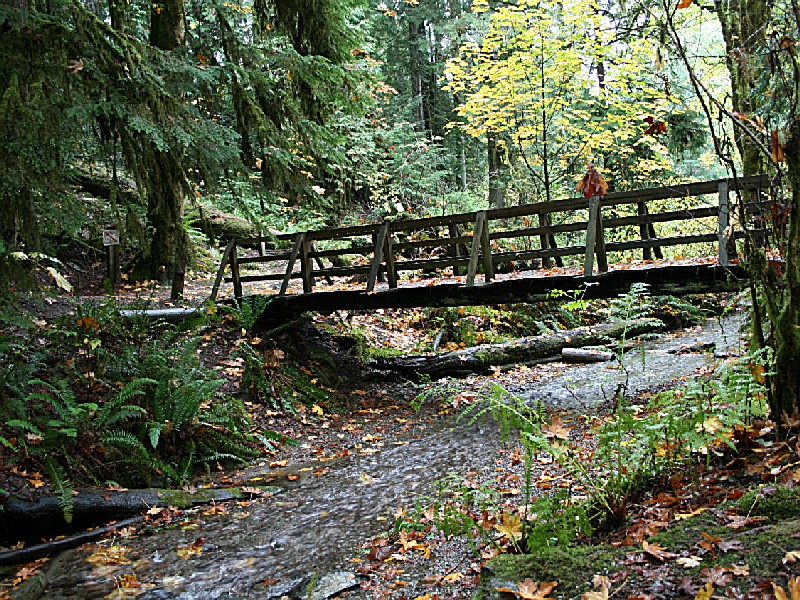
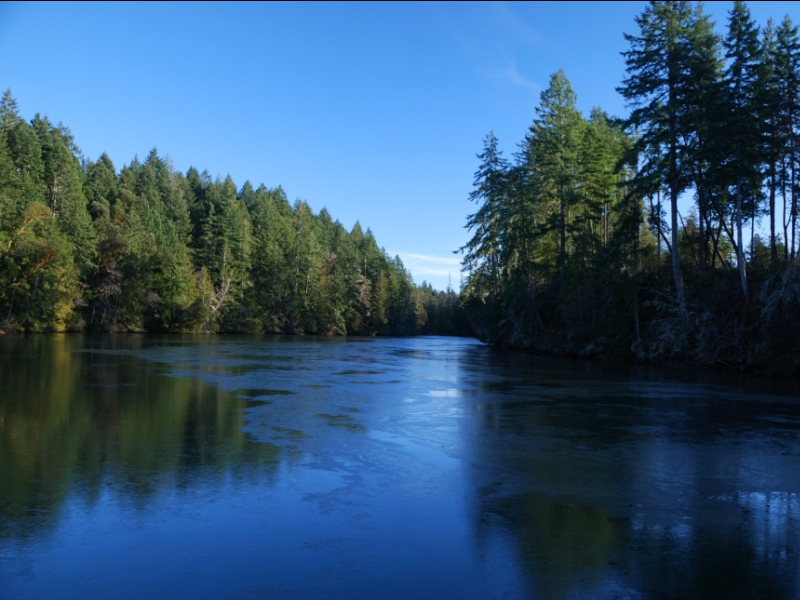
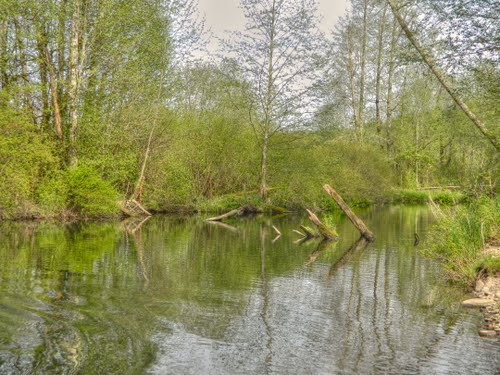
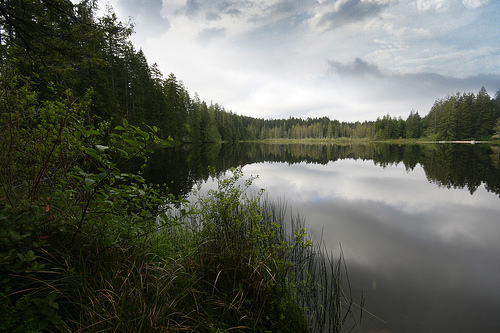
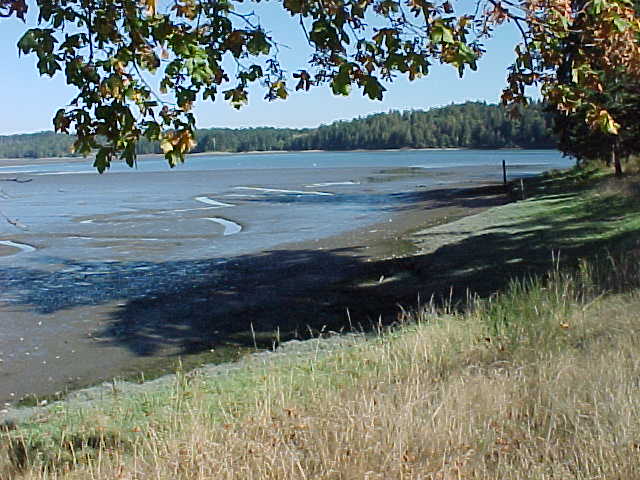
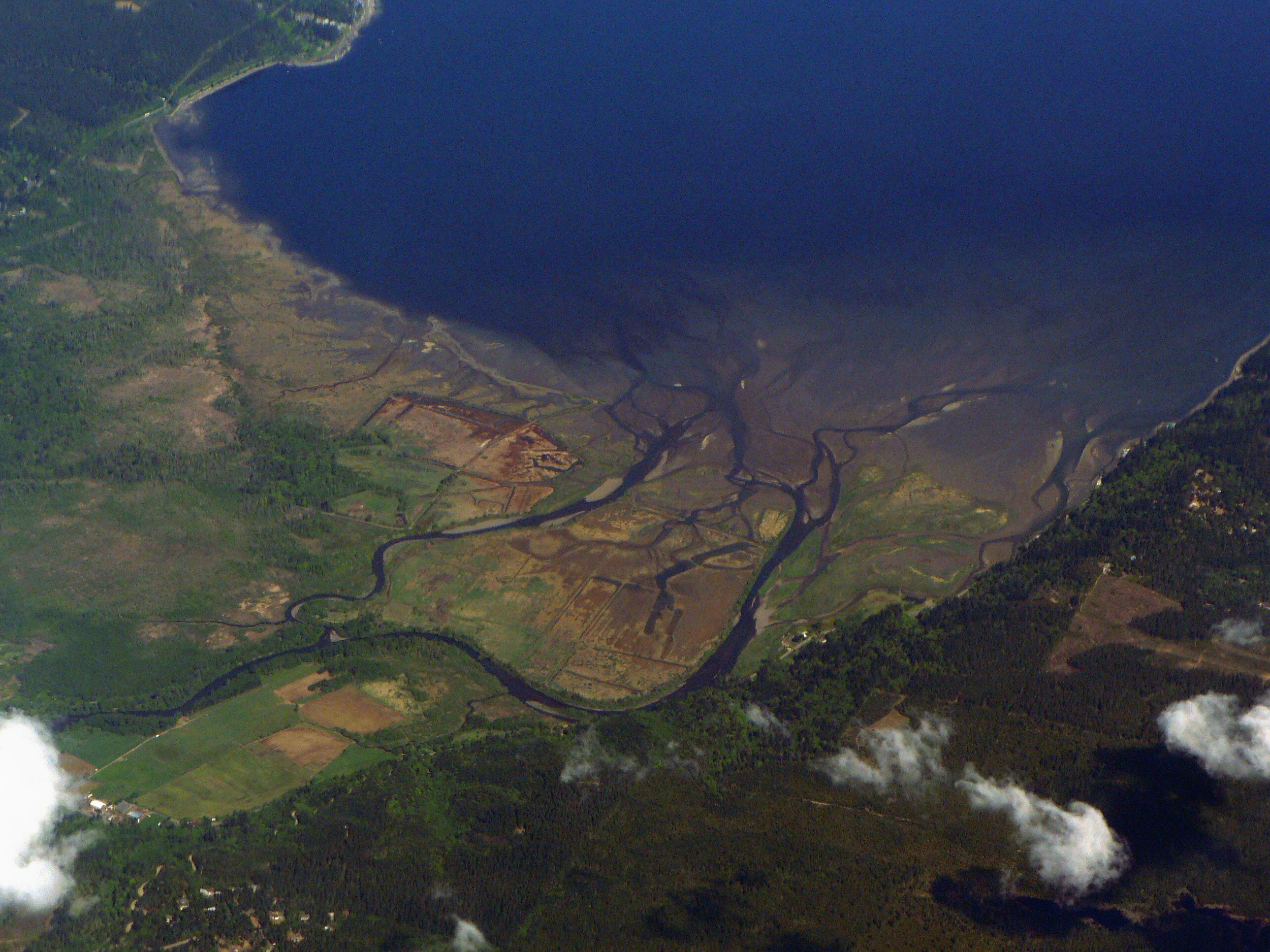
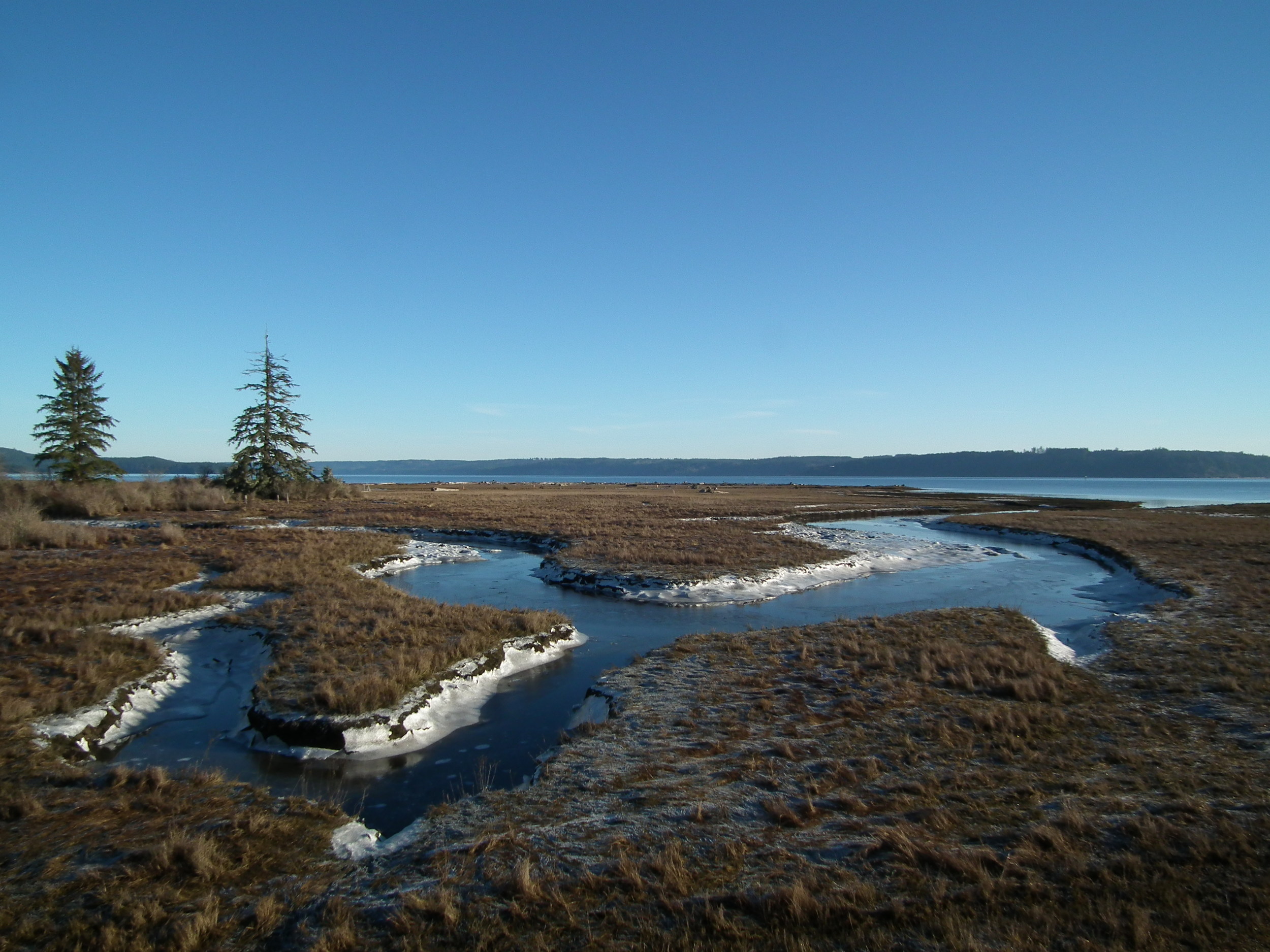
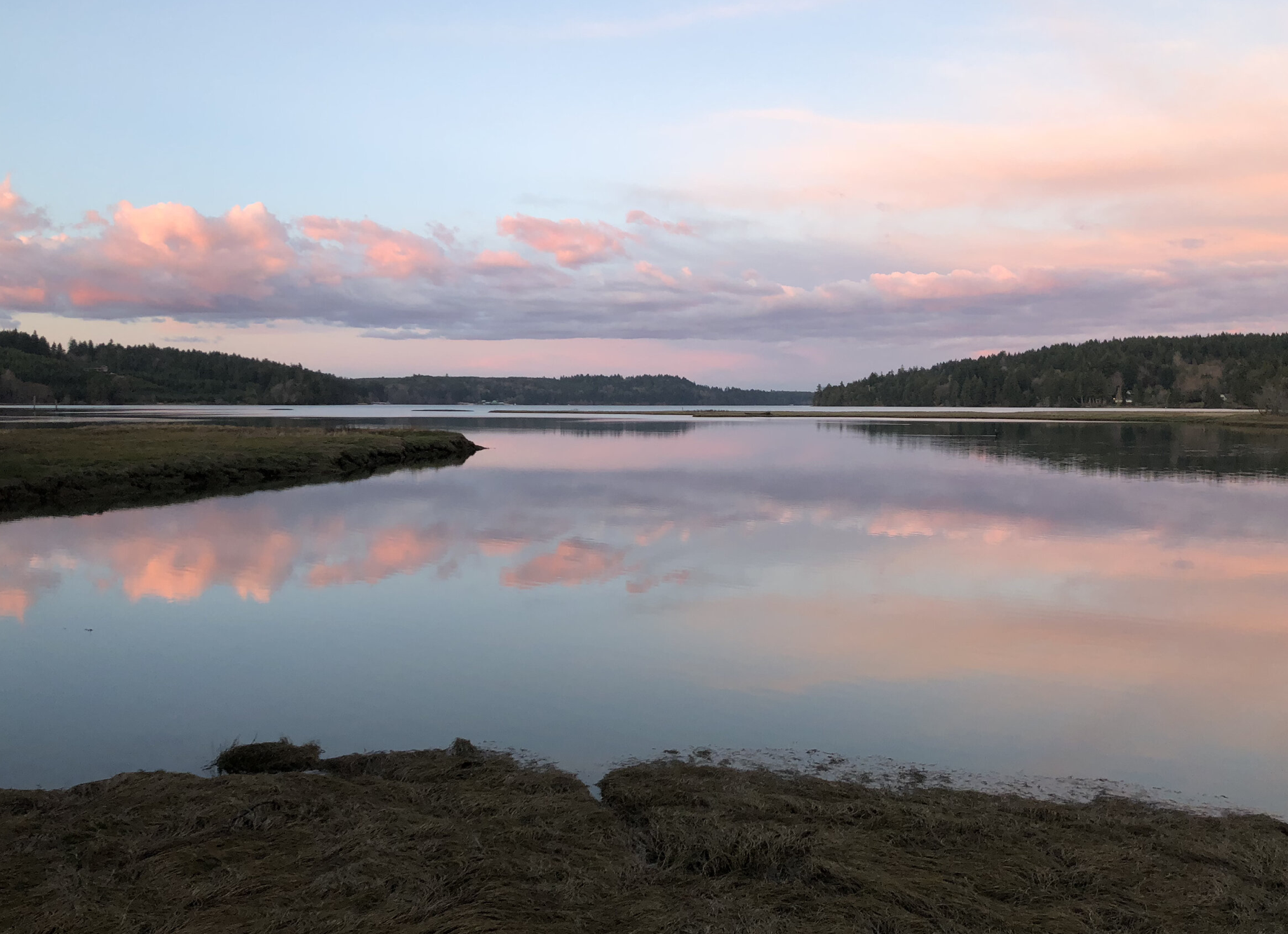
Traditional Mexican along with views of the Hood Canal