
Sea Lions & Harbor Seals of the Salish Sea
For many people, above the surface, sea lions and seals blur together. Both are sleek marine mammals with whiskered faces, dark eyes, and the unnerving ability to look adorable and deeply competent at the same time. Both haul out on rocks, beaches, docks, and floating logs around the Salish Sea. Both vanish into the water with enviable grace. But spend any real time with them, especially underwater, and their differences become obvious.
Whiskers in the Green
Story & Pictures | Thom Robbins
There are dives where the water gives you exactly what you came for. You drop into Hood Canal with a camera and find plumose anemones blooming from pilings like pale chandeliers. You descend at Sund Rock hoping for wolf eels and get lucky enough to find one peering from its den, green eyes steady as old glass. You head north toward the San Juan Islands and drift past walls dressed in kelp, watching rockfish hold themselves in a current stronger than it looks – Then there are dives where the water decides otherwise.
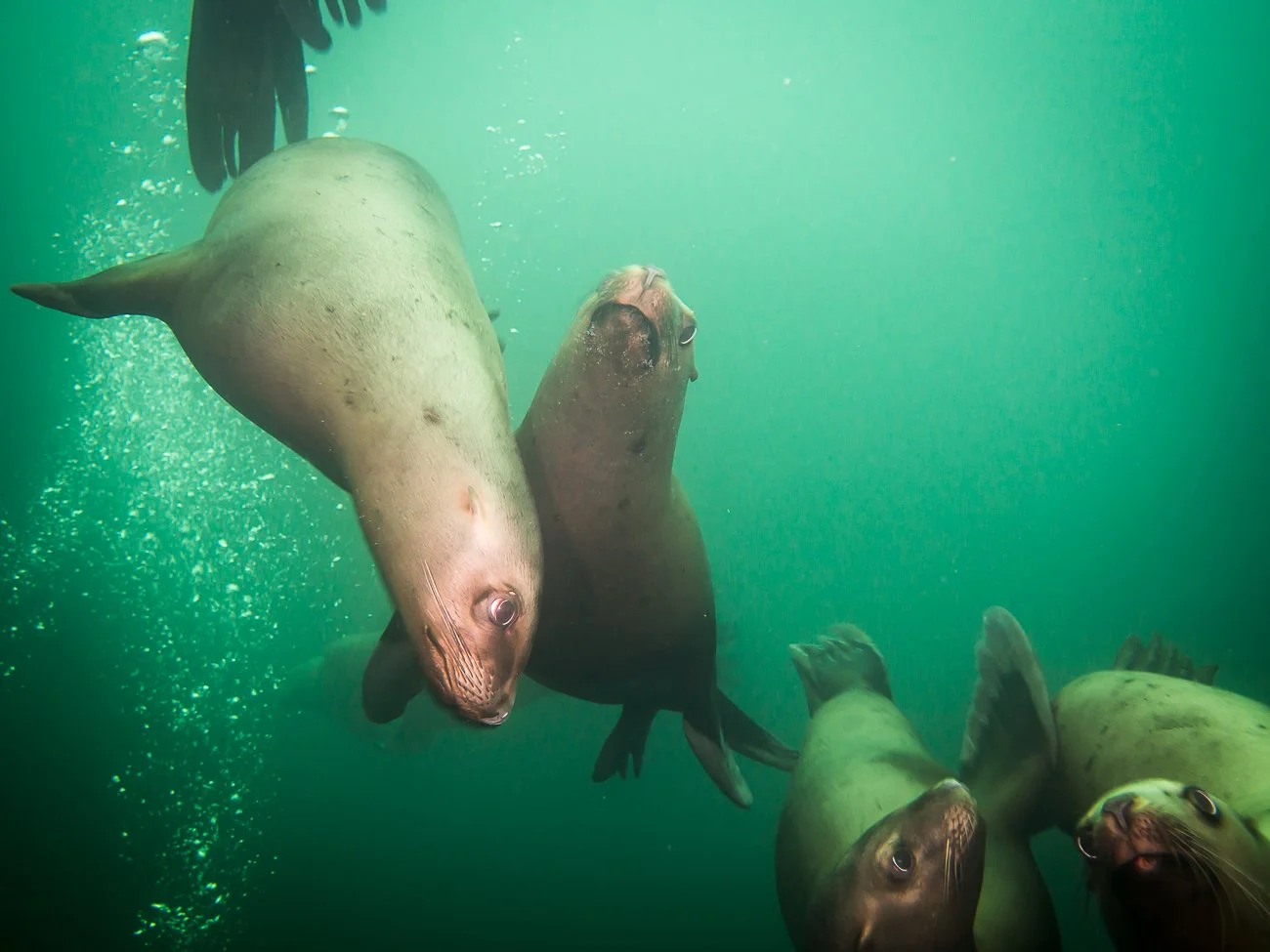
I had my camera aimed at a sculpin no longer than my thumb, trying to frame the shot before it bolted. I felt a light tug on my fin. Not hard, just enough to make me turn. Behind me hovered a young sea lion, suspended in the green water like a dog that had just stolen a sock. It let go, rolled once, then blasted away in a trail of bubbles before circling back to see if I had learned the rules.
Another time, I was focused on a nudibranch inching across a piling when I sensed movement beside my mask. A harbor seal had drifted in so quietly it seemed to arrive fully formed. It hovered over my shoulder, staring at the same sea slug I was photographing as if it had concerns about my composition.
That is part of the magic. Sea lions and harbor seals often feel less like wildlife you happen to encounter and more like curious neighbors checking in on what you are doing.
For many people, above the surface, sea lions and seals blur together. Both are sleek marine mammals with whiskered faces, dark eyes, and the unnerving ability to look adorable and deeply competent at the same time. Both haul out on rocks, beaches, docks, and floating logs around the Salish Sea. Both vanish into the water with enviable grace. But spend any real time with them, especially underwater, and their differences become obvious.
They are among the most charismatic animals in Pacific Northwest waters, and they know it, playful, intelligent, and efficient predators closely tied to the health of this inland sea. When one appears on a dive, the whole mood lifts.
The easiest way to tell them apart begins with the ears.
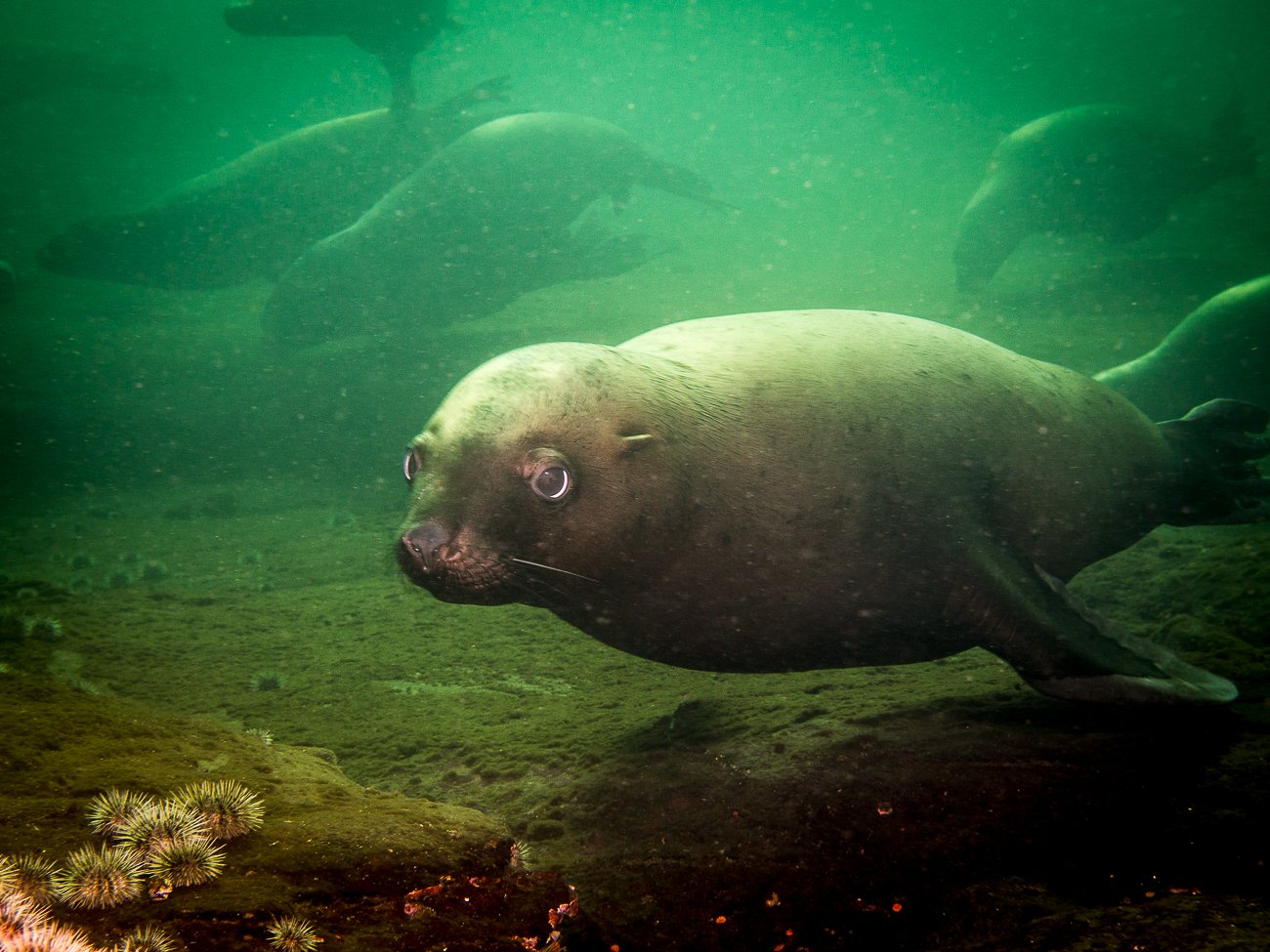
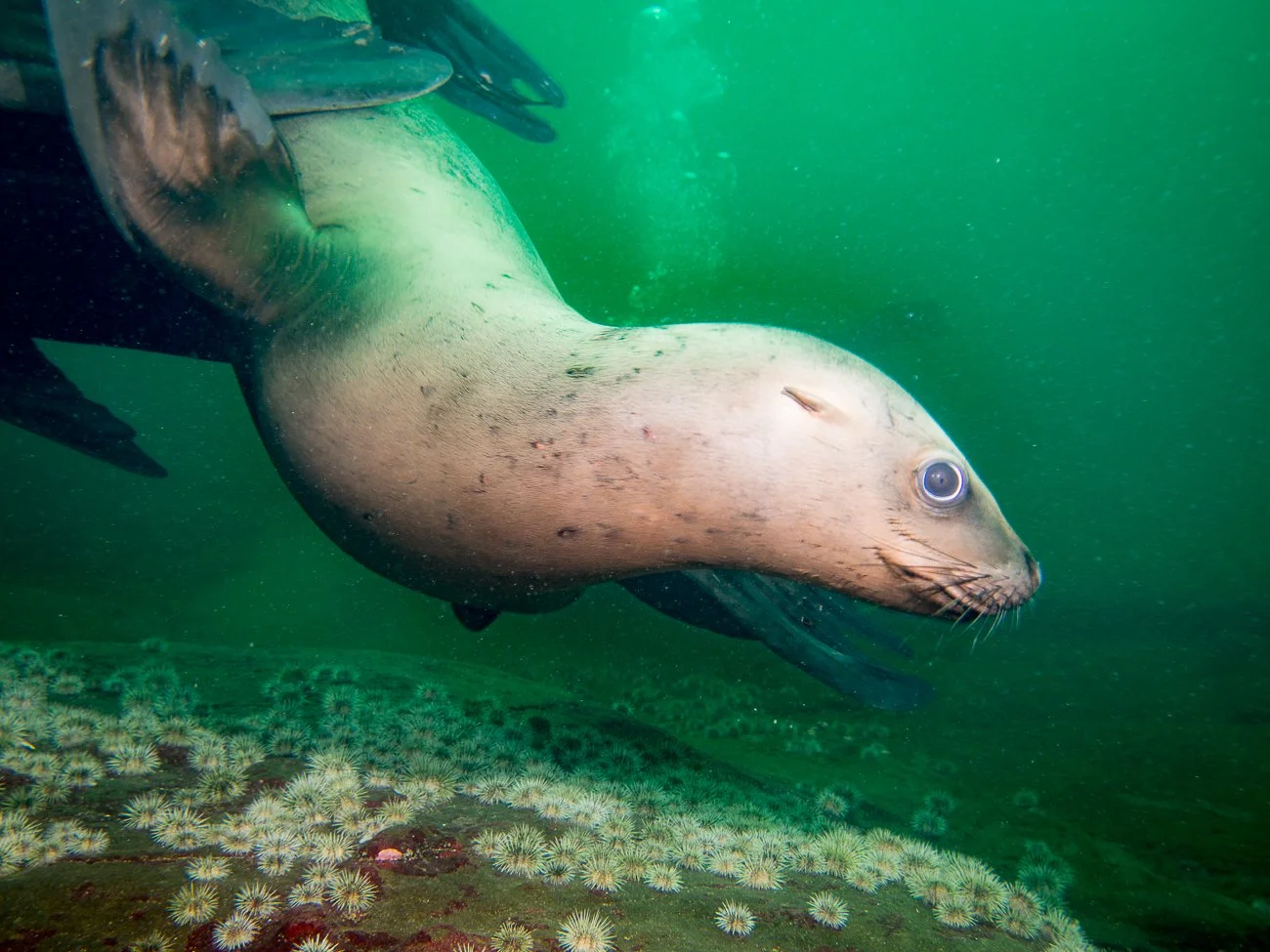
Sea lions have visible external ear flaps. Harbor seals do not. If you can clearly see little ears on the side of the head, chances are you are looking at a sea lion. If the head appears smoother and rounder, you are likely looking at a harbor seal.
That is the quick version. The better version comes with watching.
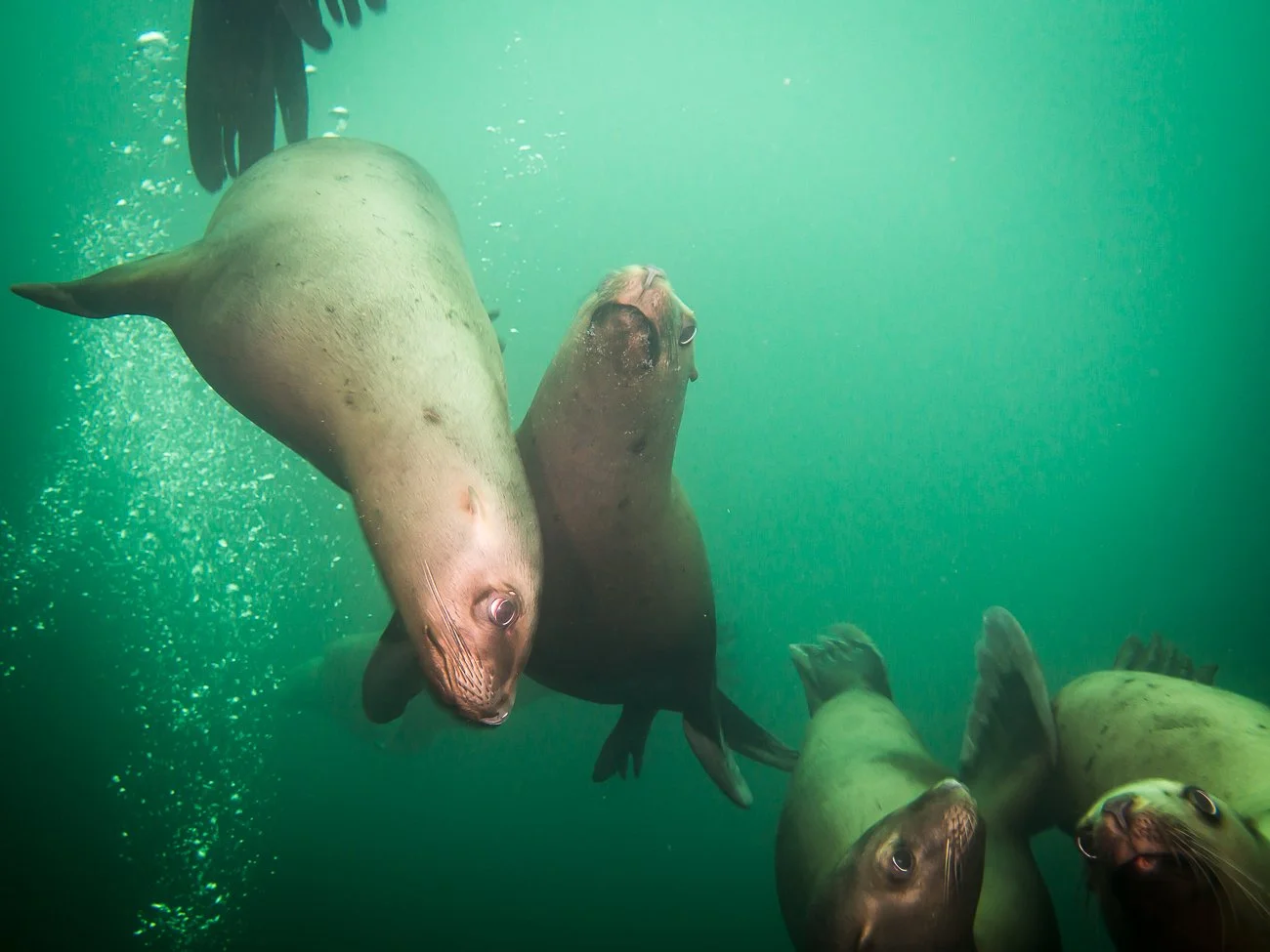
Sea lions are built for swagger and noise. Longer, louder, and more theatrical, they carry themselves like animals aware of their own presence. In the Salish Sea, the two species most people encounter are California sea lions and Steller sea lions. California sea lions are the familiar barkers of docks and buoys, energetic, vocal, and often piled on top of one another in noisy heaps. Steller sea lions are larger, heavier, and impressive enough that the first one you see underwater can feel less like wildlife and more like weather moving toward you.
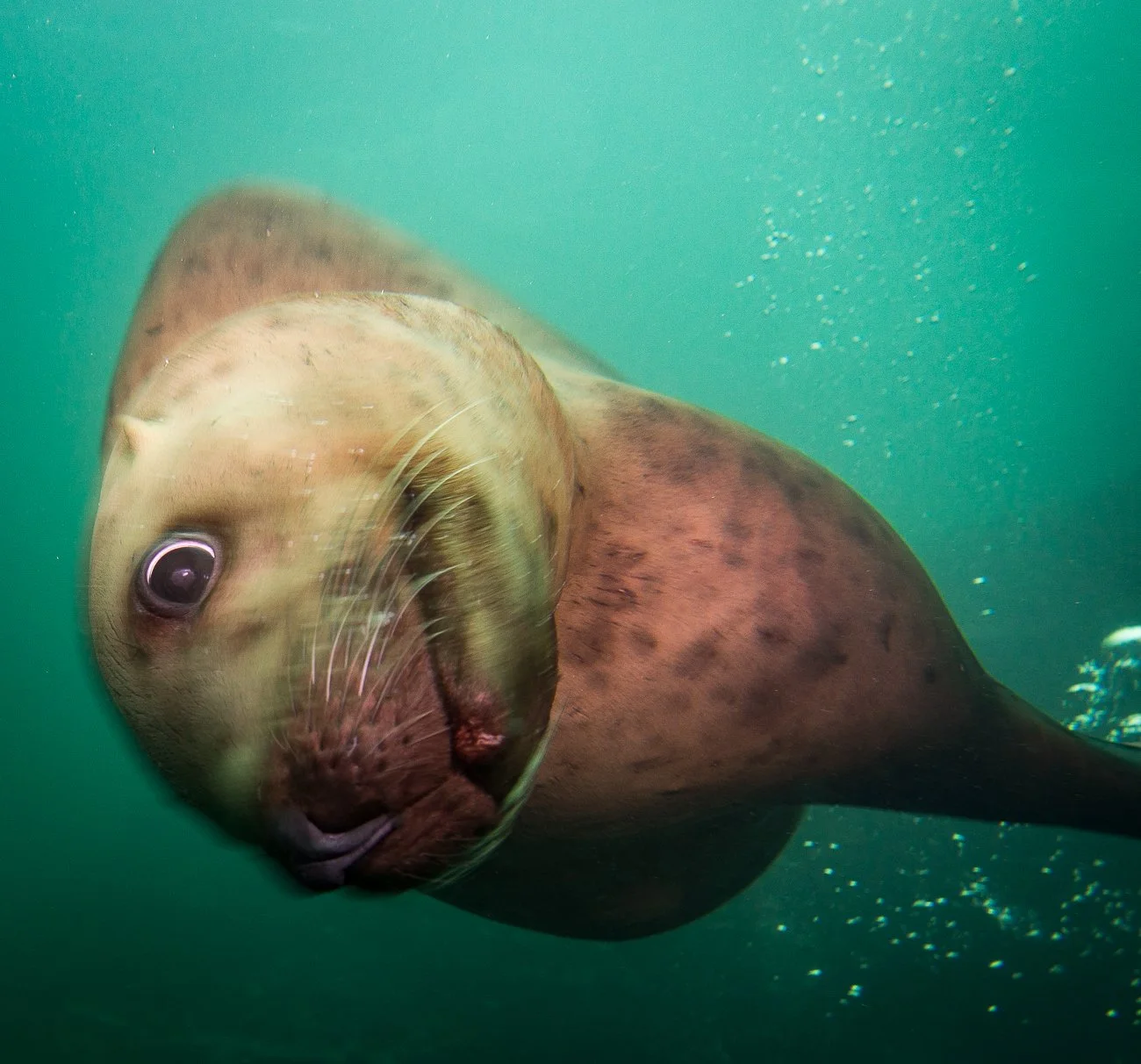
Sea lions belong to the eared seal family and use their large front flippers almost like wings. They can rotate their rear flippers beneath them, allowing them to move on land with surprising confidence. On haul-outs, they bark, posture, shove, and argue like a committee meeting with no chairperson.
In the water, all of that bulk becomes grace. They become pure athletes. They bank, roll, accelerate, stop, and reverse direction with the kind of ease that makes a diver feel assembled from spare parts. I have watched sea lions streak past so close I could see old scars across their hides, whiskers swept back flat against their faces. Then, with one effortless turn, they were gone.
Young sea lions are often the comedians. They blow bubbles in your face, dart in close only to veer away at the last second, grab at loose fins, hoses, or hoods, and return repeatedly to see whether you have become more entertaining since the last pass. They remind you that intelligence and mischief often travel together.
Harbor seals move through the world differently. They are smaller, rounder, and quieter, with large dark eyes and faces that can look permanently thoughtful. On land, they move with a soft-bodied undulation, unable to rotate their rear flippers beneath them as sea lions do. In the water, however, they become sleek and efficient, propelled by smooth movements of the hind body and rear flippers.
Where sea lions often announce themselves, harbor seals simply appear.
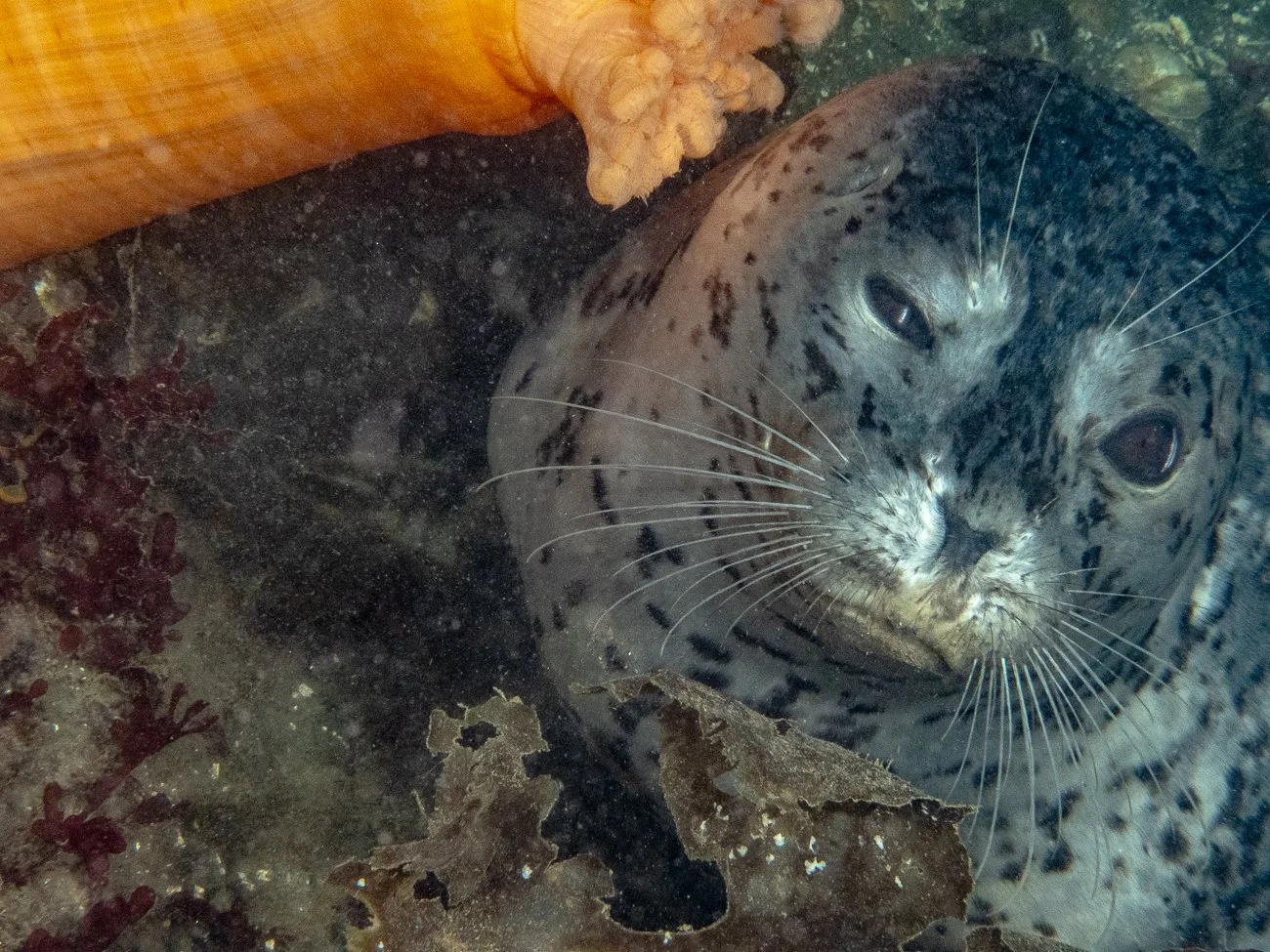
You scan the water column, and suddenly one is there, suspended just beyond your bubbles, watching with calm interest. Then another. Then emptiness again.
They move with a composed self-possession, less interested in spectacle than observation. If sea lions are the extroverts of the pinniped world, harbor seals are the thoughtful introverts who miss nothing.
Color can help, though nature loves exceptions. Harbor seals often wear mottled coats in shades of gray, silver, tan, or brown, marked with spots or rings. Sea lions tend to be more uniformly colored, usually darker brown to tan, with smoother-looking coats.
Behavior is often the fastest clue. Sea lions are more likely to race in, circle, blow bubbles, tug at fins, and treat a diver like an unexpected toy. Harbor seals are more likely to hover nearby, inspect you carefully, and drift close enough to make eye contact before slipping away.
Both reward patience. Neither should be chased. The best encounters happen when you stay calm and let them decide the distance.
For all their playfulness, both live demanding lives shaped by weather, tides, predators, and the constant need to eat enough in cold water.
Harbor seals are year-round residents throughout much of the Salish Sea. They haul out on beaches, mudflats, rocks, floating logs, and quiet shorelines to rest, molt, warm themselves, and give birth. Their pups enter a world that expects competence from an early age. Many can swim within hours of birth, though they still rely heavily on their mothers for milk, protection, and guidance. In the wild, harbor seals can live 25 to 30 years, long enough to know these shorelines well.
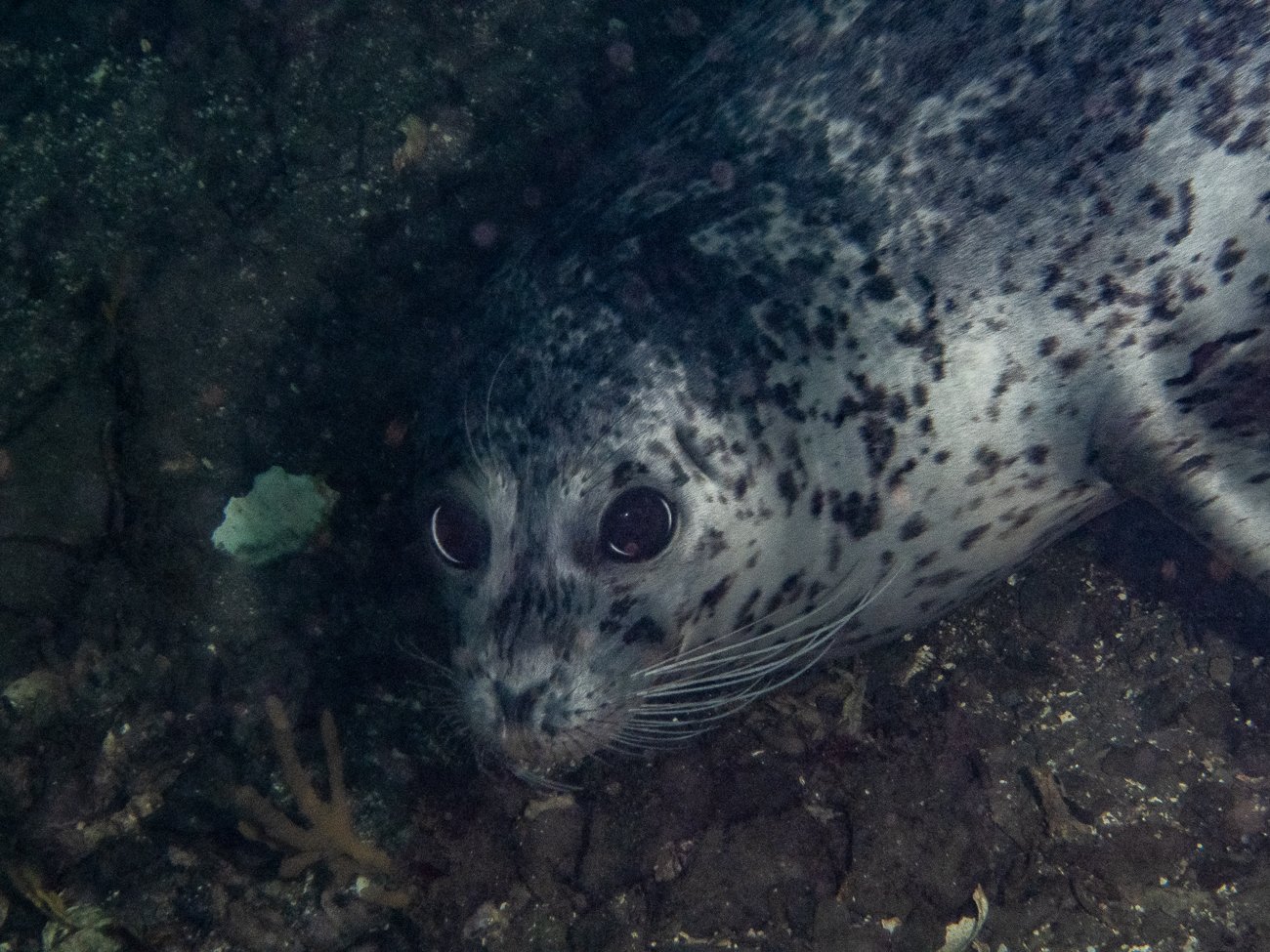
A mother harbor seal with a pup is one of the more memorable sights these waters offer. The pup stays close, surfacing beside her, learning quickly in a place where hesitation can be expensive. Bald eagles, currents, storms, disturbance, and predators do not grant many second chances.
Sea lions use the Salish Sea somewhat differently depending on species and season. California sea lions are often seasonal visitors, especially males that move north after breeding farther south. Steller sea lions maintain a broader regional presence and use haul-out sites to rest between feeding trips. Their rookeries, where breeding occurs, are generally outside the central Salish Sea, but individuals are common enough visitors that they feel like part of the neighborhood. Sea lions can live 20 to 30 years, when the ocean allows it.
Young sea lions seem born with mischief already installed. Juveniles are often the ones most interested in divers, boats, docks, and anything unfamiliar. Curiosity likely helps them develop the speed, coordination, and confidence they will need as adult hunters.
Both sea lions and harbor seals feed primarily on fish and squid, taking advantage of whatever is seasonally abundant. Herring, salmon, smelt, sand lance, and other small fish that travel in schools make up much of their diet.
A healthy prey base supports not just seals and sea lions, but seabirds, larger fish, whales, and the broader ecosystem around them.
Watching one hunt underwater changes how you think of them. The softness many people notice from shore gives way to speed, precision, and purpose. A harbor seal that looked sleepy on a log can turn into a torpedo the moment fish appear, reaching speeds of around 15 miles per hour in a burst. A sea lion that spent the morning barking on a buoy can cut through a bait ball with athletic brutality, capable of pushing closer to 25 miles per hour when it decides to move.
They are not pets of the sea. They are predators built by cold water and hunger.
They are also exquisitely adapted to the environment. A thick layer of blubber insulates them from temperatures that send divers scrambling for dry gloves and thicker undergarments. Their blood carries oxygen efficiently. During dives, heart rates can slow, and blood flow can be prioritized to essential organs. Harbor seals can remain underwater for 20 to 30 minutes, sea lions closer to 10 to 15. By the time you start wondering where they went, they are already behind you again.
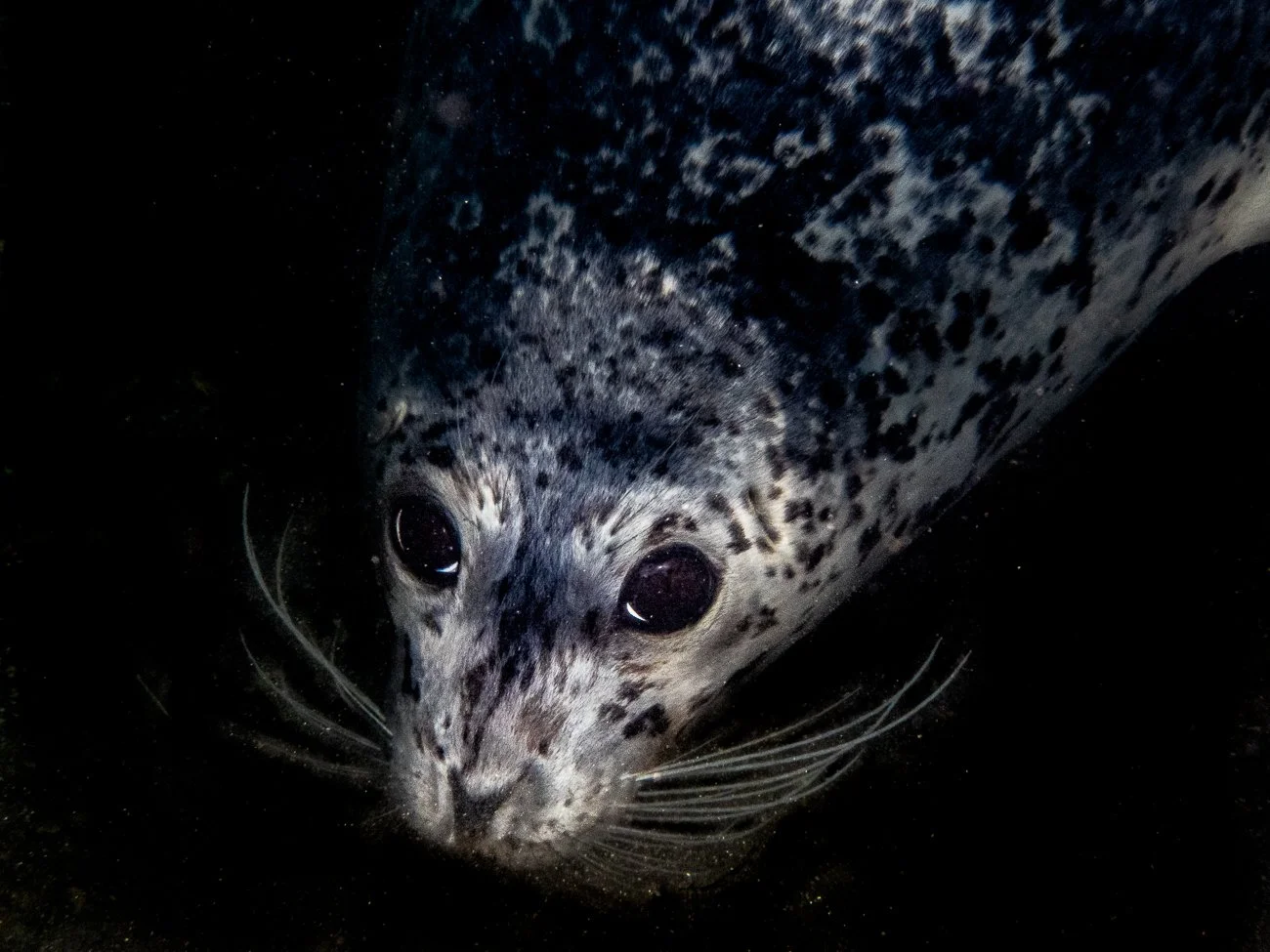
Even their whiskers are remarkable. Those stiff facial whiskers, called vibrissae, help detect movement and turbulence in the water. In simple terms, they can help read the traces left behind by prey. Long after a fish has passed, the water may still be telling on it.
Spend enough time diving here, and you begin to recognize personalities.
There was a harbor seal at Sund Rock last year that would appear near the safety stop almost every few dives, never close enough to touch, always close enough to study. It seemed to favor staying just outside arm’s reach, rotating slowly to keep one eye on me.
If I looked away, it drifted closer. If I looked back too quickly, it retreated a few feet. We repeated this silent negotiation several times over the season. A juvenile sea lion in the San Juans once became fascinated with the reflection in my dome port. It rammed the water in front of it repeatedly, then barked underwater, a strange muffled burst that vibrated more than sounded. When that failed to solve whatever problem it had with its own reflection, it sped off and returned with two companions, as though expert consultation was required.
Moments like that are funny, but they also reveal something deeper. These are social, aware, inquisitive animals navigating complicated worlds.
In the ocean, relationships are rarely simple. Sea lions and harbor seals are loved by people who watch them from beaches, ferries, marinas, kayaks, and shorelines. A whiskered face rising beside a boat can improve a day in seconds. Tourists point. Locals smile despite themselves. Children lose all composure.
To divers, they can feel like temporary companions. I have had harbor seals mirror my movements for minutes at a time. I have had sea lions thread themselves through my exhaled bubbles as if I were some new underwater fountain installed for their amusement. I have had one repeatedly swim behind me and look over my shoulder every time I tried to photograph something on the reef, apparently determined to supervise.
But friendship, in the human sense, is not really the point. Curiosity is. These animals investigate their world constantly, and sometimes we happen to be in it.
Their enemies are more serious. Bigg’s killer whales, the mammal-hunting orca often seen in the Salish Sea, prey on seals, sea lions, and other marine mammals. When they are nearby, haul-outs can empty quickly, and behavior can change in an instant. What looked lazy a moment ago becomes alertness distilled.
Large sharks are less common here than in some coastal regions, but remain part of the broader marine story. Disease, storms, and scarcity also take their toll.
Human impacts are often the more persistent challenge. Entanglement in fishing gear, marine debris, vessel disturbance, pollution, shoreline development, and depleted prey stocks can all affect populations. Even well-meaning people can cause stress by crowding haul-outs, separating mothers and pups, or forcing animals into the water.
The best wildlife viewing leaves wildlife unbothered. Give hauled-out animals space. Keep dogs back. Use binoculars instead of footsteps. On the water, slow down when needed and avoid forcing animals to react to your presence. Underwater, never corner or pursue them.
If they want to meet you, they will make that clear quickly. And when they do, it is hard to forget. There are flashier creatures in the Salish Sea. Giant Pacific octopus carry myth with them.
Wolf eels look imagined. Nudibranchs seem painted by someone unwilling to choose only one color.
Salmon carry the weight of economies and cultures. Orca arrive with instant gravity. But sea lions and harbor seals possess something rarer: personality visible at a glance.
You see it in the harbor seal hovering inches away, whiskers forward, deciding what to make of you. You see it in the sea lion that rockets in from nowhere, steals a playful tug at your fin, and vanishes before you can laugh into your regulator.
You see it in the animal that watches you watch the sea.
For those of us lucky enough to dive here, they become part of the rhythm of these waters. Never guaranteed, never scheduled, always hoped for. Every diver knows the feeling of surfacing after one of those encounters.
You climb back onto shore or boat, smiling harder than the conditions deserved. The water may have been cold, the visibility poor, the current annoying, the camera stubborn.
None of that matters now. Because for a few minutes, something wild invited you into its day. And in the green waters of the Salish Sea, that remains one of its finest gifts.
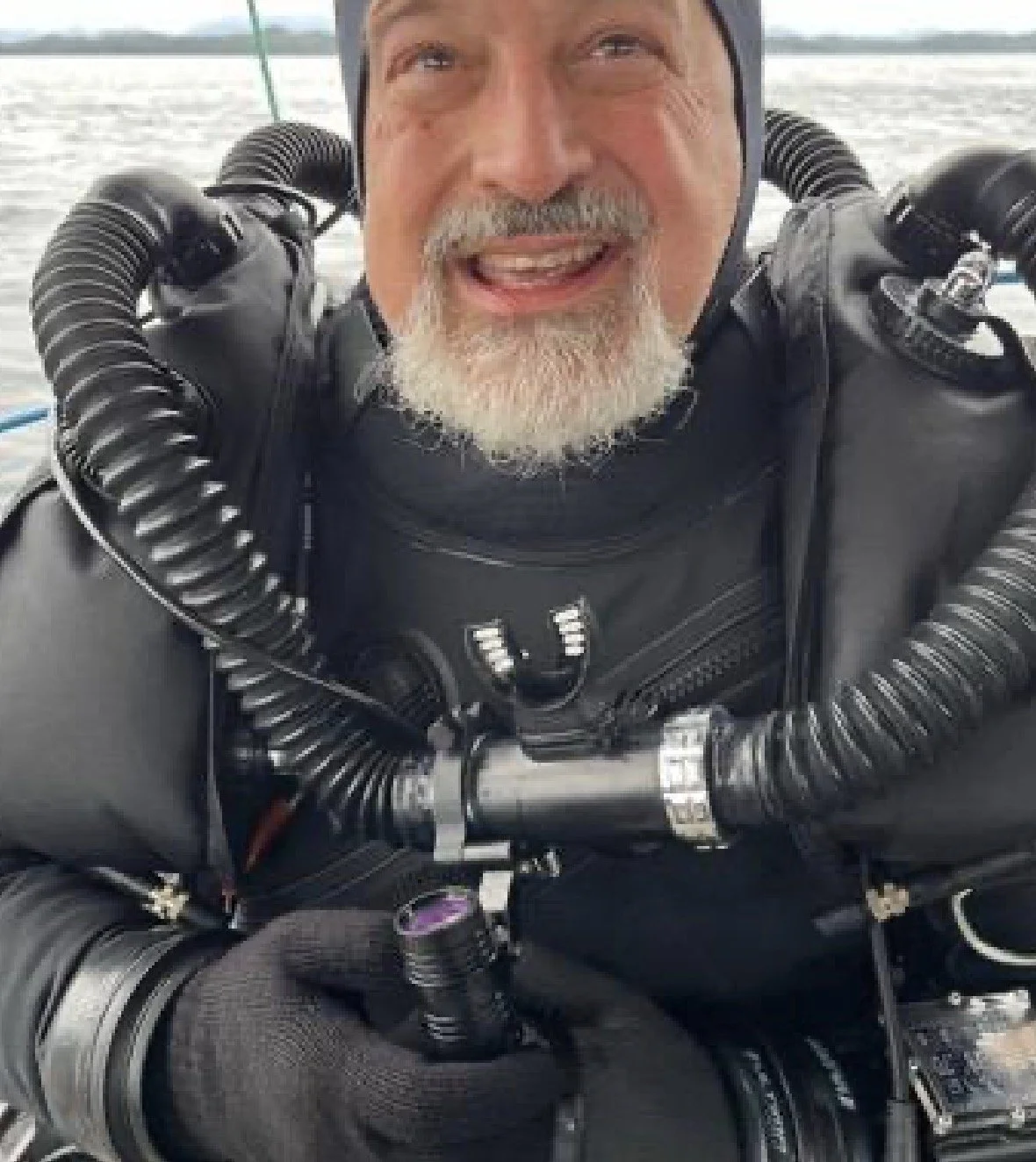
Thom Robbins is a seasoned diver, underwater photographer, and author with a deep passion for the Pacific Northwest and its marine life. With over thirty years of diving experience, Thom has spent countless hours beneath the surface, documenting the mysterious beauty of wolf eels, octopuses, and nudibranchs as well as seals and sealions. His underwater videos and photographs bring the hidden world of the Salish Sea to life, captivating both online and print audiences. He is a regular contributor to the Fjord.

Taking Care of Our Stars
Starfish, or sea stars, are some of the ocean's most fascinating creatures. They lack brains and blood, digest food outside their bodies, and can regenerate lost limbs—sometimes even growing a new starfish from a single severed arm. In the colorful, thriving world of the Salish Sea, starfish stand out for their beauty and vital role in the ecosystem.

Text & images Thom Robbins
Starfish, or sea stars, are some of the ocean's most fascinating creatures. They lack brains and blood, digest food outside their bodies, and can regenerate lost limbs—sometimes even growing a new starfish from a single severed arm. In the colorful, thriving world of the Salish Sea, starfish stand out for their beauty and vital role in the ecosystem.
Beyond their striking appearance, starfish play a crucial role in maintaining balanced ecosystems. As keystone species, they regulate the populations of other marine animals, maintaining ecosystem balance. Without them, the entire system can become unbalanced, affecting many different species.
Starfish or Sea Stars?
While 'starfish' and 'sea star' are often used interchangeably, sea star is the scientifically accurate name. The reason is simple: sea stars are not actually fish. They lack scales, fins, and gills, which are essential characteristics of true fish. Regardless of this, 'starfish' remains the popular term in everyday language!
Diving into our local waters reveals a world of intricate ecological connections, with starfish acting as caretakers, maintaining the delicate balance of their underwater habitat.

One of everyone's favorites, the Ochre Sea Star, (shown above) with its vivid shades of purple, orange, and yellow, plays a crucial role in the Salish Sea. It's role of preying on oysters, mussels, and barnacles maintains an intertidal population balance and diverse marine ecosystem. Some aquaculture farmers may not agree, but without sea stars, oysters would dominate the habitat and disrupting the ecosystem balanc
30 Local Stars
Of the 2,000 species worldwide, over 30 sea stars are found locally, adapted to the cool, nutrient-rich waters. This includes the vibrant Rainbow Star, known for its striking red and orange hues, often seen in rocky subtidal areas. This species is an active predator, feeding on urchins, snails, and even other starfish. Another intriguing species is the Vermilion Star, which inhabits deeper waters and stands out with its bright red hue. It primarily feeds on sponges and small invertebrates, slowly moving along the seafloor for prey.
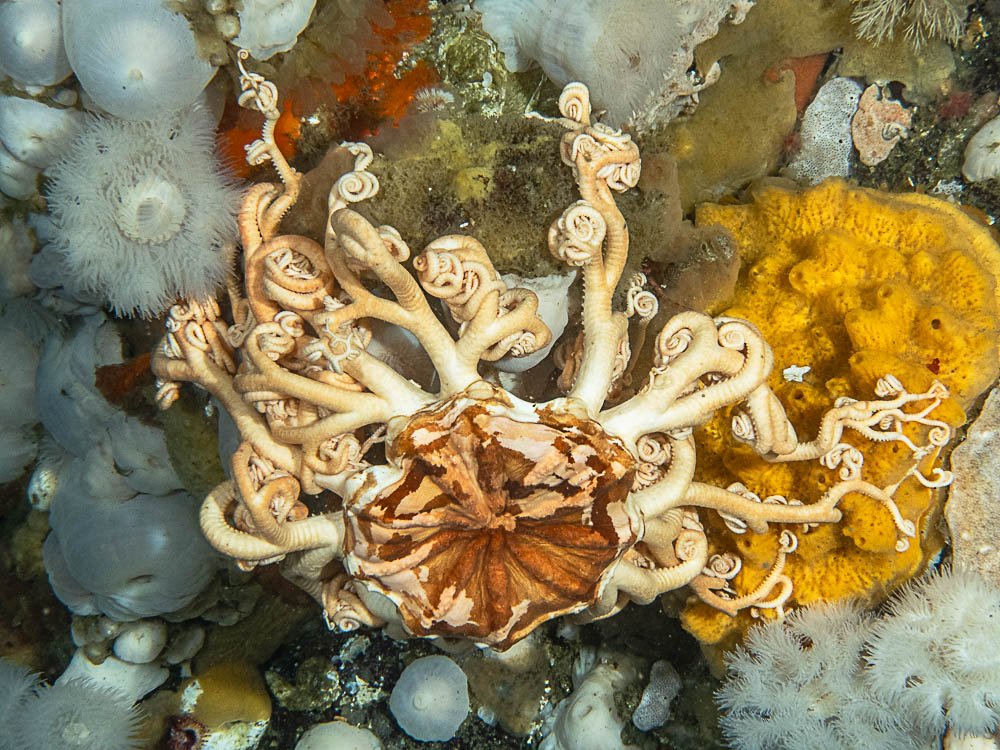
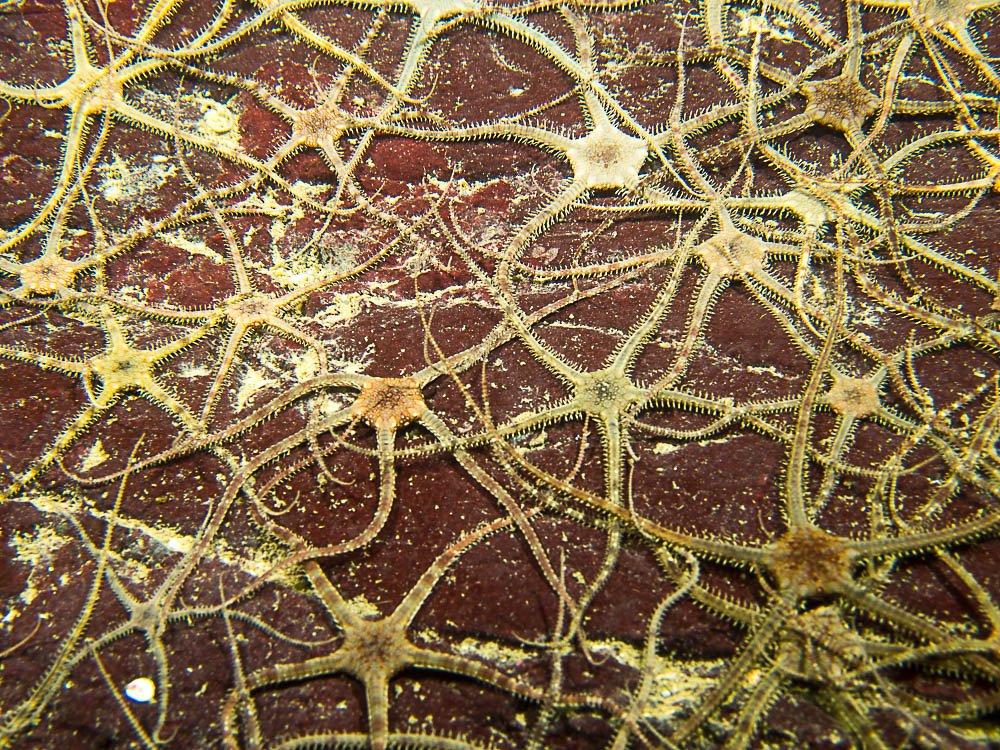
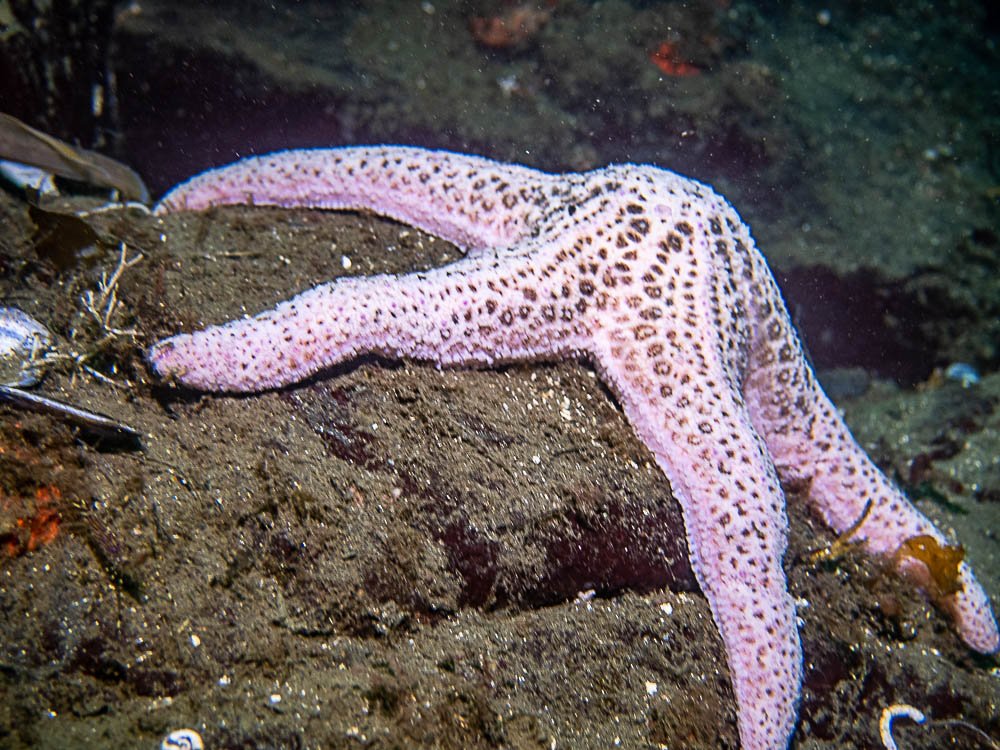
Starfish belong to a diverse group of marine animals called echinoderms, which include sea urchins, sand dollars, and sea cucumbers. Echinoderms are characterized by radial symmetry, often with a five-point structure, though some species can have more arms. They also have unique skin, which ranges from smooth and velvety to spiny and rough. Their internal skeleton is made of calcium carbonate plates, giving them strength and flexibility.
Water for Blood
Instead of blood, sea stars pump seawater through a network of canals called the water vascular system. This system powers their movement, helps them breathe, and delivers nutrients throughout their bodies. By filtering seawater stars can absorb the oxygen and nutrients they need to survive.
By pumping seawater, they extend and retract tiny tube feet on their arms, which act like suction cups. This enables them to crawl across the ocean floor, clinging to rocks and rough surfaces. Some species do this surprisingly fast. the Sunflower Sea Star can travel up to a meter per minute!

Vermillion Star
Some sea stars use their suction-cup tube feet to pry open mussels, clams and oysters, exerting pressure with their tube feet up to ten times their body weight, giving them the power to open even the most tightly closed shells.
Once a starfish has pried open a shell just enough, it does something extraordinary—it extends its stomach out of its body and into the shell. This allows it to digest the prey externally, turning the meal into a liquid form that it can absorb into its body. This method of external digestion makes it easier for starfish to consume prey that would otherwise be too large to eat.
Each species has evolved distinct feeding strategies. For instance, the Leather Star has been known to drill tiny holes into the shells of its prey, providing access to hard-to-reach food sources.
A New Limb
One of the most fascinating features of starfish is their incredible ability to regenerate. Losing a limb isn’t the end for a starfish; it’s an opportunity for renewal. They can grow back a severed arm and, in some cases, even regenerate an entire body from just a part of a limb, as long as it includes part of the central disc.
This ability comes from specialized cells in their arms that can transform into the various types of cells needed for regrowth. This regenerative power helps them escape predators, heal from injuries, and even reproduce, making them incredibly resilient. Scientists are studying this ability not just to understand marine life better but also to explore its potential applications in medical research, offering new insights into how cells can regenerate and repair.

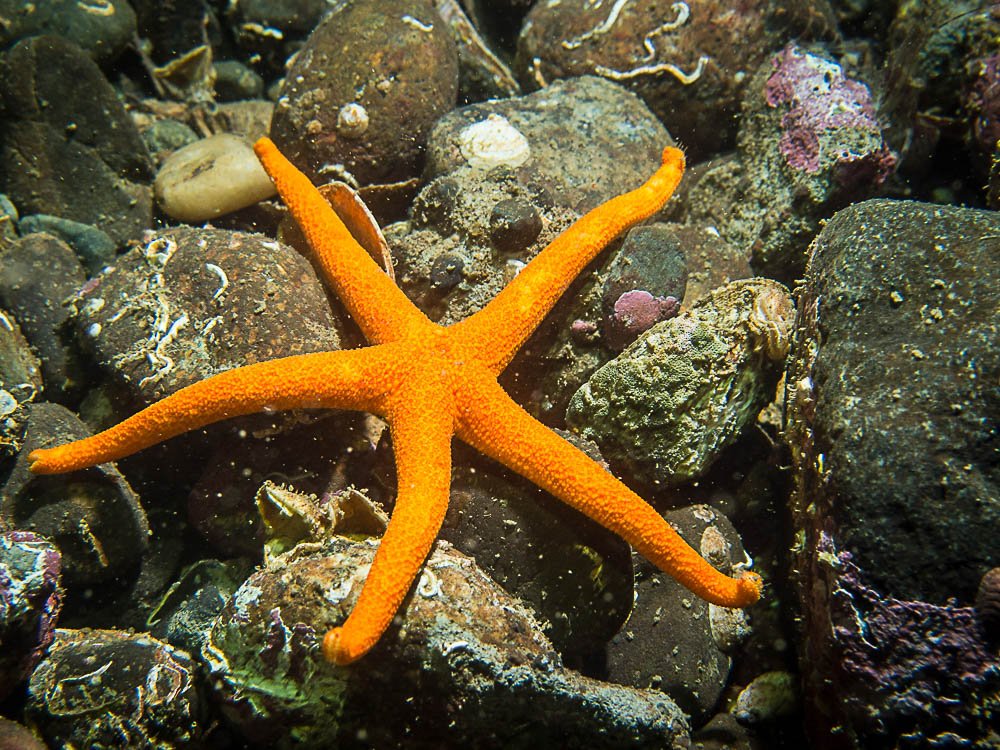
Each starfish species has adapted to thrive in its niche within the diverse marine environment. For instance, the Blood Star is well-suited to the cooler, deeper waters of the Pacific, where it feeds primarily on organic detritus and sponges. Unlike intertidal species, the Blood Star can be found on rocky reefs and sandy bottoms. Its bright red or orange coloration helps it stand out. Yet, it has developed the ability to blend into its surroundings when threatened, making it resilient and adaptable.
Deep-dwelling species like the Giant Pink Sea Star prefer the quiet, dark seabed. These starfish are found moving across the ocean floor, searching for prey like sponges and other slow-moving animals. The Velcro Star is known for its smooth, fluid movement. Their tube feet glide effortlessly over different surfaces in a coordinated, wave-like pattern. This technique lets it navigate tricky terrains, such as rocky crevices and dense kelp beds, with agility and speed. Its graceful movement, combined with a varied diet of algae, small invertebrates, and detritus, makes the Velcro Star highly adaptable across Pacific marine habitats.
The Bat Star, are often found in tide pools using their arms to sense the world around them. Each species has found a way to survive and thrive, whether braving the harsh intertidal zone, navigating the deep sea, or at home in tide pools.
Who needs a Brain?
Starfish have a decentralized nervous system rather than a central brain. This system consists of a nerve ring around their mouth, which connects to radial nerves running down each arm. Each arm acts independently, allowing the starfish to respond to its environment without a central control center.

The radial nerves help the starfish detect changes in temperature, light, touch, and the presence of chemicals in the water. Starfish may not have eyes like ours, but their keen sense of their surroundings helps them survive and thrive in a complex and sometimes harsh environment. Through research, conservation efforts, and sustainable practices, we may ensure that these celestial emblems of the ocean continue to thrive.
Starfish Lifecycle
The lifecycle of a starfish begins with species releasing vast clouds of sperm and eggs into the water, allowing fertilization to occur freely in the open sea. Once these eggs are hatched, starfish begin life as tiny, free-swimming larvae called bipinnaria. The larvae look nothing like their star-shaped adult selves. They resemble translucent creatures with cilia that help them move. Feed on microscopic plankton, life is perilous for these young starfish. They drift with the currents, exposed to predators and other dangers, with only a fraction progressing to the next development stage. They gradually transform into brachiolaria larvae, developing the first signs of the star-like body.

After months of drifting, the larvae transform dramatically, settling onto the seafloor and developing into juvenile starfish. This stage is crucial as they switch from a free-swimming lifestyle to one anchored to the ocean floor. Once settled, they start to look more like the familiar star-shaped adults, with their tube feet ready to help them move and search for food. Different species have their unique spawning behaviors. The Sunflower Sea Star, known for its speed and many arms, can produce thousands of eggs simultaneously, increasing the chances that some will survive despite the high predation risk. In contrast, the Leather Star releases fewer eggs throughout the season, spreading their reproductive efforts. Starfish have surprisingly long lifespan. The Red Sea Star lives up to 20 years. Their longevity allows them to play a vital role in maintaining the balance of their ecosystems. Each stage of their lifecycle, from tiny drifting larvae to powerful adult predators, is a testament to their resilience, intricately linked to the currents and tides.
Wasting Disease

Starfish wasting disease
Sea stars are adapted to withstand harsh conditions, like as pounding waves, intense heat, and dry low tides. However, during the 2014-2016 marine heatwave, ocean temperatures made them more susceptible to sea star wasting disease causing a populations decline from Mexico to Alaska. Sea star wasting disease (SSWD) is a condition that causes lesions, limb loss, and disintegration. It has been linked to Sea Star-associated Densovirus (SSaDV). Researchers have found higher concentrations of this virus in sick sea stars compared to healthy ones. The virus attacks their tissues, breaking down the body and spreading through shared habitats and even the water. This has been especially devastating for the Sunflower Sea Star. By 2021, it was estimated that up to 90% of the West Coast Sunflower Sea Star population were lost due to this disease. As a primary predators of sea urchins, their absence has led to a surge in urchin populations. Sea urchins began to overgraze kelp forests, resulting in "urchin barrens," areas where kelp has been decimated, leading to the loss of shelter and food for fish and invertebrates. This imbalance's ripple effects highlight how crucial sea stars are to maintaining a healthy ecosystem. Their decline affects the immediate species they prey on and can lead to broader shifts, impacting the entire marine food web. Researchers are exploring solutions including breeding disease-resistant sea stars. Some facilities have raised sea stars in captivity and released them into the wild, hoping to restore populations and introduce more resilient individuals. While challenges remain, efforts continue to understand this devastating disease.
As keystone species, starfish play a critical role in aquatic ecosystems. Today, starfish face numerous threats, from rising ocean temperatures and pollution to habitat loss and the spread of sea star wasting syndrome. Conservation efforts, such as breeding disease-resistant starfish and monitoring sea star health, are crucial to ensure these creatures continue to thrive.

Roam Wolfdog Sanctuary Offers Education Tours
Nestled in the forest outside Shelton in Mason County, the ROAM Wolfdog Sanctuary provides a home for some of the most misunderstood animals in the world—wolfdogs.
Story: Jeff Slakey
Amongst the woods outside Shelton, off Highway 101, the ROAM Wolfdog Sanctuary provides a home for some of the most misunderstood animals in the world—wolfdogs. On a sprawling 40-acre property, the sanctuary educates the public, advocates for conservation, and provides a safe, enriching life.

photo credit: ROAM Wolfdog Sanctuary
Every wolfdog at ROAM has a story, and most share a similar beginning. They were bred to be pets, then abandoned or surrendered when their owners realized they weren't suited for a domestic lifestyle. "All of these animals here were bred to be somebody's pet," explains Jody Woolard, sanctuary's founder. "They want to mimic something that looks like it just walked out of Yellowstone Park, but they require a lifestyle that most people aren't prepared for."
Unlike dogs, wolfdogs have wild instincts that make them difficult to manage in a home environment. They require large enclosures, an all-raw diet, and specialized care. Many are high-content wolfdogs, meaning they have over 90% wolf DNA. While some enjoy meeting people, others take their time warming up to new faces.
One of the biggest misconceptions about wolfdogs is that they make good guard dogs. In reality, they tend to be skittish rather than protective. "They are not house pets," Woolard says. "They need to be outside. They need enclosures with eight-foot-tall fencing and dig guards so they can't escape."
Their diet is also unique. "They eat raw," says animal caretaker Reanna Warren. "Chicken, steak, pork—sometimes beef, but they're picky. They won't touch boneless, skinless chicken, and if it's ground beef, it has to be frozen."
ROAM is not only a shelter—it's a permanent home for its residents. Each enclosure spans about an acre, giving the animals space to roam while protecting the public. "We try to create an environment for them that is as natural as possible," Woolard says. "In the winter, we get snow, which they love. And in the summer, the forest keeps it from getting too hot."
Community plays a role in keeping the sanctuary running. Volunteers come to help clean enclosures and construct new habitats. Food donations come from local grocery stores and hunters. For visitors, a tour of ROAM is a chance to see these animals up close and learn about wolves' vital role in the ecosystem. "Wolves keep deer and elk populations in check, which benefits many other plant and animal species," explains Woolard. "But in some regions, they're still being hunted. Nearly 1,000 wolves in the Northern Rocky Mountains were killed last year alone."
Touring ROAM
Tours at ROAM last about 90 minutes and offer an up-close look at the lives of these animals. Visitors can witness a playful interaction between Issabel and Kovu, a bonding moment between Pretty Boy Floyd and Felony, or even hear the pack's haunting howls echoing through the trees. "Two of our neighbors leave their windows open at night just to hear the howling," Woolard shares.
As a nonprofit 501(c)(3) organization, ROAM relies on donations and sponsorships to continue its mission. "Every year, wolfdogs are abandoned, rescued, or euthanized because people purchased an animal they weren't prepared to care for," says Woolard. Sponsorships cover food costs, medical care, and facility maintenance, ensuring the wolfdogs can live out their life safely and comfortably.
Another way you can help is by spreading awareness about ROAM, the wolfdogs, and the importance of conservation. "Education is key," Woolard says. "The more people understand these animals, the better we can protect both them and their wild counterparts."
So, if you're a wildlife enthusiast, an advocate for conservation, or someone looking for a unique experience in Mason County, a visit to ROAM Wolfdog Sanctuary is sure to leave you with a newfound respect for these remarkable animals.
To learn more or schedule a tour, visit their website, roamwithus.org or come to ROAM with the pack. The Guided Educational Tours at Roam cater to wildlife enthusiasts, animal lovers, students, and families seeking an enriching and educational experience. This exclusive opportunity allows guests to engage with wolfdogs in a meaningful way and support the sanctuary's mission of promoting coexistence and understanding between humans and wildlife.
BIRDS OF A FEATHER FLOCK TOGETHER
Birding in the Pacific Northwest is more than checklists and binoculars. From wetlands and estuaries to forest trails along Hood Canal, this guide explores how modern birding blends technology, community, and quiet observation—highlighting local places in Mason County where birds and birders naturally gather.
H/T Tracing The Fjord | Winter ‘25 | STELLA WENSTOB | olympicbirdtrail.com
Those folks obsessed with bird identification? Yes, birders—and they’re far cooler than the stereotype suggests.
Once caricatured as binocular-toting nerds with overstuffed packs and dubious dried banana chips, today’s birders are more likely carrying a smartphone than a color-coded guidebook. Nerdy, it turns out, is in. Modern birding trades paper for sleek apps like iBird and iNaturalist, making it easy to identify, log, and even crowdsource sightings—all while contributing to real scientific understanding.
In the Pacific Northwest, with its remarkable variety of birdlife, birding is about far more than snacks and checklists. It’s an inviting way to slow down, look up, and connect with the natural world.
Getting Started
The Audubon Society is a great place to start if you’re just dipping your webbed foot into the vast waters of birding. Their website offers a free birding app, engaging articles, and access to hundreds of local chapters—five in the Olympic-Kitsap Peninsula area alone—that host birding classes, walks, and events.
One of those events is the longest-running bird census in the world: the Christmas Bird Count. Now entering its 125th year, the count gathers data from volunteer birders across North and South America. It was developed as a replacement for the old holiday “side hunt,” a competitive tradition among hunters that focused on the most game taken over the season.
Learning From the Nest
If the weather is too nasty to head outside, stay in your nest and feather it with avian knowledge. The Audubon Society offers online courses, including interactive Zoom lectures with local experts. The Cornell Lab of Ornithology provides more in-depth, accredited bird identification courses, along with plenty of solid free basics.
The Washington Ornithological Society and American Birding Association also offer a digital, up-to-date version of A Birder’s Guide to Washington. While it doesn’t help with identification, it provides an exhaustive list of where to find species and helps plan productive birding adventures.
Birding Mason County
If you’re ready to venture out in wintery weather, Mason County is teeming with migratory and year-round resident birds. Hit the trails and start scanning the skies, vegetation, and waterways.
Pack binoculars, a scope, digital camera, or smartphone (with iBird and Audubon maps downloaded). Old-school works too—just a notepad and pencil. Wear good walking shoes and weather-appropriate clothing.
Almost every green space—backyard or state park—offers birding potential. To honor the spirit of road trips and the hallowed practice of list-making, here are a few favorite local birding haunts.
For the Birds
Hilburn Preserve
The Capitol Land Trust Hilburn Preserve, just off Highway 101 west of Shelton, features an easy half-mile loop beside the lively Goldsborough Creek. The wooded habitat is ideal for spotting woodland birds such as Red-breasted Sapsucker, Hutton’s Vireo, Pacific Wren, and Cedar Waxwing.
Bayshore Preserve
Leaving Hilburn, head east on Railroad Avenue toward downtown Shelton, then north on Olympic Highway South. Turn right onto Highway 3 (East Pine Street), which follows Oakland Bay to the Bayshore Preserve.
This Capitol Land Trust property is part of the Great Washington State Birding Trail. Oak savannas border the shoreline and Johns Creek outflow. Peregrine Falcons have been spotted perched in the oaks, while Great Blue Herons frequent the open areas. Scan the bay for waterfowl diving in warmer waters.
Mary Theler Wetlands Nature Preserve
Located just outside Belfair (22641 WA-3), this 139-acre preserve protects estuarine habitat along the Union River delta. Marshlands, meadows, forests, and tidal waters support impressive wildlife diversity.
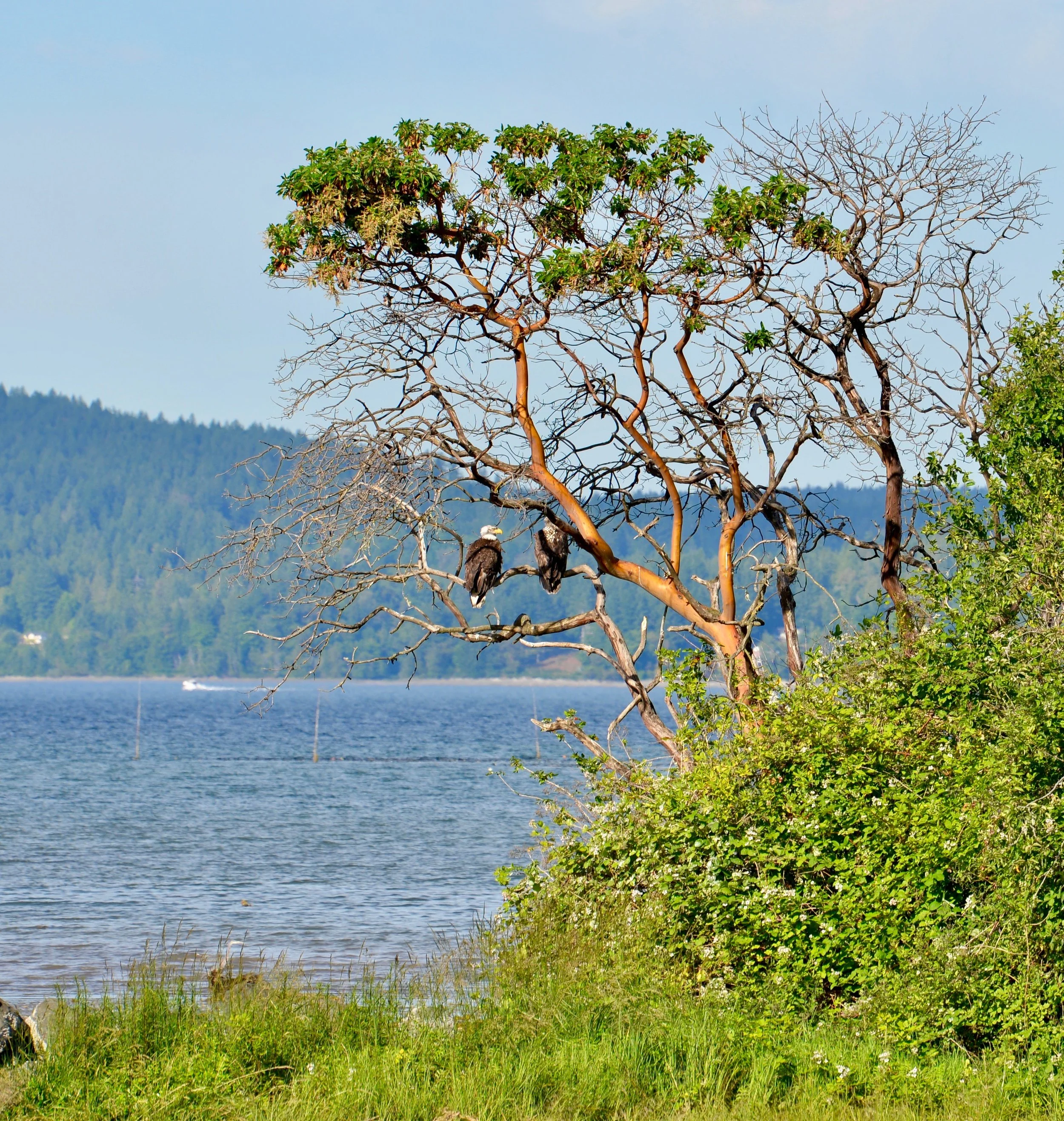
Five trails highlight different habitats, some with views of the southern Olympic Mountains. The River Estuary Trail—built atop breached dikes—offers sightings of river otters, Belted Kingfishers, and Great Blue Herons. Pools host Northern Pintail, Green-winged Teal, Common Merganser, and a wide range of shorebirds. Bald Eagles are commonly seen.
Twanoh State Park & Skokomish River Delta
Backtrack along Highway 106 toward Hood Canal to reach Twanoh State Park. With over 182 acres of forest and shoreline, it offers both terrestrial and marine birding. The 2.5-mile inland trail is reliable for Red Crossbills and Brown Creepers.
Continuing through Union brings you to the Skokomish River delta, rich with waterfowl such as Mallard, Northern Pintail, Red-breasted Merganser, and large flocks of American Wigeon. Bald Eagles are frequent here.
Hood Canal Corridor
Heading north on Highway 101 keeps you alongside Hood Canal, with strong birding stops at Potlatch State Park, Lilliwaup Creek, Eagle Creek, and Jorsted Creek.
At Jorsted Creek, pilings from an old log dump serve as roosts for all three species of cormorants. Lacking water-repellent oils, these birds are often seen perched with wings spread to dry.
The Hamma Hamma River estuary is another productive area and home to a nearby Great Blue Heron rookery.
Dosewallips State Park
The final stop on this list, Dosewallips State Park spans more than 1,000 acres of river, estuary, shoreline, and mature forest. Known for Roosevelt Elk and curious seals offshore, it also supports a wide range of bird species.
The North Tidal Trail crosses marshes and offers excellent winter views of migrating Trumpeter Swans.
The parks and preserves of the Pacific Northwest offer outstanding birding opportunities. Birds of a feather flock together—and birders are never far behind.
For more information on fjord birding, visit olympicbirdtrail.com.
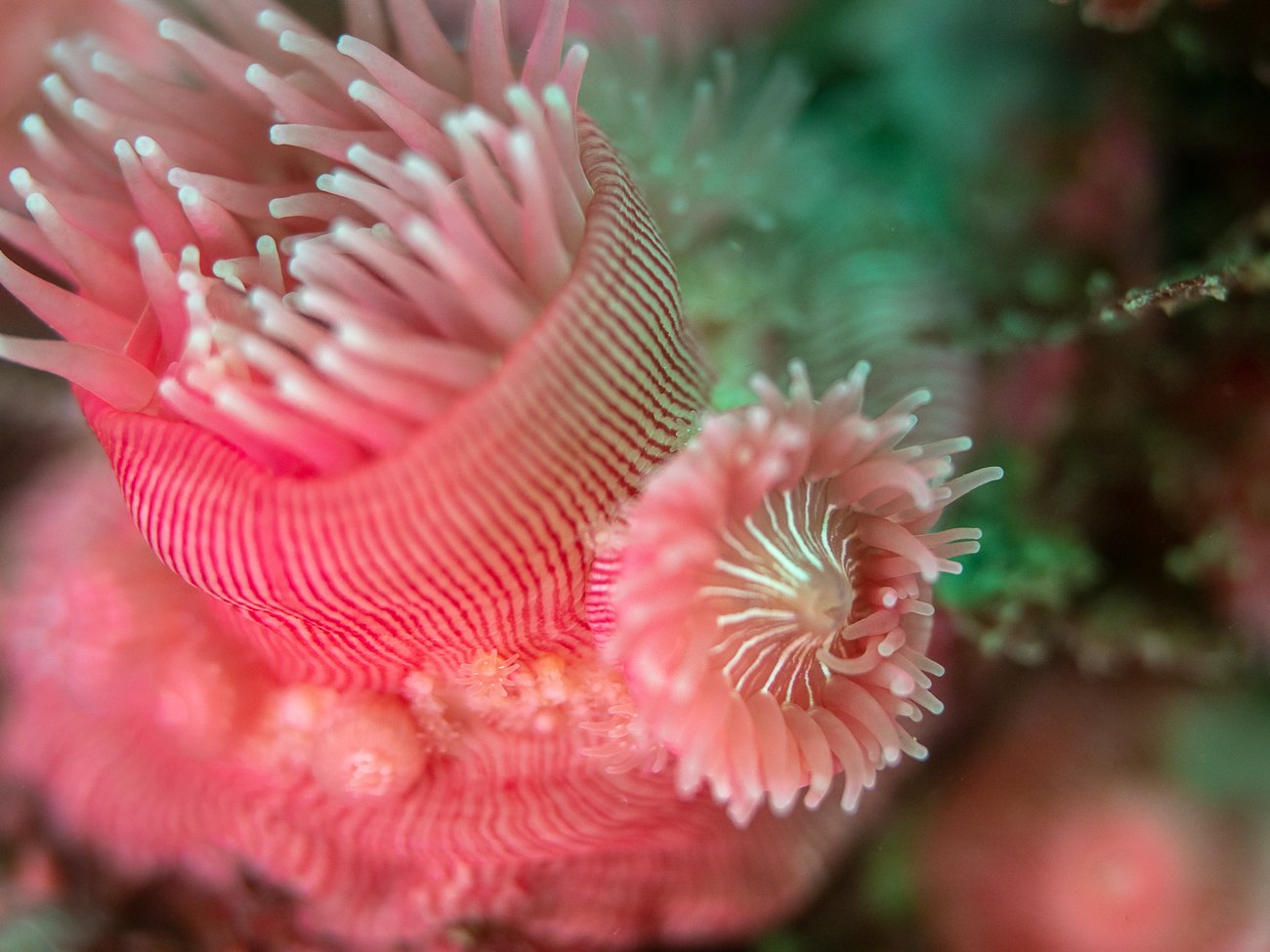
THE STILL ONES: LIFE AMONG PACIFIC NORTHWEST ANEMONES
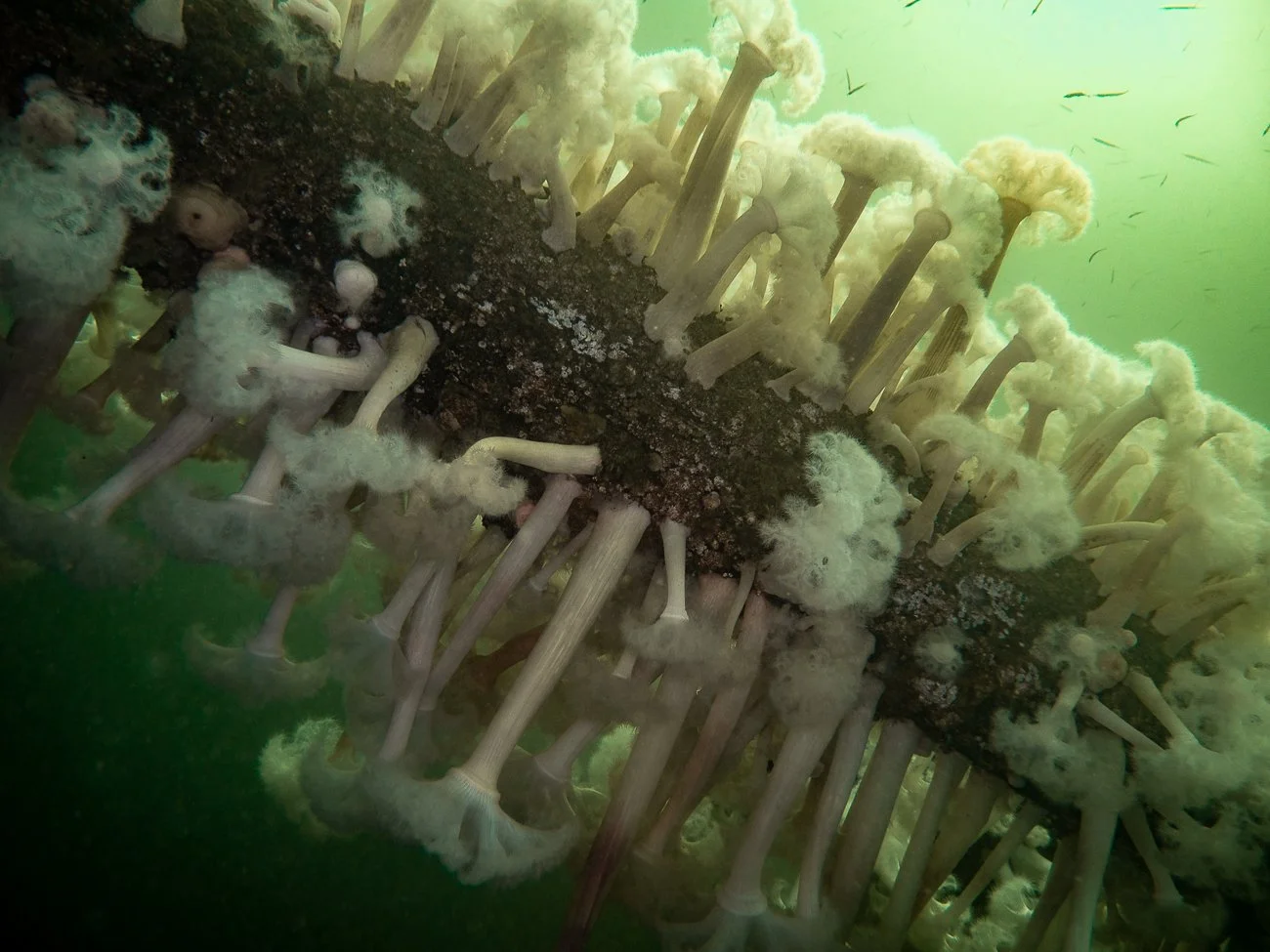
Drop beneath the surface of Hood Canal and the noise of the surface fades away. In the cold green water, sea anemones reveal themselves not as simple flowers, but as hunters, shelter, and the steady framework of the underwater world.
STORY & IMAGES: THOM ROBBINS
H/T Tracing The Fjord | Winter ‘25
Drop beneath the surface of Hood Canal, and the world does something strange. The noise you never realized you carried slips away. The cold presses close, the green water folds around you, and what felt familiar on the surface becomes something older, slower, more deliberate. Down here, even the smallest things can pull your attention, and few creatures lure you in like anemones.
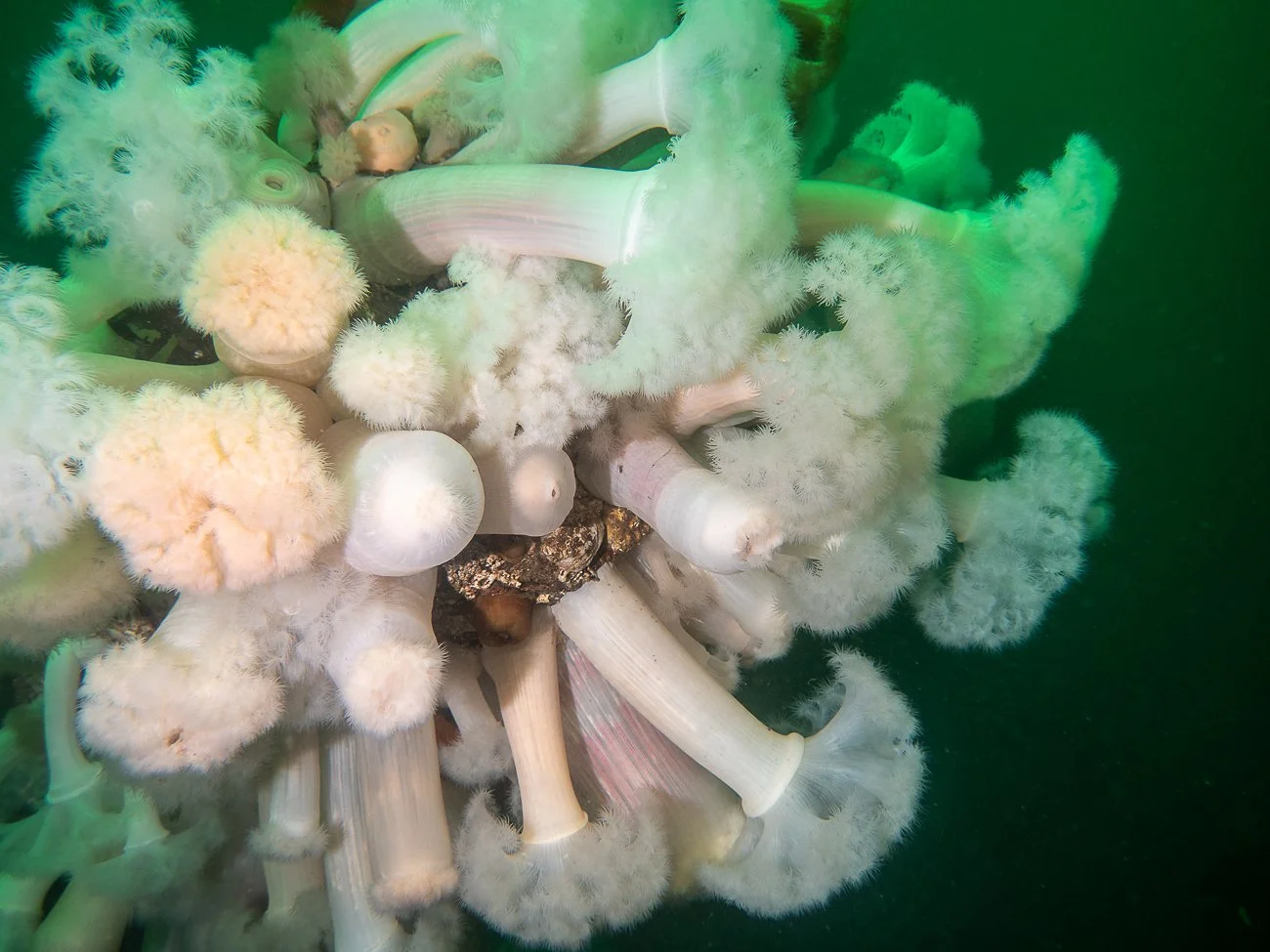
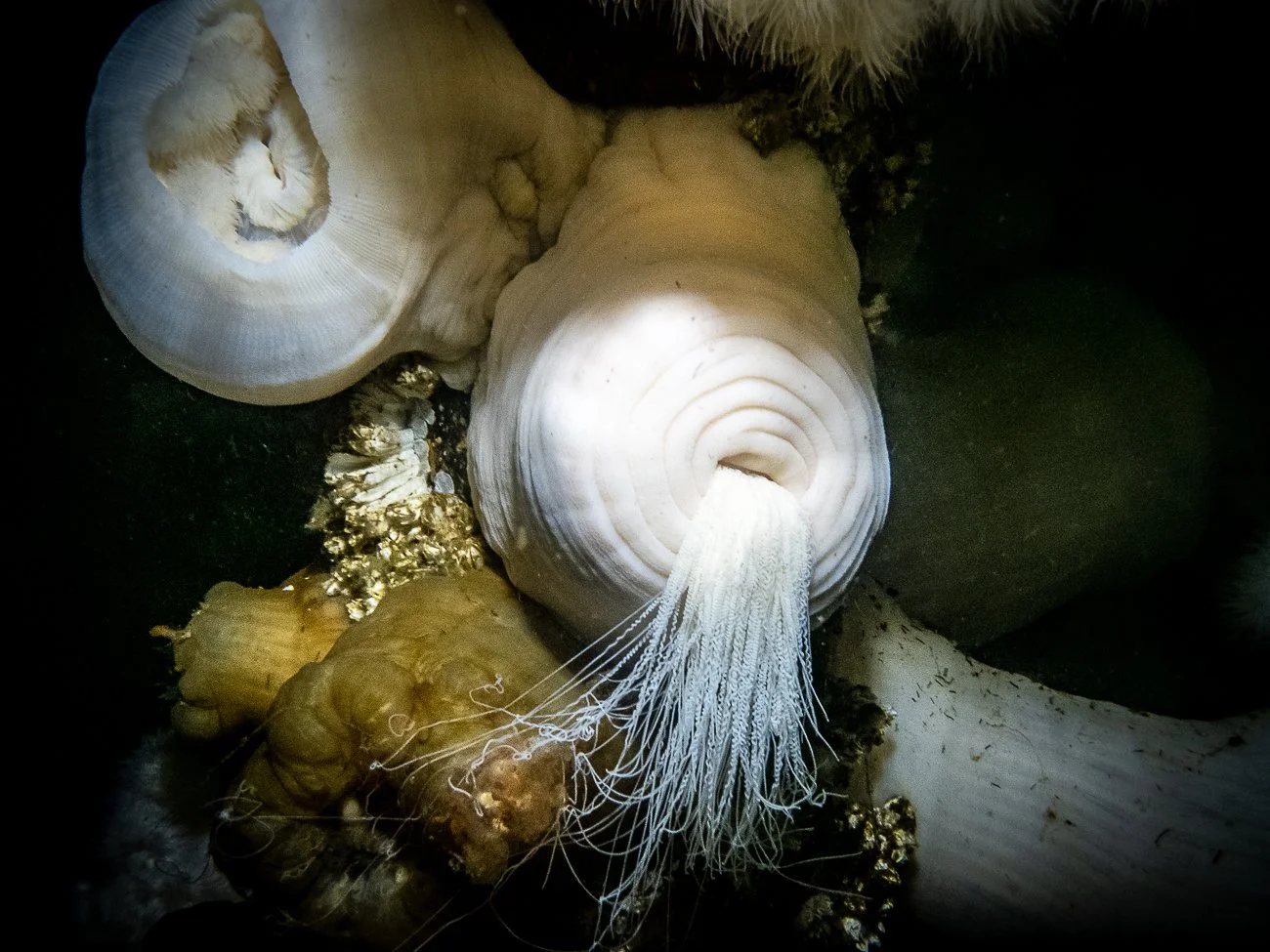
The first time I hovered eye-level with a pair of orange-and-white plumose anemones, anchored together, I realized I’d stopped breathing. They rose from the rock like a lantern someone forgot to snuff out, their feathery rings swaying with the patience of something that had never once needed to rush. I had dropped into the water that day looking for wolf eels, maybe a wandering Pacific octopus if I was lucky, but instead I found myself suspended in the water, staring at a creature that held the whole moment in its grip.
The light from my dive torch slid across its surface, and the anemone flared gently, as if waking. The muted fire of orange and white felt older than anything else on the reef. I stayed there longer than I meant to, caught by something anchored in place, looking back without eyes and waiting without fear.
People often imagine anemones as simple flowers of the sea. They are anything but. Spend enough time underwater with them and you see the truth: they are predators, architects, survivors, and quiet powerhouses of the Pacific Northwest. They feed the ecosystem, help shape the seafloor, and provide shelter for everything from tiny shrimp to juvenile rockfish.
And they manage all of this without ever taking a single step.
Up close, anemones feel uncanny in a way only the sea manages—rooted creatures that still seem alert and watching. Divers tend to lump them together, these bright creatures pinned to the rocks, but the truth is far older and stranger than it appears. They all belong to the same ancient lineage, the class Anthozoa, animals that appeared long before fish, long before bones, long before anything with a face to show its intent.
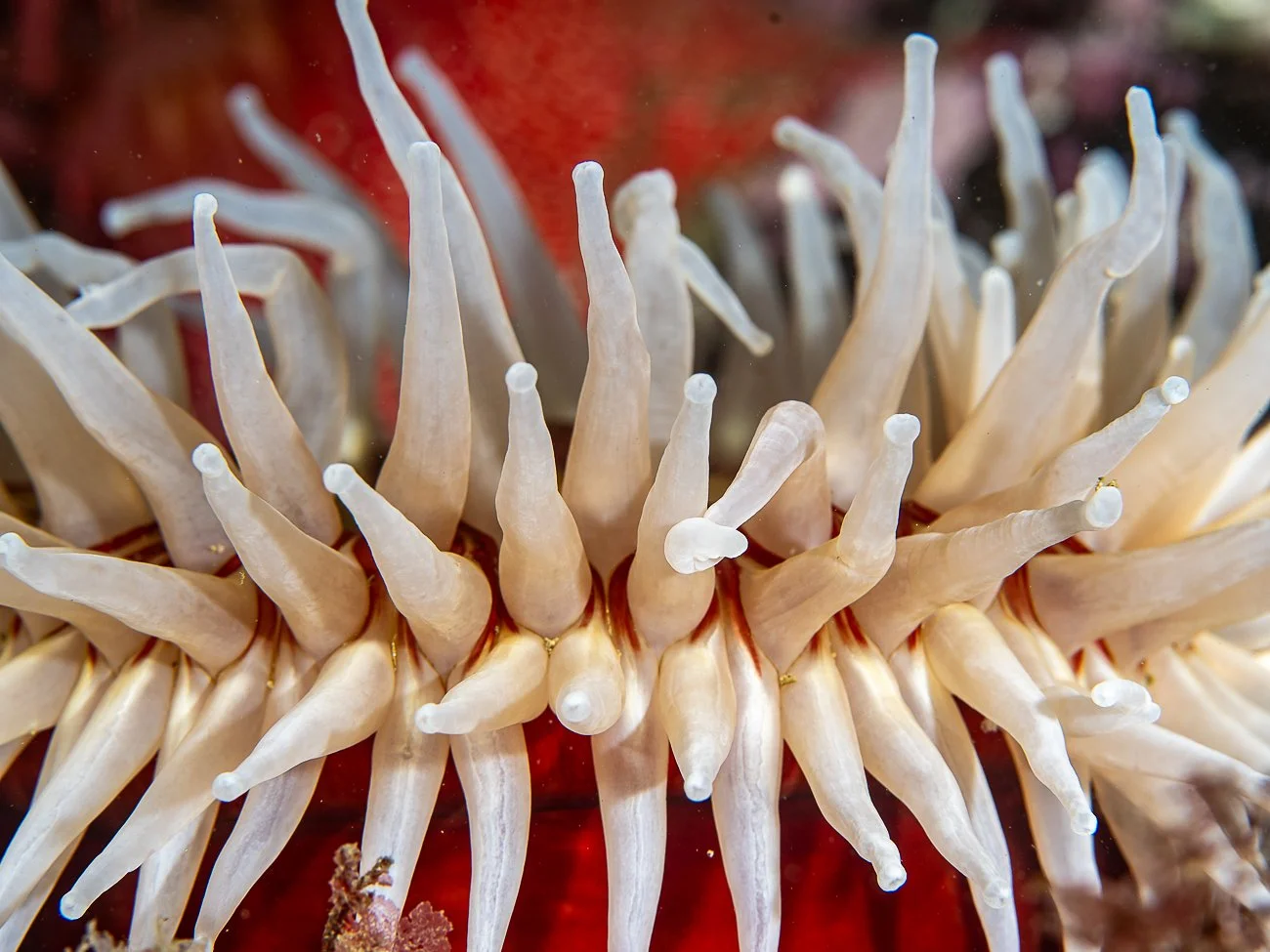
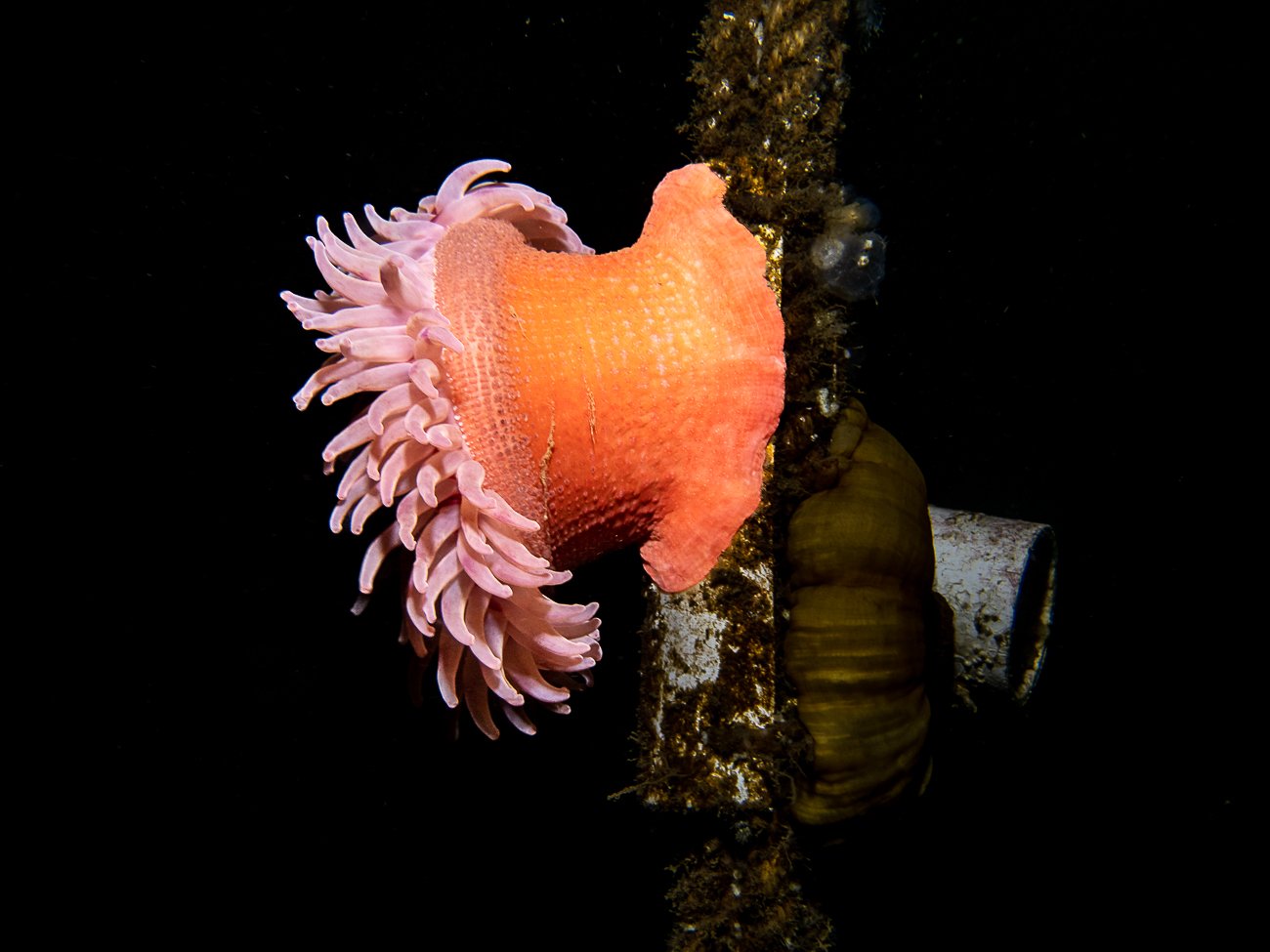
Each anemone follows a familiar blueprint: a soft column crowned with tentacles and anchored by a disc. That disc holds the animal to rock, piling, sand, or shell and lets it ride out currents that could peel skin from stone. For a few species, it even becomes a getaway tool. When conditions turn bad, some Pacific Northwest anemones release their grip, inflate slightly, and drift away like pale balloons searching for safer ground.
Stillness is their choice, not their limitation.
In the Pacific Northwest alone, there are several dozen species of sea anemones. Within that shared design, each species holds its own personality, its own way of surviving a world that rarely shows mercy. Some anemones are patient hunters, waiting for fish or shrimp to brush against their tentacles so their stinging cells can fire like tiny traps tucked inside a single hair. Others are filter feeders, living a life where the current does the work, sweeping plankton across their tentacles. A few do both, depending on what the tides bring, switching strategies the way a writer changes pens—steady and deliberate.
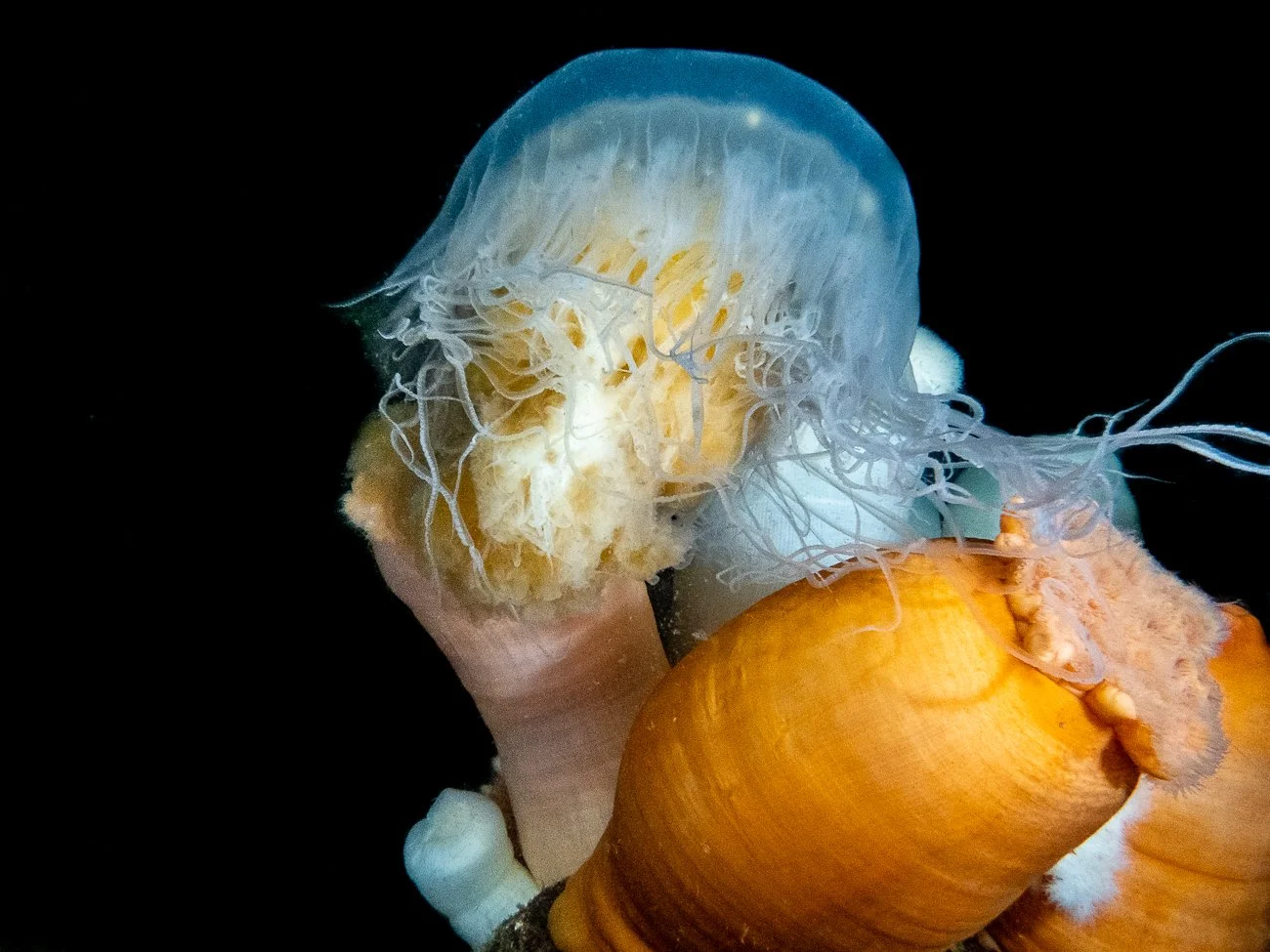
Some swallow crabs whole. Others feed on jellies. Some are as small as scattered beads on the rock, and others rise tall enough to brush a diver’s mask.
They are family in the scientific sense, but in the water, they feel more like estranged relatives gathered in the rooms of the same old house. They share the same history, but each carries its own hidden secrets. Some shimmer with light borrowed from algae living inside them. Others wage quiet chemical war against their neighbors.
A few clone themselves into armies that spread across the seafloor like a slow tide. Others, despite their rooted appearance, quietly unstick and sail off into the dark if the world around them shifts.
They may look decorative at first, but spend enough time with them and the illusion dissolves. Beneath the calm is intention. Beneath the color is strategy. And beneath the soft drift of tentacles is a creature that has been perfecting survival since before the ocean knew anything more complicated than hunger and light.
Once you start paying attention, their structure begins to make sense through function rather than form. At the top, the tentacles guard a single opening that leads into the coelenteron, the chamber where circulation, digestion, and waste share a common path. There is no heart or specialized organs, only water moving through the body to do the work. It is simple on the surface and efficient beneath, a design nature created early and never had reason to revise.
If you understand that basic framework, the distinctions between species sharpen, almost like personalities rather than anatomy.
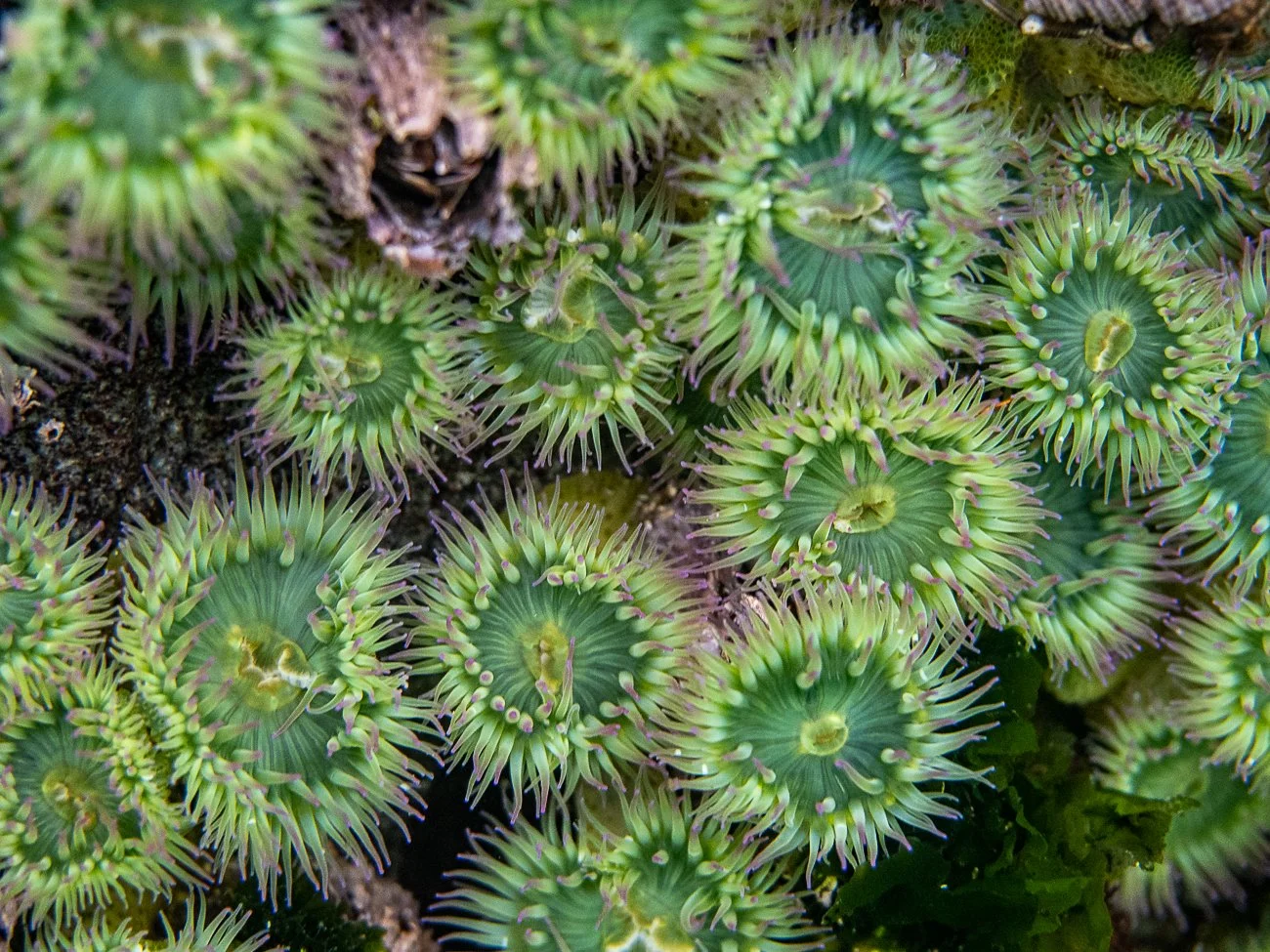
Giant green anemones are usually the first to pull you in, their bodies lit from within as if they are holding on to every bit of sunlight they ever borrowed. The color runs deeper than the tissue because of the algae living inside their cells, tiny partners trading photosynthesis for shelter. Brush too close and the whole ring of tentacles snaps shut, quick and certain, a reflex shaped by millions of years of ambush. To us, the sting is little more than a pinprick. To anything small enough to count as prey, it is a door shutting for good.
Plumose anemones follow the same plan but stretch it into something ghostly. They rise from pilings and rocky shelves as pale towers, their feathery tentacles blooming under a dive light. They do not hunt so much as gather. They stand in the current and let the world pass through their arms, sifting plankton with steady ease. On night dives, they look like candles lining some forgotten aisle, pale glimmers flickering each time a tide pulse rolls through. I have floated among them with only my breath for company and felt, for a moment, that I had wandered someplace sacred and not entirely safe.
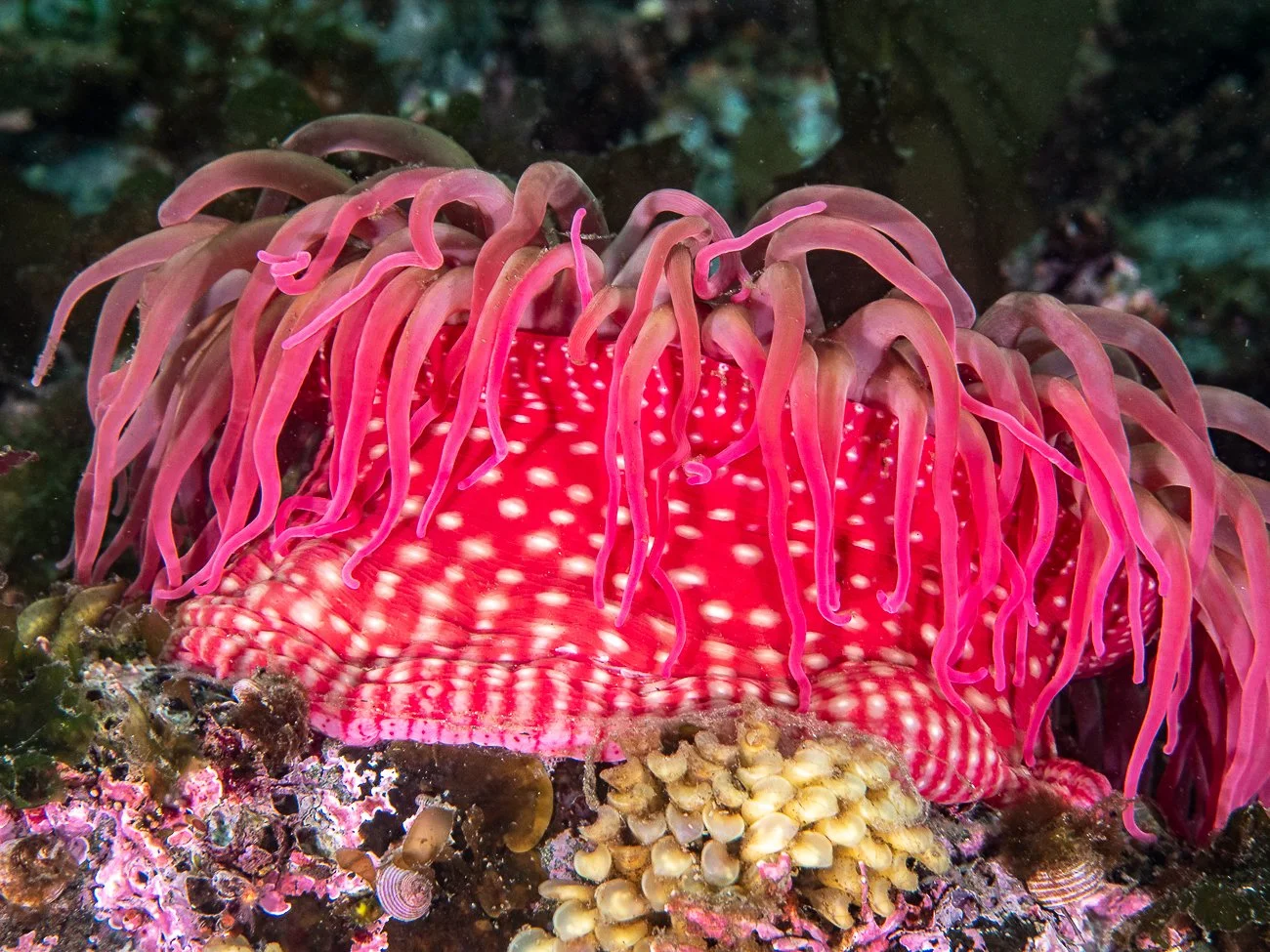
Painted anemones carry the same architecture but disguise it under carnival colors. Reds, purples, creams, and browns swirl across their columns, so vivid you almost doubt what you see through your mask. They hold perfectly still, predators that know stillness can be its own kind of lure. I once watched a hermit crab inch across the edge of a painted anemone, as if easing across ice that might crack beneath it. One careless touch, one stumble into the tentacles, and that would have been the end of him. The anemone never twitched. It didn’t need to. Time does the work.
Then there are the aggregating, or clonal, anemones, the most abundant anemones on the tide-swept rocky shores of the Pacific coast. They repeat their small green design across whole stretches of reef, shrinking the instant a finger or wave brushes them. Most people never realize these harmless-looking colonies wage slow territorial wars, leaving chemical borders etched into the rock long after the fighting has ended.
And in the dimmer reaches of the walls, you find the strawberries—small and intensely bright, gathered in clusters that shine like embers against the rock. Their red and pink tones come from pigments in their own tissues, natural shields that help them handle shifting light rather than anything they eat. A single anemone barely catches the eye, but together they form tiny reefs, pockets of shelter where young fish slip out of the current. Shrimp thread themselves between the bodies, and tiny crabs wait out storms beneath the guarded crowns, trusting something that looks delicate yet stays anchored through anything the water delivers.
That is the truth anemones keep tucked beneath their soft crowns. They look like decoration, the ocean’s wildflowers, but nothing could be more wrong. They are shelter and glue, hunters and architects, patient predators and caretakers. They build structure where none would stand. They root the ecosystem in place. Without them, parts of Hood Canal would feel hollow in ways you only understand after you have spent years underwater, watching the quiet power of creatures that never move and never need to.
They are not background. They are the bones around which the seafloor grows.
For something anchored in place, anemones live complicated lives. They begin as drifting larvae, tiny specks carried wherever the tides push them. Most never make it, swept off or swallowed long before they touch stone. The few that survive settle on a rock, shell, piling, or even an old bottle and anchor there. Once they attach, they stay for life, which can stretch for decades if the currents and predators leave them be.
Once settled, anemones grow slowly and steadily, unfurling their tentacles to hunt. Those tentacles are loaded with tiny stinging cells called nematocysts. Under a microscope, they look like harpoons coiled in a trap, waiting for anything soft enough to touch.
Here’s a quiet bit of trivia: the same stinging machinery that makes box jellies deadly exists in Pacific Northwest anemones. Ours are far gentler, but the machinery is the same—just scaled down.
Some reproduce sexually by releasing eggs and sperm into the water, letting the current handle the matchmaking. Others, like aggregating anemones, clone themselves until an entire colony becomes one genetic individual. Kneel beside one and you might be looking at hundreds of copies of a single ancestor.
It’s an ancient strategy, and it works.
Underwater, alliances are messy, and enemies show up in strange shapes. Small crabs hide beneath anemones. Shrimp thread between their tentacles. Juvenile rockfish hover above them like nervous birds perched on an unseen rail. Anemones are living real estate, shelter for whatever needs protection from the current or from things waiting to strike.
Some fish even learn to hover close enough to avoid predators but not so close that they get stung. It’s an uneasy arrangement, but down here, even bad roommates can get along if the alternative is being eaten.
Crabs, strangely enough, are both protected by and prey to anemones. I have watched decorator crabs tiptoe across their tentacles with scraps of sponge strapped to their backs like makeshift armor. They move with a careful, testing gait, feeling for the slightest hint of danger. Sea stars sometimes pry anemones off rocks, consuming them in slow, patient mouthfuls. It is not a quick process. Nothing underwater ever is quick.
And then there are the battles you never see, the chemical duels between neighboring colonies. Aggregating anemones have specialized “fighter” polyps that they use to burn competitors. The line between territories is drawn in sting scars. Some anemones even fight themselves by accident, clone battling clone after currents shift them into the wrong arrangement.
Everything in the ocean is friend, enemy, or dinner. Sometimes it is all three at once.
If you ever want to understand the Pacific Northwest, descend into Hood Canal when the water turns green and the current softens. Look for the places where color gathers on the stone. Where tiny tentacles reach and sway. Where something motionless begins to feel like it is breathing with the sea.
Anemones are easy to overlook, but once you notice them, they pull you in. They are the quiet machinery of the ecosystem, visible only when you slow down enough to see them. They filter water, provide habitat, feed predators, and shape entire stretches of shore with time and patience.
On one late-winter dive, I found a single giant green anemone perched on a rock, its tentacles half-closed against the surge. I hovered there, just watching it. A whole world moving around a creature that stayed fixed in place. I raised my camera, took the shot, and realized something simple.
Not every marvel in the Salish Sea chases you or darts across your light, trying to be seen. Some simply wait to be noticed. And once you do, you begin to see the seafloor differently. You understand how much depends on what stays still.
THOM ROBBINS BIO
I spend as much time underwater as life allows, teaching diving and photography, chasing the perfect shot, and writing both nonfiction and fiction inspired by these waters. You can explore more of my work at www.thomrobbins.com.
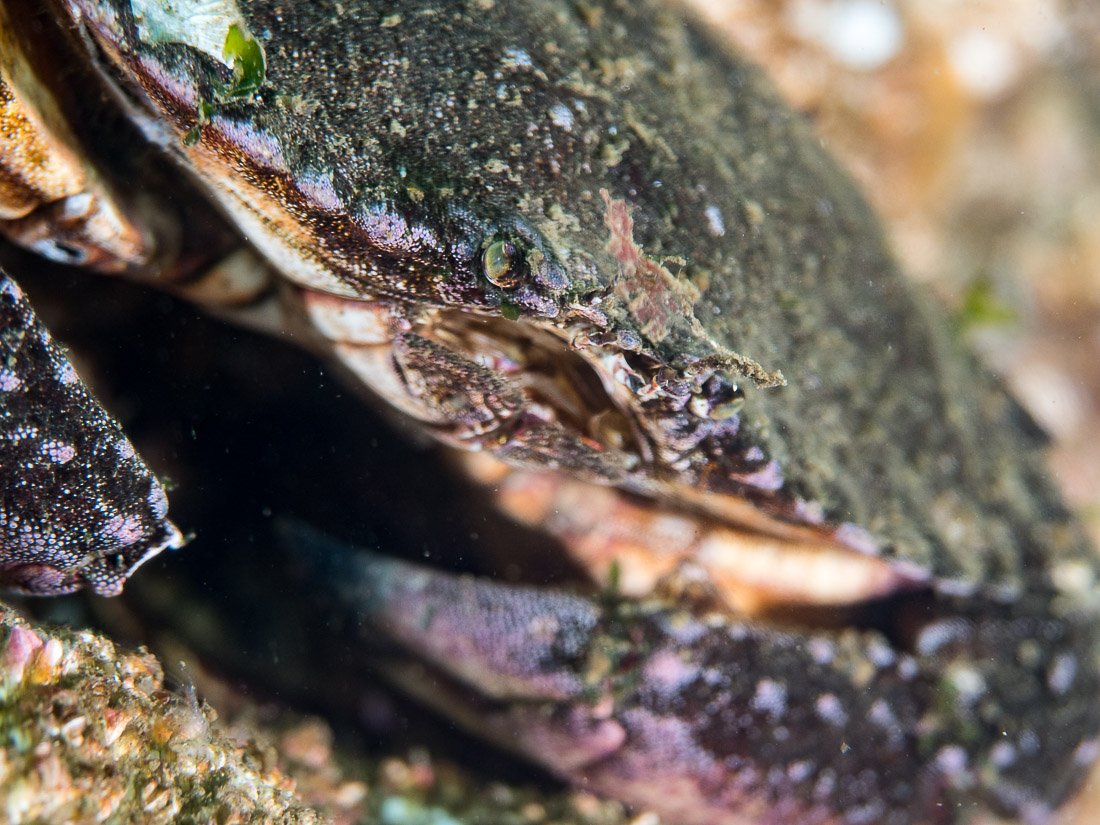
Crabby Characters: Stories from the Seafloor
Spend enough time beneath the surface of Hood Canal, and the silence starts to speak not in words, but in motion. Everything down there moves slower in the cold except the crabs. The crabs are always busy. Always urgent. I’ve watched one spend ten full minutes excavating a hole no deeper than a coin is thick, only to abandon it and scuttle off as if remembering something more important.
Thom Robbins | story and picturesSpend enough time beneath the surface of Hood Canal, and the silence starts to speak not in words, but in motion. Everything down there moves slower in the cold except the crabs. The crabs are always busy. Always urgent. I’ve watched one spend ten full minutes excavating a hole no deeper than a coin is thick, only to abandon it and scuttle off as if remembering something more important. One squared off with its own reflection in my camera dome, claws raised like a boxer waiting for the bell. And another cleaned algae off its shell, as if preparing for a first date.

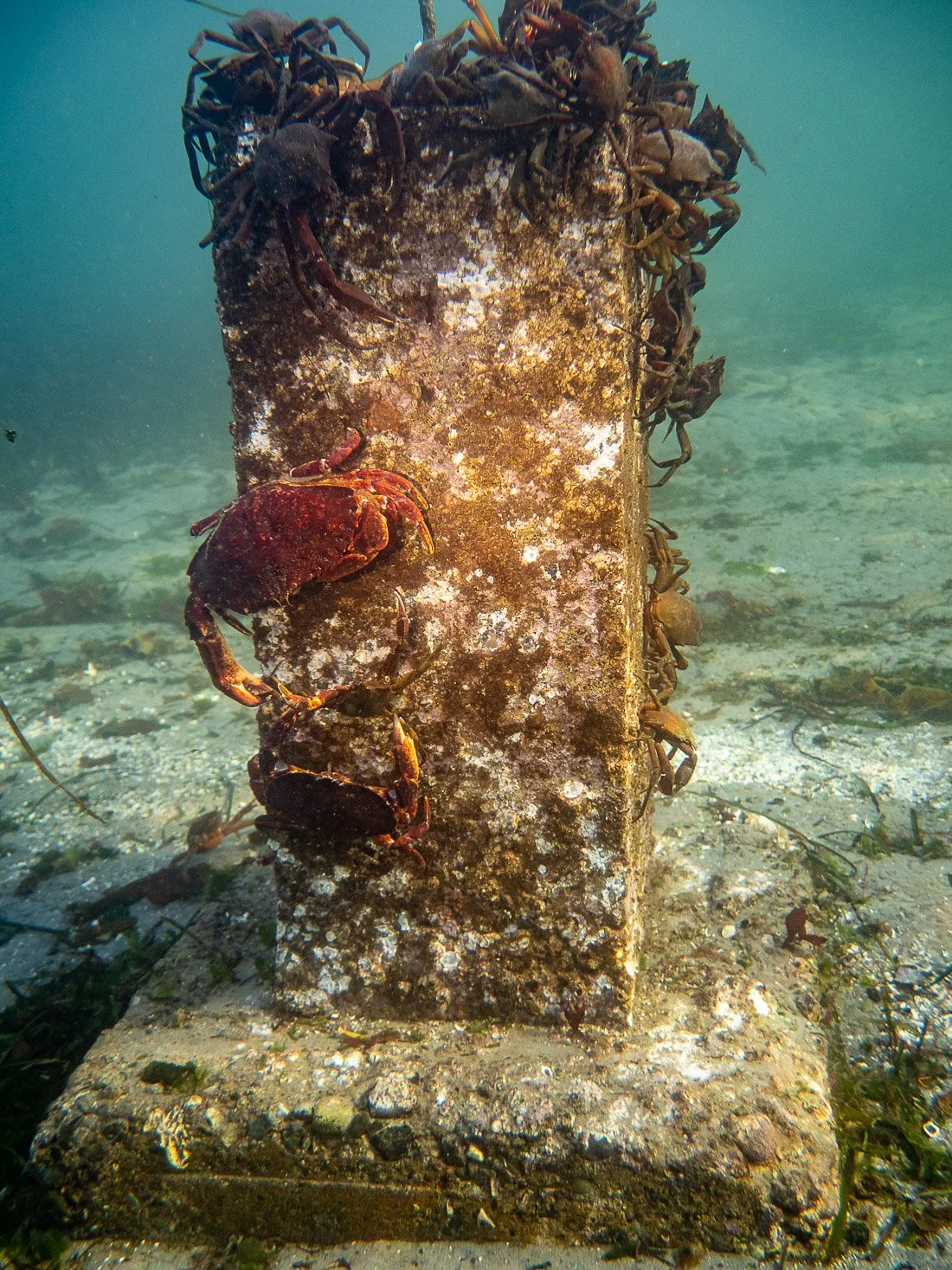
They aren’t graceful like the kelp fish or hypnotic like moon jellies. They’re rough-edged little bulldozers, powered by instinct and old armor, constantly on patrol. You’ll find them under ledges, in discarded cans, perched on the pilings of a long-lost dock. Red Rock crabs, kelp crabs, decorator crabs, hermits dragging their spiral shells like tiny trailers behind them, all of them crawling, shoving, digging, sparring, eating, surviving.
To dive in Hood Canal is to enter their world, not as an observer but as a trespasser in a busy kingdom. And the deeper you go, the more you start to wonder: who’s really watching who?
There are over thirty species of crab living in the Salish Sea, and I swear I’ve startled half of them just getting my fins on. Big ones, small ones, legs like knitting needles—some so camouflaged they vanish if you look away. They're not background players down here. They're the quiet architects of the seafloor. Scavengers, cleaners, prey, and predators, they keep the submerged machine running.
Take the Dungeness crab. Everyone knows that name from a dinner menu, but out here, in the cold green quiet, you see the other side of it. These are not docile creatures. They fight like boxers in the sand, claw-to-claw. I once watched two square off over a fish head, each strike spraying up little clouds of silt. No hesitation, no mercy. The winner dragged the prize beneath a ledge and vanished. The loser waited a few beats, then started digging like it had never happened.
Red Rock crabs are the neighborhood bruisers, bad-tempered, road-shouldered, all edge. Their claws are darker than blood, twice as quick. You don’t want to get too close. They make sure you know when you’ve stayed too long.

Then there are the kelp crabs, graceful, spindly, with legs that seem to unfold forever. They cling to the long, swaying forests of bull kelp like sentries, their shells often coated in fuzz or film. I’ve seen them frozen in place for minutes, like a spider in a web—until they move. And when they do, they move fast.
But my favorite? The decorators. They’re the mad geniuses of the crab world—slow-moving and soft-shelled, but never unprepared. They tear pieces of sponge and algae from their surroundings, stitching them onto their backs like makeshift armor or fancy hats. Sometimes they vanish into the scenery. Other times, they look like moss-covered monsters crawling across the sand. I found one once with an entire anemone riding on its back, swaying as a crown.

Crabs do more than scuttle around at our feet. They oxygenate sediment, recycle waste, and form the base of countless food webs. Otters eat them. Octopuses hunt them. Even gulls have learned to flip them over like breakfast pancakes. But somehow, they endure.
Out here, beneath the weight of the water, they don’t feel small at all. They seem ancient, as if they’ve been here longer than we have. As if they know something we don’t, and maybe they do. Watch them long enough and you start to see why: crabs are built like tanks, only stranger. You don’t realize how alien they are until you’re face-to-face with one in the dark, thirty feet down. Your dive light catches the gleam off that hard, unblinking shell. They look back with stalked eyes, unmoving, weighing whether to run, fight, or decide you aren’t worth the thought.
Like spiders and shrimp, crabs are arthropods wrapped in an exoskeleton that is both armor and skeleton, with no bones inside and everything important protected on the outside. That shell, or carapace, is tough as old fiberglass, etched like a puzzle box, often scarred from past fights, and it doesn’t grow with them. When they get too big for it, they crack it open like a coffin and climb out soft and defenseless until the new shell hardens. I’ve found husks underwater that look like dead crabs until you realize they’re ghosts on the sand.
Most crabs have ten limbs, eight legs, and two claws, but don’t let the symmetry fool you. Those claws aren’t there just for show. They’re everything. I’ve watched crabs use them like tools, snapping open clam shells with surgical efficiency. I’ve seen them fight, claws locked like wrestlers on a mat, each trying to twist the other into submission. And once, on a night dive near an old piling field, I caught sight of a male crab slowly waving one claw back and forth in the beam of my flashlight, rhythmic, almost elegant, like conducting the tide. Mating display. Or maybe a warning. Hard to say. But whatever it was, it felt old. Practiced.
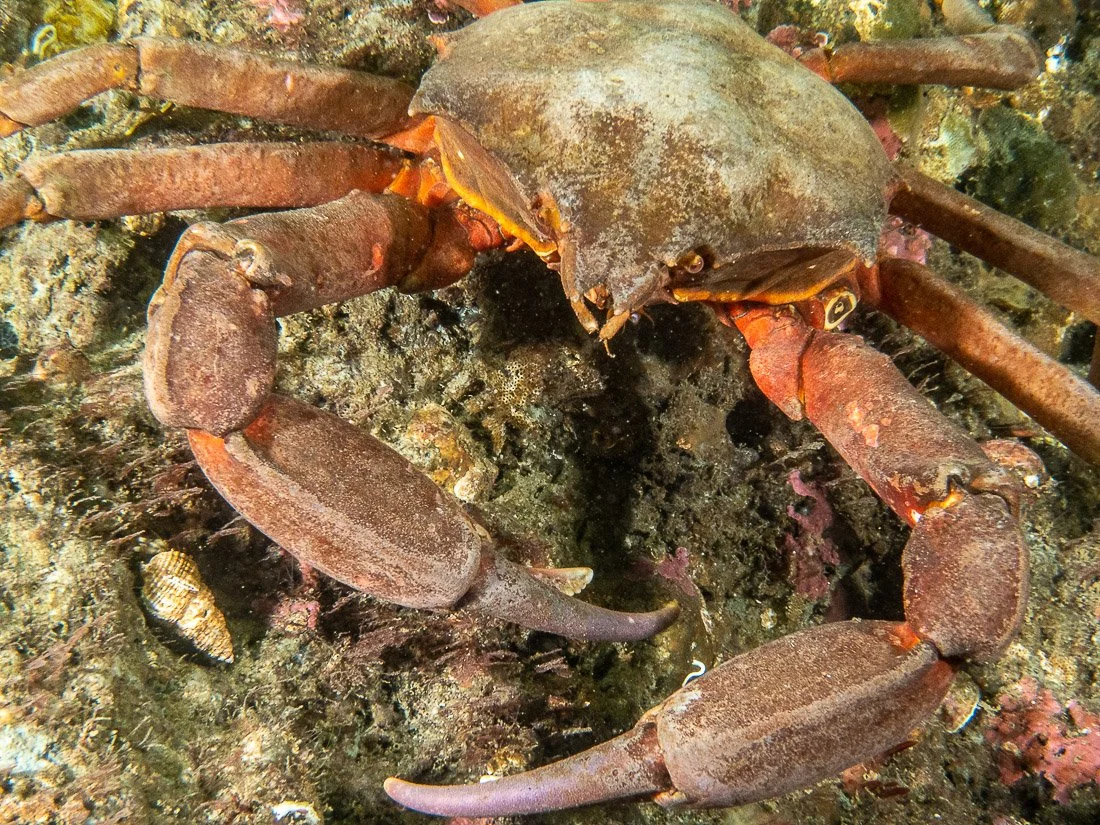
Even the Puget Sound king crab, the largest crab you’re likely to see in the Pacific Northwest, with a carapace that can span nearly a foot across, is unforgettable when you’re lucky enough to spot one. Its shell flashes red-orange under your dive light, edged with faint blue highlights as if brushed with frost.
Sometimes, you’ll notice asymmetry in its claws, with one noticeably larger than the other. This can happen after a molt, when a lost claw is still regrowing, or from years of favoring one claw over the other, like a boxer’s strong hand. That imbalance isn’t clumsy, it’s deliberate. Bigger doesn’t always mean better, but it does mean louder. That oversized claw speaks before the crab ever moves. It says: I’ve survived something you haven’t. I’ve fought. I’ve rebuilt.
Many of them have. Crabs here lose claws to predators, traps, and each other, but they don’t stay broken. They molt, wait, and grow it back slower, a little different, but the same. When you see that heavy claw raised like a crooked banner, it’s not just a weapon, it’s a story of survival, hard-won and costly.
Down here, everything fights to keep going—sometimes with teeth, sometimes with venom. Crabs fight with whatever they’ve got left, rebuilding one joint, one muscle fiber at a time. There’s an honesty in that brutality.
You never forget the first time you see a crab run. It’s not a graceful thing. Not smooth like a seal gliding past or a school of herring flickering in unison. It’s sharp. Sudden. Like something went off inside it. One second it’s there, perfectly still, and the next it’s gone—vanished sideways into the shadow of a rock or beneath a curtain of eelgrass.
That sideways sprint comes from design. A crab’s legs hinge on the sides, not underneath like ours. Each leg pushes like an oar, catching the bottom and shoving the body across the sand with precision. When you see it up close, there’s a rhythm to it, like a dancer on a single beat.
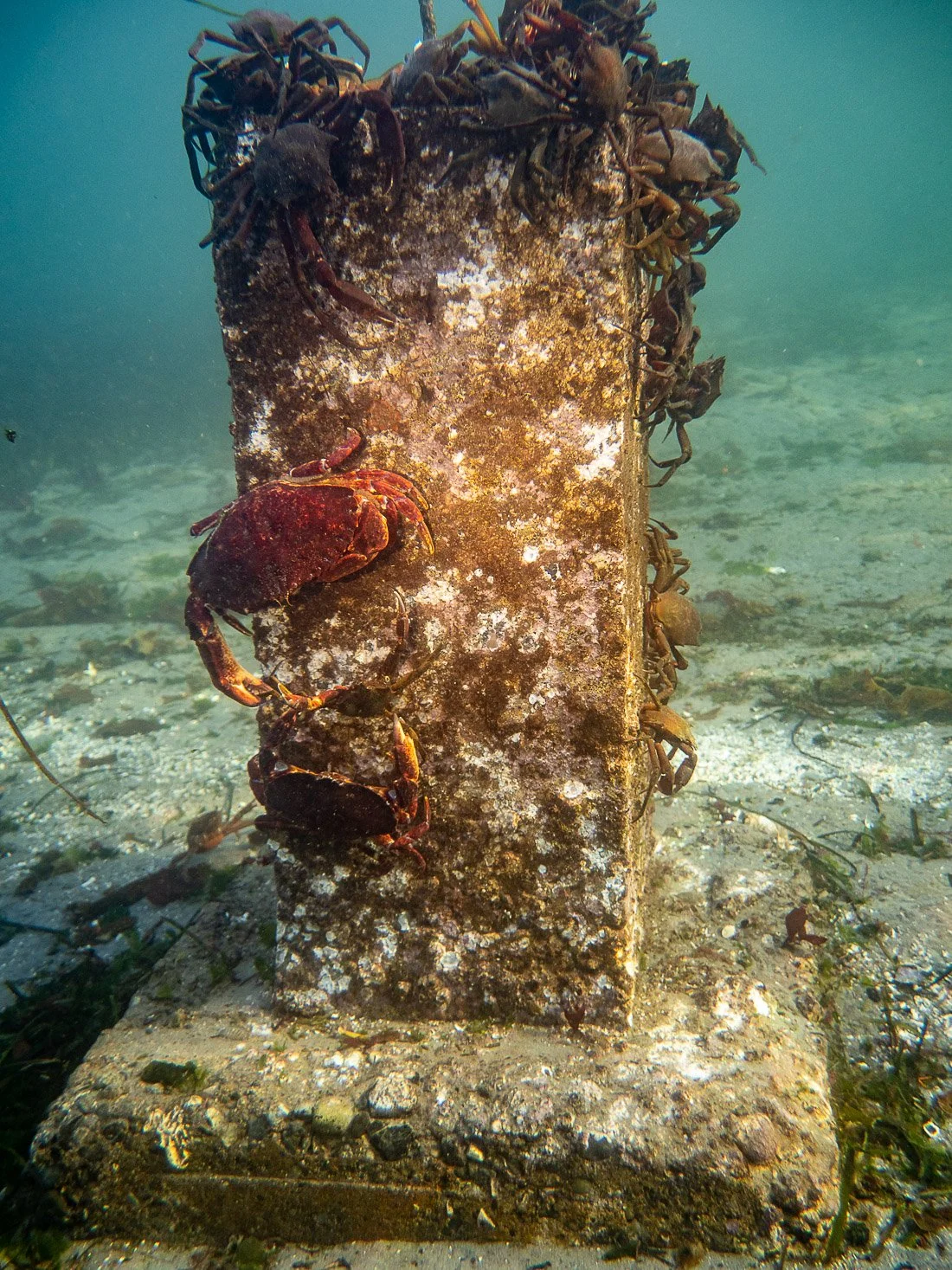
And when they move, they move faster than you'd think. The crabs here in Hood Canal—Red Rock, Dungeness, and the occasional Northern Kelp Crab aren’t built for land speed, but underwater? They’re spring-loaded traps. One second, they’re still, blending into sand or clinging to a piling; the next, gone. Just a blur of motion and a trail of stirred-up silt.
I’ve watched a Dungeness bolt sideways across a sandy shelf with such force it left a trench behind, vanishing beneath a ledge before I could even lift my camera. Kelp crabs don’t move quite as fast, but when they do, it’s sudden, those long, delicate legs pulling their mossy bodies up and over kelp blades like they’re trying to escape the light. Helmet crabs and graceful kelp crabs can vanish into the gloom in a blink if you come too close.
They don’t waste energy, every movement counts. When they go, it’s all at once, like something spooked in the woods, sharp and armed.

I’ve chased more than a few across the bottom camera in hand, bubbles rising just trying to land one clean shot. But more often than not, all I’m left with is a cloud of sand and a shape disappearing into shadow. That’s the game—they always win.
Not all of them run. Some freeze, legs tucked tight, trusting camouflage to outlast your curiosity. Decorator crabs are masters of this—covered in algae, sponges, and stitched-on debris, they hold so still you doubt they were ever moving at all. You notice them only when they twitch once, like something from a dream that leaves no footprints.
Others bluff. The Red Rock raises its claws in defiance, even when outmatched, daring you to come closer. And I’ve seen graceful kelp crabs pull themselves into near-vertical poses, legs extended, trying to look bigger. They don’t want to fight, but they’ll make you think.

Then there are the burrowers, smaller crabs like helmet crabs or hairy shore crabs. When spooked, they vanish downward instead of outward, kicking up sand as they wedge themselves under rocks or into old clam holes. They disappear.
Every crab makes a decision in that split second before it moves: fight, freeze, flee, or fade. They don’t choose wrong more than once. Here, hesitation means you get eaten. And if you’re lucky and quiet, you get to watch them make their choice. When they stop—when they finally wedge themselves beneath a rock or vanish into the reef’s contours—they don’t pant or pulse like a fish might. They just stop, as if nothing ever happened.
Down here, it’s not the fastest creature that survives. It’s the one that knows when to run, how to vanish, and what angle to take when it does. Crabs figured that out a long time ago.
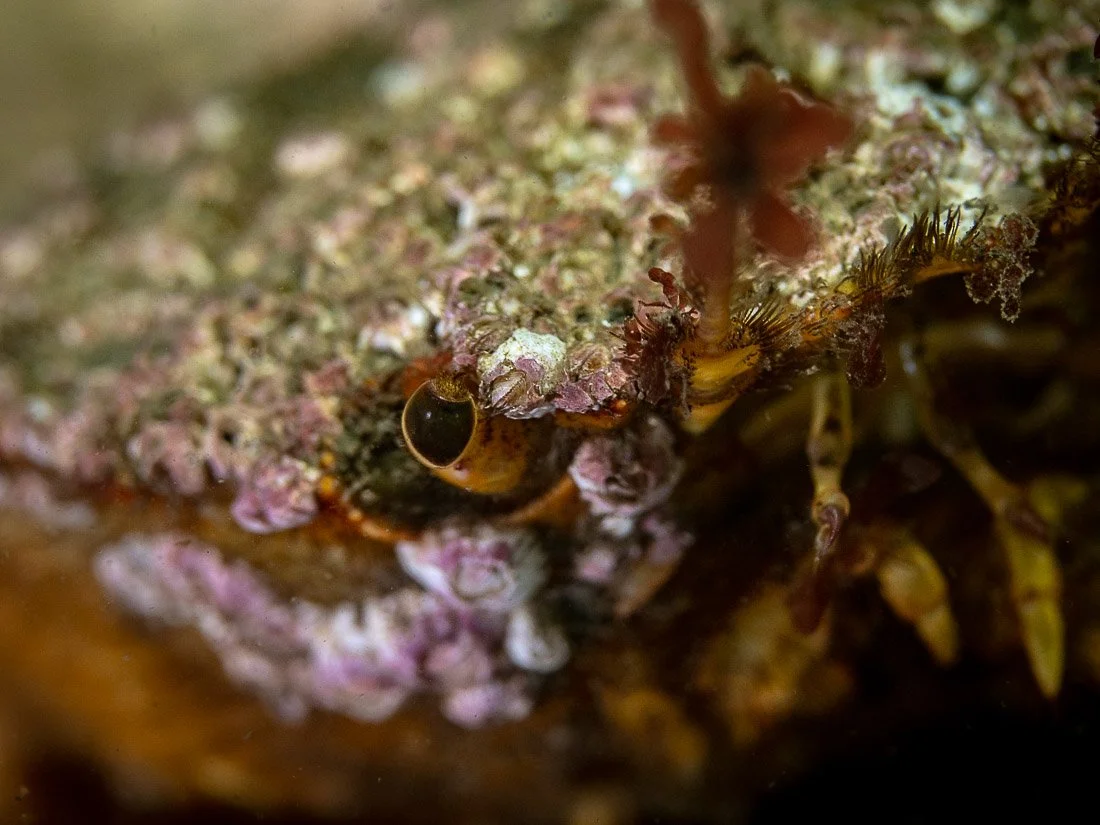
The eyes are the first thing you notice, two dark marbles on stalks, swiveling like radar dishes in the murk. They move independently, scanning front and back at the same time, and it’s unsettling in a way I can’t quite shake. I’ve knelt in the silt, barely breathing, and watched a crab watch me, one eye fixed on my mask while the other seemed to scan the reef behind it, like it was calculating the best escape route. Or maybe waiting to see what I’d do next.
But crabs aren’t just watching. They’re communicating in ways most people never notice. They tap, drum, raise, and wave their claws in deliberate patterns, not just to warn or threaten but to talk. Males might flash their chelae, the front claws built like living pliers—part weapon, part tool—each ending in a sharp, hinged pincer. Look at me. I’m strong. I’m ready. Don’t come any closer. It’s a kind of semaphore, silent and specific, evolved not for show but for survival. Some species send messages through the seafloor by drumming with their legs.
The closer you look, the more the body itself becomes a language.
Beneath that armored face, their mouthparts are hidden in plain sight, tucked up under the shell like something secret. Most people never notice them. But divers have time. We wait. We watch. And if you’re patient, you’ll see those tiny, feathered appendages in constant motion, pulling in food, sorting it, filtering it, working like a factory line. It’s never still. Even when a crab looks motionless, it’s chewing through the world one particle at a time.
And they’re not picky. Crabs are opportunistic feeders—algae, plankton, fish scraps, rotting kelp, even other crabs if the tide turns cruel. I’ve seen it happen fast, almost clinical. No ceremony. No malice. Just need.
They speak through motion, posture, and action, enough where sound doesn’t carry and light doesn’t last.
Beneath the shell, hidden to most, lies one of the weirdest parts of crab biology: they breathe through gills, just like fish. The gills are tucked into chambers beneath the carapace, kept moist by leg movements and flaps called scaphognathites that pump water over them. I’ve seen crabs dug into damp sand during low tide, perfectly still but alive, waiting for the tide to return.

Here's something most folks don't realize: you can tell male and female crabs apart by flipping them over. Males have a narrow, pointed abdominal flap; females have a broad, rounded one shaped like a dome. That’s where they carry their eggs, thousands packed tight like orange caviar, gently fanned with back legs to keep oxygen flowing. It’s a strange kind of tenderness, watching it happen underwater. There’s something ancient about it. Something careful.
When you see a crab crawling across the bottom, it’s easy to think of it as just another bit of marine clutter, another scuttling shape in the gloom. But inside that shell is a creature perfectly engineered for survival, part armor, part instinct, part mystery. The more time I spend with them, the more I believe they’re not just part of the seafloor. They are the seafloor, living, crawling, biting proof that nature doesn’t waste time on beauty when function works better.

And still, somehow, they're beautiful.
Crabs aren’t just skittering distractions; they’re survivors in a complex life cycle that begins as floating larvae barely bigger than plankton. After hatching, young crabs go through multiple molts, shedding their exoskeletons to grow. These larval forms, called zoeae, drift with the currents—tiny, vulnerable—before settling to the bottom where the real battles begin.
Molting continues in adulthood. During these soft-shelled interludes, crabs are most vulnerable. Many hide in the sand or under rocks. For females, it’s the only time they can mate, making it a moment of both risk and opportunity.
Once fertilized, females carry eggs on their undersides like a clutch of orange grapes. Watching a crab fan her eggs with rhythmic leg flicks reminds you that even armored creatures tend their young with surprising delicacy.
Not all eggs survive, and not all crabs do either. For every empty shell tumbling in the current, another waits just out of view, ready to take its place.
As a diver, I’ve learned that the best moments often happen in the periphery. You come for the wolf eel or the octopus, but you stay because something small scuttles in and steals the show. Crabs are like that, endlessly watchable, hard-wired to move, eat, and thrive.
Next time you’re under the surface or in a tidepool, watch a crab at work. There’s a world in those legs, strange and alive as anything in the sea. A reminder, we’re only visitors in their kingdom.
Thom Robbins Bio
I am fascinated with the underwater world here in the Pacific Northwest. I have been a diver for over thirty years and have never been happier than underwater with a camera. I spend as much time underwater as possible, writing, shooting pictures, or teaching diving and photography. You can learn more about me at https://www.thomrobbins.com.
When not diving, I spend time with my wonderful, patient wife, Barb. We live in Shelton, Washington, where we relish a relaxed lifestyle close to world-class diving spots. Barb’s support has been instrumental in my passion for diving; she is my best and often harshest critic, constantly pushing me to capture better photos. Our 21-year-old son inspires me to be a better person every day. Completing our family are our two English Bulldogs, who bring us endless joy.

Jellyfish : grace in the current
Gliding through the green summer currents, jellyfish seem to exist somewhere between matter and myth—elegant, translucent, and suspended in a world shaped by light and movement. Though often dismissed as pests or feared for their sting, these gelatinous invertebrates are a vital and beautiful part of the ocean’s marine ecology, especially during the warmer months
Thom Robbins | Story & pictures
Gliding through the green summer currents of the Salish Sea, jellyfish seem to exist somewhere between matter and myth—elegant, translucent, and suspended in a world shaped by light and movement. Though often dismissed as pests or feared for their sting, these gelatinous invertebrates are a vital and beautiful part of the Salish Sea’s marine ecology, especially during the warmer months.
At least 10 known species of jellyfish (Class Scyphozoa and Hydrozoa) are commonly found in the Salish Sea. However, the exact number varies depending on seasonal conditions and depth. The region also hosts a variety of hydromedusae, small jellyfish-like organisms from the class Hydrozoa and ctenophores (comb jellies), which are not true jellyfish but are often seen alongside them.
In the summer, diving in the Salish Sea isn’t about crystal-clear views but seeing what moves through the murk. As the surface waters warm, sunlight and nutrients combine to spark massive phytoplankton and algae blooms. These microscopic organisms flourish in the long daylight hours, turning the water cloudy green and dramatically reducing visibility.
At the same time, nutrient-rich upwelling from deeper waters feeds this explosion of life, creating a cascading effect through the food web. These blooms nourish jellyfish and other filter feeders, yet they can also trigger oxygen depletion in deeper layers—a process known as eutrophication. As algae and plankton die off and decompose, they consume oxygen, sometimes creating low-oxygen zones that drive fish and invertebrates like wolf eels into shallower waters, or out of the area entirely.
Despite the haze, the midwater teems with motion. Jellyfish pulse silently past in the filtered light, their delicate forms catching the sun like drifting ornaments. I’ve hovered motionless on some dives as dozens of moon jellies passed—some brushed softly against my mask. In those moments, the murk becomes a cathedral, lit not by clarity but movement. Among the most commonly seen is the Moon Jelly (Aurelia labiate). Recognizable by its delicate, bell-shaped body and the four horseshoe-shaped gonads visible through its dome, the moon jelly is both harmless and hypnotic. Although capable of stinging, its venom is so weak that divers typically feel nothing more than a light brush, if anything at all.


Another summer highlight is the Fried Egg jelly (Phacellophora camtschatica), which drifts through the current like a golden sun. Its yolk-colored center and frilled white tentacles make it one of the most photogenic creatures in the water column. Despite its size, it poses little threat to swimmers or divers. Less frequent but unforgettable is the Lion’s Mane jellyfish (Cyanea capillata)—the world's largest known jellyfish species. Its tentacles can grow over 30 meters long in Arctic populations, though those found in the Salish Sea are often smaller. Its sting is more noticeable, though rarely dangerous, and it tends to favor colder, deeper waters where few divers tread.
Jellyfish have been drifting through Earth’s oceans for over 500 million years, long before dinosaurs roamed the land or fish evolved bones. Fossil evidence shows that their basic body plan has remained remarkably unchanged, a testament to just how well-adapted they are to life in the water column. These ancient invertebrates are one of the oldest animal groups on Earth. Unlike many marine organisms, jellyfish never developed hard skeletons or complex organs. Instead, they relied on simplicity and flexibility: a hydrostatic body, a decentralized nerve net, and the ability to reproduce both sexually and asexually.
“Their survival lies in elegant simplicity. Jellyfish drift with currents, respond to light and nutrients, and reproduce quickly when conditions align—strategies that have carried them through five mass extinctions. Most jellyfish species live only a few months in their adult medusa form.”
In the Salish Sea, each summer bloom connects us to this deep evolutionary past. To hover among these creatures is to glimpse a lineage nearly as old as the ocean itself. Their movements may be fleeting, but their presence speaks to a legacy stretching back over 500 million years.
Built to Drift
Though they seem simple, jellyfish are highly specialized. With no bones, brains, or hearts, they are built to drift. The jellyfish found in the Salish Sea all share the same basic anatomy, but with fascinating variations.
At the center of a jellyfish’s structure is its bell, the umbrella-like dome that pulsates to move it through the water. This bell is made of a gelatinous material composed chiefly of water, up to 95% in most species. Radial canals branch from the stomach, distributing nutrients throughout the bell.
Larger predators also take an interest. Occasionally, ocean sunfish (Mola mola)—the world’s largest bony fish—wander into the Salish Sea, and jellyfish are a favorite food. Their thick skin protects them from stings as they chomp through even the largest medusae. Historically, leatherback sea turtles, specializing in eating jellyfish, may have traveled this far north, though sightings today are extremely rare.
Even other jellyfish can be predators. With its long, trailing tentacles, the fried egg jelly often feeds on smaller jellyfish that become ensnared in its stinging threads. It’s a quiet cannibalism, part of the natural food web.
Jellyfish can be an unexpected snack for juvenile salmon, especially pink and chum. These young fish sometimes feed on tiny jellies and jelly-like plankton as they migrate through the sea, supplementing their diets during their early life stages. When a jellyfish’s life ends and it sinks to the seafloor, crabs, sea stars, and other scavengers move in. They scavenge the soft tissue, recycling the jelly’s nutrients into the ecosystem.
For all their fragile, ghost-like appearance, jellyfish play a key role in the Salish Sea’s complex food web, both predator and prey. Their presence supports a range of species, many of which rely on these gelatinous drifters more than most people realize.
Unlike animals with hearts and blood vessels, jellyfish lack a true circulatory system. Instead, they rely on the simple structure of their bodies to move nutrients. Through a combination of internal canals and diffusion, the passive movement of molecules from areas of high concentration to low, nutrients are spread throughout the jellyfish's tissues. This efficient, low-energy system works because jellyfish are composed mainly of water and have thin, soft bodies, allowing nutrients and gases to move freely without blood or vessels.
Jellyfish lack a brain but rely on a decentralized nerve net to detect touch, orientation, and light. Around the bell’s rim are specialized sensory structures called rhopalia, which contain balance organs (statocysts) and light-sensitive spots (ocelli). These help jellyfish maintain their position in the water column and respond to environmental changes. In many species, like the Moon Jelly, you can see the four gonads (reproductive organs) through the bell. These are typically arranged symmetrically and give the jelly its iconic pattern. Jellyfish are usually gonochoric, meaning individuals are either male or female, though some species can change sex depending on environmental conditions.
Though they may appear delicate, jellyfish anatomy is an evolutionary success story, fine-tuned over half a billion years. Every structure, from the trailing tentacle to the light-detecting rhopalium, keeps these animals alive in a constantly shifting marine world.

Born of Water
Jellyfish have one of the most complex and fascinating life cycles in the animal kingdom, cycling between two distinct forms: the polyp and the medusa. Most of the jellyfish we see while diving are medusae—the free-swimming, bell-shaped adults. But before reaching this stage, each jellyfish begins life as a microscopic larva called a planula, which settles onto a hard surface and develops into a polyp. These polyps can remain dormant for years, cloning themselves and waiting for the right environmental cues—usually a change in temperature or light—to begin a process called strobilation.
During strobilation, the polyp stacks tiny disc-like ephyrae that break off and develop into juvenile jellies. This ability to clone and reproduce asexually means jellyfish can quickly take advantage of favorable conditions, leading to the massive blooms divers witness during Salish Sea summers. Some polyps may produce genetically identical clones, while others undergo sexual reproduction to introduce new genetic material.
In particular, Moon Jellies are known for their resilience and adaptability. They can tolerate low-oxygen conditions better than many other marine organisms, allowing them to thrive in increasingly stressed ecosystems. Crystal Jellies exhibit a unique form of reproduction in which males and females release gametes into the water column, a method known as broadcast spawning—one of the most ancient reproductive strategies in the ocean.
Hanging beneath the bell, a jellyfish’s tentacles and oral arms serve as its defense system and means of feeding. Along the tentacles are thousands of specialized stinging cells called cnidocytes, each containing a microscopic harpoon-like structure known as a nematocyst. When triggered by touch or the presence of prey, these structures fire, delivering venom that can stun or immobilize small organisms. Moon jellies don’t chase their meals—they drift with open arms through clouds of plankton, letting the current deliver each bite. Their tentacles sweep plankton, tiny crustaceans, and larval fish toward their fringe of short, frilly oral arms, transporting the food to the central mouth.
The fried egg jelly takes a slightly different approach. Its long tentacles snare zooplankton and smaller jellyfish, which are slowly drawn to its oral arms for digestion. Large and dramatic, it feeds with quiet efficiency, drifting through the current, letting the ocean deliver each meal. But while they drift and feed with effortless grace, jellyfish are also food for a surprising array of marine life. Sea anemones, rooted to rocks and pilings, often snatch passing jellies with their sticky tentacles. If a moon jelly drifts too close or becomes weakened, an anemone will pull it in, undeterred by the jelly’s stinging cells. Whenever I run across this it always looks like a child sucking in a plate of spaghetti.
Conservation
Although jellyfish are often seen as survivors—creatures that thrive where others struggle—they are also indicators of broader changes in marine ecosystems. In the Salish Sea, shifts in jellyfish populations can reflect changes in water temperature, nutrient levels, and even human impacts such as coastal development and pollution.

For instance, increased runoff from agriculture and urban development introduces nutrients that can intensify plankton blooms, indirectly supporting larger jellyfish populations. While this may seem like a success story for jellies, it often signals ecosystem imbalance. In extreme cases, jellyfish blooms can disrupt fisheries by clogging nets, consuming fish larvae, and competing with commercial species for food. Plastic pollution also poses a risk. Jellyfish sometimes ingest microplastics, mistaking them for prey, and may in turn be eaten by larger animals like salmon or sea turtles, passing toxins up the food chain. Interestingly, the translucent structure of jellyfish makes them particularly difficult to spot when entangled in discarded fishing gear, meaning they can suffer unnoticed in ghost nets.
Despite these concerns, jellyfish have become unlikely ambassadors for science, conservation, and discovery. One of the most important breakthroughs in modern biology came from the Crystal Jelly, found off the coast of Friday Harbor. Scientists discovered green fluorescent protein (GFP) in this species—a molecule that glows green under ultraviolet light. GFP acts like a molecular flashlight when inserted into other organisms, allowing researchers to track genes and observe biological processes in real time. This discovery revolutionized genetic and medical research, earning a Nobel Prize and highlighting the hidden value of marine life.
Conclusion
Encountering jellyfish while diving in the Salish Sea is never ordinary. Whether it’s a Moon's hypnotic pulse or a Crystal's rare glow, these animals embody a unique blend of grace, resilience, and ecological importance. They are living filters, slow-motion drifters, and seasonal storytellers, revealing much about the world beneath the waves. While some may still associate jellyfish with stings or beach closures, divers know better. To hover beside a jelly in its element is to witness nature in its purest form—unhurried, mysterious, and vital. In a time when ocean health is at risk, jellyfish remind us that beauty and science are not separate but intertwined. Their presence is more than a summer spectacle—it’s a quiet signal that even the oldest life forms still move among us, pulsing with stories the sea has never stopped telling. To witness one is to glimpse time suspended—fragile, pulsing, and older than memory

The Elusive Geoduck : Reviled and Reveled
This large saltwater clam derives its common name, geoduck, from a Nisqually word which is said to loosely translate as “dig deep.” Don’t let their awkward looks deter you. Prepared right, this misunderstood bivalve is versatile and utterly delicious.
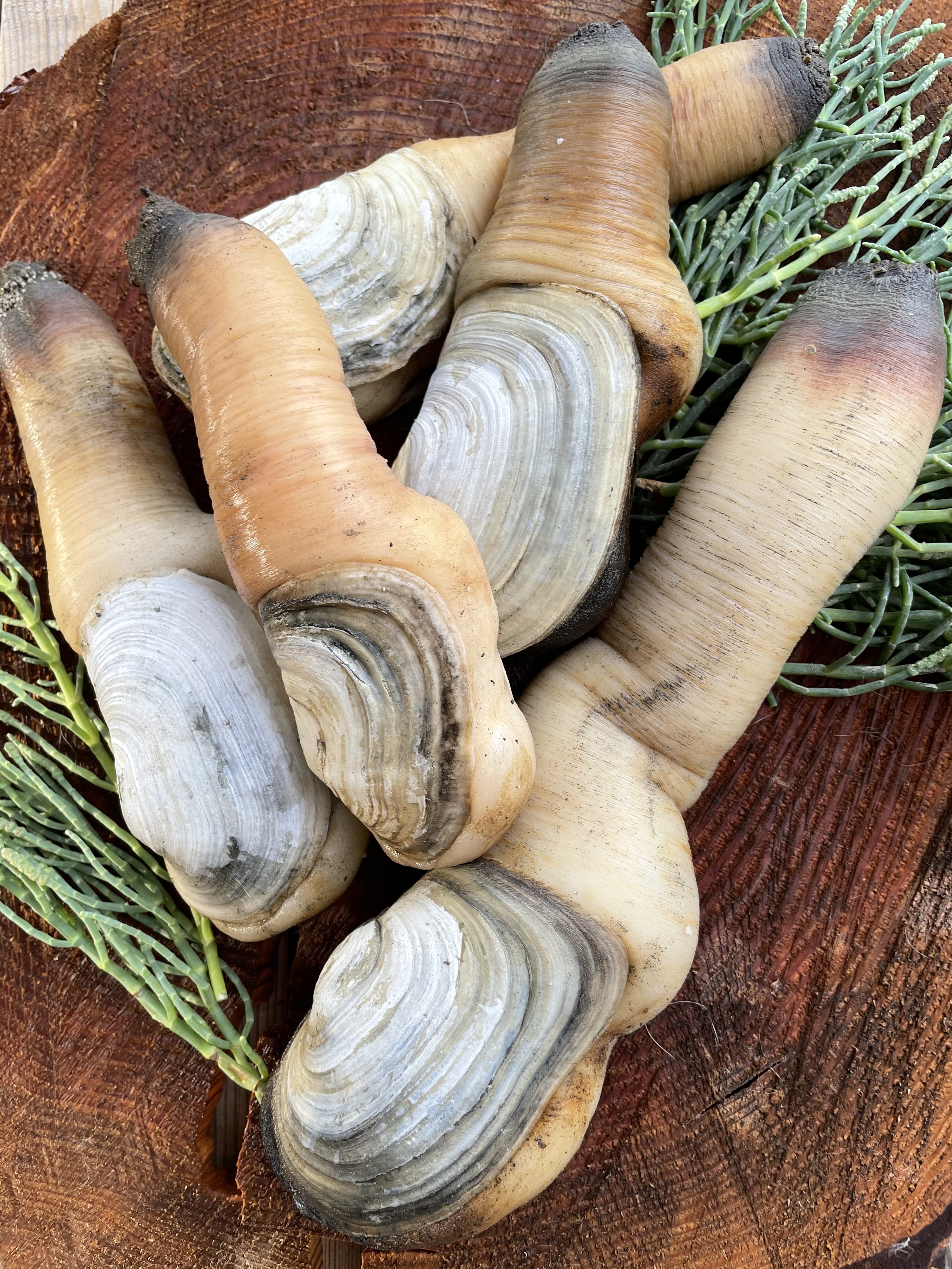
This large saltwater clam derives its common name, geoduck, from a Nisqually word which is said to loosely translate as “dig deep.” Don’t let their awkward looks deter you. Prepared right, this misunderstood bivalve is versatile and utterly delicious.

The geoduck is native to intertidal and sub-tidal waters from Alaska to California. With a shell that ranges from just 6 – 8 inches, the long siphon, or neck, makes it the largest burrowing clam in the world. In fact, a geoduck’s neck can be as long as three and a half feet in length. So large that even from when it is small as an inch, it cannot be withdrawn into the shell.
Geoduck attain maximum size at age fifteen, but are one of the longest living animals in the world. The typical lifespan of a wild geoduck can range to 140 years. The oldest being recorded at 168 years. Buried three feet deep in mud or sand, once they make it through their fragile adolescence, these giant clams do a fantastic job of keeping safe with their thick unpalatable skin.

Farmed geoduck
It takes about six years to raise a farmed geoduck to market. Beginning life in a hatchery tank, the small seed (about one inch long), are “planted” in the soft sand in the intertidal and protected with PVC tubes. The covered tube keeps them safe from predators until they are large enough to dig deeper.
Natural beds of geoducks grow on many of Washington’s public beaches with Puget Sound and Hood Canal containing the most abundant populations available for public digging. The best places to see experienced diggers capturing these big clams are at the Duckabush and Dosewallips State Park on Hood Canal. If you can’t harvest your own, head over to one of the restaurants and markets listed below or order fresh online.
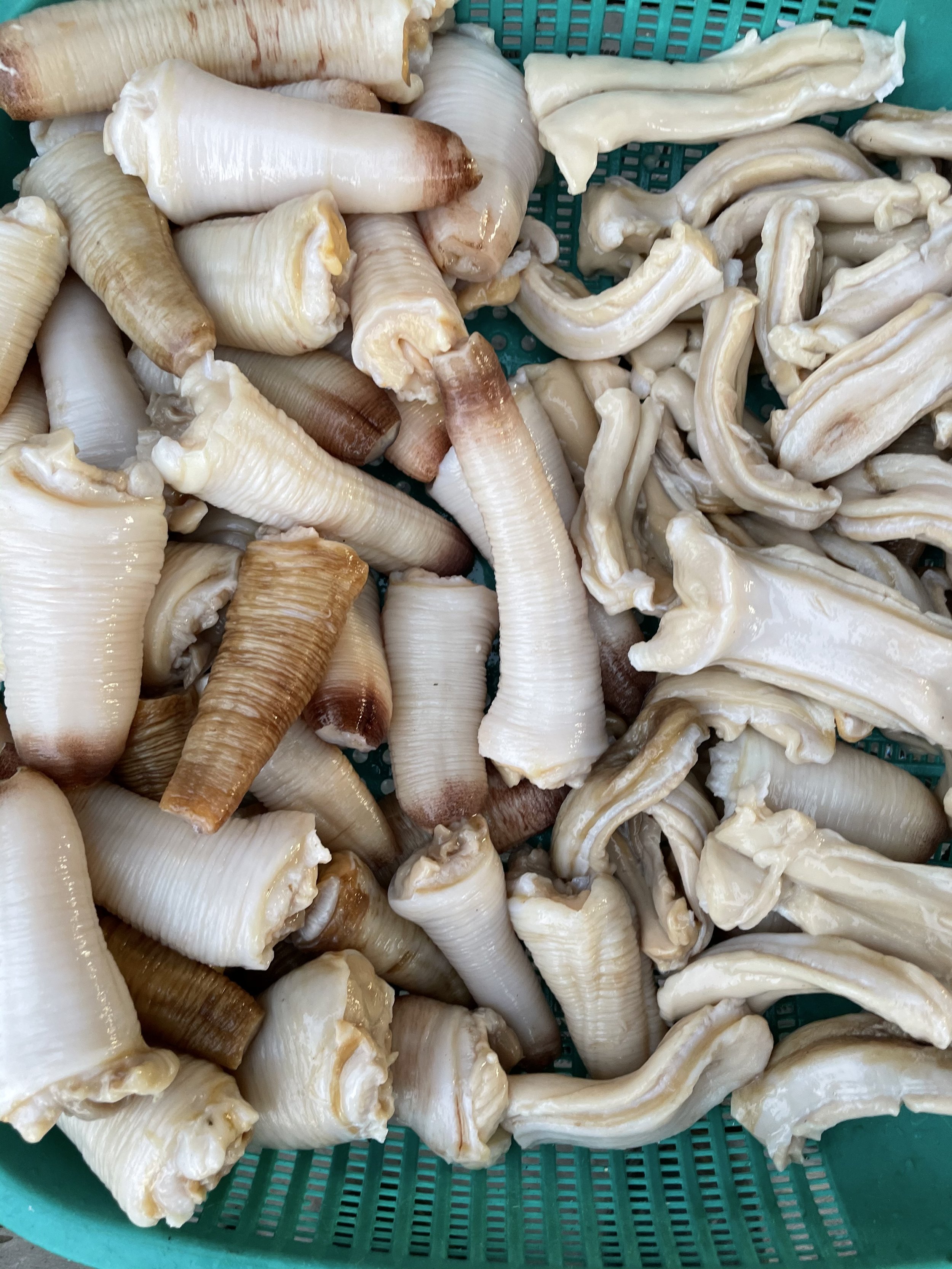
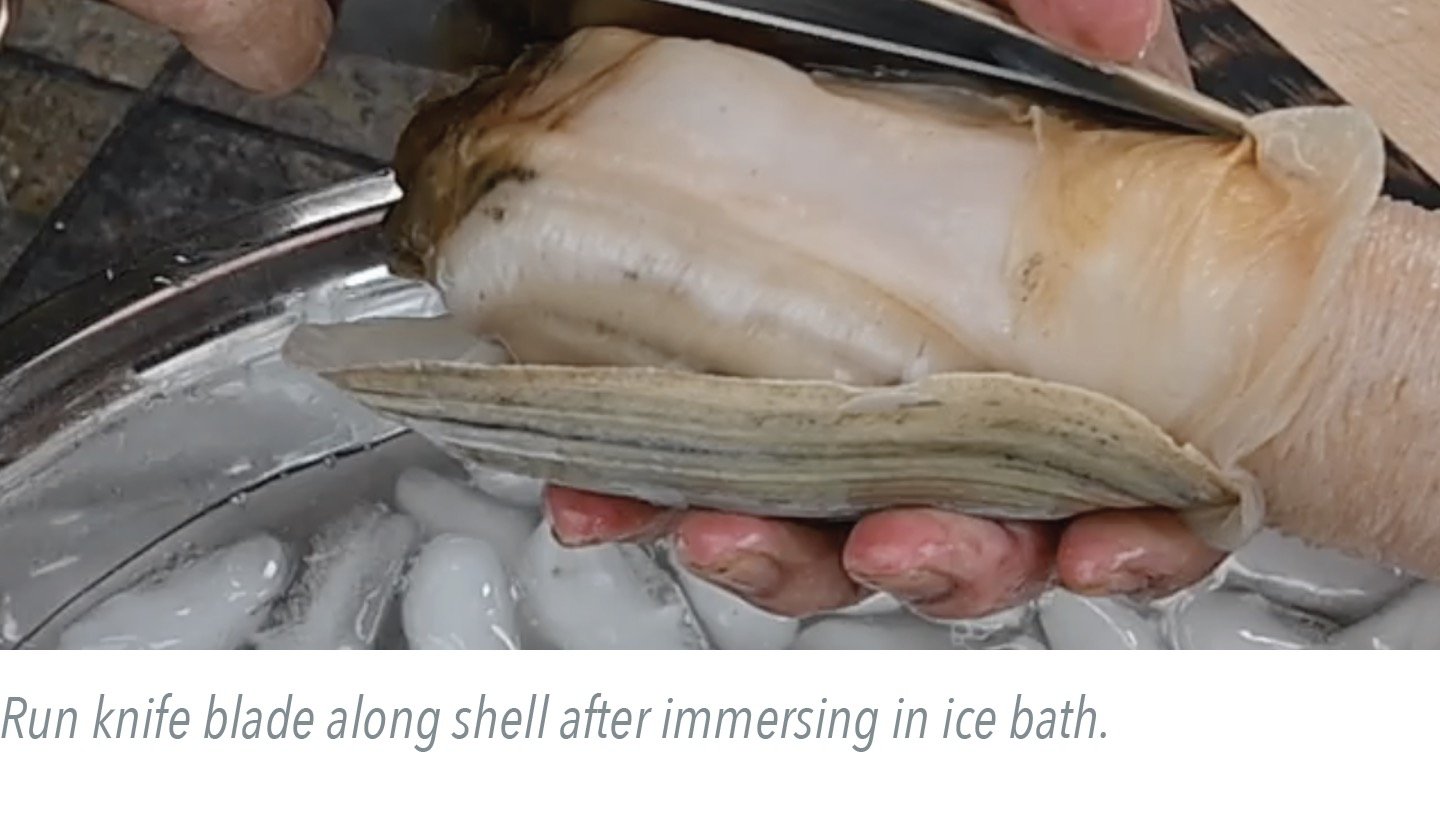

Preparing Geoduck
Preparing a geoduck can seem overwhelming but it is surprisingly simple:
Boil a pot of water and prepare a bowl of ice water large enough to fit your geoduck. Using tongs, immerse the whole clam in the hot water for about six seconds.
Immerse it in the ice bath for about the same amount of time. Holding the shell with one hand, run the blade of your knife along the inside of the shell and extract the body from the shell.
Grasp the tough outer tube that surrounds the siphon meat and pull. The hot water and ice bath will have effectively separated the thick skin from the tender neck meat.
Discard the bulbous stomach and your efforts will be rewarded with tender meat from the body and the tougher but just as tasty meat from the siphon. The siphon meat is often ground to make chowder or patties.
Prepared Geoduck: tide to table
Just like being elusive to catch, geoduck can be difficult to find at restaurants. Fortunately in Washington some of the biggest producers of geoduck also have their own restaurants that they can supply this year round delicacy.
Here are a few South Puget Sound farmers that really know their Ducks:
Chelsea Farms and Oyster Bar
222 Capitol Way N
Olympia, WA 98501
Phone: (360) 915-7784
Chelsea Farms first made their mark on Olympia’s map in 1987 when Linda and John Lentz started their adventures in sustainable shellfish farming. Their legacy continues with the next generation, Shina and Kyle.
Taylor Shellfish Retail Store and Oyster Bars throughout WA
130 SE Lynch RD Shelton WA, 98584
PHONE: (360) 432-3300
Hours: Open for curbside pick up Monday - Sunday: 10am - 6:00pm; Closed all major holidays
Taylor Shellfish Farms harvests their own farmed geoduck from the Puget Sound. At their oyster bars across the state, diners can sample fresh geoduck sashimi with sesame ginger lime dressing. The giant clam is also used in Taylor Sheellfish Farms’ Northwest Chowder. Product also available online and shipped directly to your home.
Fjord Oyster Bank Restaurant
24341 N Hwy 101, Hoodsport
Phone: (360) 877-2102
Hours: THUR-FRI 5PM-8PM, SAT & SUN 1PM - 7PM | Closed MON-WED
The Fjord celebrates the recipes of Xinh Dwelley who was known for her acumen with geoduck. Available at the restaurant are sashimi, geoduck wontons, fritters, geoduck chowder, and ceviche. The Fjord sources their geoduck from commercial farmer on Harstine Island.

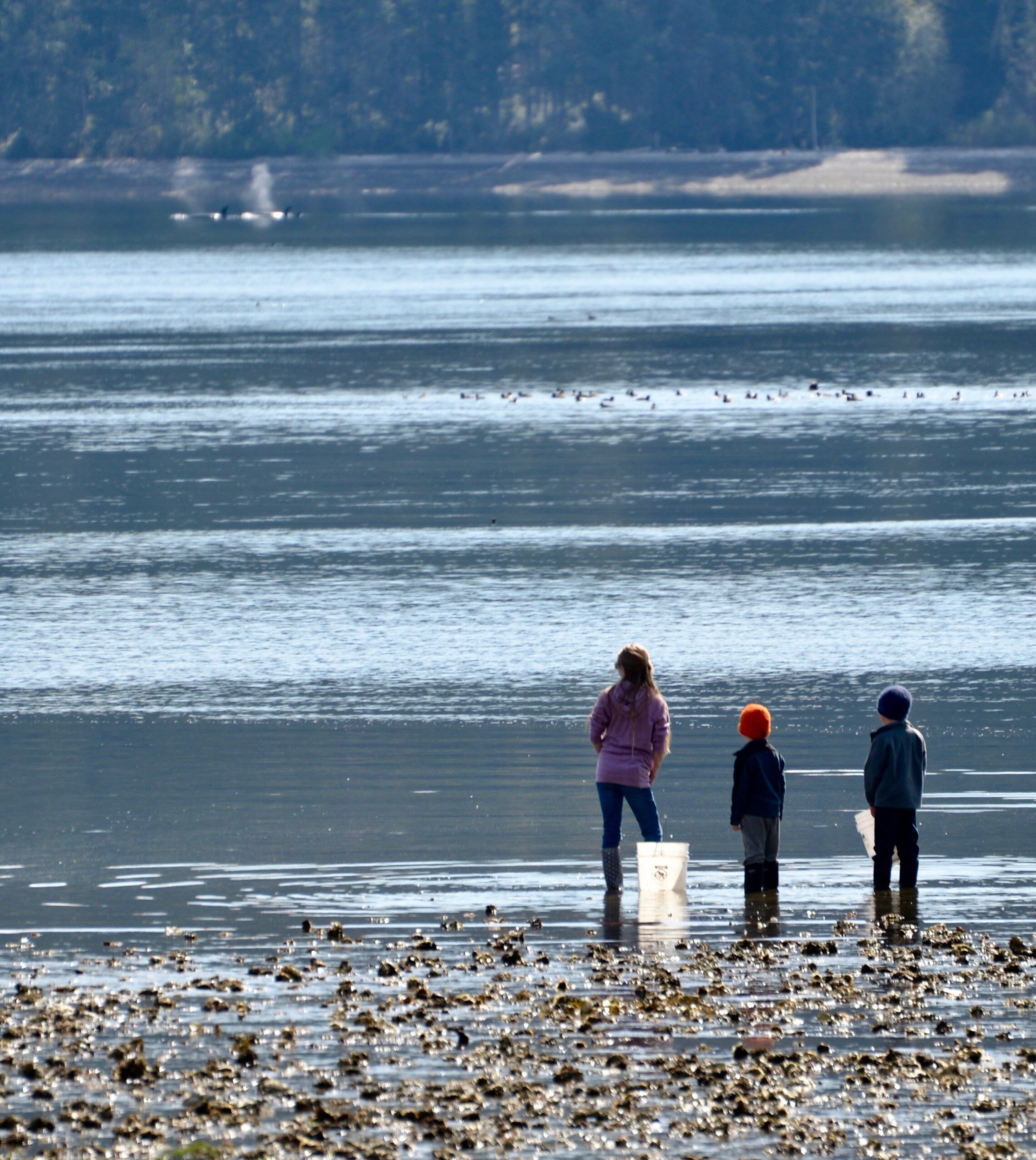
Whale watching from the Shores in Hood Canal
The whales are in Hood Canal! These last few weeks Hood Canal and South Puget Sound have produced a lot of exciting sightings of whales in the area.

Walking along the shores of Hood Canal and the waters of Hammersley Inlet you can spot many interesting marine creatures from the lowly (yet delicious) Olympic oyster to the lumbering California sealion. Although not as dependable as catching a glimpse of a harbor seal, or a great blue heron, the sight of an orca (Orcinus orca) is perhaps the most rewarding.
With newborn calves weighing as much as 400 lbs, orcas are the largest species within the oceanic dolphin family. Full grown female orcas may reach lengths of 18-21 feet and weigh as much as 9,000 lbs and males can get to be 21-24 feet and weigh as much as 12,000 lbs. Because of their size these giants need to eat 150-250 pounds of food a day to survive.
Usually traveling in multi-generational pods of two or more family groups, lead by older matriarchs (grandmas) these whales are strongly devoted to family.
The matriarchs have been observed to aid in the raising of their grandchildren (in a way similar to human grandmothers) and, like human females, they live many years past their reproductive age.
The eldest sons and daughters of matriarchs tend to stay with the family unit (or matriline). Researchers using specially adapted microphones hung underwater, have documented that each matriline has distinctive calls special to it and apparently understood within the pod.
This has led some scientists to argue that orcas have dialects and languages, something that no other animals are documented as having (beyond humans).
Orcas are found across the globe, usually favoring cold waters, but they swim to tropical waters to moult their skins. In the Pacific Northwest, researchers have documented three populations of orcas which have distinct feeding and social behaviors: the Transients who prey on other marine mammals, such as dolphins and seals;
The Residents who find sustenance primarily in chinook salmon; and the little understood offshore orca that are found from California to Alaska and are purported to eat fish and varieties of sharks. According to researchers there are no obvious biological reasons why these whales eat such specific food.
In fact, this preference may be starving the chinook dependent Southern Resident whale population seen in the inland waters of the Salish Sea (Puget Sound, the San Juan Islands, and Georgia Strait), which are in such small numbers they are listed as endangered in both Canada and the United States.
Researchers have been struggling to save these whales and understand why they do not diversify their feeding habits. The most interesting argument researchers have made is that the Southern Residents, although physically able to eat sea mammals or other fish, have established taboos within their groups that prohibit them – in an essence they have cultural constraints, such as seen amongst humans refusing pork or beef on cultural grounds.
Additionally, Residents and Transients have been observed to actively avoid one another, which is reflected in the fact that the Transients tend to visit the waters of Southern Puget Sound between the months of March and September, when the Southern Residents make their migration out of the Southern Puget Sound area. Genetic research has further revealed that there is no interbreeding between these two groups– almost as if they were a different species.

The Southern Residents may be seen chasing the chinook on their upriver run during the fall from several easily accessibly points on shore: on Hammersley Inlet from Walker Park (near Shelton), on Totten Inlet from the Arcadia Point Boat Launch, on Case Inlet at Latimers Landing, and at the Allyn Waterfront Park.
Along the Hood Canal orcas are more rare, but this Spring, a pod of Transients was spotted several times from the Hood Canal Bridge all the way down to Belfair. This group stayed in the area for quite a while much to the delight of the shore residents.
Before you head out to look for whales, check out the many online resources provided by the Orca Network. They offer a constantly updated list of orca and whale sightings. In May the reports on the Orca Network Sightings orcanetwork.org logged orca sightings along Hood Canal from vantage points at Dabob Bay, Brinnon, Seabeck, Lilliwaup, Potlatch, Union, and Tahuya.
If you plan to search from the shoreline a good pair of binoculars and a zoom lens are recommended. Look for sudden sprays of water and the tell-tale black dorsal fin. If you are searching by boat, exercise caution and remember you are a guest in their waters.
If you see a blow go slow, it is the law in the US to travel less than 7 knots and stay at least ½ mile away when traveling by boat near orcas. If the orcas come closer than 300 yards to your boat, you must turn off the engine, as the noise from the engine can confuse the whales and there are many accidents resulting from props and whale collisions. Also fish finders and depth sounders should be turned off when not in use.
http://www.orcanetwork.org

A convocation of eagles
A convocation of eagles is not a feted occasion requiring black gowns and tasseled caps. Like a murder of crows or a gaggle of geese, a convocation is the unexpected collective noun for a group of eagles.
A convocation of eagles is not a feted occasion requiring black gowns and tasseled caps. Like a murder of crows or a gaggle of geese, a convocation is the unexpected collective noun for a group of eagles.
Eagles have inspired humans throughout history – and the world. The Ancient Romans used them as a symbol of Empire. Here in the United States, the Bald Eagle (Haliaeetus leucocephalus) is our national bird.
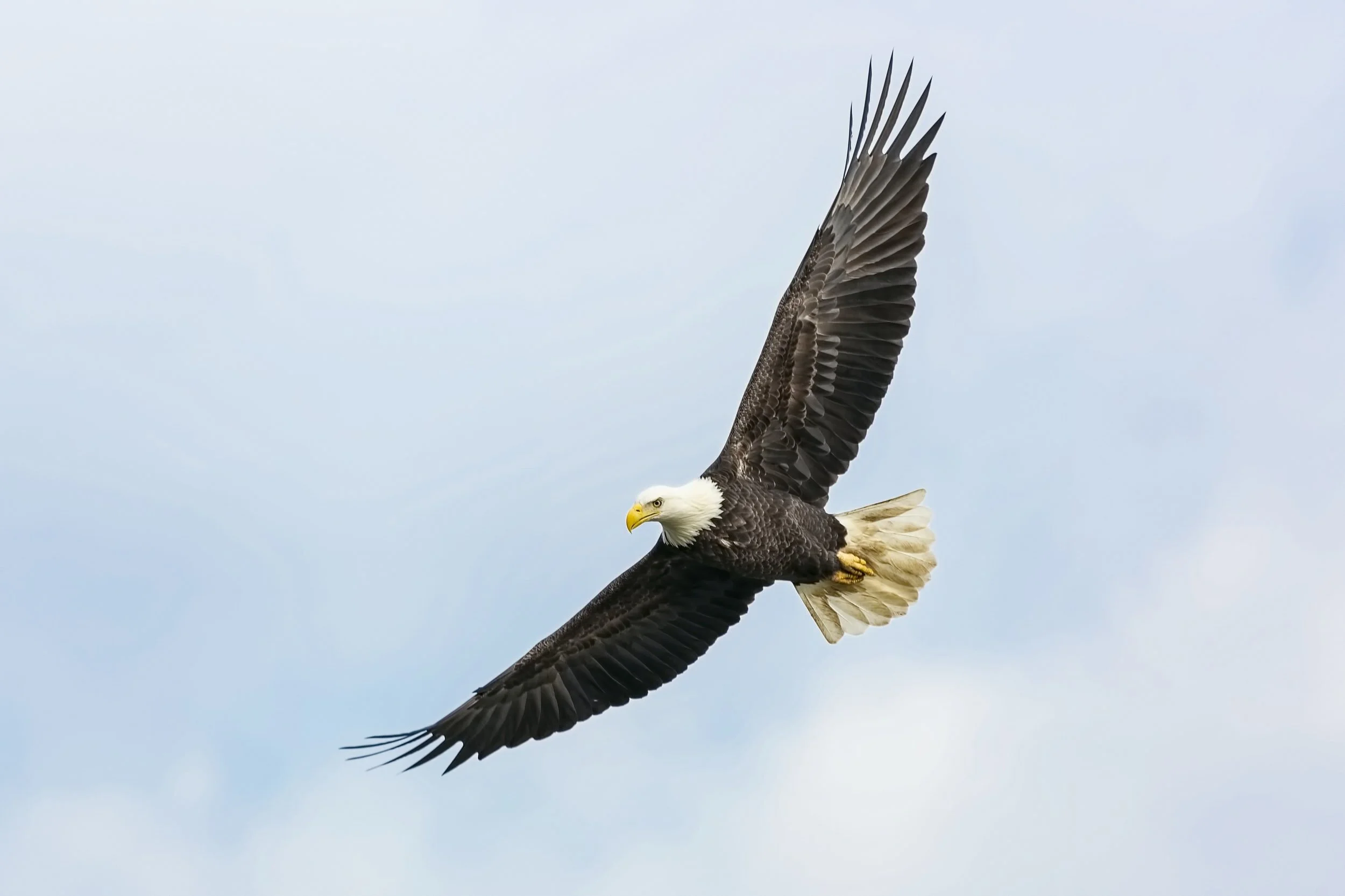
Native American tribes, including Hood Canal’s Skokomish, venerate the Bald Eagle. Many tribes associate the eagle with the creator. Since this bird is the strongest flyer, it is believed to carry prayers to the heavens. Feathers and other parts of the bird (such as the talons) are important to many Native American ceremonies, such as smudging, powwows, and talking circles.
At the turn of the 18th century, the Bald Eagle population was estimated to be between 300,000–500,000. In the early 20th century however, the eagle was targeted for sport and because of their perceived predation upon livestock. Between 1918 and 1930 one ornithologist estimated that approximately 70,000 bald eagles had been shot in the state of Alaska. Additionally, nesting sites were disturbed by logging and other forms of development.
The Bald Eagle Protection Act was introduced in 1940 to protect nests, eggs, feathers, and to stop the slaughter of Bald Eagles. By the 1950s, however, there were reported to be only 412 nesting pairs left in the 48 conterminous United States.
Pushed to near extinction
Further, pressure was placed upon Bald Eagles populations (and many birds of prey species) by the pesticide Dichlorodiphenyltrichloroethane (DDT). Since Bald Eagles are predators at the top of the food-chain, this chemical was concentrated in their prey and even the prey of their prey. This bioaccumulation disrupted the Bald Eagle’s metabolism of calcium, severely effecting fertility rates and inhibiting healthy egg production.
Bald Eagles were declared endangered in 1962.

Shari Sommerfeld Images
Revival of a species
However, this is actually a happy story. In 2007, the Bald Eagle was federally delisted from the endangered species list. With the banning of DDT in the United States in 1972 (1989 in Canada), extensive breeding programs, and the enforcement of the Bald and Golden Eagle Protection Act– the population soared. By 2005, in Washington State alone, it was estimated that there were over 840 breeding pairs. In 2009, the Bald Eagle population of the United States was estimated to be nearly 143,000 birds, this number is expected to stabilize at 228,000 birds in the next 5 to 15 years.
Speaking of resurgent populations, January to February is the mating season for Bald Eagles. Usually mating for life, male and females perform stunning aerobatic courtship displays with airborne talon clasping and free falls.

Along the Hood Canal, nests are in trees near water or open fields. Old cedar snags, giant spruces, or the larger coniferous trees are favorites. Both the male and female gather branches and twigs to weave into these monstrous nurseries.
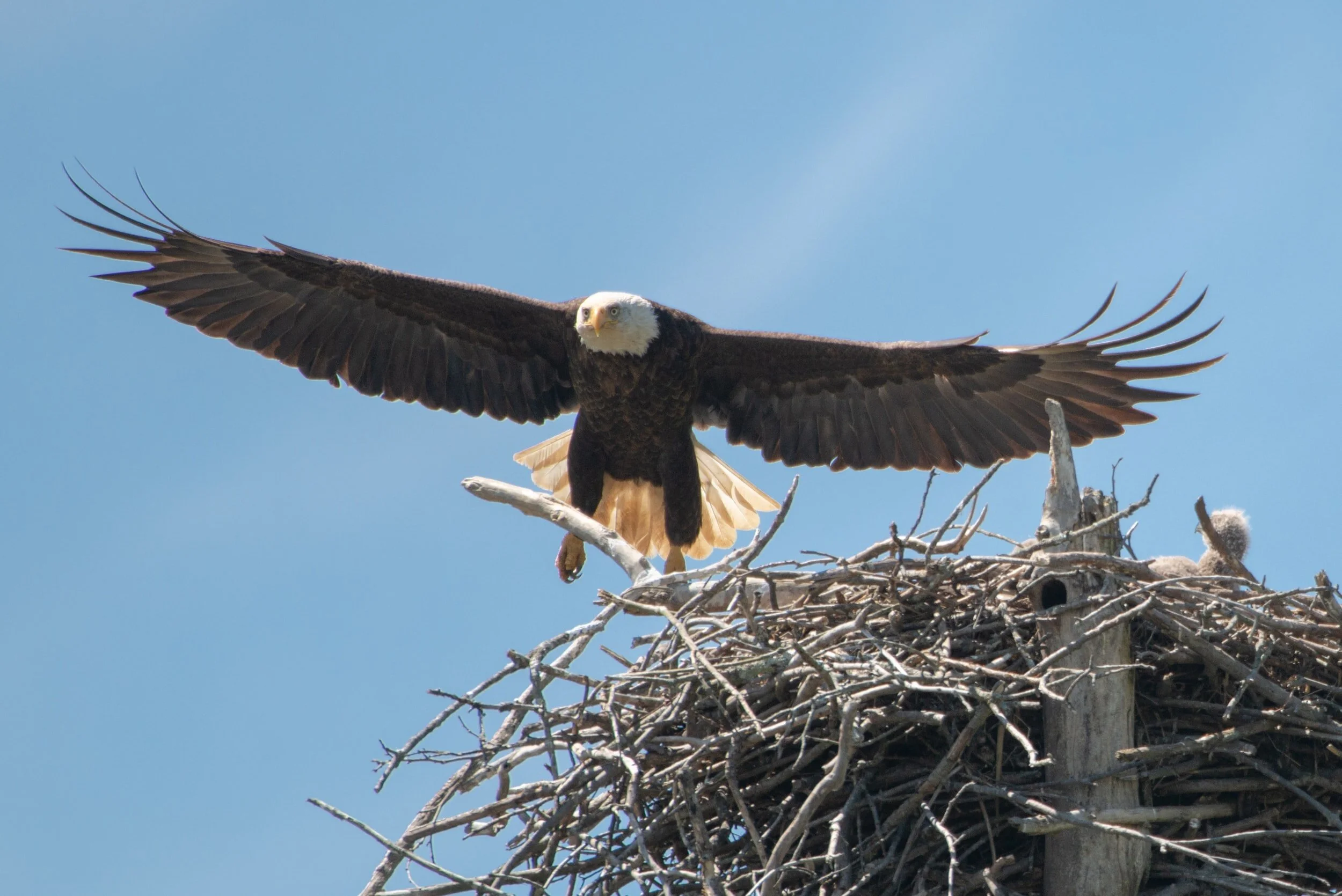
Eagle nests, known as aeries or eyries, are one of the largest nests at nearly 5-6 feet in diameter and 2-4 feet in height.
The female will typically lay 1-3 eggs and both the male and female will take turns incubating the eggs for 34-36 days. After 10-12 weeks (approximately late summer), when the fledglings have left the nest, the mating pair and fledglings may travel to Northern British Columbia and Alaska to take advantage of the early salmon runs.

Shari Sommerfeld Images
To learn more about birding locations on Hood Canal, visit olympicbirdtrail.org for a list of 25 top locations around the peninsula.
A Few Eagle Facts
Bald Eagles are not actually bald, their name comes from an older term for “white- headed.”
At 80.3 inches, the Bald Eagle’s wingspan is slightly greater than a Great Blue Heron. Mature Bald Eagles can weigh between 105.8 to 222.2 oz, with the females usually weighing in on the larger end of the spectrum.
The Bald Eagle is the only eagle native to North America. There are other eagle species in North America, but they are found more globally too, whereas the Bald Eagle is specifically found in North America.
Bald Eagles have a long-life span. The oldest recorded bird in the wild was killed by a car in 2005 in New York, 38 years after being banded in the same state in 1977.
Bald Eagles have a soft, chirpy call, which runs counter to the image of a strong, powerful bird, so its call is often dubbed over in TV and movies with the call of a Red-Tailed Hawk.
Bald Eagles are capable swimmers, if their free-fall salmon dive results in a catch that is just a little too large for lift-off, they can swim ashore with their catch, using their massive wings as “oars.”
Don’t keep an illegal eagle! Possession of an eagle feather without a federally approved permit may be punishable by a $100,000 fine and/ or a year in jail. Permits are only granted to federally recognized Native American Tribal members.
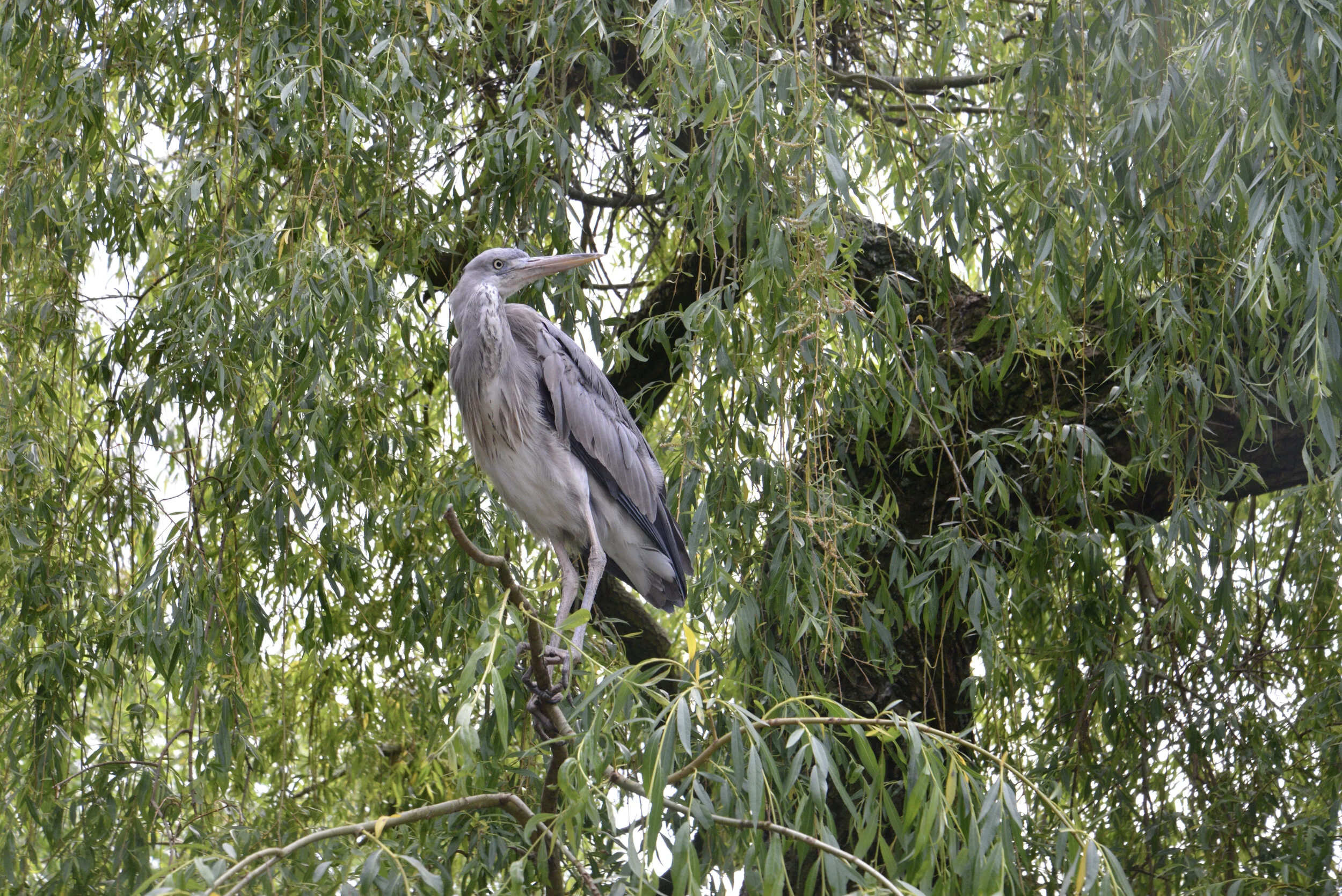
10 Myths & Facts about Great Blue Herons
It’s a common sight to see the “lucky” great blue heron patiently hunting on the shores of Hood Canal and South Puget Sound. Largest of the heron species, up to 4’ in height, they actually only weigh between 5-6 pounds. Here are a few things you may not have known about these iconic Northwest birds.
It’s a common sight to see the “lucky” great blue heron patiently hunting on the shores of Hood Canal and South Puget Sound. Largest of the heron species, up to 4’ in height, they actually only weigh between 5-6 pounds. Here are a few things you may not have known about these iconic Northwest birds.
MYTH
Great blue herons only eat fish.
Great blue herons dine mostly on fish but they will also stalk everything from insects to small mammals and even other birds. In Washington, mice and voles making up a major portion of their winter diet when they choose to hunt on land.
2. FACT
Herons spend about 90 percent of waking time stalking prey.
Great blue herons grab prey in their strong beaks or use their dagger-like bills to impale. This action is known simply as a ‘bill stab’. They shake the prey to break spines before gulping them down. Great blue herons can swallow fish that are much wider than their narrow neck and have even been know to catch small birds in flight. Patience and speed are the keys to their hunting success.
3. MYTH
Great Blue Herons are cranes.
A crane is totally different type of bird. You can tell them apart by looking at the beaks and the way they fly. Cranes have shorter beaks and hold their necks straight when in flight, whereas herons curve necks into an S-shape. Herons are able to do this because of specially shaped vertebra. Great blues also fly with their legs ‘hanging” which is unique from most birds.
4. FACT
Herons are often called “Dinosaur Birds.”
Fossil records date them back 1.8 million years ago, but they are thought to have existed about 25 million years ago during the Cenozoic age. Maybe it’s also because of the prehistoric sounds they make as they take off with the giant 6’ wingspan flapping!

5. MYTH
Great Blue Herons can’t swim.
The great blue does many things that other herons choose not to do, including swimming in deep water with apparent grace and comfort. A quick search on the internet will show multiple accredited images of herons happily swimming in deep water. It’s not a common occurrence though, so consider yourself lucky if you catch sight of this phenomena. Swimming is a testament to the great blue heron’s incredible adaptability.
6. FACT
Great blue herons have adapted “bib” feathers to keep them clean.
Specialized feathers on their chest grow continuously and fray into a fine cleaning powder. This powder is used to help groom their entire body and clean off fish slime.

7. MYTH
Great Blue Herons are monogamous.❤️
Not technically. Great blues are known to be ‘serial monogamous’ — they have one partner for a year but choose a different one each mating season. Despite being territorial with other herons, they typically breed in nesting colonies at the tops of trees containing up to 500 breeding pairs. These colonies are called “heronries.” They obviously do not have any social distancing issues. Great blue herons generally return to the same breeding grounds each year although with different partner choices.
8. FACT
Mates work to build the nest, as well as incubate and feed their young –together.
When the mating pair is chosen, the male gathers sticks while the female weaves them into a platform nest lined with moss, grass, and small branches. She lays 2-6 blue eggs, and both parents take turns incubating them for 4 weeks until the young hatch. They also take turns feeding regurgitated prey to the young chicks.
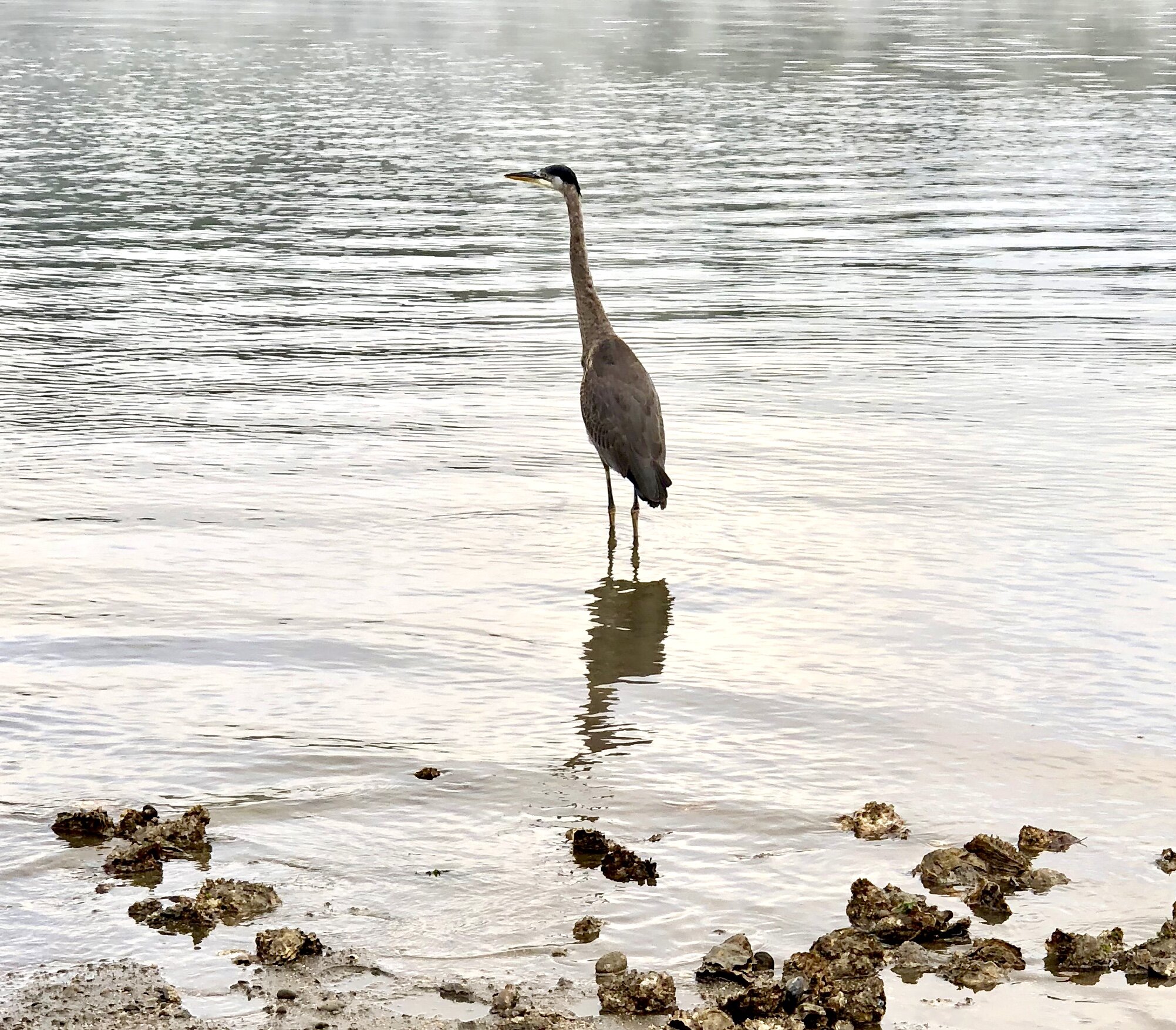
9. Myth
Heron chicks have yellow eyes when they are born.
Heron chicks have gray eyes when born that become bright yellow when they are adults. The parents continue feeding the nestlings for a few weeks after fledging (leaving) the nest. Young herons will fledge at around two months.
10. FACT
Great blue herons’ colors can demonstrate age, sex, and mating season.
Adult males are larger and generally have brighter orange legs than a female. During breeding season, the lore (the lore is the region between the eye and bill) will turn a bright blue, the iris will turn reddish, and the yellow bill will take on an orange hue.

A couple other things you didn’t need to know about great blue herons:
To keep cool they flutter their throat muscles to increase evaporation.
It can take up to two weeks to build a nest.
Life expectancy of a great blue heron is 15-23 years
Despite their size they can fly as fast as 30 MPH.
An adult heron consumes up to one pound of fish per day.
Learn more
The Cornell Lab - all about birds
Audubon - Great Blue Heron guide
Olympic Bird Trail - Top birding locations on Hood Canal, South Puget Sound, Pacific Coast, and Olympic Peninsula




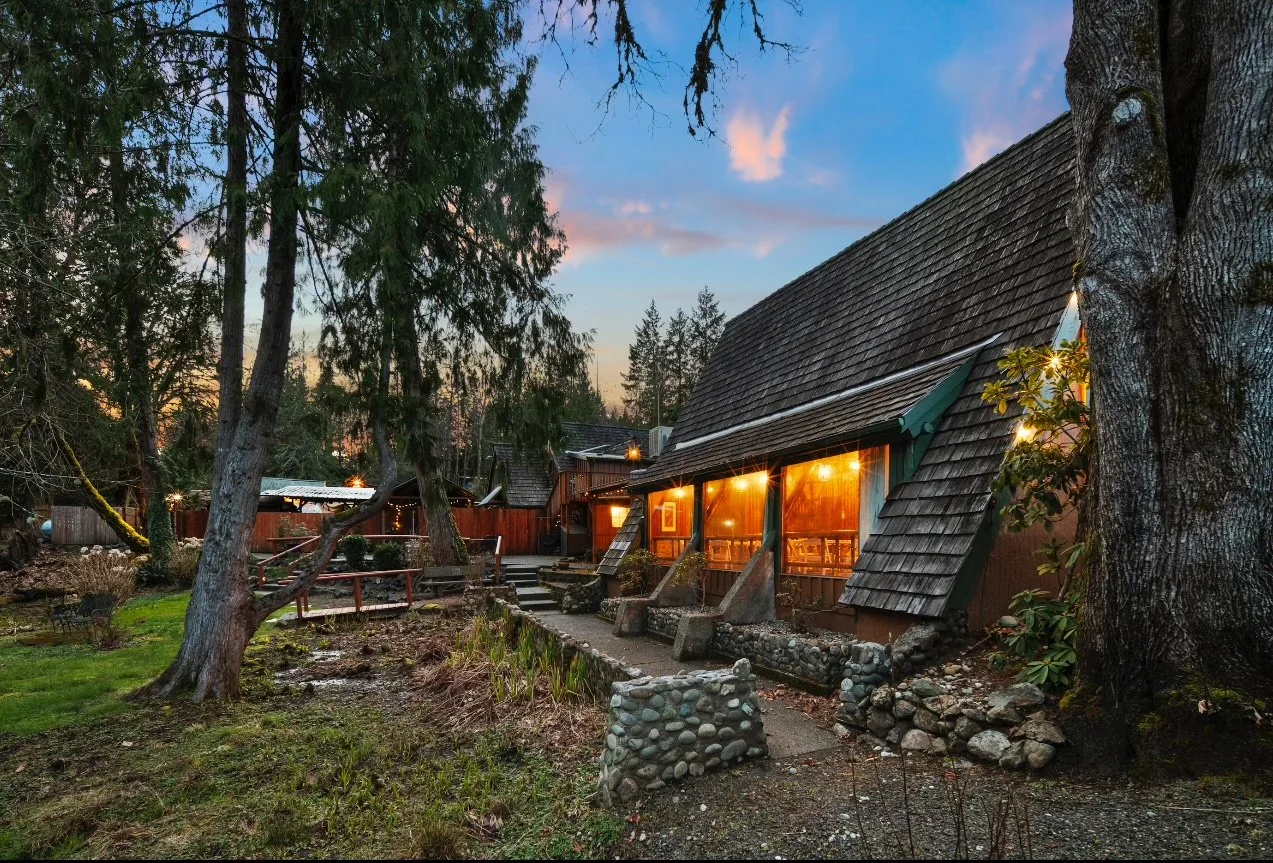
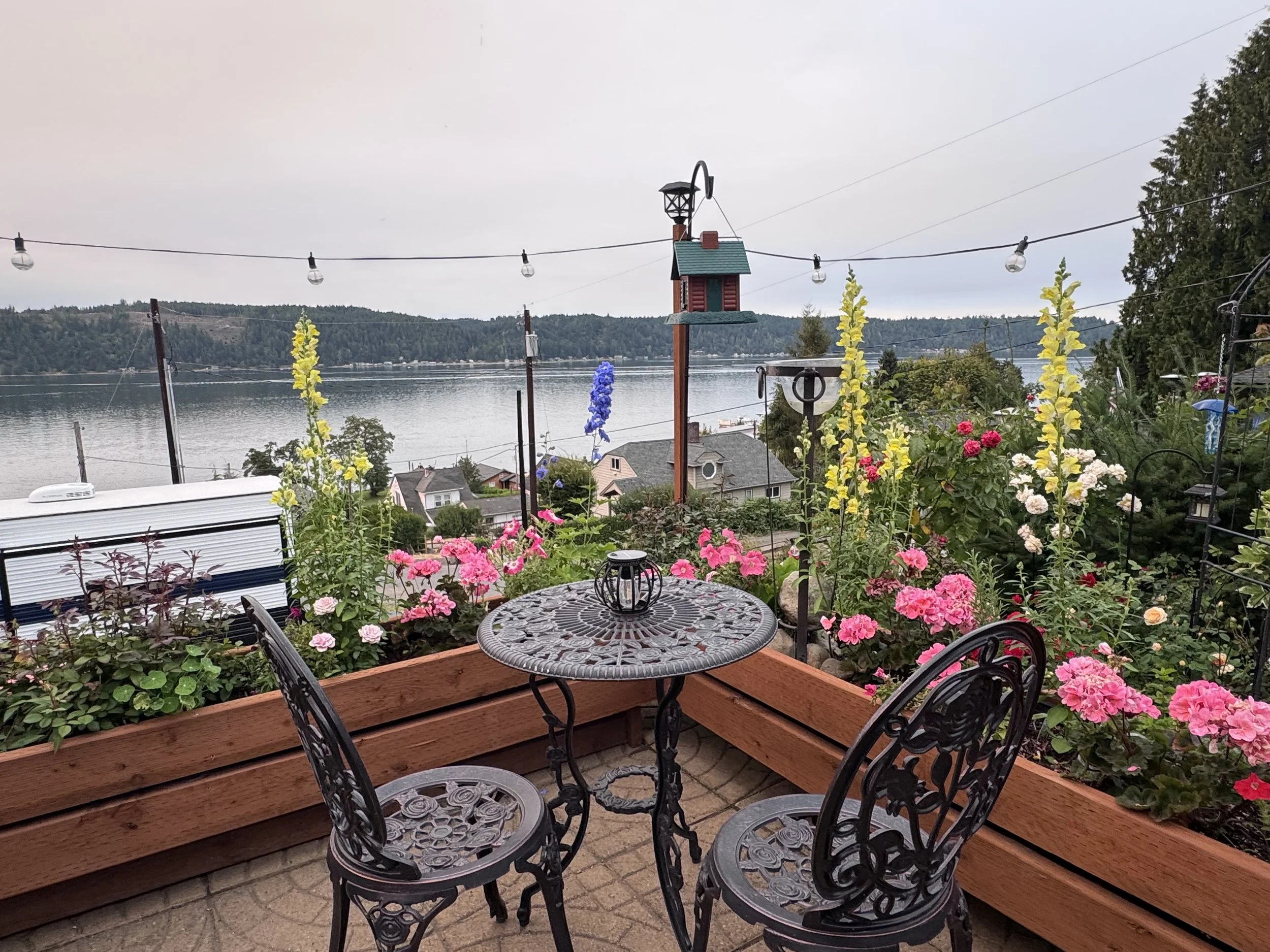





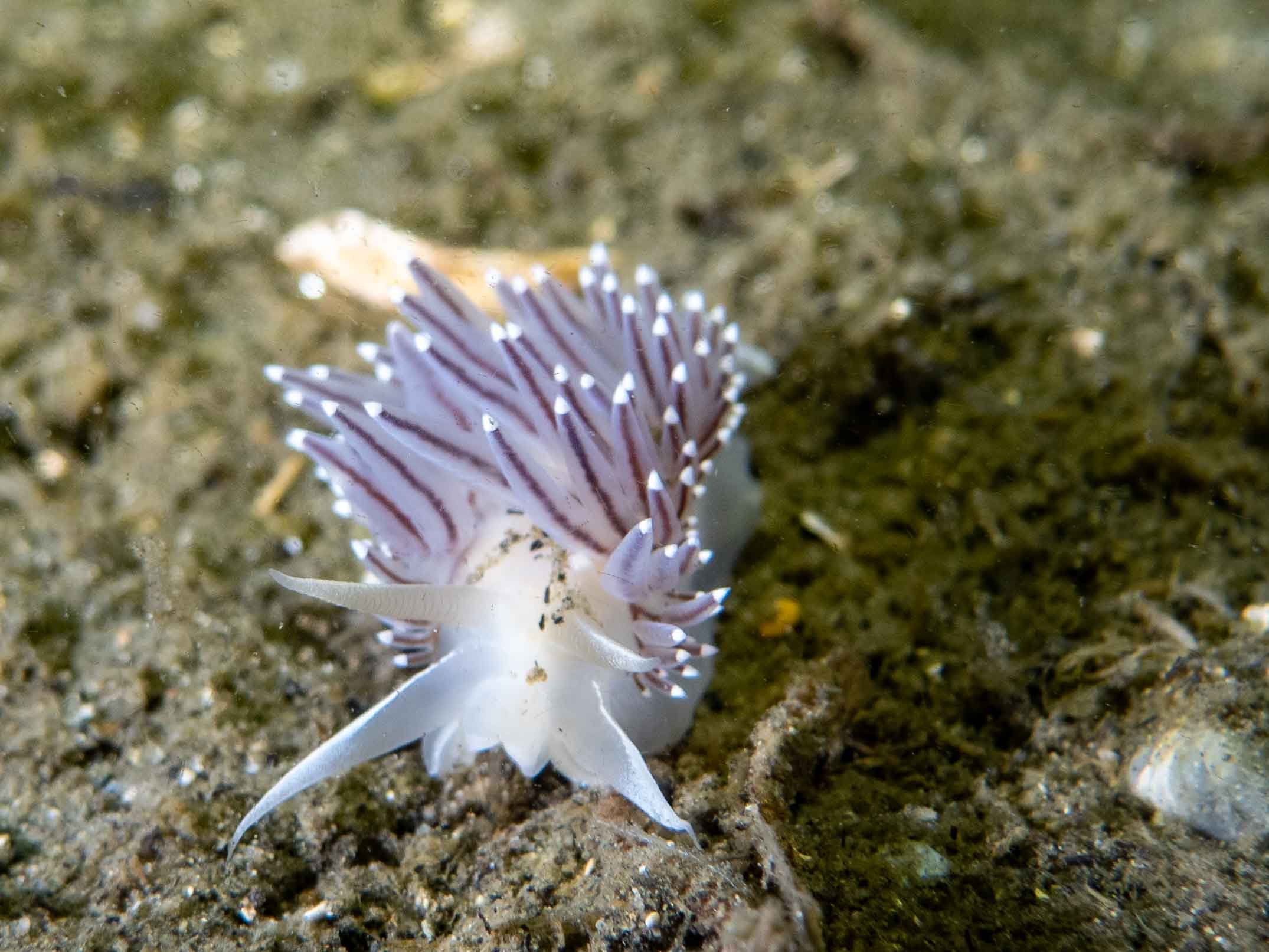
Underwater Wonders:The Vibrant World of Nudibranchs
With their brilliant colors and unique patterns, these vibrant sea slugs captivate divers and underwater photographers alike. Despite their small size, nudibranchs' diversity, intriguing behaviors, and ecological significance make every encounter unique
Story and Pictures by Thom Robbins
In the Pacific Northwest, divers can't help but talk about nudibranchs. With their brilliant colors and unique patterns, these vibrant sea slugs captivate divers and underwater photographers alike. Despite their small size, nudibranchs' diversity, intriguing behaviors, and ecological significance make every encounter unique. Observing their feeding habits or marveling at their colors and patterns turns an ordinary dive into an extraordinary experience. It's no wonder dive enthusiasts travel from around the world to places like the Salish Sea to see these mesmerizing creatures.

How to pronounce “Nudibranch”
The word nudibranch is pronounced “Noo-de-brank”, with the ‘ch’ making a ‘k’ sound. The name nudibranch comes from Latin and Greek. “Nudi” means naked in Latin, and “Brankia” means gills in Greek. This name suits them well since their gills are exposed on their backs.

Nudibranchs, or sea slugs, are marine gastropod mollusks with unique sensory systems. They belong to the Mollusk family, which includes snails, slugs, and octopuses, and are closely related to land-based slugs and snails. With their dazzling colors and intricate patterns, nudibranchs are some of the ocean's most visually striking creatures. They have long captured the imagination of both scientists and divers. With about 3,000 known species of nudibranchs worldwide, scientists believe many more remain undiscovered. Approximately 300 species have been documented in the Salish Sea. With their extraordinary colors and behaviors, nudibranchs are a fantastic example of evolution and still hold many mysteries.
Nudibranchs have been known to humans for thousands of years, but scientific classification began in the late 18th and early 19th centuries. The first recorded description was in 1691 by English naturalist John Ray, who described a species of "sea mouse." Recent advances in technology and imaging have made studying nudibranchs easier, revealing new insights into their biology and behavior. High-resolution microscopes and genetic analysis techniques help scientists examine their anatomy and evolutionary history in greater detail.
Nudibranchs are primarily found on the ocean floor, where they gracefully navigate using a broad, flat muscle on their underside called a foot. This muscular foot allows them to glide slowly over the substrate, often at a pace of just a few centimeters per minute. However, some species can swim short distances in the water column by undulating their foot muscle in rhythmic waves. This unique movement, though still relatively slow compared to other marine creatures, adds elegance and adaptability to these fascinating sea slugs as they explore the diverse habitats of the Salish Sea.
Nudibranchs are omnivorous and have oral tentacles near their mouths that act like hands to help them search for food. They also possess a set of curved teeth called a radula, similar to a toothed tongue. The radula allows them to scrape food off surfaces, munching on various organisms, including hydroids, seaweed, corals, algae, barnacles, fish eggs, sponges, anemones, and even other nudibranchs. While some species enjoy a diverse diet, others are picky eaters, consuming only one type of prey. Interestingly, some nudibranchs can even feed on other sea slugs, including those of their species. In this way, nudibranchs play a crucial role in the Salish Sea's food web, helping regulate other organisms' populations.
Nudibranchs have poor vision and can only discern light and dark, so they sense the world through two highly sensitive tentacles called rhinophores on their heads. Unfortunately, these rhinophores tend to stick out and serve as a lure for hungry fish. However, most nudibranchs can withdraw their rhinophores into a receptacle in their skin when they sense danger.
Nudibranchs also have symbiotic relationships with certain organisms in the Salish Sea—for example, some nudibranchs partner with zooxanthellae, a type of algae that lives inside their bodies. The nudibranch provides a safe and protected environment for the algae, and in return, the algae give the nudibranch energy through photosynthesis.
Gallery of nudis
Photos by Thom Robbins
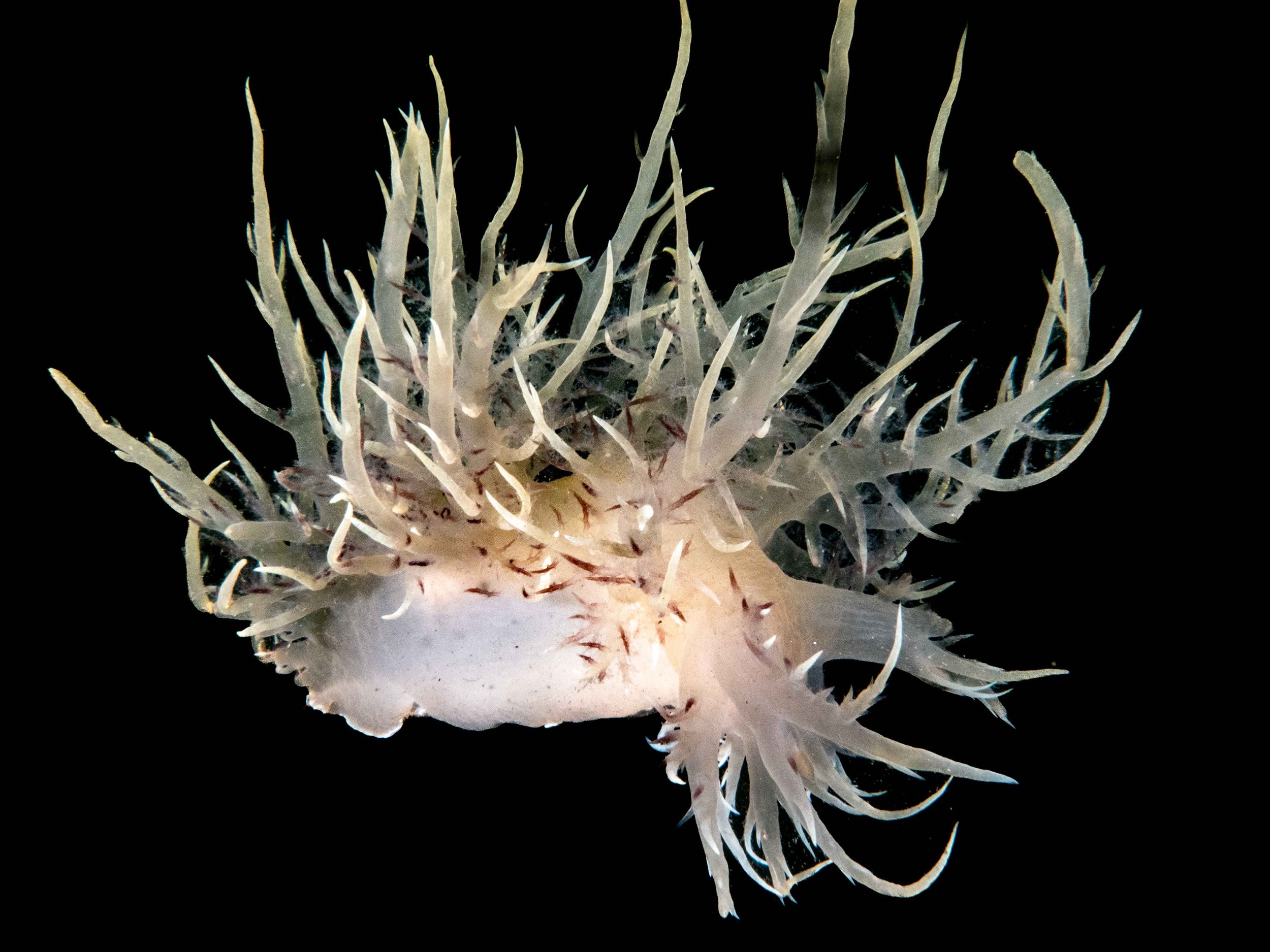
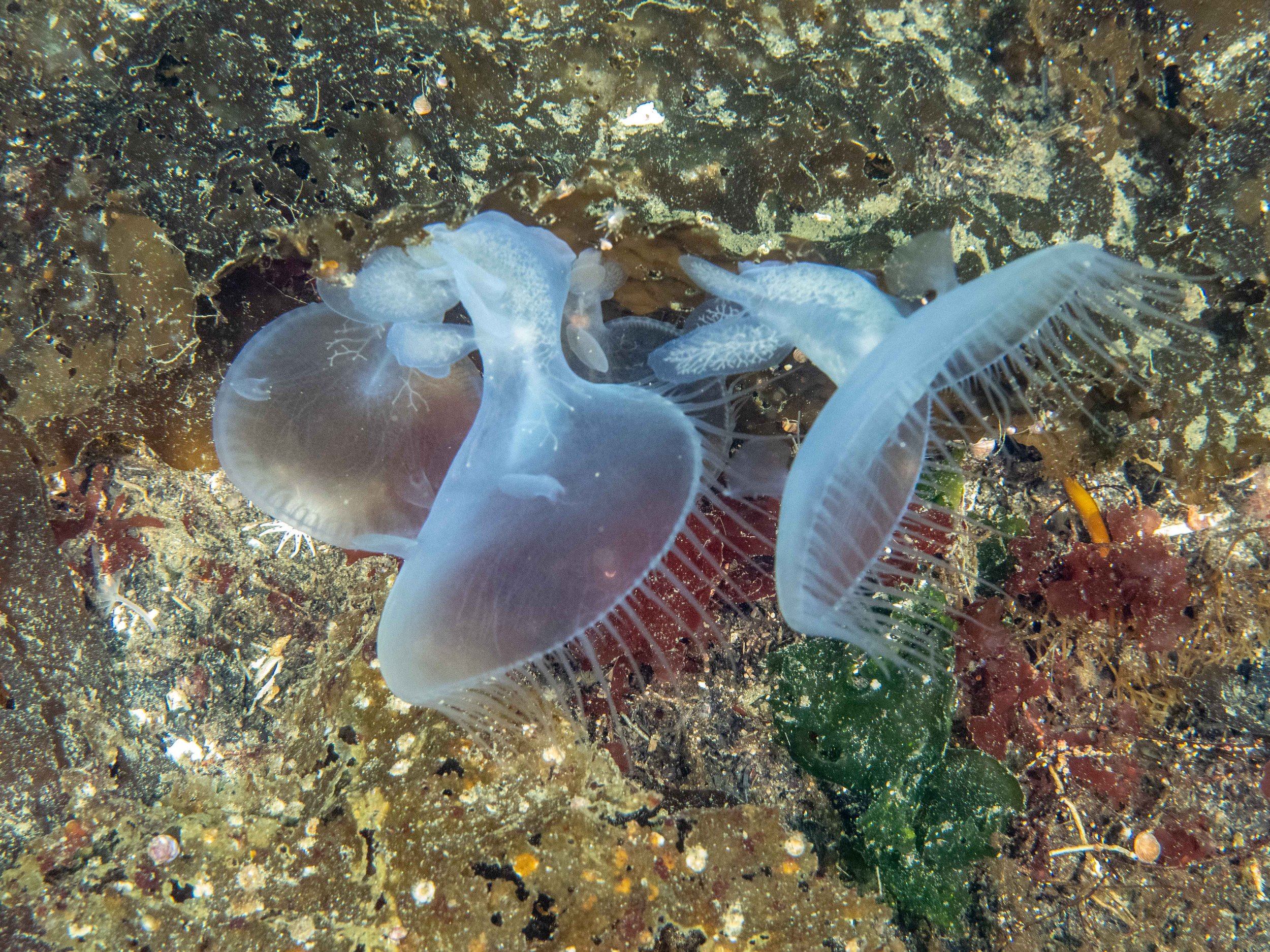

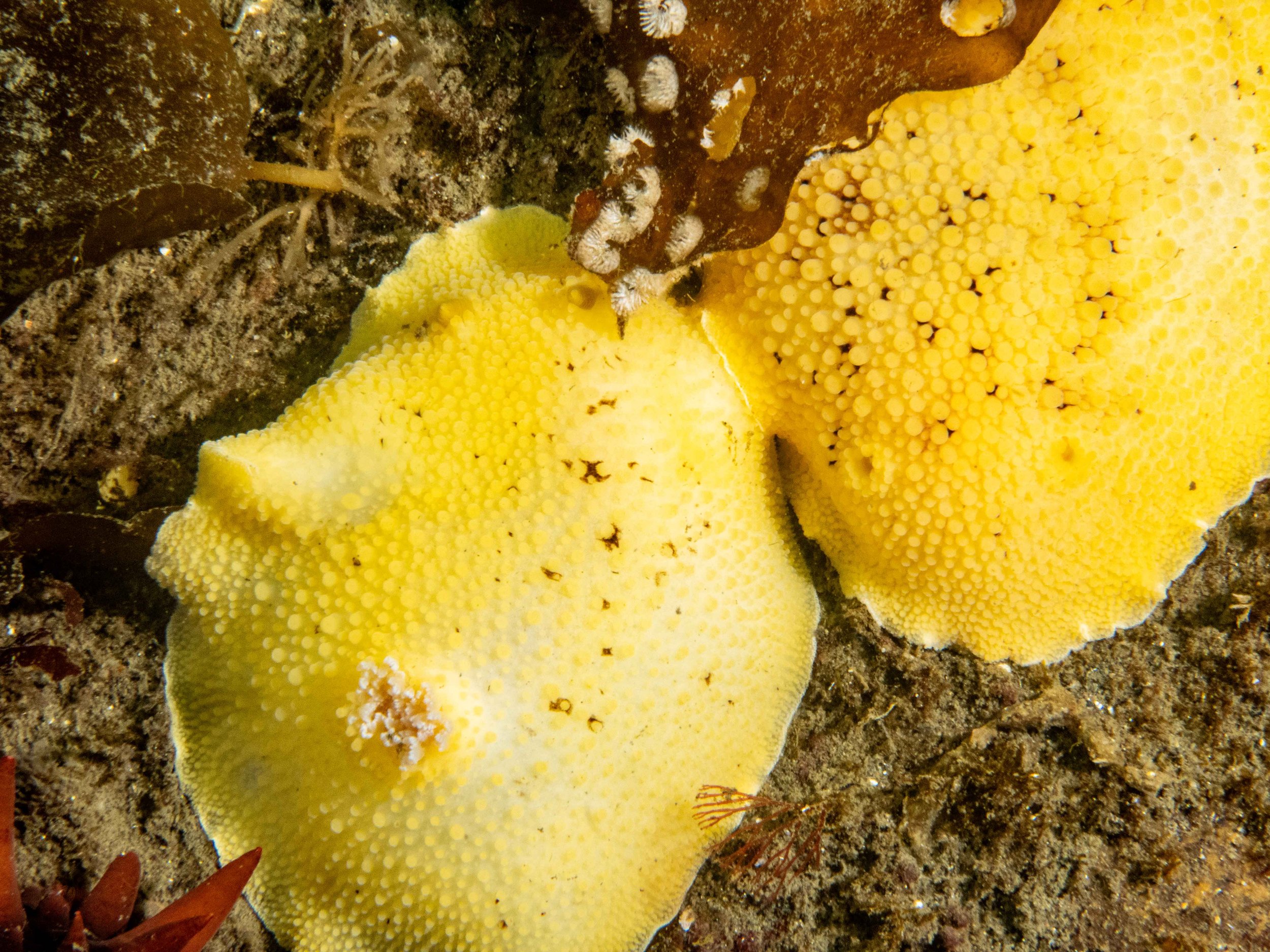
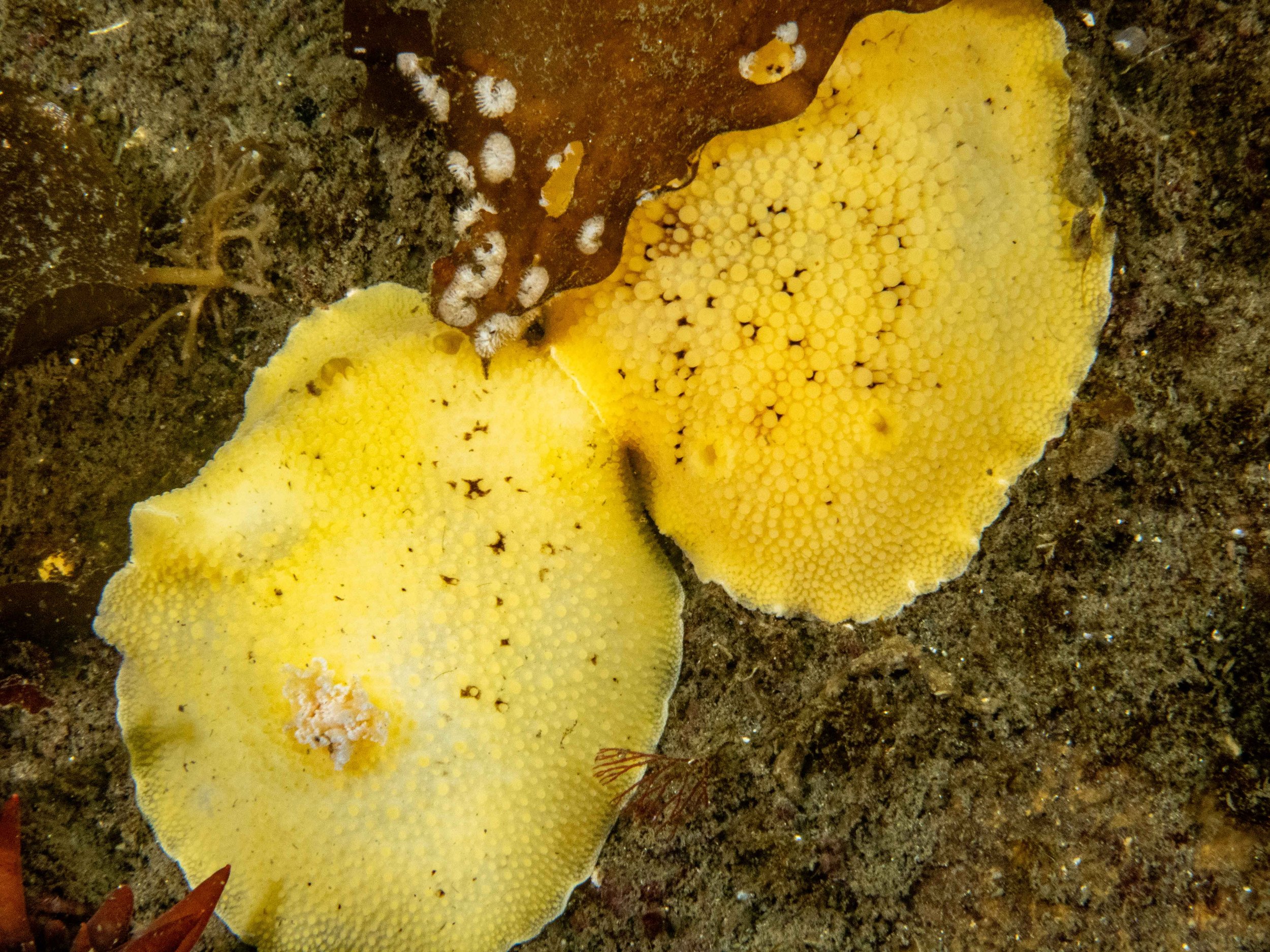
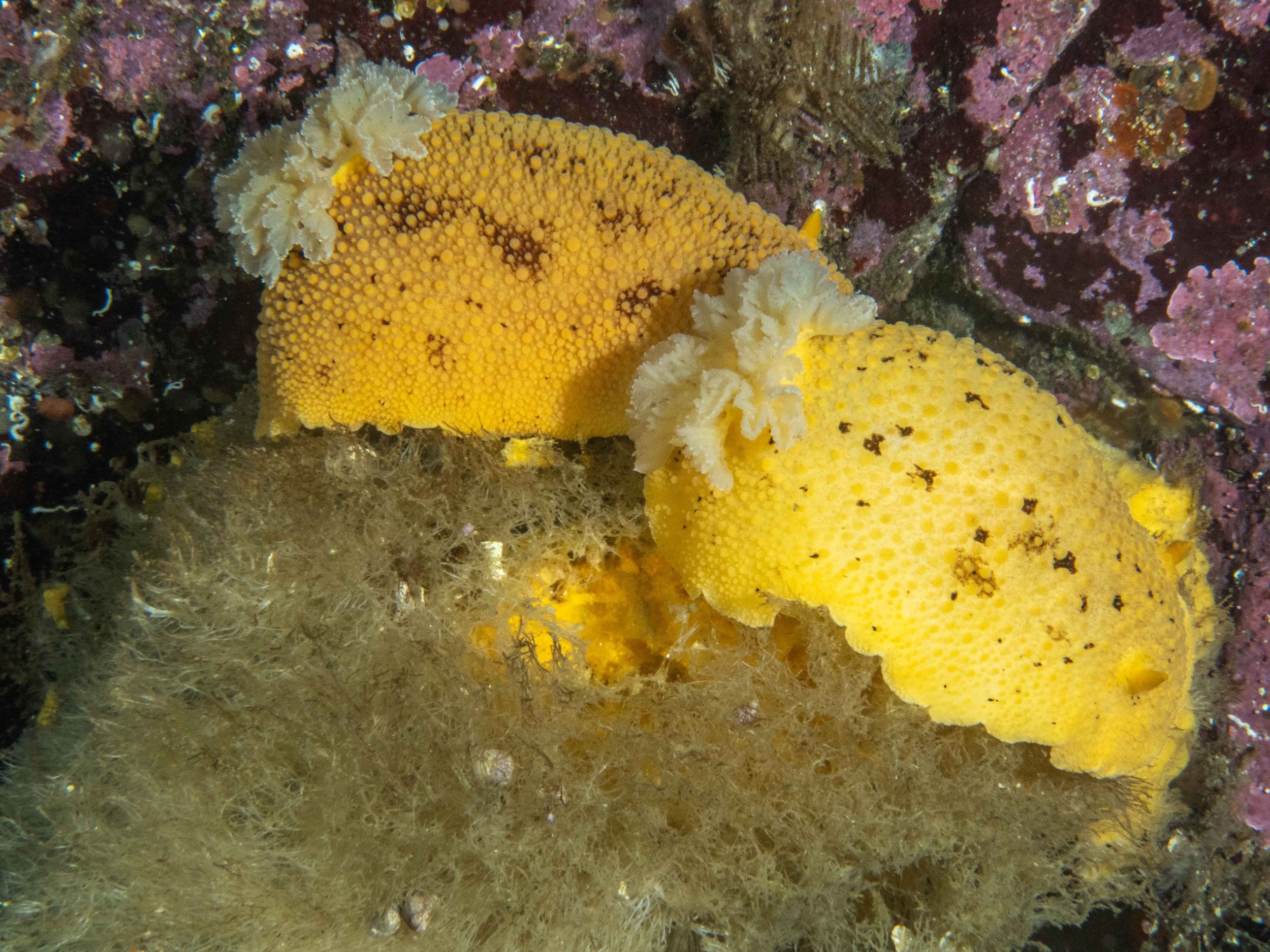

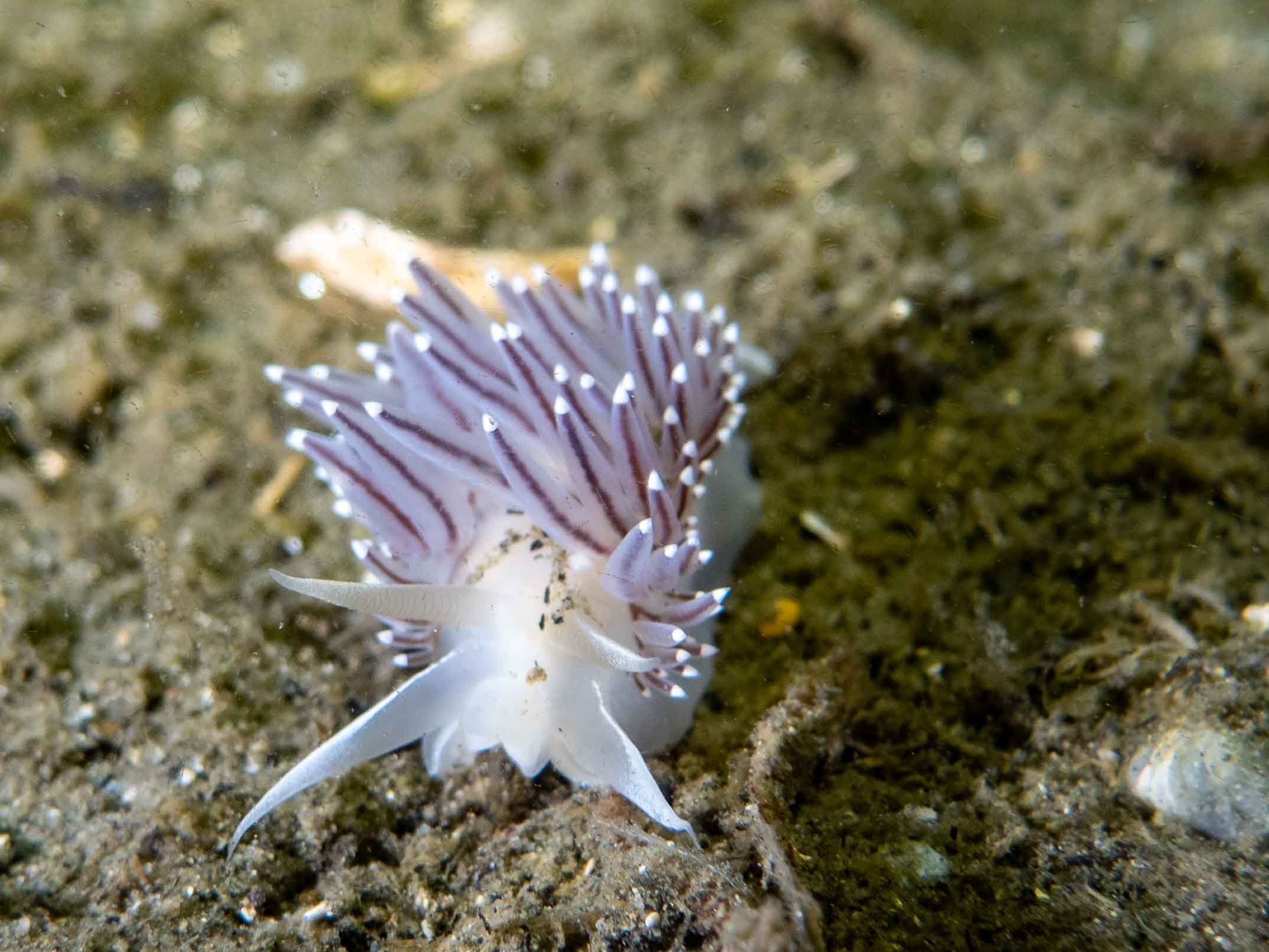
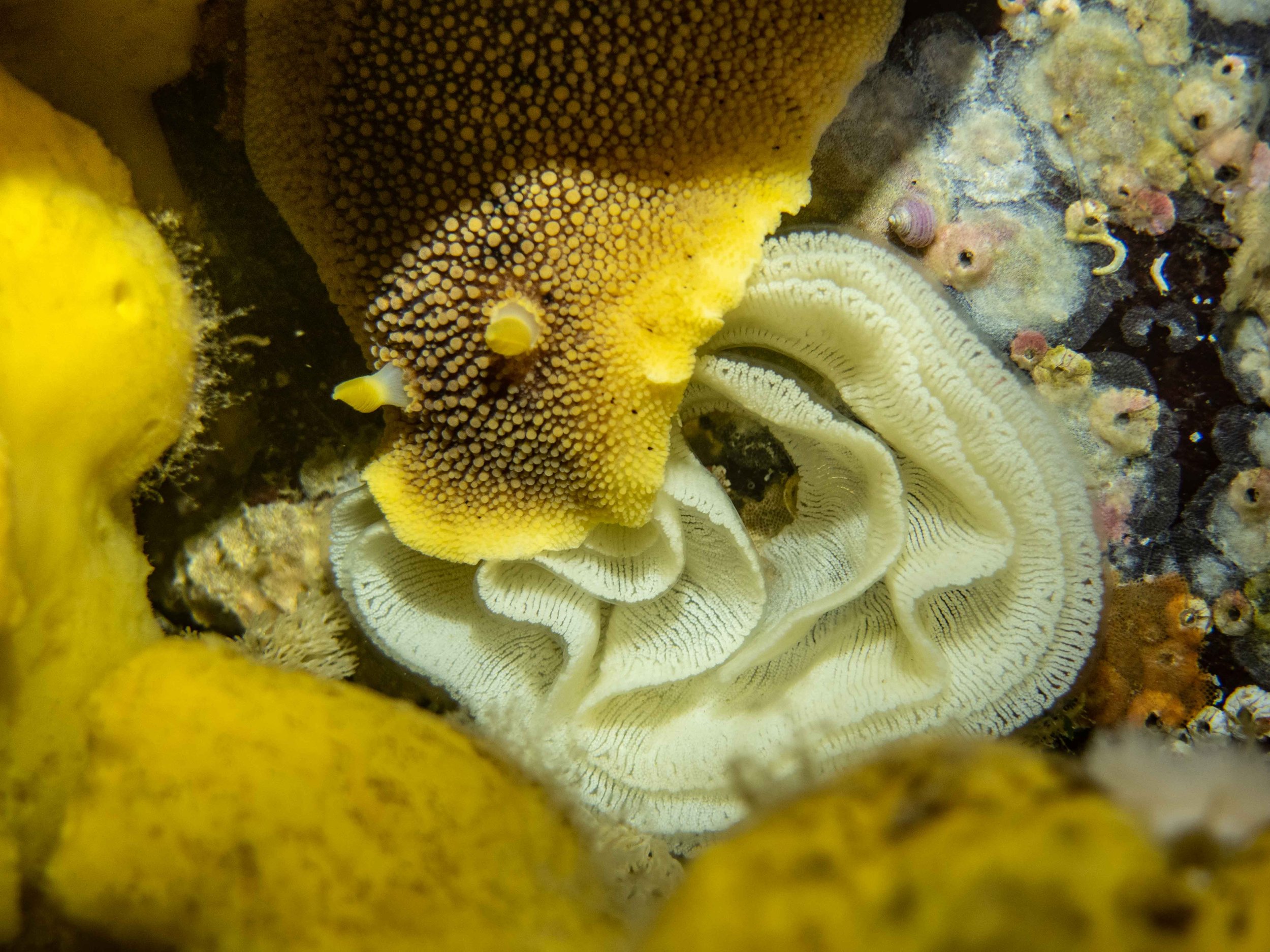
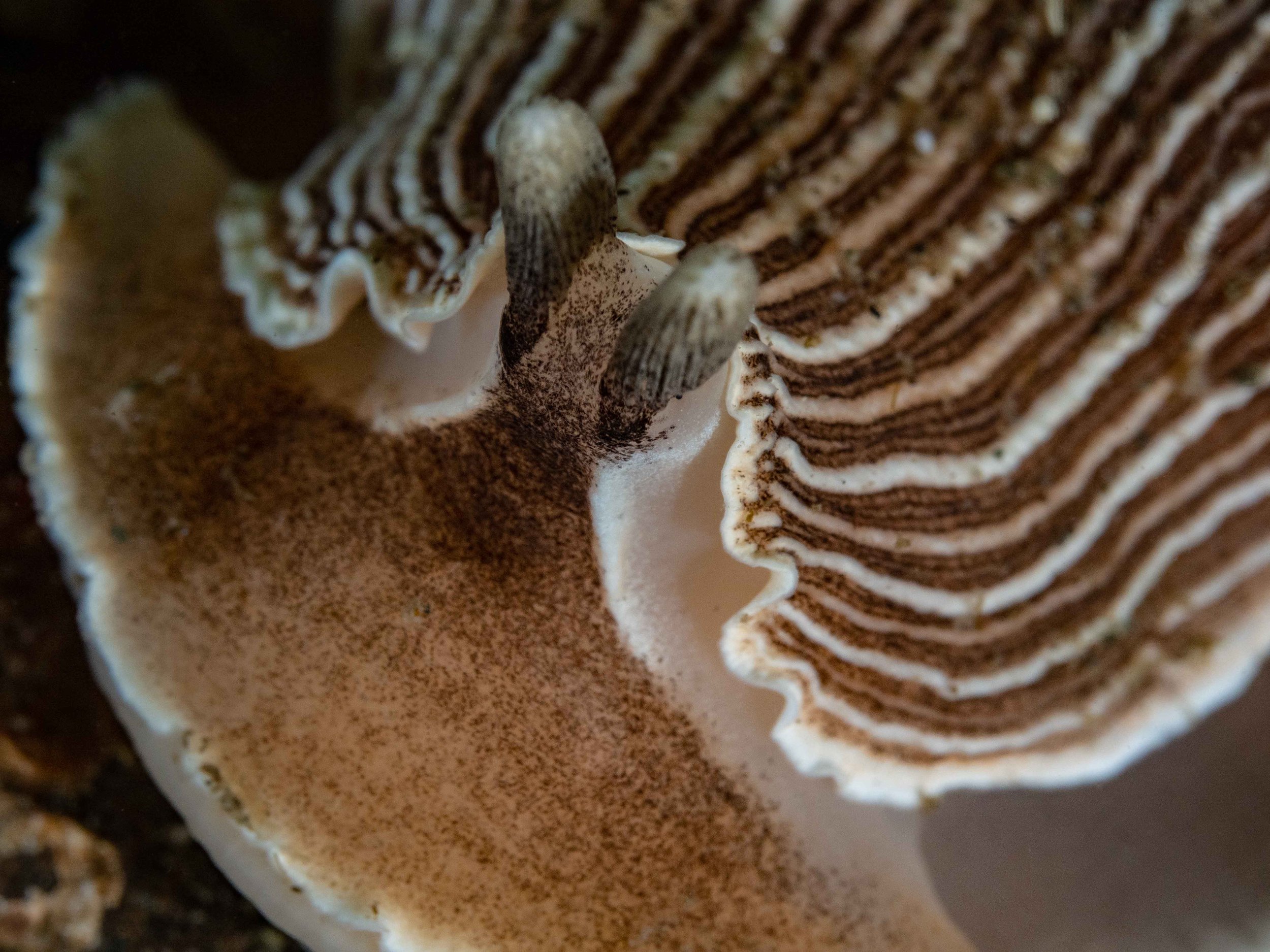

The Lifecycle of a Nudibranch
Nudibranchs are hermaphrodites, possessing both male and female reproductive organs, allowing them to mate with any mature species member. Finding a suitable mate can be challenging as they must locate a partner of appropriate size, age, and species. Although mating is crucial for survival, nudibranch mating behavior is not fully understood.
Since nudibranchs do not roam far and have a short lifespan, ranging from one week to one year, their survival depends on mating whenever the opportunity arises. After a brief courtship, the mating ritual takes only a few minutes. Nudibranchs lay ribbon-like egg masses that hatch into free-swimming larvae, eventually settling on the seafloor as adults.
When two nudibranchs meet, they engage in a mating dance involving various physical interactions, which differ depending on the species.
Several nudibranch species have interesting mating practices and reproductive strategies. For instance, the sea lemon nudibranch is known for its elaborate courtship dances, while the opalescent nudibranch has more solitary and secretive mating habits. The mating process finishes with one nudibranch inserting its penis into the other's genital opening to transfer sperm and fertilize the eggs.
The dance of the sea lemon nudibranch is a captivating display of intricate behaviors. It begins with the nudibranchs detecting chemical signals through their rhinophores and sensory organs. Once a potential mate is identified, they initiate a series of movements and interactions. Sea lemons may swim in circles around each other, using rhythmic body contractions to create water currents.
They align their bodies and exchange tactile touches using oral tentacles and rhinophores, including stroking or tapping each other. These interactions allow them to assess their potential mate's size, texture, and readiness and to exchange chemical cues through skin contact to determine compatibility and reproductive readiness. The sea lemon courtship can last several minutes or even hours. If they find a compatible mate, they align their bodies side by side and mate.
The opalescent nudibranch engages in a mesmerizing courtship behavior known as "chaining" or "following." It begins with one nudibranch following the slime trail left by another. The follower extends its oral tentacles to touch the rear end of the leading nudibranch, triggering a reciprocal response. This back-and-forth interaction can continue for quite some time.
During courtship, they may touch each other with their oral tentacles, antennae, and rhinophores, intertwining their bodies or forming a chain-like structure with multiple individuals. This behavior helps them assess each other's compatibility for mating by exchanging chemical cues through their slime trails, which convey information about reproductive state and readiness. This courtship dance allows them to determine species compatibility, identify potential mates, and ensure successful reproduction.
Nudibranchs also engage in chemical warfare during mating. They can produce and store toxic compounds from their food, such as sponges and algae, in specialized glands in their bodies. These toxins are a defense mechanism against predators and can also repel unwanted mating advances. If a nudibranch is not interested in mating, it can release a cloud of noxious chemicals to discourage further advances.
After mating, nudibranchs lay their eggs in long ribbons or strings sheathed in protective mucus. Although adults don’t care for the eggs, some species cover them with defensive chemicals to deter predators. Family size varies by species, with some laying just a few eggs and others depositing several hundred or even millions. The egg ribbon protects the developing eggs, and nudibranchs often lay them in locations that provide optimal conditions for growth and survival. The eggs hatch into tiny larvae that drift in ocean currents for several weeks before settling on a suitable substrate and developing into adult nudibranchs.
In our area, nudibranch eggs hatch in two ways: as tiny larvae with shells that swim and feed in the plankton or as miniature adults. The swimming larvae, known as veligers, must find the right food before they settle down and grow into small adults. The juvenile nudibranch feeds on tiny organisms like algae and small invertebrates for several weeks. As it grows, it will feed on larger prey such as sponges and hydroids. Nudibranchs have feeding mechanisms that set them apart from other mollusks. They have an oral hood that extends over their mouth, which they use to capture prey. This oral hood contains several rows of sharp teeth that can pierce the prey's outer layer and inject it with digestive enzymes.The time it takes for a nudibranch to grow to maturity can vary depending on the species, but it typically takes several months to a year. When the nudibranch reaches maturity, it begins to search for a mate.
Conclusion
Diving into the waters of tour area transforms the ordinary into extraordinary. As you descend, a serene quietness envelops you, like an explorer charting new frontiers. Camera in hand, navigate this alien landscape, like an astronaut on an oceanic planet. The vastness of the reef invites you to uncover its secrets. Glide along its surface, examine each nook and cranny with curiosity. Vivid marine life enchants, with each nudibranch a brilliant stroke from nature’s palette. In this underwater maze, the adventure takes an exciting turn. A nudibranch appears, its vibrant colors catching your attention. The incredible beauty of these creatures sharpens focus. Point, click, forever preserving your encounter with the dazzling nudibranch.
To learn more about diving locally to see nudibranchs, visit the Sund Rock Marine Preserve, or contact YSS Dive Charters . Both are located near Hoodsport on Hood Canal. You can also often view nudibranchs at very low tides around the docks and piers.
Author: Thom Robbins
Thom has been a diver for over thirty years and is never happier than underwater with his camera. He writes shoots, and teaches diving and photography. Thom lives in Shelton with his wife and mentor, Barb, son and two English Bulldogs. Learn more at thomrobbins.com.

Feast your eyes on a face with personality to spare!
Get any group of divers together in the Pacific Northwest and ask them what makes for a great dive. Everyone will agree that a wolf eel was somehow involved. There is something unique about the supremely ugly faces of an adult wolf eel staring at you from its den.
Story & Pictures, Thom Robbins
Get any group of divers together in the Pacific Northwest and ask them what makes for a great dive. Everyone will agree that a wolf eel was somehow involved. There is something unique about the supremely ugly faces of an adult wolf eel staring at you from its den.

Hood Canal Wolf Eel | Photo credit: Thom Robbins
This can turn an ordinary dive into a great one. The conditions don’t matter – cold, terrible visibility or strong currents are forgotten once a wolfie (as we call them locally) appears publicly. It’s not surprising why divers worldwide travel to places like the Hood Canal to catch a glimpse of these fantastic creatures.
Meet wolfie

Hood Canal Wolf Eel | Photo credit: Thom Robbins
Throughout history, the peoples of the northern Pacific have held wolf eels in deep respect. Many of the native tribes in the area viewed the wolf eel as a creature of strength and resilience, symbolizing protection due to its robust and intimidating appearance. This belief often extended to the spiritual realm, where the wolf eel was thought to embody protective spirits. In Washington, the wolf eel is now a protected species in the Puget Sound and Hood Canal.
This is not because they are endangered but because their value as a living resource to divers and photographers far exceeds whatever commercial value the species could provide as a food source. Some dive sites, like Sund Rock in the Hood Canal, are well-known locations where wolf eels interact with divers and provide unique photo opportunities.
Wolfies are not related to eels. Instead, they are part of a family known as the wolf fishes.

Hood Canal Wolf Eel | Photo credit: Thom Robbins
They belong to an even larger group of fish known as Perciform, generally considered perch-like fish. But their long-bodied, eel-like appearance is unique in this group of fishes. The wolf eel can be found as far south as San Diego in southern California, then northward up the Pacific coast to the Aleutian Islands in Alaska. The popular term “wolf eel” comes from the large frontal canine-like teeth used to seize their favorite meals, mainly hard-shelled crustaceans and invertebrates. The typical menu includes crabs like Dungeness, Red Rock, and Green Urchins.
Most wolf eels can grow to about six feet long and weigh almost thirty pounds, although they can grow to eight feet. These massive fish are speculated to live up to 10 years in the wild, though no research is available on their longevity. Scientists have found that they can begin reproducing between four to seven years, suggesting they may be long-living fish. One fact that I find fascinating is that they lack a swim bladder, a feature commonly found in most fish species. The swim bladder is an internal gas-filled organ that helps fish regulate their buoyancy and control their vertical position in the water column. However, the wolf eel has evolved without this organ, relying on its muscular body and strong pectoral fins to maneuver and maintain its position in the water. The lack of a swim bladder allows wolf eels to lounge around on the bottom or lay in their home lairs. Like snakes, they swim by making S shapes with their bodies and use their pectoral fins to steer. This unique adaptation allows the wolf eel to thrive in rocky coastal habitats, where it can navigate through crevices and caves with exceptional agility. By forgoing the swim bladder, the wolf eel has developed a specialized set of skills, making it an expert hunter and a master of its underwater domain.
Additionally, wolf eels have a slimy coating on their bodies, which serves several important purposes for their survival and protection in their marine environment. First, it acts as a natural defense against infections. The slime contains antibacterial and antimicrobial properties that help prevent the growth of harmful bacteria and parasites on their skin, reducing risk of infection.
The slimy coating makes it difficult for predators to grip or hold onto a wolf eel.
When threatened or attacked, a wolf eel can release more slime from its skin, making it slippery and challenging for predators to maintain a firm grip. This slippery defense mechanism allows the wolf eel to escape from potential threats. The slimy layer reduces friction when the wolf eel moves through the water, allowing them to easily pass through tight spaces and narrow cracks without getting stuck.
Lifecycle of a Wolf Eel
Approximately 24 hours before mating, the female wolf eel’s abdomen becomes noticeably distended. When this happens, the male will butt his head against the back of her abdominal region. This action appears to stimulate physiological activity. A series of waves move through the female's body from her head to her tail, particularly pronounced in her abdominal area. The male will then wrap himself around the female so that their heads will be side by side and their genital regions adjacent. In this position, the female releases the eggs, usually between 5,000 and 10,000, and the male fertilizes them as they appear. After fertilization, the female will coil about the eggs, molding them into a ball-like cluster. The eggs are adhesive to each other but not to the rocky walls of the den. Both parents will then coil themselves about the egg mass, sometimes together and at other times individually, tending the eggs and ensuring they are rotated so that a good flow of water passes through them.
After about 16 weeks, the eggs hatch, and the larvae float towards the upper part of the ocean or the sea, where they spend nearly two years of their lives. The tiny fish are born brownish pink, about 1 1/2 inches long. They turn dark gray within a day and start snacking on small shrimp after a few days. The larvae that emerge are left on their own to swim with the plankton in the ocean. From birth, they are voracious predators and will strike at their planktonic prey, much like a coiled snake will strike at a mouse. Constantly searching for prey, the larval wolf eels will lead a pelagic existence. Eventually, the maturing youngsters settle on the ground and enter a den. Denning will typically occur in the Puget Sound area from February through April.

Juveniles wolf eels exhibit a more vibrant and striking appearance. | Photo credit: Thom Robbins
The change from a pelagic to a bottom-dwelling existence spawns physical changes in the juvenile wolf eel. Juveniles exhibit a more vibrant and striking appearance. A vivid orange or reddish-orange color with darker markings often characterizes their appearance. This vibrant coloration helps juveniles blend in with their surroundings, such as rocky reefs or kelp forests. As they mature into adults, their coloration becomes more subdued brown or reddish-brown. The skin often has spots of a darker color, which may be outlined in a lighter color. The males will also develop a puffy face, enlarged jaws, huge bulbous lips, and a powerful sagittal crest at the top of their heads to support the increased muscle mass required for the jaws.
Friends & enemies
There is no fairness in the realm of a Salish Sea rocky reef. A fierce battle for ownership unfolds around the most desirable den sites. The key contenders are the Giant Pacific Octopus (GPO), and the formidable wolf eel.
Both species vie for control over these coveted shelters, which serve as their sanctuary in a harsh underwater world. This struggle is fueled by their shared habitat, prey, and an unyielding desire for the same type of den sites.
With its unmatched dexterity and cunning, the octopus poses a formidable challenge to the wolf eel. I have watched the battle when a GPO ruthlessly evicts a wolf eel, sometimes even targeting mated pairs, and claims the den as its own. Despite the wolf eel's valiant efforts, there is little it can do once an octopus of even modest size has set its sights on a particular den.
Ask any diver, and they can attest to the futility of trying to dislodge an entrenched octopus from its chosen abode.
Submerging into the chilly embrace of the Salish Sea transforms the ordinary into the sublime. A serene quietness wraps around you as you descend below the waves, echoing the solitude of an explorer charting new frontiers. Gripping your camera firmly, you traverse this alien landscape, feeling every inch an astronaut on an oceanic planet.
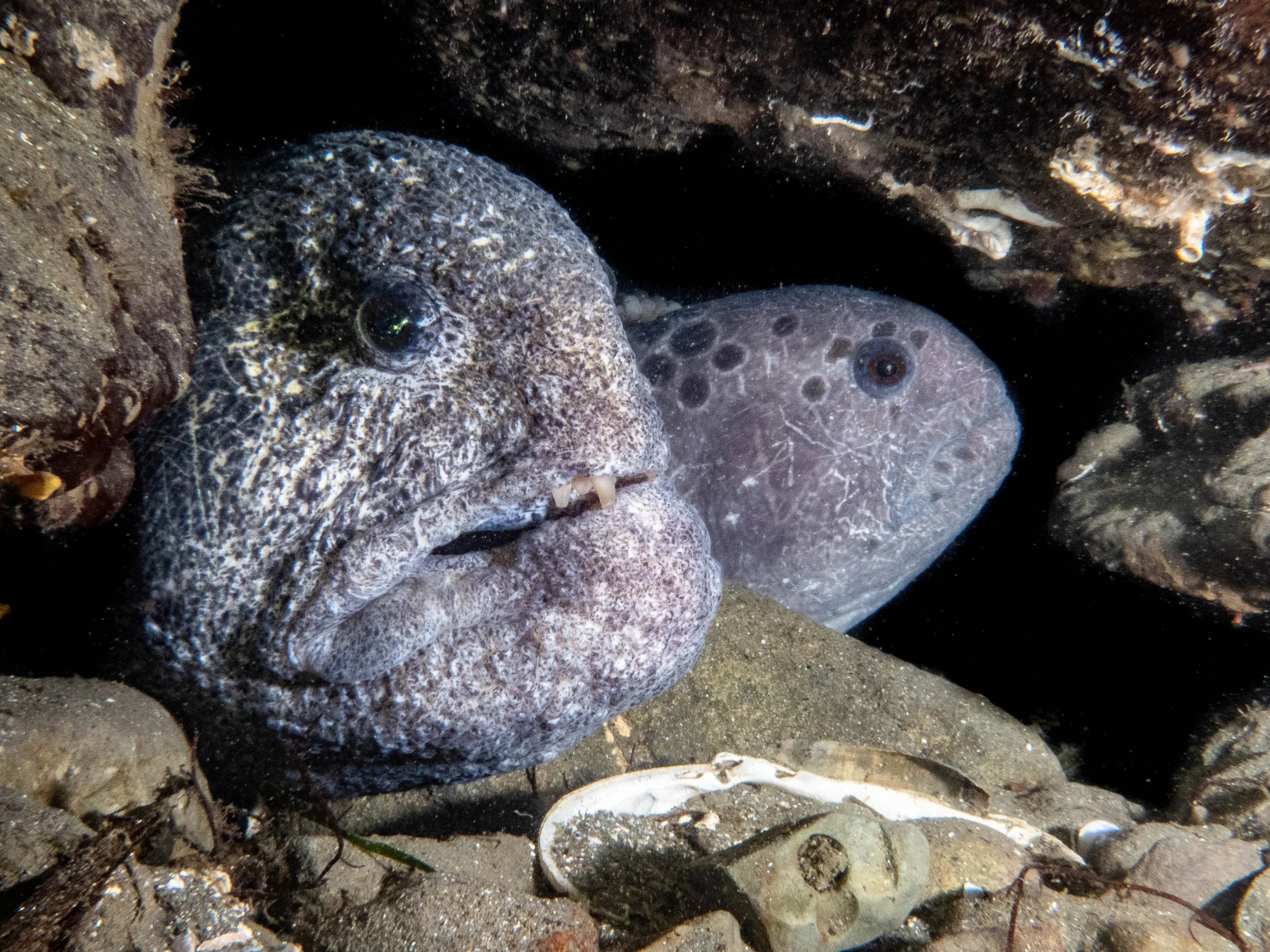
Hood Canal Wolf Eel | Photo credit: Thom Robbins
Before long, you approach a wall, its vastness urging you to uncover. You glide along its face, examining each nook, cranny, and boulder with a mix of awe and curiosity. The vividly colored marine life enchants you, each organism a stroke of brilliance from nature’s palette. In this marine maze, your adventure takes a thrilling turn.
From the periphery, a wolf eel appears, locking eyes with you. There’s a mutual recognition, a shared wonder between you and the creature, silently communicating in this mesmerizing undersea world. The thrill of the encounter sharpens your focus, and with camera in hand, you ready yourself to document this surreal moment. You aim and capture the scene, forever preserving your encounter with the wolf eel.
Hood Canal Diving:
Sund Rock Marine Preserve
26472 US-101, Hoodsport
sundrock.com
YSS Dive Charters
24080 N US-101, Hoodsport
yssdive.com/charters
About the Author: Thom Robbins

"Fascinated with the underwater world in the Pacific Northwest,I have been a diver for over thirty years and have never been happier than underwater with a camera. I spend as much time underwater as possible, shooting pictures or teaching diving and photography. You can see and purchase my photo collections at robbinsunderwater.com. If you want to learn about diving or photography, reach me at thomrobbins@gmail.com.
When not diving, I spend time with my wonderful, patient wife, Barb. We have just relocated to Shelton to enjoy a more relaxed life. Without Barb, I wouldn’t have continued my passion for diving. She is my best and often harshest critic, pushing me to explore better photos. I also have a 21-year-old son who makes me want to be a better person daily. Last but certainly not least are my two English Bulldogs, essential to my family's life."
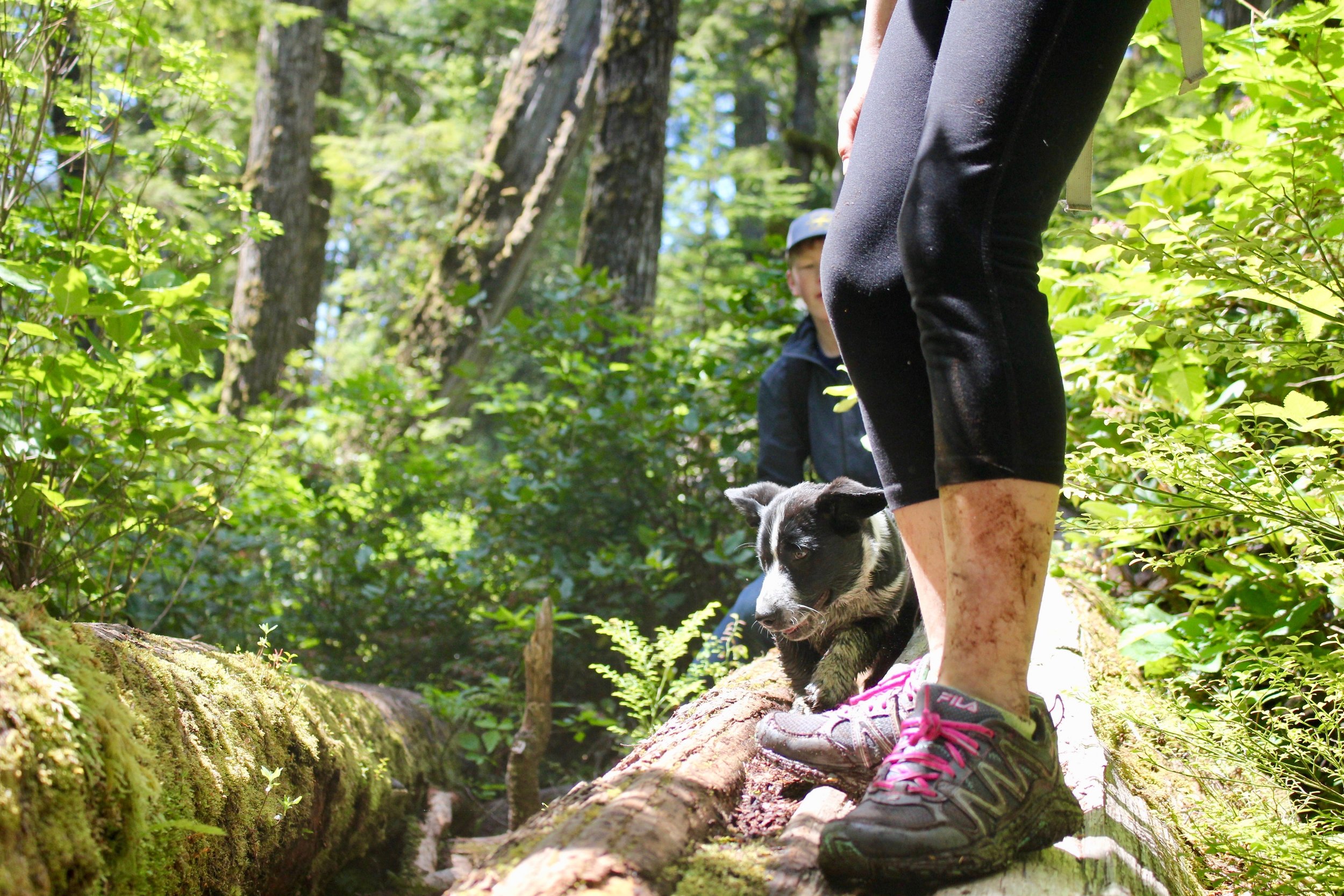
Dog Friendly Fjord
The dog days of summer are here, and our four legged friends around the region can’t help but wag their tails enthusiastically. After months of rain, wind, and snow, we need little excuse to take our dogs out into the wilds of the Hood Canal.
By Douglas Scott, The Outdoor Society
The dog days of summer are nearly here, and our four legged friends around the region can’t help but wag their tails enthusiastically. After months of rain, wind, and snow, we need little excuse to take our dogs out into the wilds of the Hood Canal.
While we are just as excited as our pets to hit the trails, sometimes it can be difficult to locate a dog-friendly destination. Luckily, the Hood Canal is full of incredible locations for us and our dogs– from an easy day out to a tongue hanging trek!
Location is the easiest way to know if a trail is dog-friendly or not. In Olympic National Park, dogs are not allowed on trails. If the trail is located in Olympic National Forest, DNR Land, or at a State Park, the majority of trails will be dog friendly. Remember that even if a trail is dog friendly, you are still responsible for keeping them on a leash and picking up after them. Not everyone on a trail is used to dogs, so please be conscientious of others. Also, never leave a bag of waste on the side of the trail, carry it with you, even if you are hiking back past it later. Finally, always remember to bring extra water for you and your dog, as water sources are not always readily available.
Easy Access Spots
Dosewallips State Park
Found right off of Highway 101 and along Hood Canal, Dosewallips has a few hiking options, with a favorite being the fantastic Steam Donkey Trail. At just 3.5 miles in length and an elevation gain of 400 ', this trail reveals water cascades, bridge crossings, ferns and river views.Your dog will love visiting with other dogs and the endless sticks to pick up. Yes, this gentle dog-friendly hike will have the whole pack begging for more adventures.

Twanoh State Park and Trail
On the eastern side of Hood Canal, Twanoh State Park is yet another incredible dog-friendly destination. Situated right along the water, between Union and Belfair, Twanoh has a few miles of trails in the woods and along the shore, helping to making this one of the most dog-friendly locations on this stretch of Hood Canal. Your dog will love this for the beach and the water.
Ranger Hole
Twenty-two miles north of Hoodsport, the Duckabush River makes for a fun stop for you and your dog. The Ranger Hole Trail is just two miles in length but feels very remote. Passing through second growth timber, the trail leads to the Duckabush River, where you can watch the raging waters churn in white rapids. Dogs, kids, and families will love this short day hike. Your dog will love this trail for the walk, the trees and the many smells from the local wildlife.
Next Level Destinations
Upper South Fork Skokomish
Here, you and your dog can wander in pristine old-growth forests and enjoy this corner of Olympic National Forest. The trail crosses over bridges and through towering trees for nearly four miles before reaching the Olympic National Park boundary. The road here is closed to motor vehicles between the months of October and April, making it an ideal summer destination. Your dog will love this for the remoteness and the many chances to dip in the water.
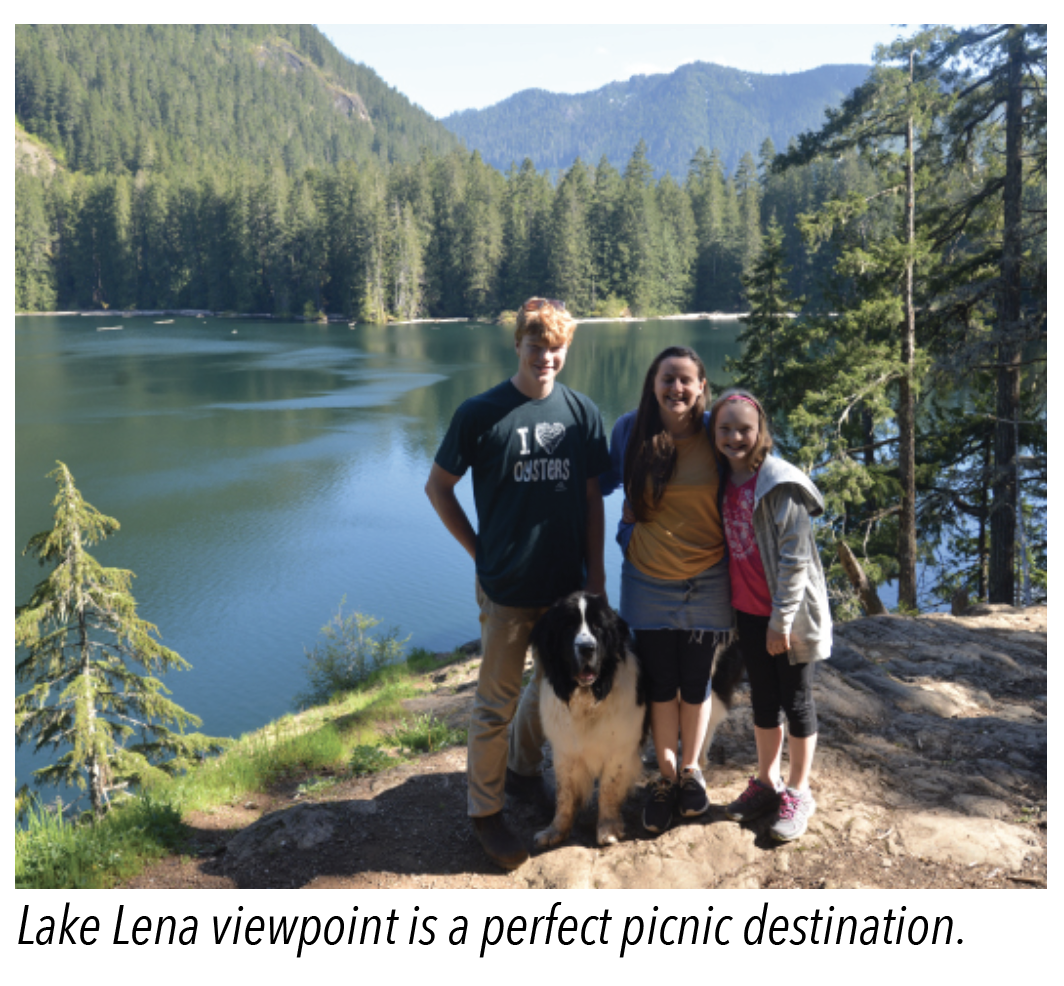
Lena Lake
Found along the Hamma Hamma River in the Olympic National Forest, this trail is for hikers and dogs hoping for a long day of hiking and exploring. At around seven miles round trip and gaining 1,300 ft in elevation, this hike can be hard for many people and pooches. Bring water and treats for all. Take your time while hiking through a mossy forest, over cool bridges and enjoy the stunning lake.
Memorable Canine Adventures
The Valley of Silent Men
Past Lena Lake, those hoping for an even more amazing adventure should hike into the Valley of the Silent Men. You’ll be hiking for 10 miles or so round trip, but this valley is a wonderland. Full of old growth, moss-covered boulders, and cascading creeks, you and your dog will be intoxicated with the beauty of this overlooked section of Olympic National Forest. Your dog will love this for the remoteness and the creeks to wade in.
Marmot Pass
Marmot Pass is a classic hike, and doing it with your dog makes it even better. At 11 miles round trip and gaining 3,500 feet in elevation, this is a trail for dogs and humans able to hike steep trails for miles on end. Starting in a forest, you’ll eventually climb to majestic views of the Olympic interior and even Hood Canal and Puget Sound. Your dog will love this for the varying terrain and seeing you happy!
Olympic Peninsula’s Dog Friendly Map

Check out this fantastic pet friendly map provided by our partners at Olympicpeninsula.org!
Download and pack a copy along with your leash and collapsible water dish!
6 Tips for Hike Savvy Canines
Like house-bound humans, dogs need a little prep time to get ready for the trail. Here are six tips to help you and Fido have a safe and fun adventure.
#1 Take it Easy : Start with easy trails and slowly build up stamina & strength.
#2 Care for Tender Paws: Make sure your dog's pads are toughened or purchase hiking booties and let him get used to them before heading into the wild.
#3 Yield to oncoming traffic: No matter how sweet Fido appears, its good practice to verbalize how friendly he is. Step off the trail when hikers pass and heel your dog.
#4 Leash Control: If the trail requires leashes or if if your dog might run into other hikers, keep him on a short leash (-6') since a long leash is more likely to get tangled on brush. Your dog should not be allowed to roam freely.
#5 Leave no trace: Bring bags to collect and carry out your dog’s poop. If you’ll be backpacking overnight, bury it at least 6” deep and at least 200 ' from walkways, camps, and water sources.
#6 Command Ready: Hazards in the woods differ than the cul de sac. Don’t let your dog stray. Some plants are poisonous, and some creatures bite and may host diseases. Irressistable smells will lure pooch away in a flash. Make sure your obedience training is on track.
Visit backpacker.com for more ideas on a safe and rewarding journey!

Do the dirty work to protect and preserve
Hood Canal Salmon Enhancement Group has volunteer opportunities available to enhance salmon habitats on the Union River on Hood Canal. Consider vacationing in the area and doing some good for the fjord.
Salmon are a keystone species and the foundation of Pacific Northwest culture, and the Hood Canal Enhancement Group has been working hard to change the projection of their uncertain fate through riparian enhancement and weed control. Interested in helping out? The Salmon Center has plenty of opportunities for families and individuals to sign up - for a day, or week - to volunteer and help these precious resources.

Saving our Salmon Habitats
In addition to Chinook, Coho, Pink and the occasional Sockeye, Hood Canal is home to Endangered Species Act listed Puget Sound steelhead and listed Summer Chum, the latter of which is a completely unique species to this watershed. Structurally mature and diverse streamside plant communities not only increase the likelihood that salmon will continue to survive for future generations, but that the entire ecosystem will remain resilient against the effects of a changing climate.
Riparian habitat is the transitional area between land and aquatic ecosystems; therefore, the work in this program mainly takes place along rivers, streams, wetlands and estuaries. These are critical habitats for salmon and steelhead where they are born and die, and where they grow strong for their journey out into the ocean. Riparian habitat provides essential services and functions for fish, such as food; clean, cold water; large woody debris recruitment; and habitat complexity.
Without these, our salmon and steelhead populations would cease to exist, along with hundreds of species, the culture, and economy that depends on their survival.

Enhancement Group’s riparian enhancement program
HCSEG’s riparian enhancement program serves to protect and restore these services and functions, which can be understood by 4 broad categories: provisioning - the production of food and water; regulating - the control of climate and disease; supporting - nutrient cycles and oxygen production; and cultural - spiritual and recreational benefits.
“Salmon are a keystone species and the foundation of our sacred Pacific Northwest culture, and we have been working hard to change the projection of their dismal fate through riparian enhancement and knotweed control. “
The World Conservation Union lists invasive knotweed as one of the world’s worst 100 invasive alien species. Knotweed spreads aggressively along rivers establishing dense monocultures that reduce native riparian plant diversity, structure and function. Invasive plant species are the second greatest threat to global biological diversity, only second to habitat destruction. In 2020, HCSEG installed 11,000 native plants, restored 0.5 river miles and 9 acres of riparian habitat through new riparian plantings, and the survey and control of knotweed on over 40 stream miles.
In 2021, HCSEG plans to install 17,500 native plants, and restore 1 river mile and 15 acres of habitat through new riparian plantings. All of this work would not be possible without the outstanding help from our volunteer community and our Washington Conservations Corps crew.

“If we plan to install 17,500 native plants this year, we are going to need lots of environmental stewards helping us fight for the future of Pacific Northwest salmon and steelhead.” Salmon Center volunteer
Visit the Salmon Worksites and be inspired to help
If you would like to see this work for yourself, we have several public riparian enhancement worksites that you can visit: Big Beef Creek and Estuary (feel free to park at the gate and walk-in), Seabeck Creek (by the new bridge) and the Union River Estuary Preserve (at the Salmon Center). And while you’re there, consider signing up to join our community of volunteers!
Volunteers make our work possible
From data collection at fish traps, habitat restoration, support at fundraising events, and education programs, so much of what we do is made possible by the dedicated and passionate involvement of our community.
If you have questions about visiting these sites or would like more information about these projects, visit pnwsalmoncenter.org for a full list of staff contacts as well as project descriptions and opportunities to volunteer.

Hood Canal Travel Guide: Birdwatching
With its wealth of shoreline, fresh and saltwater marshes, mudflats, and bountiful forests, the Olympic Peninsula is a birders’ paradise.
A canalside Birding Itinerary
With its wealth of shoreline, fresh- and saltwater marshes, mudflats, and of course the bountiful forest, the Olympic Peninsula is a birders’ paradise. And whereas winter and spring aren’t the most popular seasons for human tourists (meaning less competition for lodging and dining), they happen to be the best for catching the avian crowds.
From soaring birds of prey to elusive divers, birdwatching is one more reason to get to Hood Canal when there aren't hordes of RVs cruising down HWY 101.

If you are looking for all the gritty details on Olympic Peninsula birding locations, check out Craig Romano’s list of the Top 25.
Whether it satisfies your ornithological cravings for the season or simply whets your appetite for much more, gear up (our suggestions are below) and follow along!
Theler Wetlands | 7am
If you only make one dedicated birding stop in the Hood Canal, Theler Wetlands, with its easily navigated trails, interpretive kiosks, and educational exhibits, should be it. More than two miles of interpretive walking trails through 39 acres of protected wetlands provide an excellent introduction to birdlife in the Hood Canal. Newbies and experienced birders alike will delight in views of bald eagles, green-winged teals, horned grebes, and more. You may even be able to spot otters in the freshwater marsh!

Photo courtesy of Clint Ferarra
Sunset Beach Deli | 10am
Whether you worked up an appetite for lunch or just need a quick coffee to fuel the next birding venture, the Sunset Beach Deli is a local favorite for gyros and Philly-style cheesesteaks. In the mornings, it’s also the go-to location for filling breakfast burritos. If you’re not quite ready to eat, have them wrap up a sandwich and take it to go.
Twanoh State Park | 1pm
Twanoh State Park is a favorite in the summer for swimming and watersports, but the quieter winter and spring months make it a great place for viewing wildlife and birds. Bring your binoculars to the shoreline for an eyeful of diving birds such as loons, mergansers, murrelets, and ruddy ducks with their distinctive upright tails. In the towering cedars and maples inland, listen for brown creepers and red crossbills.
Bonus: Between Twanoh and Potlatch, Highway 106 takes you right by the Skokomish River Delta. The overlook pull-off is a good spot to scope gulls, grebes, and goldeneyes.

Photo courtesy of Clint Ferarra
Potlatch State Park | 4pm
Like Twanoh, Potlatch bustles with humans in the summer and birds in the winter and spring. With 5,700 feet of saltwater shoreline, it’s a great place for viewing waterfowl, particularly during high tide. In the water, look for heron, scoters and scaups, and check the trees for fox sparrows and Steller’s jays.

Photo courtesy of Clint Ferarra
Dinner at 2 Margaritas | 6pm
Nothing works up an appetite quite like a day spent in the bracing sea air. Whether you’re celebrating new additions to your Life List or toasting to better luck next time, we recommend a margarita (or two) at the warm, colorful 2 Margaritas restaurant in Union. Generous portions in a cozy atmosphere make it the perfect cap to another beautiful day in the Hood Canal.
Need More inspiration?
Renowned guidebook writer and trail advocate, Craig Romano, shared 25 of his favorite bird viewing destinations with us. Start planning your trip now!
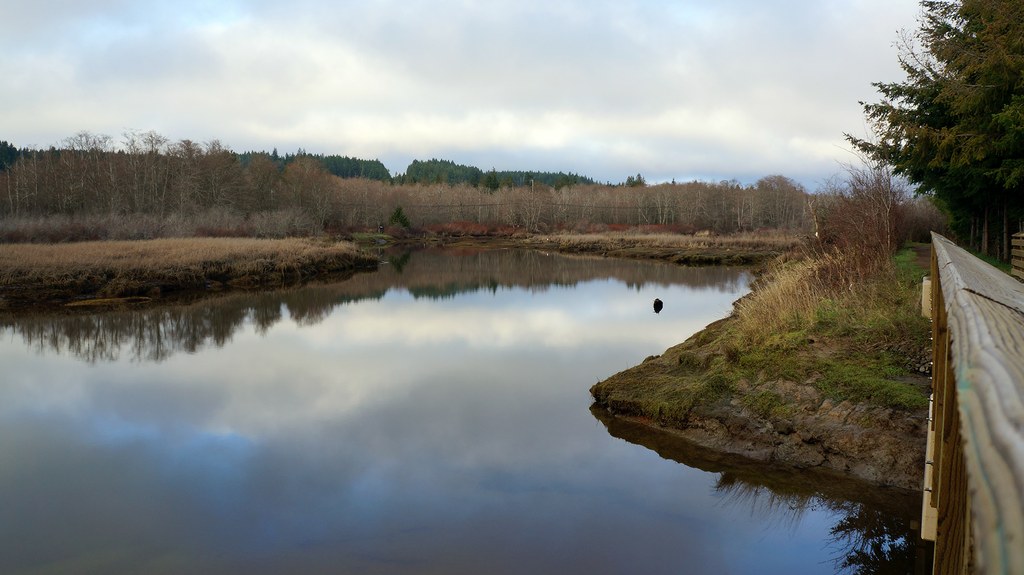
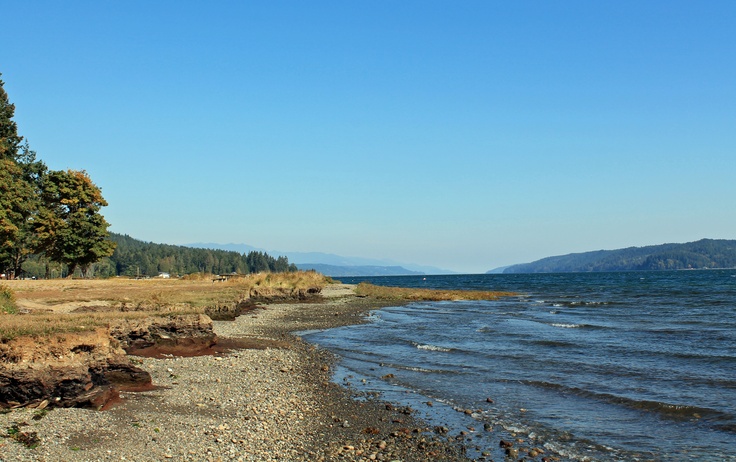
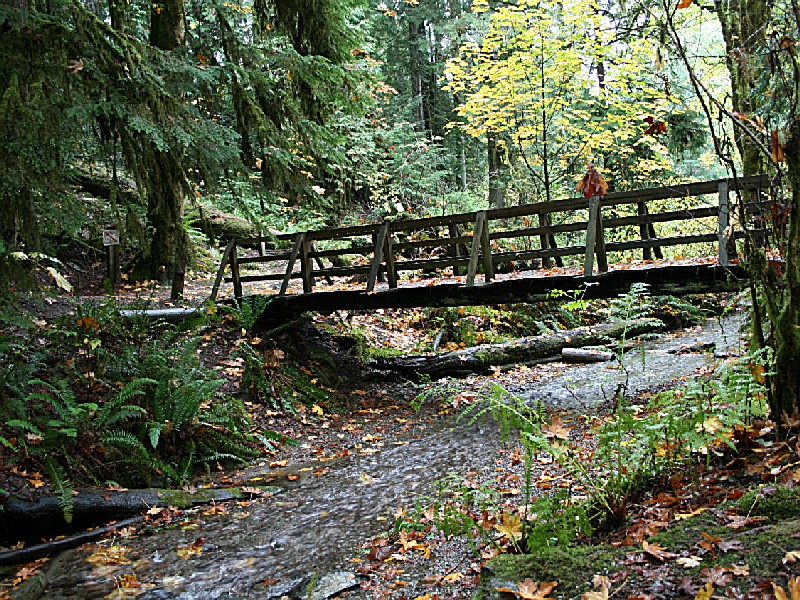
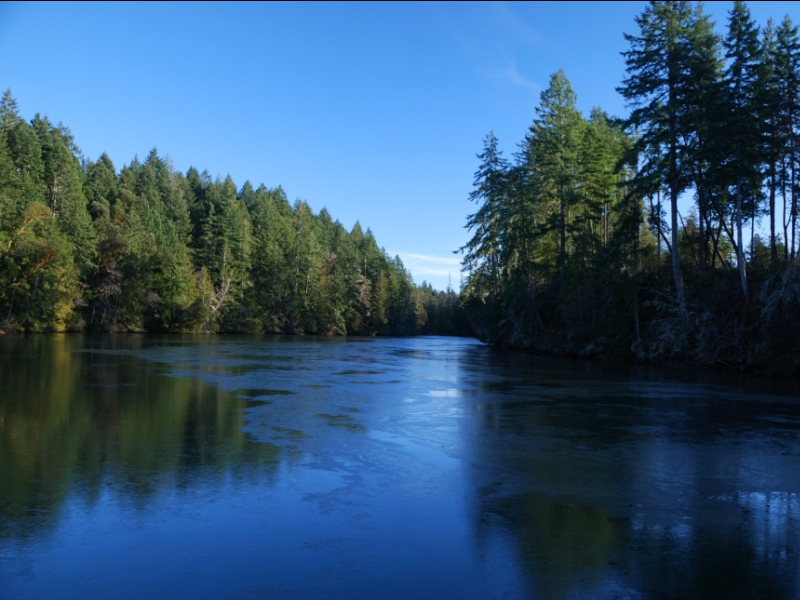
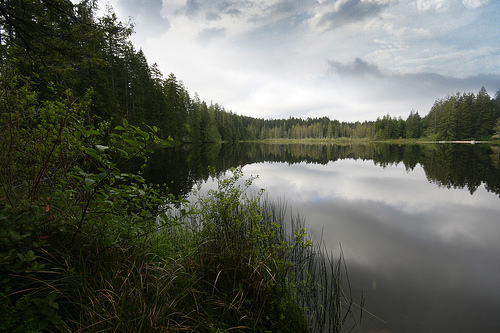
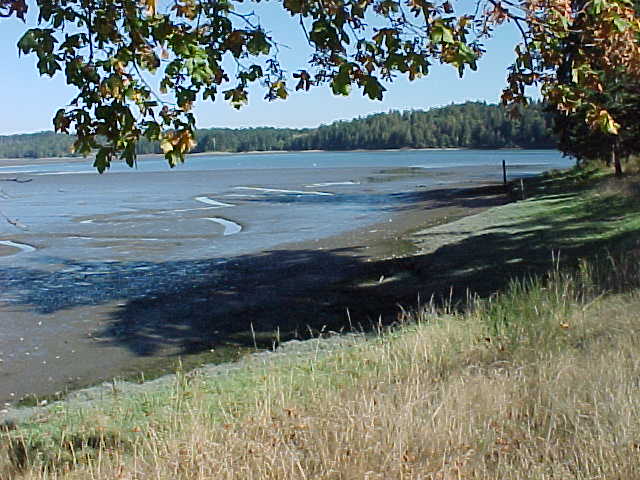
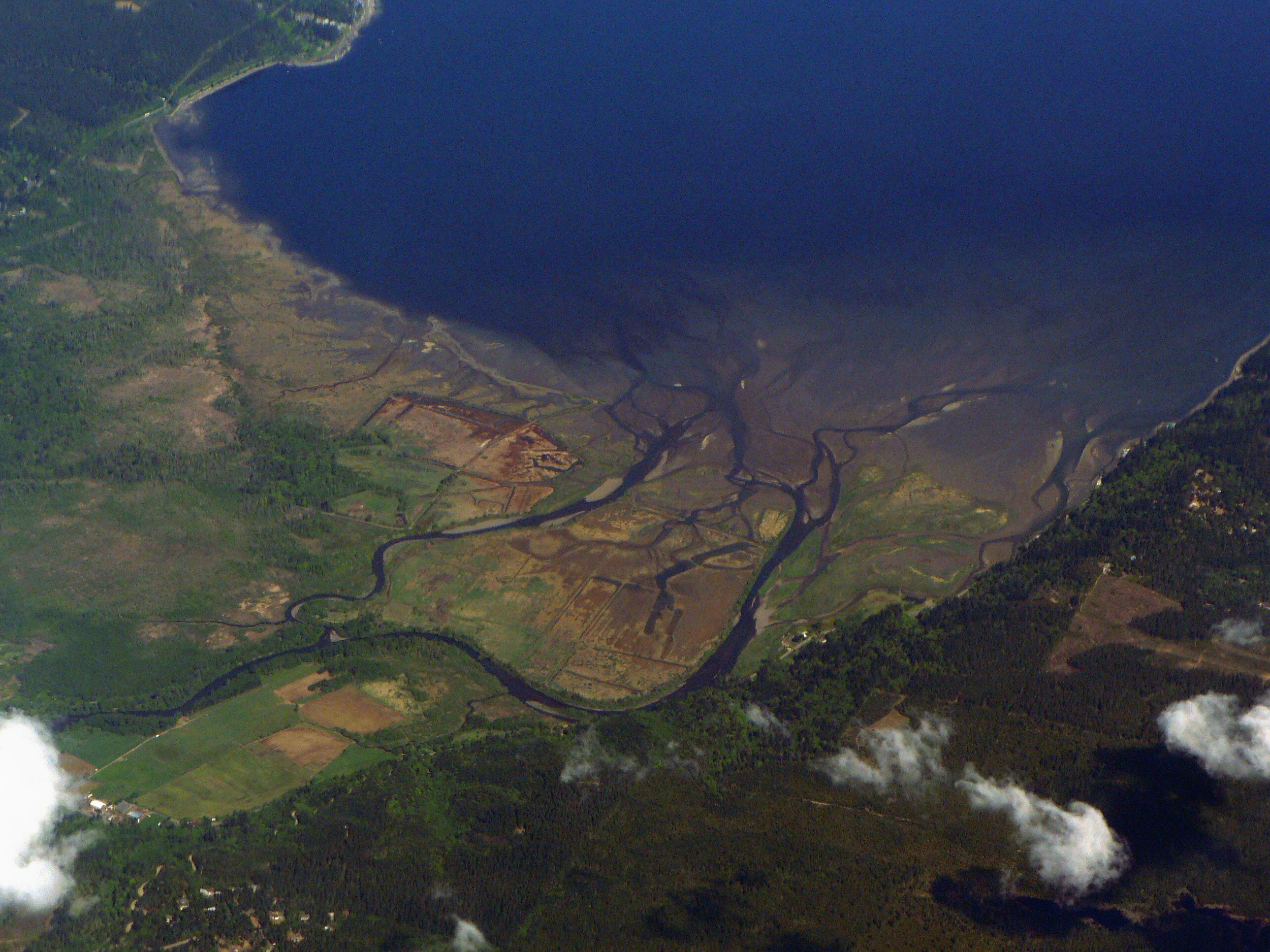
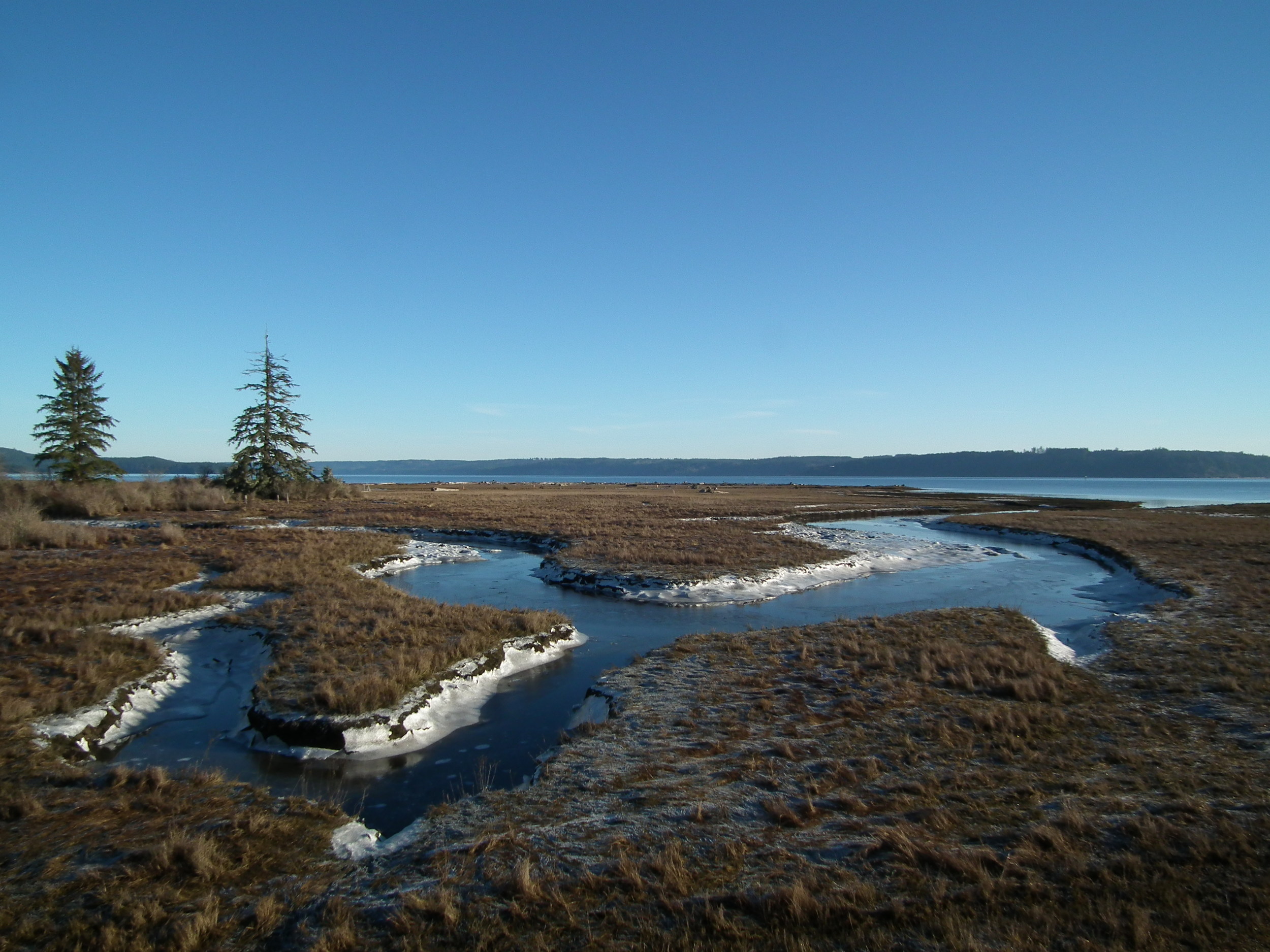
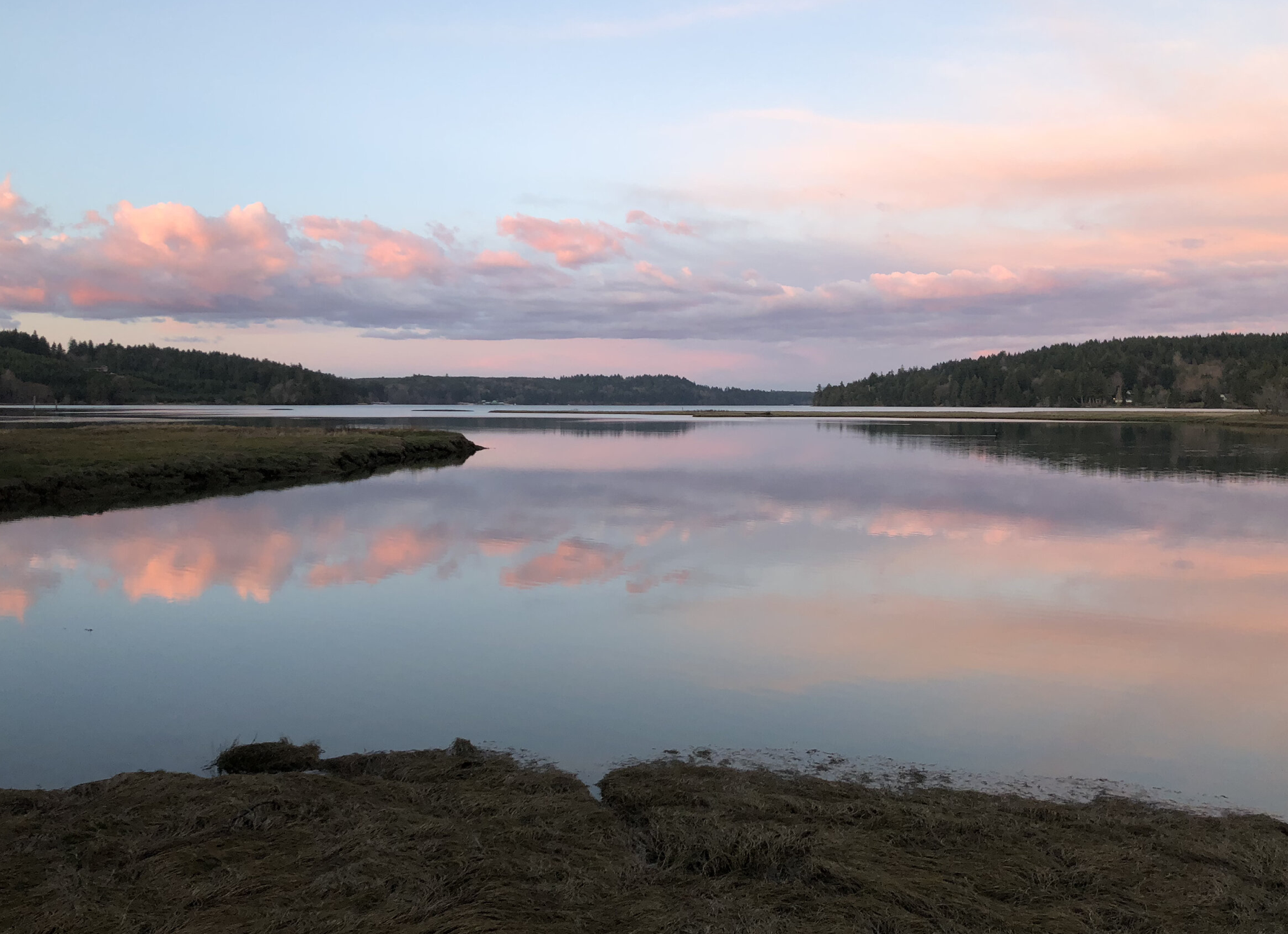
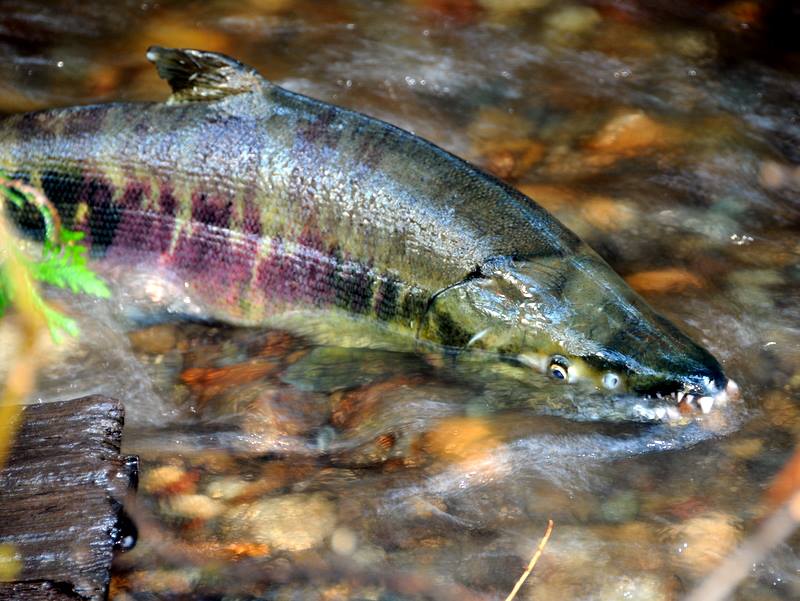
In Search of Salmon in and Around the Fjord
As the weather chills, the local streams and rivers are festooned with the lovely shades of orange and red of the turning leaves. This season also marks the last weeks in the life cycle of many salmon species as they travel up these rivers and streams to spawn and die.
Stella Wenstob
photo: South Puget Sound Salmon Enhancement Group
As the weather chills, the local streams and rivers are festooned with the lovely shades of orange and red of the turning leaves. This season also marks the last weeks in the life cycle of many salmon species as they travel up these rivers and streams to spawn and die.
Using a sense not completely understood by biologists, millions of migratory salmon return to their home streams to lay eggs.
After swimming up the stream to their spawning spot the female chooses a spot in the shallow, but swift flowing part of the river that is ensured to be highly oxygenated, called the riffle. In some of the inland streams that location can be many hundreds of miles up rapids and past many impediments. Here she digs a depression in the gravel that will serve as her nest or redd. The males will put on an impressive show biting and jumping to show their dominance and protect their chosen female from other males. After the eggs are laid in the redd, the male will deposit sperm over them, and the female will cover the eggs with gravel to protect them. A female may create as many as seven redds before she is finished spawning and each redd may hold as many as 5,000 eggs.
As soon as the salmon enter the fresh water of the stream their skins begin to change color, their sexual dimorphism enhances, they stop eating and they begin their decaying process. A migrating salmon typically lives for about two weeks after entering the freshwater.
The carcasses provide an important food source to other animals and small invertebrates who in turn provide food for the salmon fry (baby salmon) as they get older. Additionally, the nutrients given off by the rotting carcass are important fertilizers to the plants and trees growing on the banks, which in turn provide essential root systems that prevent erosion and protects the streams for further generations of salmon.
There are seven species of salmon in the Pacific Northwest: Pink (Oncorhynchus gorbuscha), Sockeye (Oncorhynchus nerka), Coho (Oncorhynchus kisutch), Chum (Oncorhynchus keta), Chinook (Oncorhynchus tshawytscha), Steelhead (Oncorhynchus mykiss), and Cutthroat (Oncorhynchus clarki clarki).
All of these species have very different life-cycles – some spend several years before they migrate up streams; some can run and spawn several times before dying; some only spawn at the mouth of streams, where others need to spawn in lakes at the head of rivers. This unique phenomenon of the salmon running can be viewed in streams and rivers all across the Hood Canal and South Puget Sound.
Kennedy Creek
The Kennedy Creek Salmon Trail located off of Hwy 101 opens up for full tours with docents answering questions from November 2 through to December 1 from 10 AM to 4 PM on weekends. This trail is maintained by the South Puget Sound Salmon Enhancement Group and their website is a great resource for learning about the trail and salmon ecology.
Beginning at the head of Oyster Bay, at the traditional site of the Sawamish/T’Peeksin village (ancestors of today’s Squaxin Island Tribe], this trail was once part of a greater network of Native American trails that connected South Puget Sound with the Pacific Coast. The Kennedy Creek was known as “Place of the Singing Fish” by the Squaxin Island Tribe due to the resonant singing of the frogs heard along the stream’s banks in the spring. Chum (or dog fish) are the dominant species that run this stream at numbers as high as 800,000 salmon a year. The tribe harvested these fish for oil and for food, drying them on racks. The salmon can be seen running right from the creek’s bank.
Salmon Center
The Salmon Center located in Belfair is open from 8 AM until 5 PM, Monday through Friday. Besides offering interesting exhibits about salmon ecology, they operate salmon traps on the Union River (off of Highway 300) that target adult summer Chums.
Twanoh Creek
As you continue along the South Shore of the Hood Canal, Twanoh Creek in Twanoh State Park offers good vantage points to view running salmon.
Purdy Creek
At the bend of the Hood Canal on a tributary of the Skokomish Watershed is George Adams Fish Hatchery run by the Washington Department of Fish and Wildlife. Each spring they release 500,000 juvenile Coho into the Purdy Creek. While the hatchery does not have scheduled tours, the friendly staff are eager to answer questions and the pens are visible from the Highway.
Hoodsport
The Hoodsport Fish Hatchery located in Hoodsport also does not offer scheduled tours, but in the fall the WDFW offers very popular Chum salmon fishing classes from the beach out front of the hatchery.
Quilcene
The Quilcene National Hatchery has been run continuously since 1911. Now focusing on Coho stock, the Quilcene National Hatchery has raised nearly every species of salmon. The hatchery successfully reintroduced Chum salmon back to the Big Quilcene River and increased winter Steelhead populations of the Puget Sound. They are open from 7:30 AM to 3 PM on weekdays and only on weekends and holidays in the spring and summer when the camp host volunteers are present. Visitors are encouraged to tour the facility and meet the hatchery staff.
More Salmon Viewing
Situated in the Belfair State Park are the Big Mission and Little Mission Creeks, which offer great salmon viewing. A little north of the North Shore Road following Elfendahl Pass Rd is Stimson Creek, a good place to view spawning salmon.
For a list of salmon spotting sites, WDFW have created an interactive multi-layer map called SalmonScape,
that shows the streams and tributaries used by migratory salmon in the state.
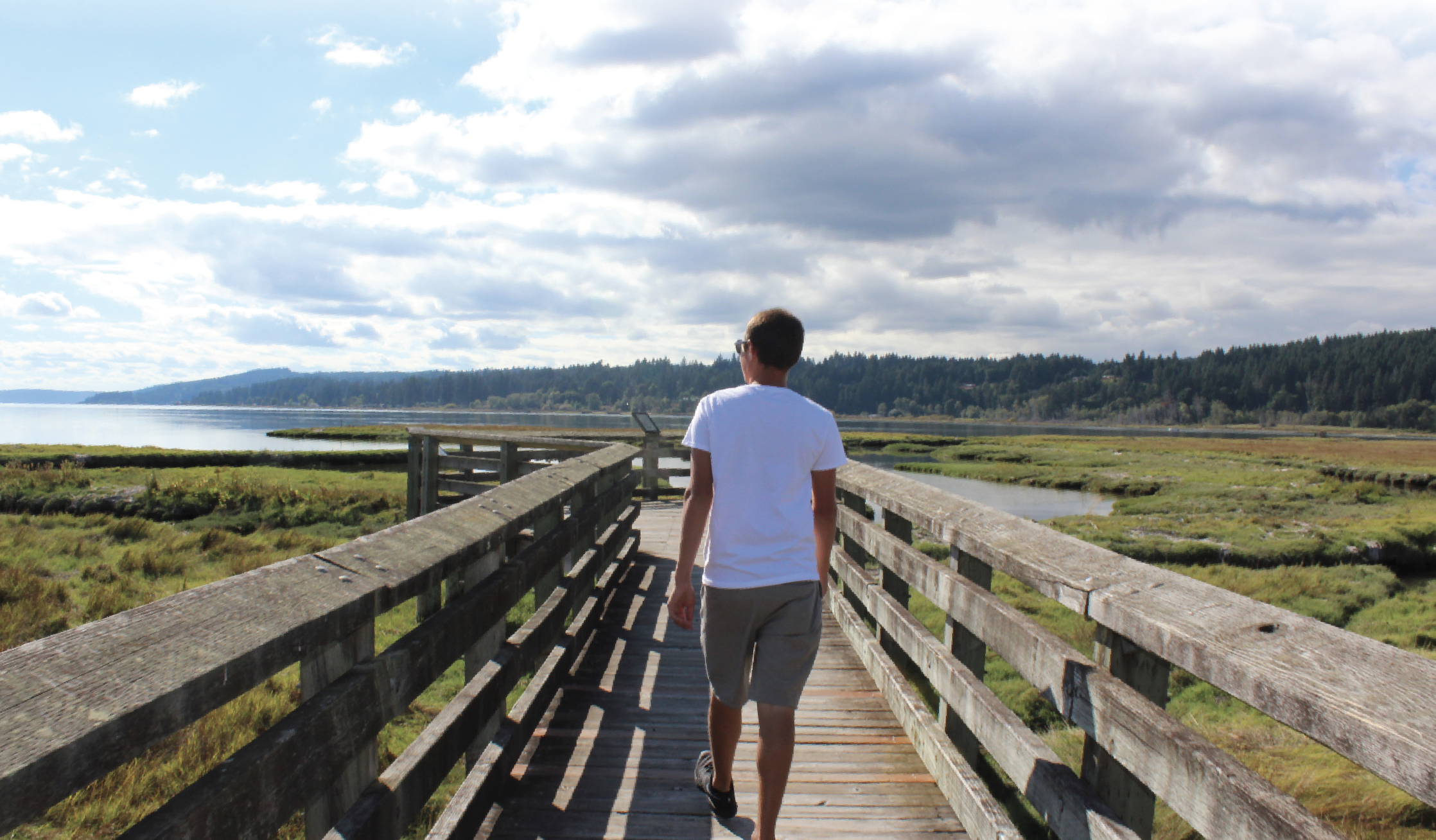
Hood Canal's Spectacular Birding Sights: Theler, Twanoh, & Potlatch
Looking for a refreshing easy local walk with plenty of birds and wildlife? Consider visiting the accessible Theler Wetlands near the south entrance to Belfair, WA. Interpretative signs, native plants, and even a reconstructed whale skeleton – makes this an inspiring walk.

With its wealth of shoreline, fresh and saltwater marshes, mudflats, and of course the bountiful forest, the fjord is a birders’ paradise.
And whereas winter and spring aren’t the most popular seasons for human tourists (meaning less competition for lodging and dining), they happen to be the best for catching the avian crowds. From soaring birds of prey to elusive divers, birdwatching is one more reason to head to the Canal.
The Audubon Society’s Great Washington State Birding Trail is a great resource.
Below we've included three birding areas to get you started!
Theler Wetlands
Located at the head of Hood Canal the Theler Wetlands offers several accessible walking trails within a protected salt marsh and estuary wetlands. The Theler Wetlands of Belfair include a gorgeous salt water estuary. The wetlands are accessible through many miles of level trails and boardwalks, surrounded by roses, shrubs, and blackberries in bloom in the summer months. The trails amount to 3.5 miles round-trip, with the option of three different routes.
The Union River Estuary Trail is the longest trail offered. To the left of the trail is an old dike that travels through some of the tidal wetlands, and to the right is fresh water marshes filled with cattails and tall grasses.
The viewing point from this perspective is spectacular! There are 360-degree views of the Union River, Hood Canal, and the Olympic Mountains.
Sam Theler, a real estate developer, deeded the wetlands to the North Mason School district in 1968 in honor of his wife.

Rebuilt whale skeleton on display in the interpretation classroom
Families can give these trails a visit, and if they are open, displays and hands-on exhibits are available to examine. They help to teach more about the wetlands ecosystem. There are mounted animals with plaques of information on each, along with a gray whale skeleton for display. There is a picnic area and a restroom as well. Keep an eye out for the many birdhouses along each trail—they are hard to miss! Often spotted are red-winged blackbirds, kingfishers, herons, eagles, otters, and geese. These trails are perfect for people of all ages.
Twanoh State Park
Twanoh State Park is a favorite in the summer for swimming and watersports, but the quieter winter and spring months make it a great place for viewing wildlife and birds. Bring your binoculars to the shoreline for an eyeful of diving birds such as loons, mergansers, murrelets, and ruddy ducks with their distinctive upright tails. In the towering cedars and maples inland, listen for brown creepers and red crossbills.
Potlatch State Park
Like Twanoh, Potlatch bustles with humans in the summer and birds in the winter and spring. With 5,700 feet of saltwater shoreline, it’s a great place for viewing waterfowl, particularly during high tide. In the water, look for heron, scoters and scaups, and check the trees for fox sparrows and Steller’s jays.
For a complete list of bird sites check out this great PDF Audubon Guide.
Traditional Mexican along with views of the Hood Canal