
Sea Lions & Harbor Seals of the Salish Sea
Whiskers in the Green
Story & Pictures | Thom Robbins
There are dives where the water gives you exactly what you came for. You drop into Hood Canal with a camera and find plumose anemones blooming from pilings like pale chandeliers. You descend at Sund Rock hoping for wolf eels and get lucky enough to find one peering from its den, green eyes steady as old glass. You head north toward the San Juan Islands and drift past walls dressed in kelp, watching rockfish hold themselves in a current stronger than it looks – Then there are dives where the water decides otherwise.
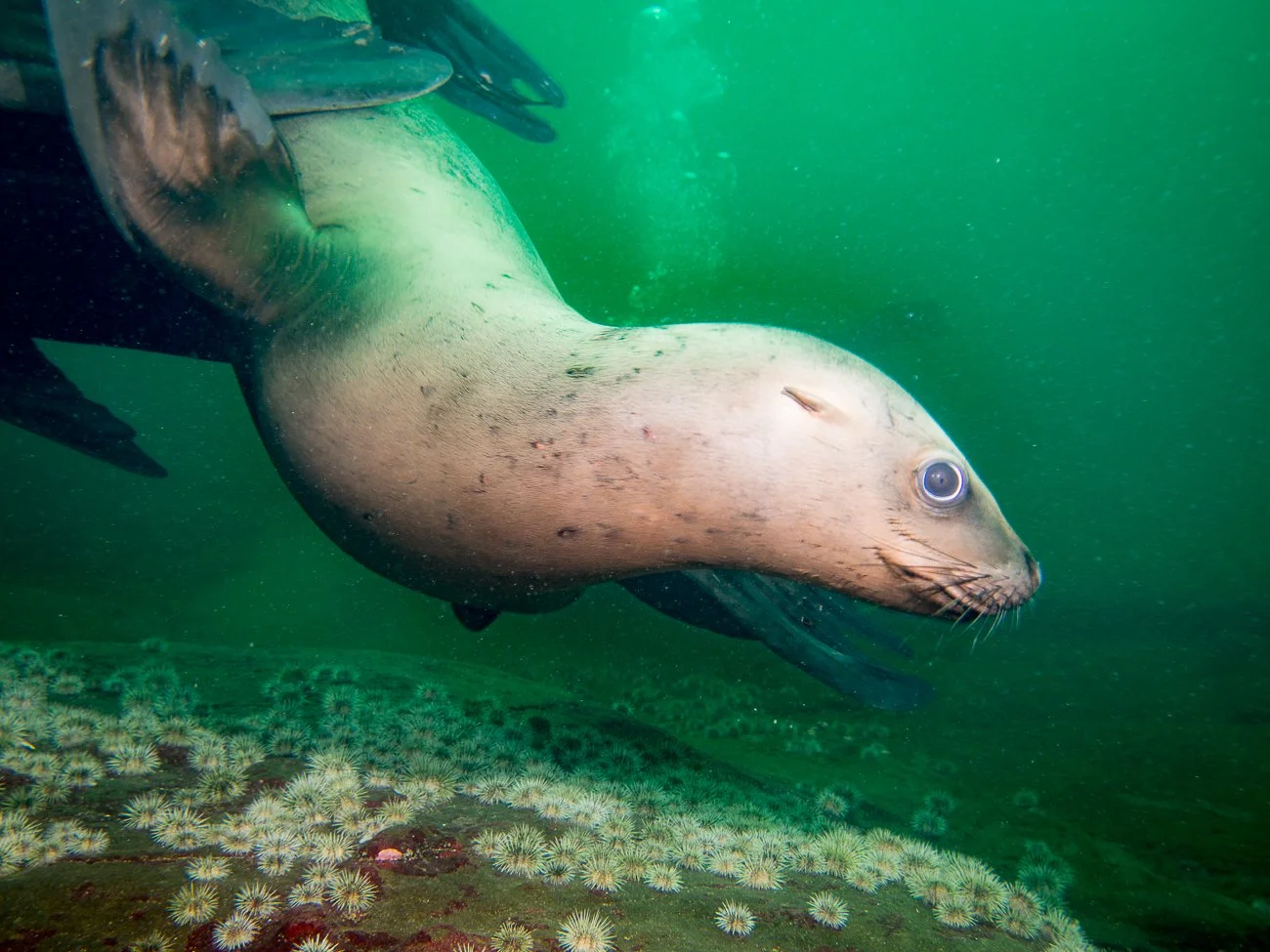
I had my camera aimed at a sculpin no longer than my thumb, trying to frame the shot before it bolted. I felt a light tug on my fin. Not hard, just enough to make me turn. Behind me hovered a young sea lion, suspended in the green water like a dog that had just stolen a sock. It let go, rolled once, then blasted away in a trail of bubbles before circling back to see if I had learned the rules.
Another time, I was focused on a nudibranch inching across a piling when I sensed movement beside my mask. A harbor seal had drifted in so quietly it seemed to arrive fully formed. It hovered over my shoulder, staring at the same sea slug I was photographing as if it had concerns about my composition.
That is part of the magic. Sea lions and harbor seals often feel less like wildlife you happen to encounter and more like curious neighbors checking in on what you are doing.
For many people, above the surface, sea lions and seals blur together. Both are sleek marine mammals with whiskered faces, dark eyes, and the unnerving ability to look adorable and deeply competent at the same time. Both haul out on rocks, beaches, docks, and floating logs around the Salish Sea. Both vanish into the water with enviable grace. But spend any real time with them, especially underwater, and their differences become obvious.
They are among the most charismatic animals in Pacific Northwest waters, and they know it, playful, intelligent, and efficient predators closely tied to the health of this inland sea. When one appears on a dive, the whole mood lifts.
The easiest way to tell them apart begins with the ears.
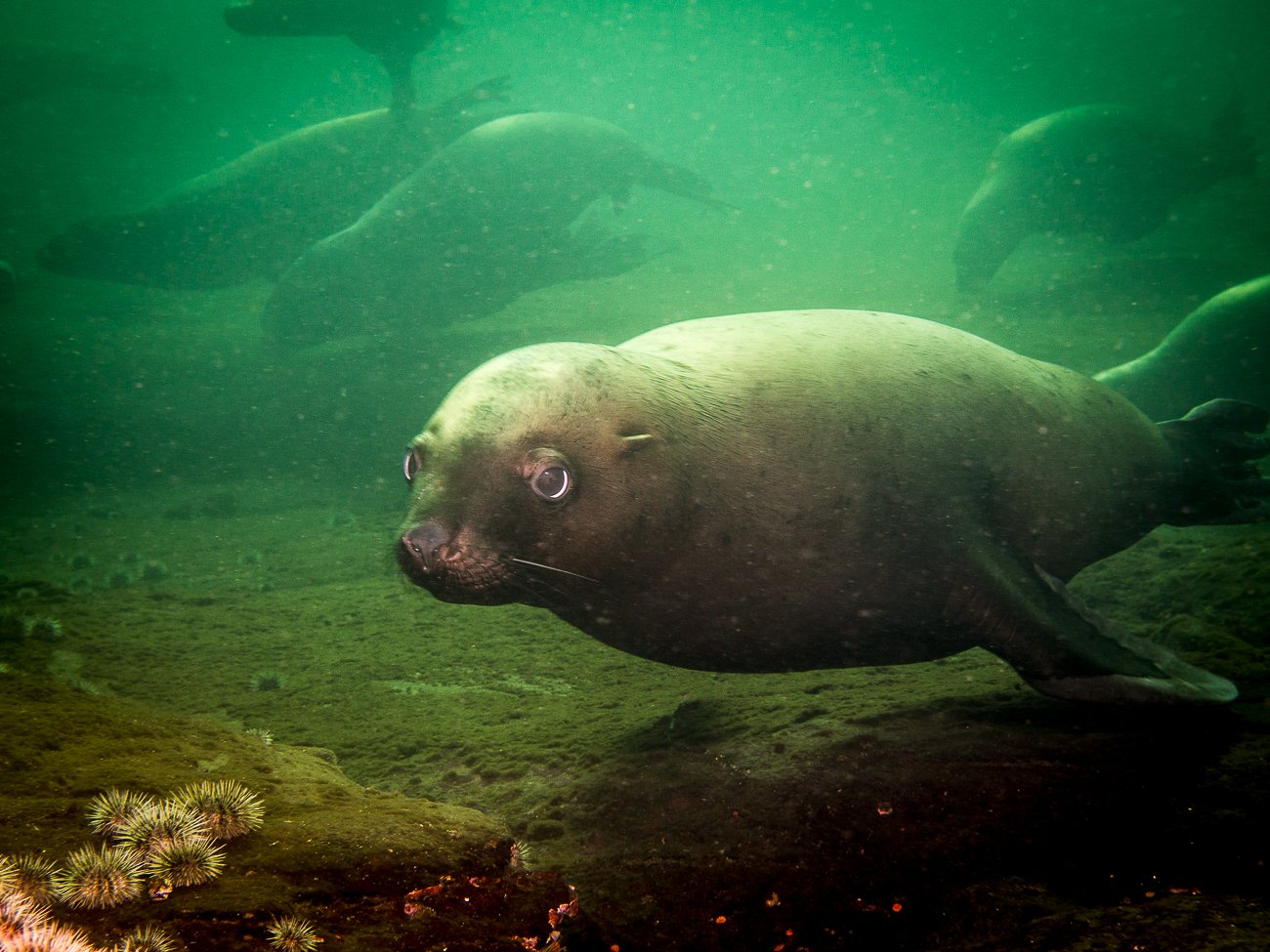
Sea lions have visible external ear flaps. Harbor seals do not. If you can clearly see little ears on the side of the head, chances are you are looking at a sea lion. If the head appears smoother and rounder, you are likely looking at a harbor seal.
That is the quick version. The better version comes with watching.
Sea lions are built for swagger and noise. Longer, louder, and more theatrical, they carry themselves like animals aware of their own presence. In the Salish Sea, the two species most people encounter are California sea lions and Steller sea lions. California sea lions are the familiar barkers of docks and buoys, energetic, vocal, and often piled on top of one another in noisy heaps. Steller sea lions are larger, heavier, and impressive enough that the first one you see underwater can feel less like wildlife and more like weather moving toward you.
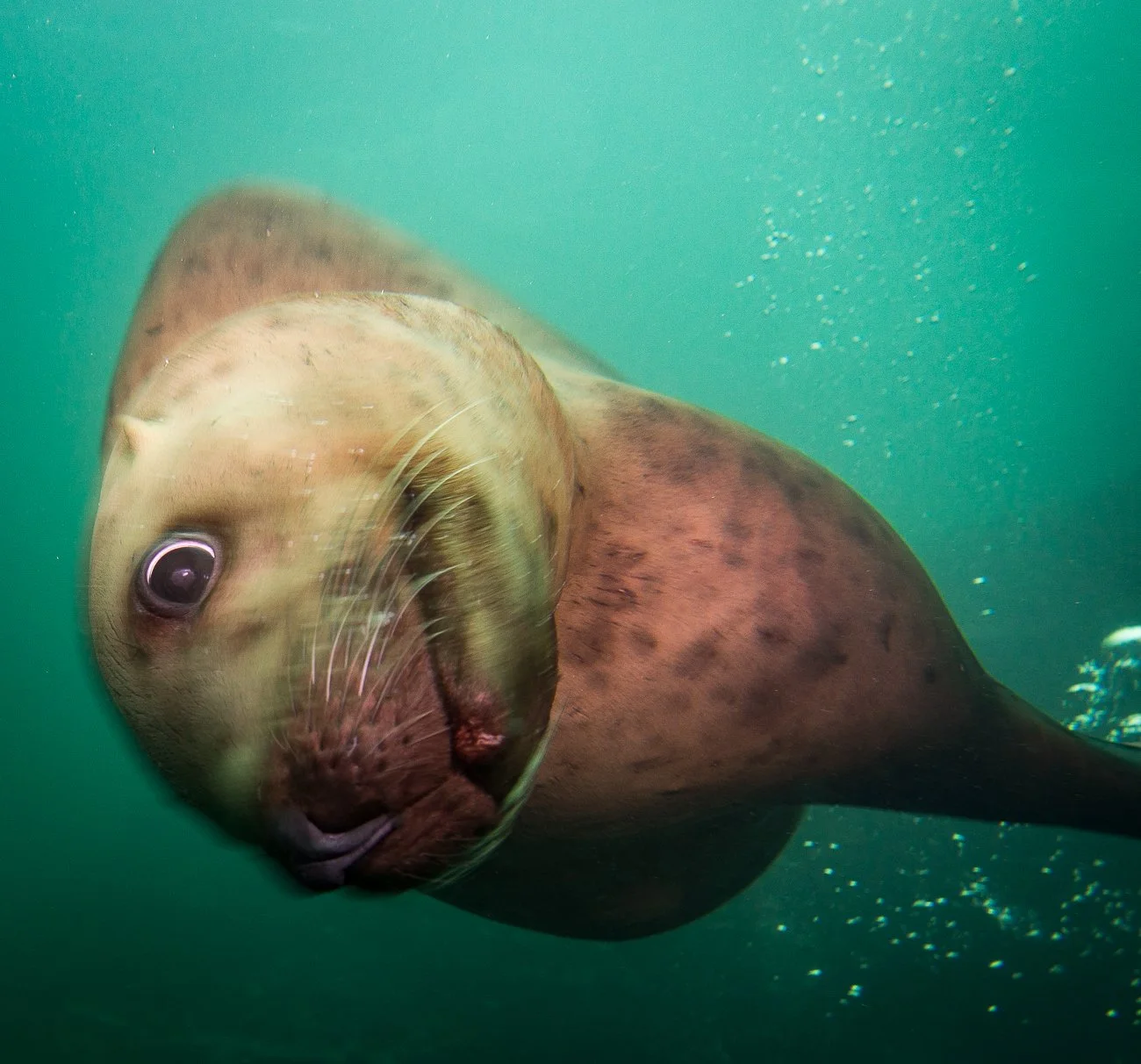
Sea lions belong to the eared seal family and use their large front flippers almost like wings. They can rotate their rear flippers beneath them, allowing them to move on land with surprising confidence. On haul-outs, they bark, posture, shove, and argue like a committee meeting with no chairperson.
In the water, all of that bulk becomes grace. They become pure athletes. They bank, roll, accelerate, stop, and reverse direction with the kind of ease that makes a diver feel assembled from spare parts. I have watched sea lions streak past so close I could see old scars across their hides, whiskers swept back flat against their faces. Then, with one effortless turn, they were gone.
Young sea lions are often the comedians. They blow bubbles in your face, dart in close only to veer away at the last second, grab at loose fins, hoses, or hoods, and return repeatedly to see whether you have become more entertaining since the last pass. They remind you that intelligence and mischief often travel together.
Harbor seals move through the world differently. They are smaller, rounder, and quieter, with large dark eyes and faces that can look permanently thoughtful. On land, they move with a soft-bodied undulation, unable to rotate their rear flippers beneath them as sea lions do. In the water, however, they become sleek and efficient, propelled by smooth movements of the hind body and rear flippers.
Where sea lions often announce themselves, harbor seals simply appear.
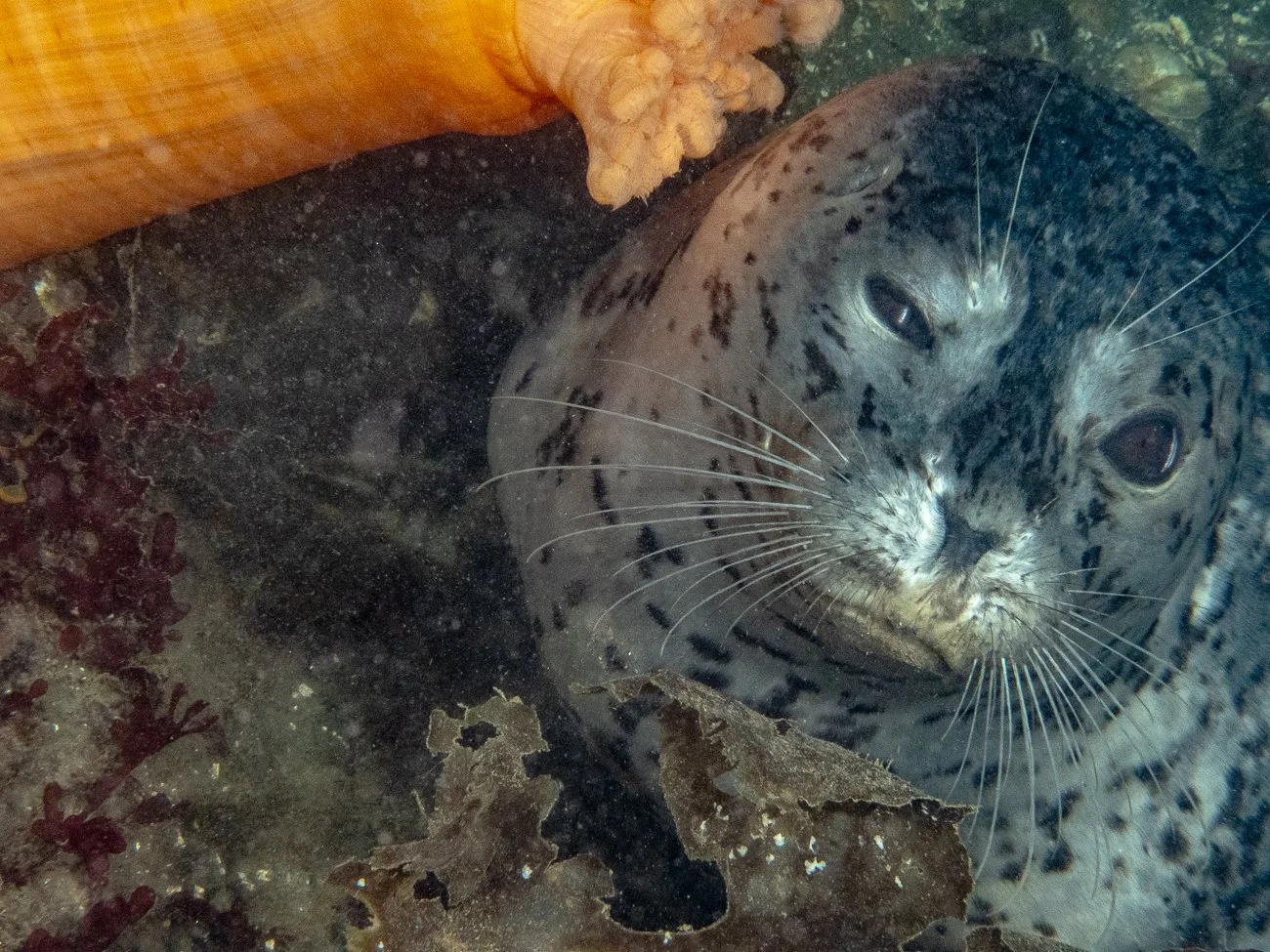
You scan the water column, and suddenly one is there, suspended just beyond your bubbles, watching with calm interest. Then another. Then emptiness again.
They move with a composed self-possession, less interested in spectacle than observation. If sea lions are the extroverts of the pinniped world, harbor seals are the thoughtful introverts who miss nothing.
Color can help, though nature loves exceptions. Harbor seals often wear mottled coats in shades of gray, silver, tan, or brown, marked with spots or rings. Sea lions tend to be more uniformly colored, usually darker brown to tan, with smoother-looking coats.
Behavior is often the fastest clue. Sea lions are more likely to race in, circle, blow bubbles, tug at fins, and treat a diver like an unexpected toy. Harbor seals are more likely to hover nearby, inspect you carefully, and drift close enough to make eye contact before slipping away.
Both reward patience. Neither should be chased. The best encounters happen when you stay calm and let them decide the distance.
For all their playfulness, both live demanding lives shaped by weather, tides, predators, and the constant need to eat enough in cold water.
Harbor seals are year-round residents throughout much of the Salish Sea. They haul out on beaches, mudflats, rocks, floating logs, and quiet shorelines to rest, molt, warm themselves, and give birth. Their pups enter a world that expects competence from an early age. Many can swim within hours of birth, though they still rely heavily on their mothers for milk, protection, and guidance. In the wild, harbor seals can live 25 to 30 years, long enough to know these shorelines well.
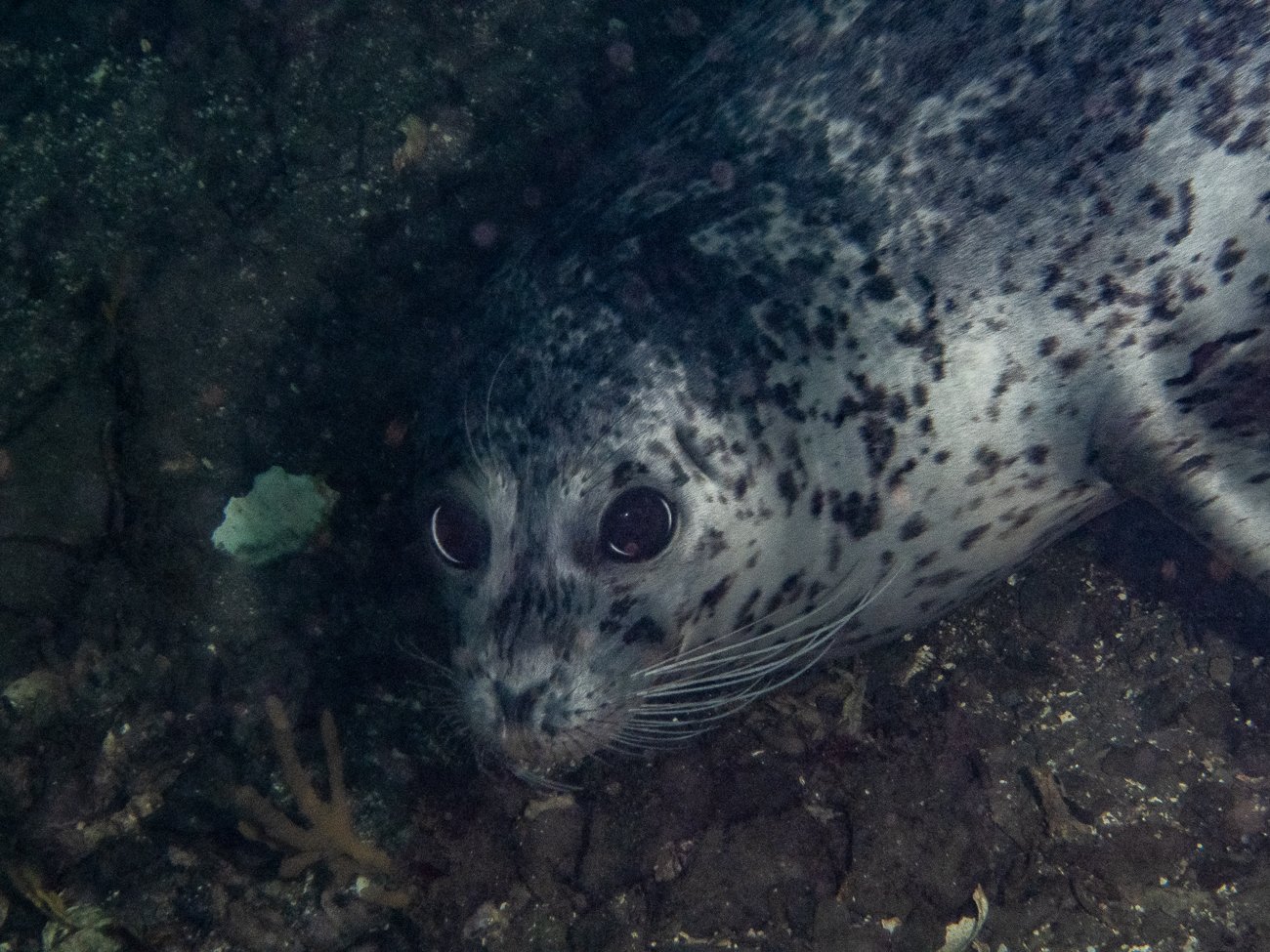
A mother harbor seal with a pup is one of the more memorable sights these waters offer. The pup stays close, surfacing beside her, learning quickly in a place where hesitation can be expensive. Bald eagles, currents, storms, disturbance, and predators do not grant many second chances.
Sea lions use the Salish Sea somewhat differently depending on species and season. California sea lions are often seasonal visitors, especially males that move north after breeding farther south. Steller sea lions maintain a broader regional presence and use haul-out sites to rest between feeding trips. Their rookeries, where breeding occurs, are generally outside the central Salish Sea, but individuals are common enough visitors that they feel like part of the neighborhood. Sea lions can live 20 to 30 years, when the ocean allows it.
Young sea lions seem born with mischief already installed. Juveniles are often the ones most interested in divers, boats, docks, and anything unfamiliar. Curiosity likely helps them develop the speed, coordination, and confidence they will need as adult hunters.
Both sea lions and harbor seals feed primarily on fish and squid, taking advantage of whatever is seasonally abundant. Herring, salmon, smelt, sand lance, and other small fish that travel in schools make up much of their diet.
A healthy prey base supports not just seals and sea lions, but seabirds, larger fish, whales, and the broader ecosystem around them.
Watching one hunt underwater changes how you think of them. The softness many people notice from shore gives way to speed, precision, and purpose. A harbor seal that looked sleepy on a log can turn into a torpedo the moment fish appear, reaching speeds of around 15 miles per hour in a burst. A sea lion that spent the morning barking on a buoy can cut through a bait ball with athletic brutality, capable of pushing closer to 25 miles per hour when it decides to move.
They are not pets of the sea. They are predators built by cold water and hunger.
They are also exquisitely adapted to the environment. A thick layer of blubber insulates them from temperatures that send divers scrambling for dry gloves and thicker undergarments. Their blood carries oxygen efficiently. During dives, heart rates can slow, and blood flow can be prioritized to essential organs. Harbor seals can remain underwater for 20 to 30 minutes, sea lions closer to 10 to 15. By the time you start wondering where they went, they are already behind you again.
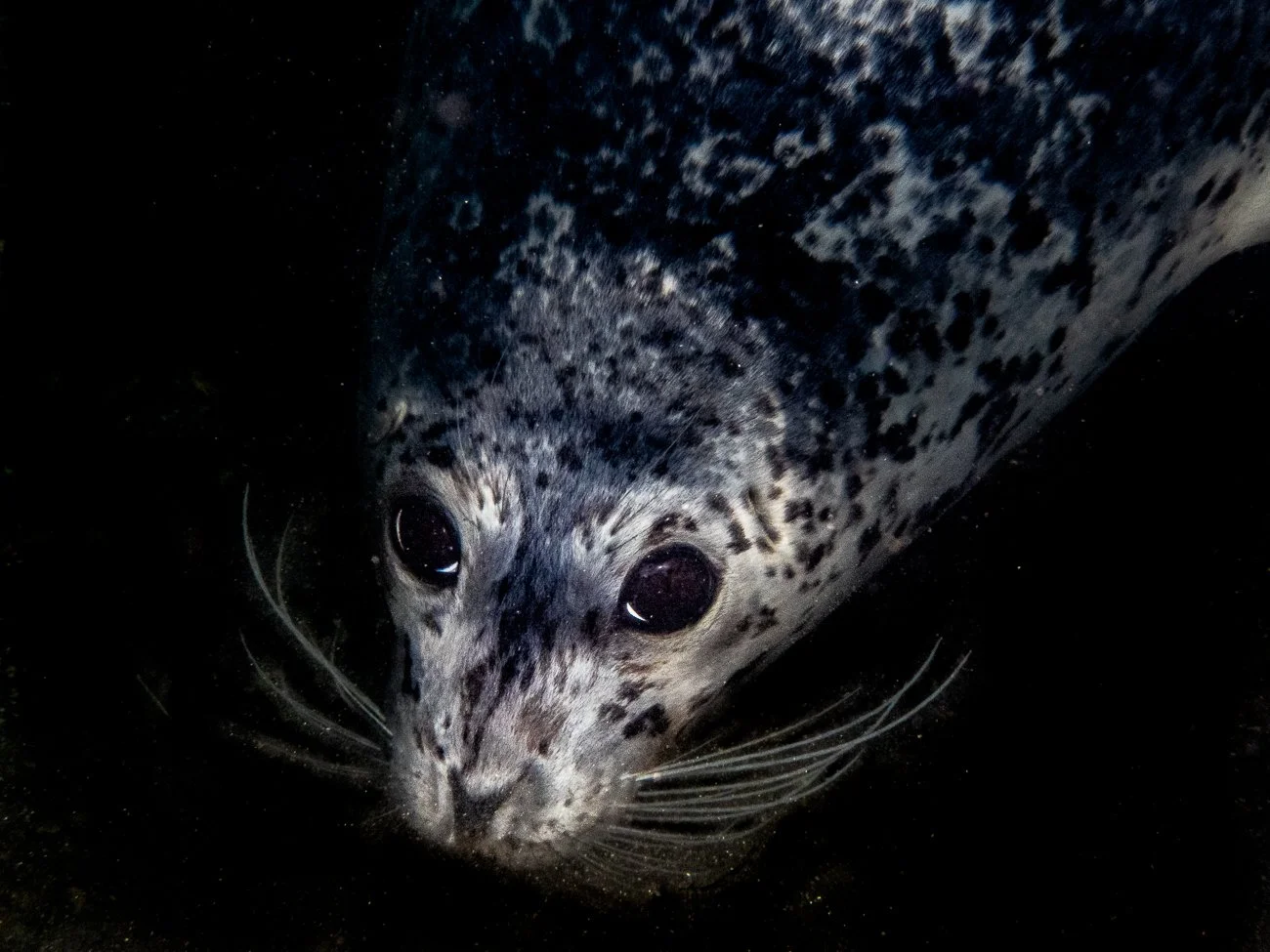
Even their whiskers are remarkable. Those stiff facial whiskers, called vibrissae, help detect movement and turbulence in the water. In simple terms, they can help read the traces left behind by prey. Long after a fish has passed, the water may still be telling on it.
Spend enough time diving here, and you begin to recognize personalities.
There was a harbor seal at Sund Rock last year that would appear near the safety stop almost every few dives, never close enough to touch, always close enough to study. It seemed to favor staying just outside arm’s reach, rotating slowly to keep one eye on me.
If I looked away, it drifted closer. If I looked back too quickly, it retreated a few feet. We repeated this silent negotiation several times over the season. A juvenile sea lion in the San Juans once became fascinated with the reflection in my dome port. It rammed the water in front of it repeatedly, then barked underwater, a strange muffled burst that vibrated more than sounded. When that failed to solve whatever problem it had with its own reflection, it sped off and returned with two companions, as though expert consultation was required.
Moments like that are funny, but they also reveal something deeper. These are social, aware, inquisitive animals navigating complicated worlds.
In the ocean, relationships are rarely simple. Sea lions and harbor seals are loved by people who watch them from beaches, ferries, marinas, kayaks, and shorelines. A whiskered face rising beside a boat can improve a day in seconds. Tourists point. Locals smile despite themselves. Children lose all composure.
To divers, they can feel like temporary companions. I have had harbor seals mirror my movements for minutes at a time. I have had sea lions thread themselves through my exhaled bubbles as if I were some new underwater fountain installed for their amusement. I have had one repeatedly swim behind me and look over my shoulder every time I tried to photograph something on the reef, apparently determined to supervise.
But friendship, in the human sense, is not really the point. Curiosity is. These animals investigate their world constantly, and sometimes we happen to be in it.
Their enemies are more serious. Bigg’s killer whales, the mammal-hunting orca often seen in the Salish Sea, prey on seals, sea lions, and other marine mammals. When they are nearby, haul-outs can empty quickly, and behavior can change in an instant. What looked lazy a moment ago becomes alertness distilled.
Large sharks are less common here than in some coastal regions, but remain part of the broader marine story. Disease, storms, and scarcity also take their toll.
Human impacts are often the more persistent challenge. Entanglement in fishing gear, marine debris, vessel disturbance, pollution, shoreline development, and depleted prey stocks can all affect populations. Even well-meaning people can cause stress by crowding haul-outs, separating mothers and pups, or forcing animals into the water.
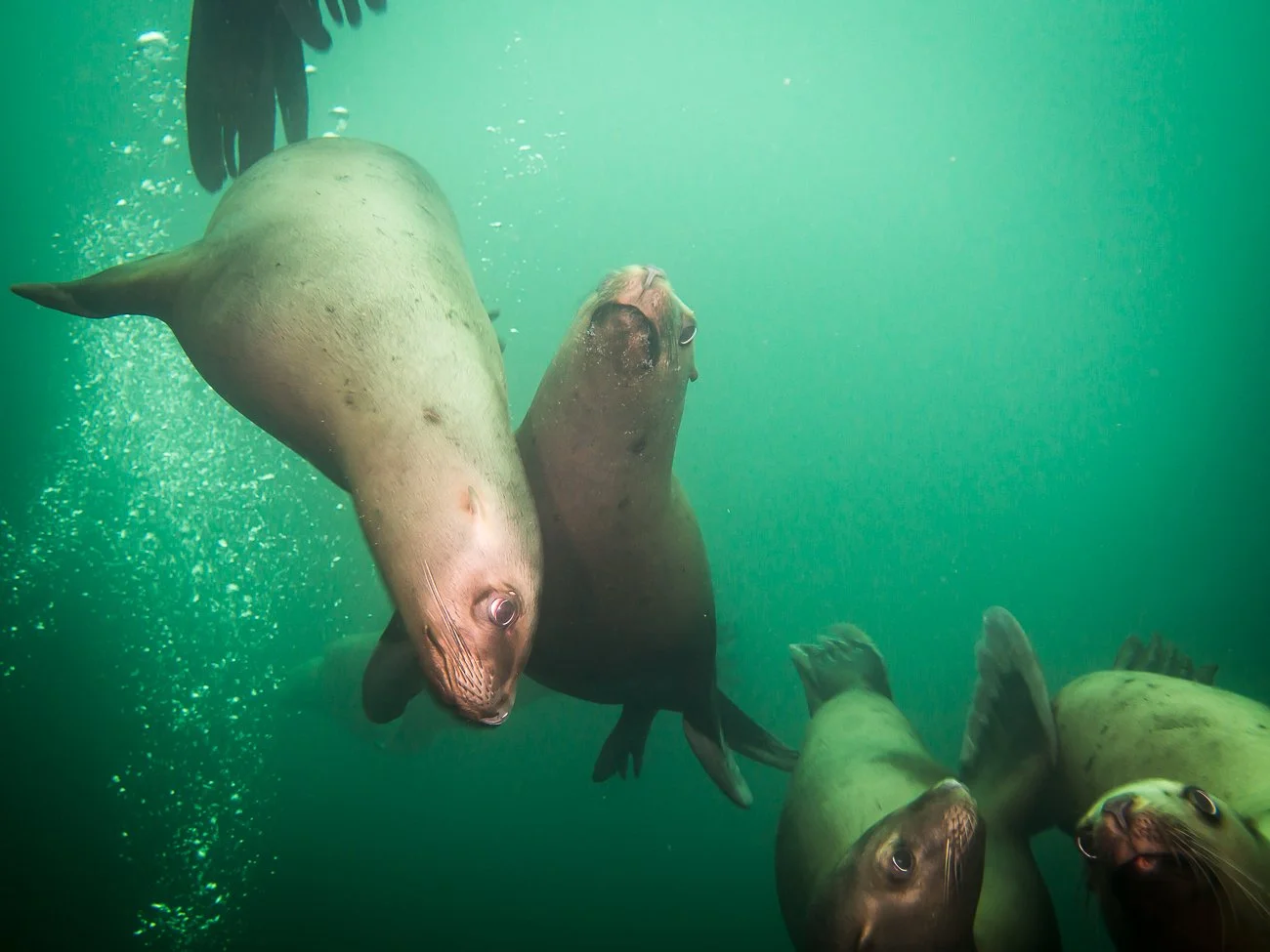
The best wildlife viewing leaves wildlife unbothered. Give hauled-out animals space. Keep dogs back. Use binoculars instead of footsteps. On the water, slow down when needed and avoid forcing animals to react to your presence. Underwater, never corner or pursue them.
If they want to meet you, they will make that clear quickly. And when they do, it is hard to forget. There are flashier creatures in the Salish Sea. Giant Pacific octopus carry myth with them.
Wolf eels look imagined. Nudibranchs seem painted by someone unwilling to choose only one color.
Salmon carry the weight of economies and cultures. Orca arrive with instant gravity. But sea lions and harbor seals possess something rarer: personality visible at a glance.
You see it in the harbor seal hovering inches away, whiskers forward, deciding what to make of you. You see it in the sea lion that rockets in from nowhere, steals a playful tug at your fin, and vanishes before you can laugh into your regulator.
You see it in the animal that watches you watch the sea.
For those of us lucky enough to dive here, they become part of the rhythm of these waters. Never guaranteed, never scheduled, always hoped for. Every diver knows the feeling of surfacing after one of those encounters.
You climb back onto shore or boat, smiling harder than the conditions deserved. The water may have been cold, the visibility poor, the current annoying, the camera stubborn.
None of that matters now. Because for a few minutes, something wild invited you into its day. And in the green waters of the Salish Sea, that remains one of its finest gifts.
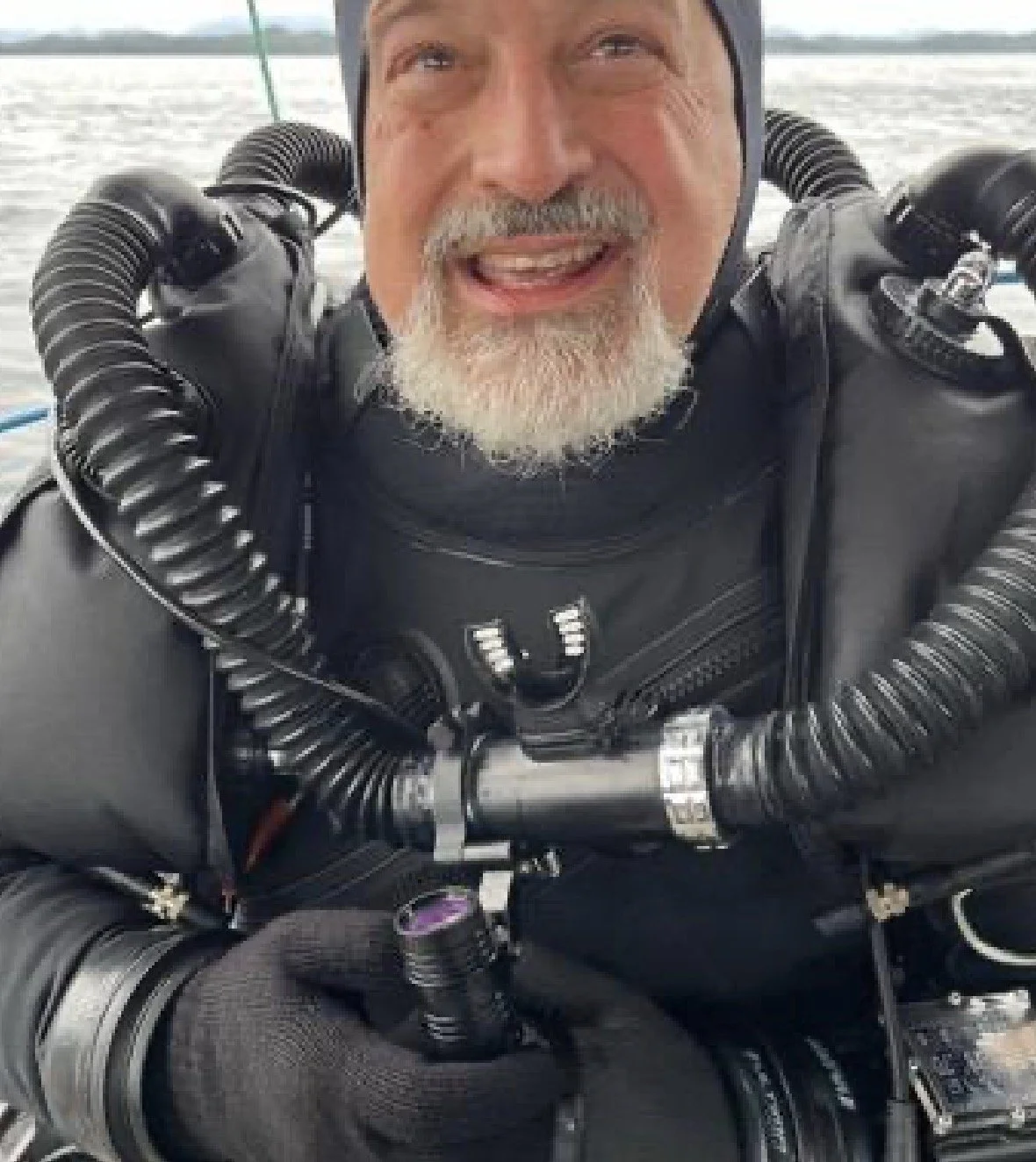
Thom Robbins is a seasoned diver, underwater photographer, and author with a deep passion for the Pacific Northwest and its marine life. With over thirty years of diving experience, Thom has spent countless hours beneath the surface, documenting the mysterious beauty of wolf eels, octopuses, and nudibranchs as well as seals and sealions. His underwater videos and photographs bring the hidden world of the Salish Sea to life, captivating both online and print audiences. He is a regular contributor to the Fjord.