
wildside harvest
Stella Wenstob | photos & story
Summer is fading, its warmth edged by the cool, crispness of fall. Theres a dampness that only can be shaken by a warm fire or a cozy drink. It is almost time to dig into the back of your closet and find that sweater that you forgot about last Spring, but you know that if you put it on in the morning, by lunch time you’ll be sweating it off. They call September a transition month, but menopausal might be more accurate. Salmon start working their way up inlets and streams and blackberries begin to rot on the vine.
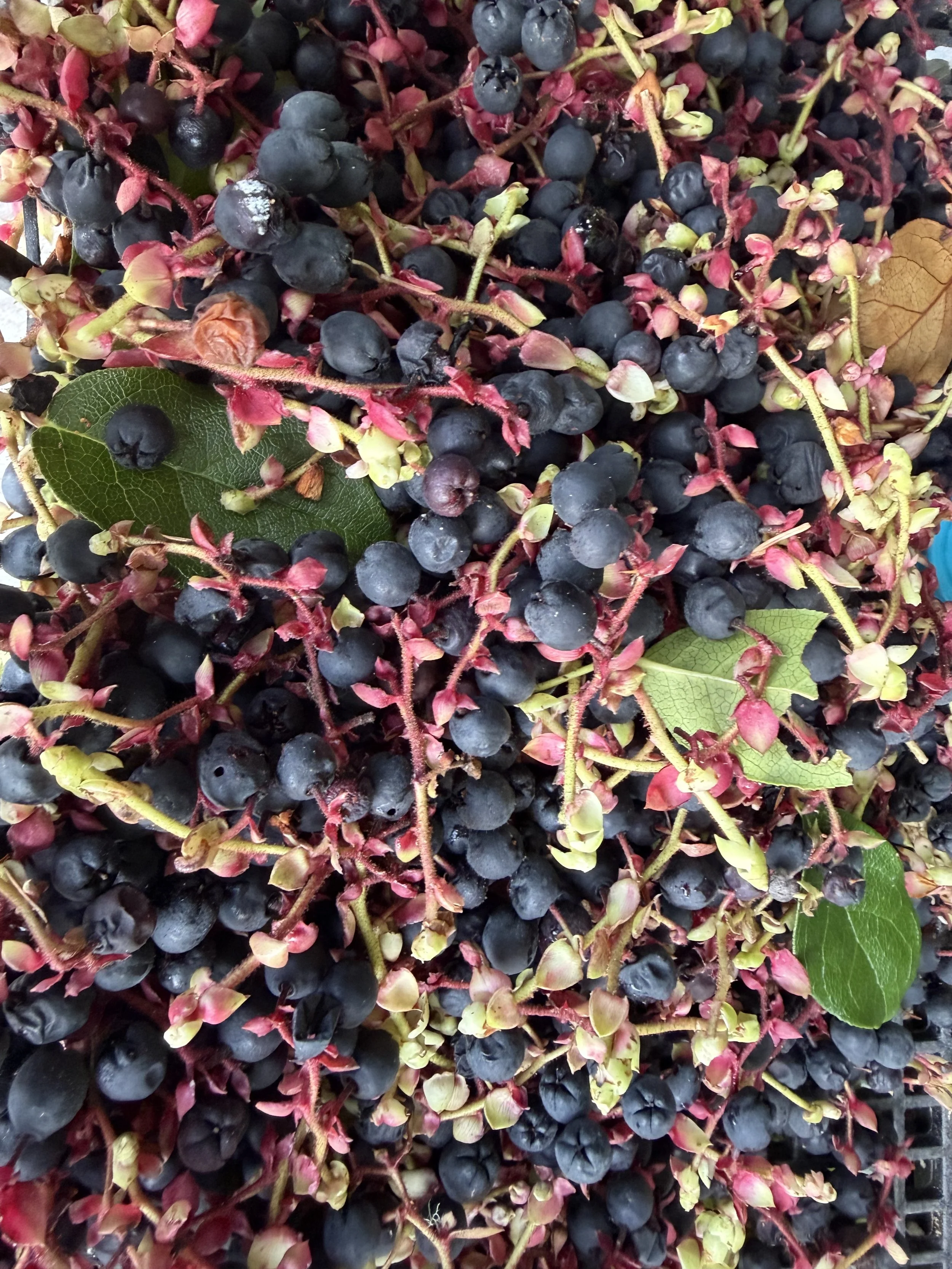
But this is not the end of the natural bounty of the Pacific Northwest. Oysters are ready for the picking. And local fruit, such as the purplish berry-like swollen sepal’s of salal (Gaultheria shallon) and the dark or sometimes bluish evergreen huckleberry (Vaccinium ovatum) are adapted to the dampness, they contain high proanthocyanidins, which have strong antimicrobial properties that deter moulding. These proanthocyanidins are a type of tannin that are found in tree barks, roots, leaves, and fruits of plants, but the salal berry’s content is charted as one of the highest in the berry world (higher in some healthy compounds than blueberry, lingonberry, and cranberry). A local super fruit salal contains compounds high in antioxidants that are full of health benefits, such as decreasing inflation, promoting cardiovascular health as well as a myriad of nutritional benefits.
SALAL
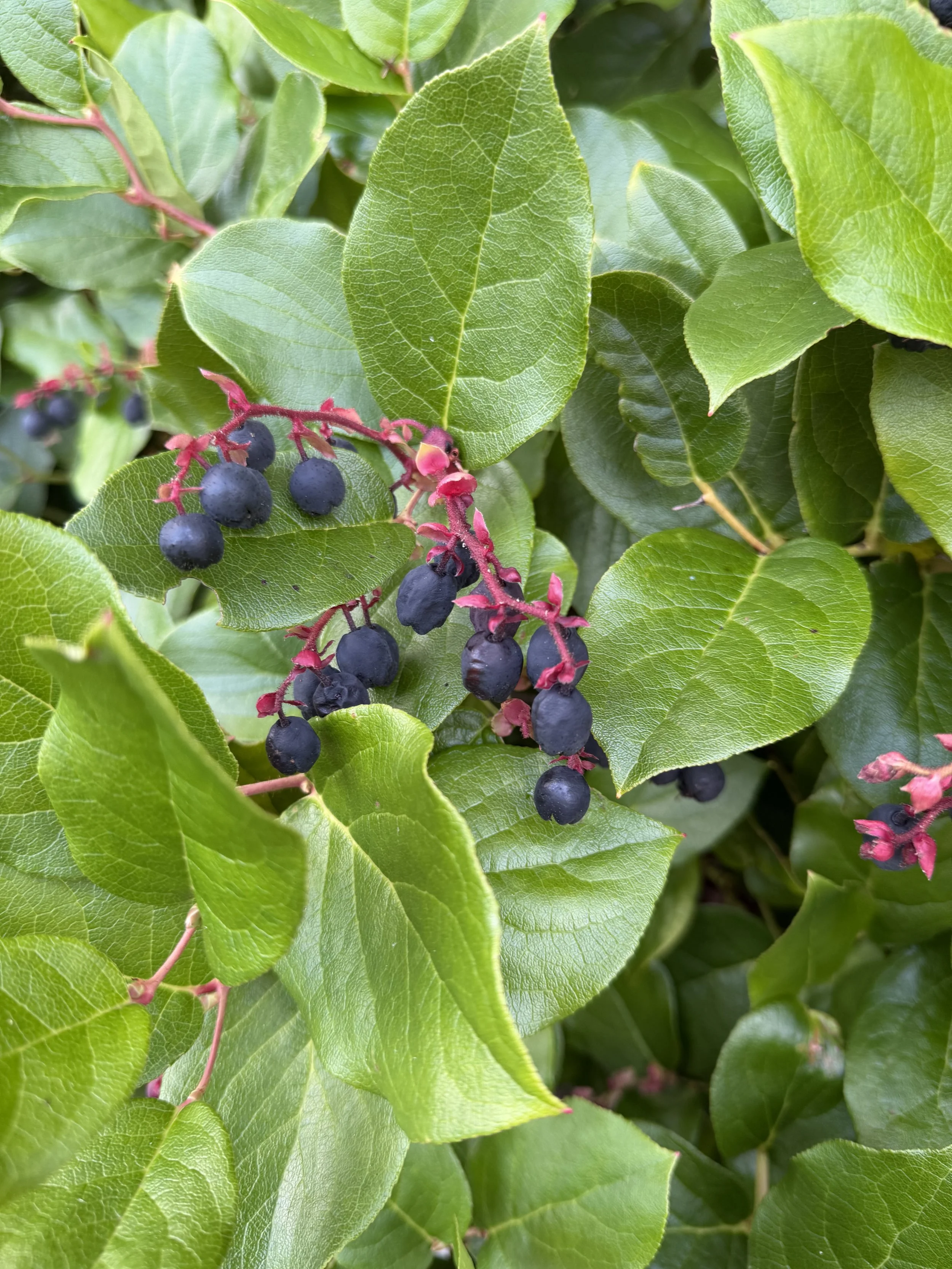
As a child I delighted in pinching the base of the slightly fuzzy fruit to pop them open revealing their inner five-pointed star shape. This shape marks salal as an untrue berry (or pseudoberry, according to botanists). True berries are formed by the swelling of the ovary or fruiting body of the flower, whereas salal (and other non-true berries like blueberry) are formed from the swollen outer sepals of the flower.
Growing up on the the west coast of Vancouver Island, I remember breaking off the reddish branches that the fruit form on in uneven clusters of 5 to 15 and pretending I was eating grapes. Which isn’t that far off since Shiraz grape berry skins are also famous for their high levels of proanthocyanidins (but still only roughly half the amount that salal does). There was a myth in my hometown that the Vinland that the Vikings discovered was not L’Anse Aux Meadows off the East Coast of Canada, but the Pacific Northwest with its dripping salal berries.
Of course, while fantasy versions of history are diverting, the truth is always more fascinating. salal was incredibly important to the Indigenous people of the Pacific Northwest. It is named in 30 languages, even language groups that didn’t see the plant growing locally (Turner 2014) but valued the berries as a trade good. [Just as an aside, there are over 50 distinct Indigenous languages spoken in the Pacific Northwest, that is the area from Alaska to Oregon– making this one of the most linguistically diverse parts of the world]. Along the Hood Canal, the Skokomish (Twana) have two words for salal: t́a’qe, which refers specifically to the plant, and t́a’qa?, which refers to the berry (Nile Thompson, undated, Skokomish Tribal Centre). The word salal comes from the Chinook Jargon, an Indigenous trade language, first recorded by the 1805-1806 Lewis and Clark expedition as variously shallon, shelwel or shellwell. This was later tightened up to salal or sallal by the Scottish botanist David Douglas (of Douglas Fir fame) when he visited Fort George (near present day Astoria) in 1825.
As its linguistic significance attests salal was widely enjoyed by Native Americans of the Pacific Northwest. There are extensive records of seeds and whole berries recovered from archaeological sites. And it is remembered how berries were harvested in huge numbers, Nancy Turner in her 2014 volume estimates this to be 100,000 to 200,000 berries per family per year. These were cooked using hot rocks and then dried into cakes that would last into the winter. These cakes were often traded from coastal tribes into the interior to tribes that did not have this delicacy. To take away the dryness, when eating them they were dipped in eulachan, seal or whale oil. The leafy branches are also useful in pit cooks. The berries were also crushed up and mixed with salmon eggs to make paint. And it is recorded that the leaves were used in teas to ease inflation and they were often chewed as a hunger suppressant. Even today salal still plays an important part in the Pacific Northwest’s economy. Known commonly as “lemon leaf” it is an ubiquitous green found in commercial floral arrangements.
My dad loves to pick ripe salal berries in late August to mid-September. He recently discovered a hack to separating the stems from the berries (a task that if often tedious and unsatisfactory as it often bursts the tender berries) – he picks the berries complete with their red stems and freezes them on baking trays overnight, the next day the frozen berries are firm enough to separate from the stems without damage.
My dad’s speciality is salal berry jelly, and it is a favorite with its rich, earthy flavou. My brother in-law calls it “medicine”. My dad is a creative cook, and I have a strong childhood memory of dad straining the tiny seeds from his boiled concoction with a pair of my mum’s pantyhose. Thankfully, dad now uses a metal strainer, but these seeds are important in the boiling stage for imparting lots of natural pectin that helps the jelly set. Another use my sister, over at the Fjord Oyster Bank, recently discovered was rendering the berries into a syrup which she used as a base for gelato! As a nod to more traditional methods of preparing salal, the internet abounds with recipes for making fruit leather with salal. I have not trued this, but its antimicrobial properties and its pulpy texture make it a natural fit for this method.
EVERGREEN HUCKLEBERRY
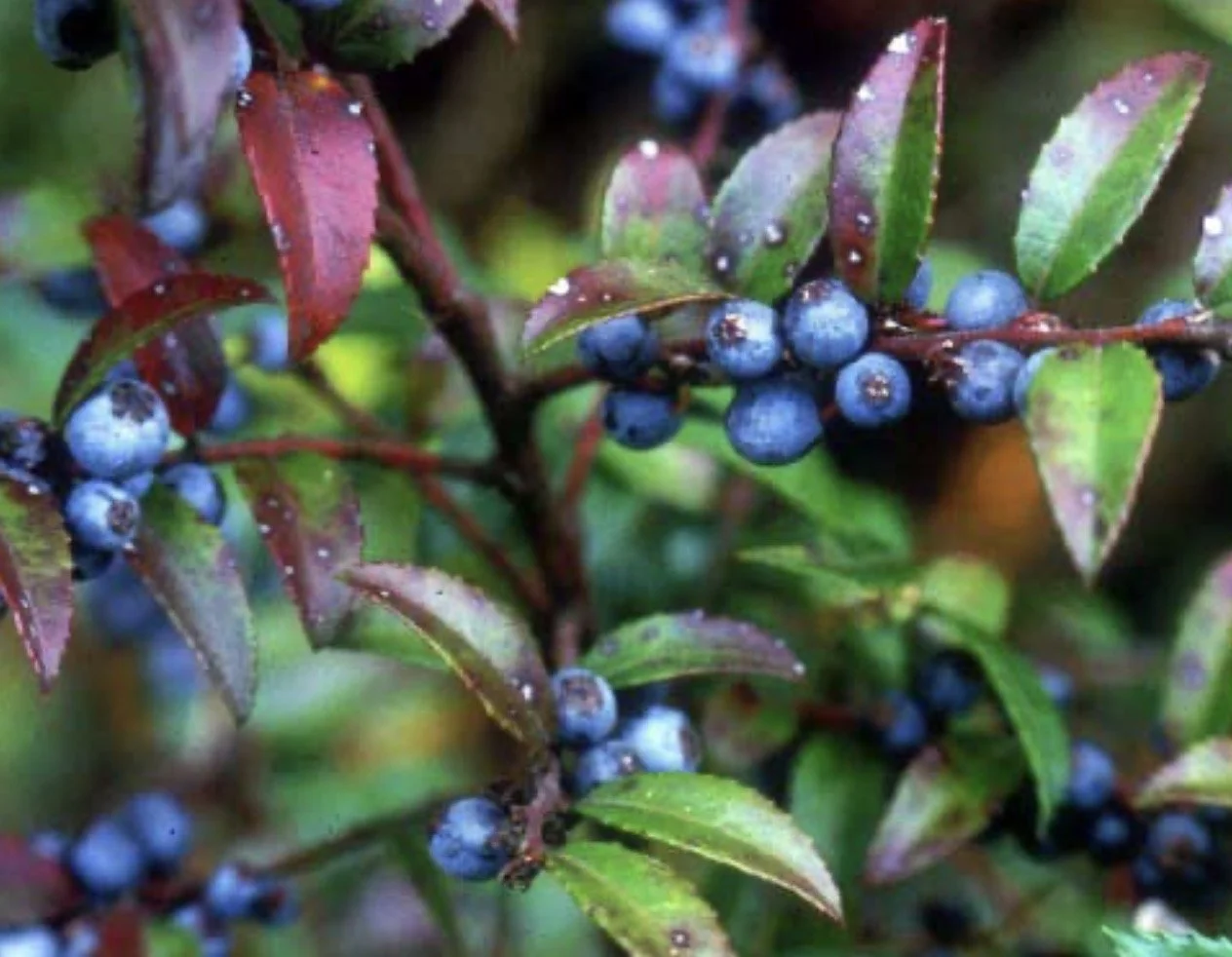
Evergreen Huckleberry (or cynamoka) is another local super fruit that becomes available in the Pacific Northwest from late summer to late fall (some even say the berries taste better after the first frost). They are known as the ya’ýaXbi (the bush) and ya’ýaX∂b (the fruit) to the Skokomish (Nile Thompson, undated, Skokomish Tribal Centre).
This sometimes dark and glossy or sometime cloudy and blue berry is my favourite berry to pick and preserve. I freeze them and love to have them with yogurt and homemade granola. They are also fantastic in baking, brightening up scones, muffins with their tangy flavor. Basically, anywhere you could use blueberries you can use these, but it will taste ten times better. Of course, my dad also like to make jelly of Evergreen Huckleberry too.
Like salal, Evergreen Huckleberry rates high on the healthy scale. According to Rossier’s survey of the literature around the healthfulness of Evergreen Huckleberry for her 2019 thesis documenting the traditional management and harvest of Evergreen Huckleberry amongst the Karuk, Yurok, and Hupa people of Northern California and Southern Oregon:
“Anthocyanins, a subclass of polyphenols that provides the blue, purple, and red pigments found particularly in dark berries such as V. ovatum, have been specifically researched regarding their ability to: 1) reduce Type II diabetes and associated issues (e.g. hyperglycemia, related kidney disorders, insulin resistance), obesity, and cardiovascular disease; 2) enhance vision; 3) be neuroprotective, 4) be antimicrobial against foodborne pathogens (e.g. Escherichia coli, Listeria monocytogenes, Salmonella enteritidis, among others) while preserving probiotic strains, and 5) be anti-inflammatory, anti-oxidant, and chemoprotective against a variety of cancers, including breast and colon cancers” (20-21, 2019).
Salal is a major food source for the Pacific Northwest people. The Makah of Northwestern tip of the Olympic (and possibly other Northwest tribes), were known to actively manage Evergreen Huckleberry bushes through pruning (also called by coppice) and by controlled burning (Turner 2014) to encourage berry productivity. Likewise, Evergreen Huckleberry is a popular cut green for floral arrangements commercially, though it is not as popular as salal.
Some people get fanatical about picking wild berries in season. They plan out their time off in terms of berry picking hours, make special berry picking buckets out of 8L ice cream buckets and rain pant bib straps, and drive dusty logging roads or hike out to find their special patch. I was raised valuing the berry-stained hands and the delicious taste of a sun warmed berry straight off the branch, I always travel with an empty bucket in the back of my car “just-in-case”, but the berry-picking process doesn’t have to be strenuous to be satisfying. It can be as easy as a walk in the park (literally). Not only is it a lovely way to spend your time, aside from a few bug bites and branch scratches, it’s a very healthy past time and people for millennia have been celebrating and enjoying these fruits of the earth.
Stella Wenstob is is historian and researcher residing on Vancouver Island's outer coast. She is a regular contributor to Tracing the Fjord.