

Wildside Harvest
A local super fruit salal contains compounds high in antioxidants that are full of health benefits, such as decreasing inflation, promoting cardiovascular health as well as a myriad of nutritional benefits.
Stella Wenstob | photos & story
Summer is fading, its warmth edged by the cool, crispness of fall. Theres a dampness that only can be shaken by a warm fire or a cozy drink. It is almost time to dig into the back of your closet and find that sweater that you forgot about last Spring, but you know that if you put it on in the morning, by lunch time you’ll be sweating it off. They call September a transition month, but menopausal might be more accurate. Salmon start working their way up inlets and streams and blackberries begin to rot on the vine.
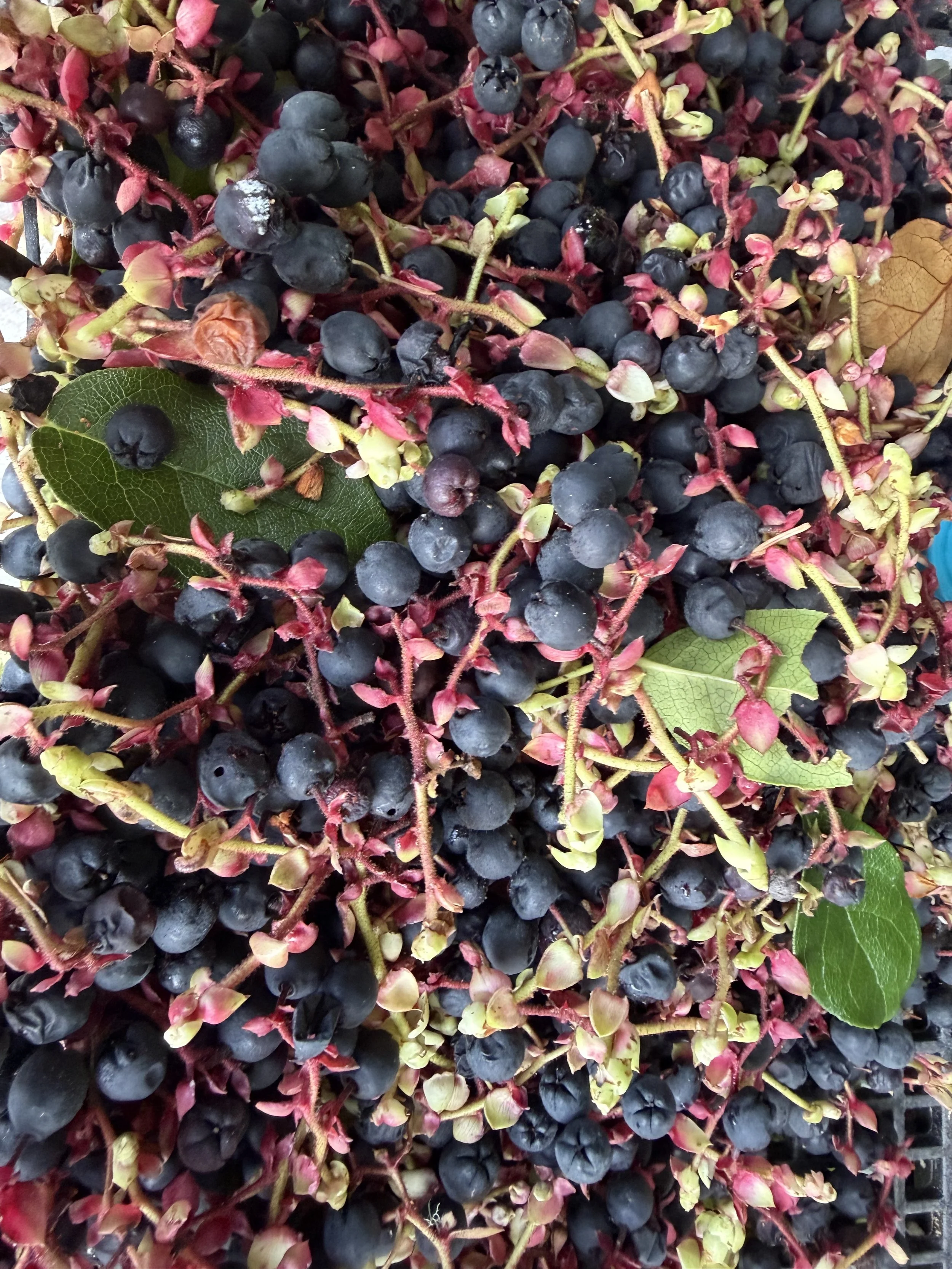
But this is not the end of the natural bounty of the Pacific Northwest. Oysters are ready for the picking. And local fruit, such as the purplish berry-like swollen sepal’s of salal (Gaultheria shallon) and the dark or sometimes bluish evergreen huckleberry (Vaccinium ovatum) are adapted to the dampness, they contain high proanthocyanidins, which have strong antimicrobial properties that deter moulding. These proanthocyanidins are a type of tannin that are found in tree barks, roots, leaves, and fruits of plants, but the salal berry’s content is charted as one of the highest in the berry world (higher in some healthy compounds than blueberry, lingonberry, and cranberry). A local super fruit salal contains compounds high in antioxidants that are full of health benefits, such as decreasing inflation, promoting cardiovascular health as well as a myriad of nutritional benefits.
SALAL
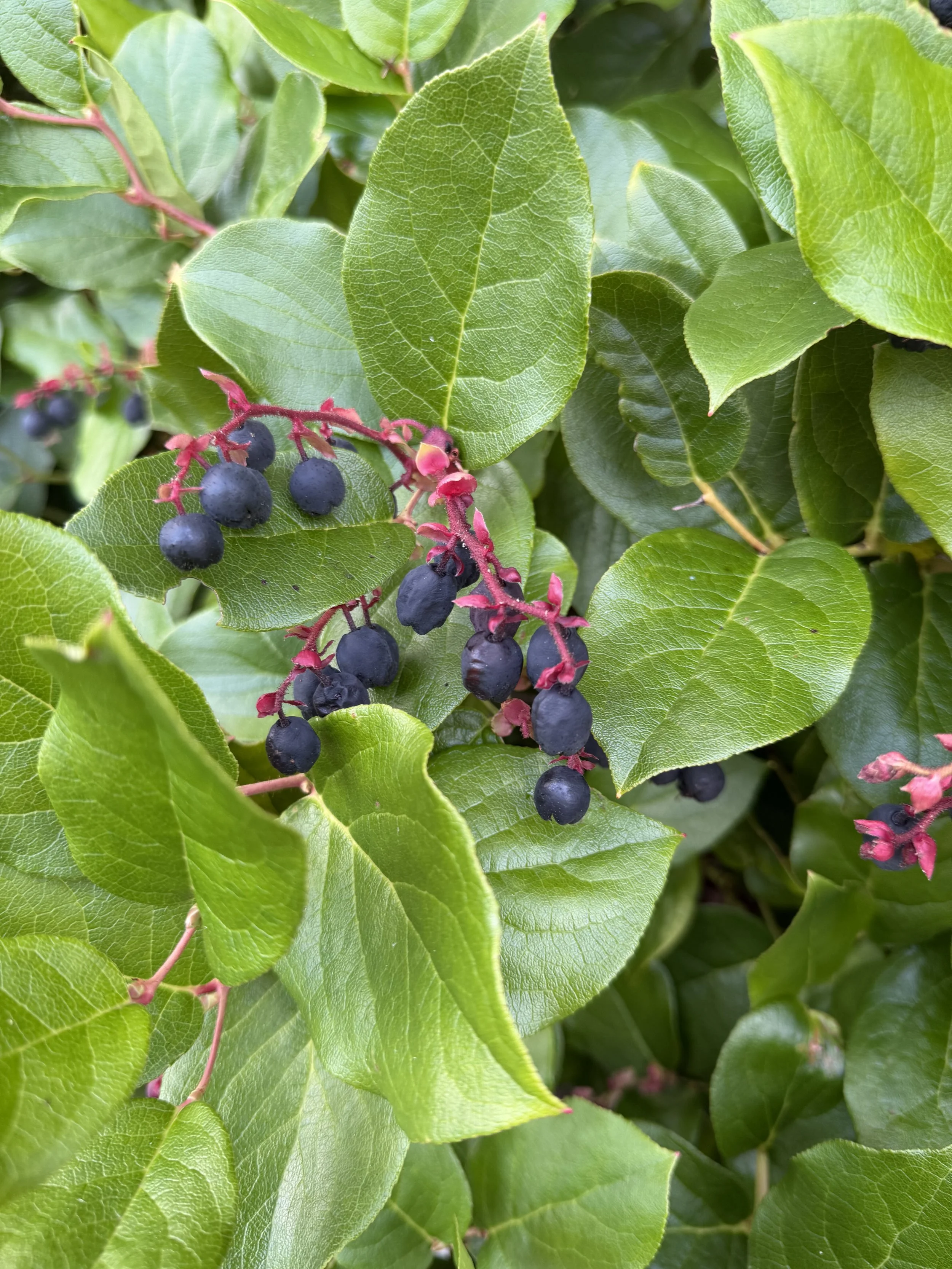
As a child I delighted in pinching the base of the slightly fuzzy fruit to pop them open revealing their inner five-pointed star shape. This shape marks salal as an untrue berry (or pseudoberry, according to botanists). True berries are formed by the swelling of the ovary or fruiting body of the flower, whereas salal (and other non-true berries like blueberry) are formed from the swollen outer sepals of the flower.
Growing up on the the west coast of Vancouver Island, I remember breaking off the reddish branches that the fruit form on in uneven clusters of 5 to 15 and pretending I was eating grapes. Which isn’t that far off since Shiraz grape berry skins are also famous for their high levels of proanthocyanidins (but still only roughly half the amount that salal does). There was a myth in my hometown that the Vinland that the Vikings discovered was not L’Anse Aux Meadows off the East Coast of Canada, but the Pacific Northwest with its dripping salal berries.
Of course, while fantasy versions of history are diverting, the truth is always more fascinating. salal was incredibly important to the Indigenous people of the Pacific Northwest. It is named in 30 languages, even language groups that didn’t see the plant growing locally (Turner 2014) but valued the berries as a trade good. [Just as an aside, there are over 50 distinct Indigenous languages spoken in the Pacific Northwest, that is the area from Alaska to Oregon– making this one of the most linguistically diverse parts of the world]. Along the Hood Canal, the Skokomish (Twana) have two words for salal: t́a’qe, which refers specifically to the plant, and t́a’qa?, which refers to the berry (Nile Thompson, undated, Skokomish Tribal Centre). The word salal comes from the Chinook Jargon, an Indigenous trade language, first recorded by the 1805-1806 Lewis and Clark expedition as variously shallon, shelwel or shellwell. This was later tightened up to salal or sallal by the Scottish botanist David Douglas (of Douglas Fir fame) when he visited Fort George (near present day Astoria) in 1825.
As its linguistic significance attests salal was widely enjoyed by Native Americans of the Pacific Northwest. There are extensive records of seeds and whole berries recovered from archaeological sites. And it is remembered how berries were harvested in huge numbers, Nancy Turner in her 2014 volume estimates this to be 100,000 to 200,000 berries per family per year. These were cooked using hot rocks and then dried into cakes that would last into the winter. These cakes were often traded from coastal tribes into the interior to tribes that did not have this delicacy. To take away the dryness, when eating them they were dipped in eulachan, seal or whale oil. The leafy branches are also useful in pit cooks. The berries were also crushed up and mixed with salmon eggs to make paint. And it is recorded that the leaves were used in teas to ease inflation and they were often chewed as a hunger suppressant. Even today salal still plays an important part in the Pacific Northwest’s economy. Known commonly as “lemon leaf” it is an ubiquitous green found in commercial floral arrangements.
My dad loves to pick ripe salal berries in late August to mid-September. He recently discovered a hack to separating the stems from the berries (a task that if often tedious and unsatisfactory as it often bursts the tender berries) – he picks the berries complete with their red stems and freezes them on baking trays overnight, the next day the frozen berries are firm enough to separate from the stems without damage.
My dad’s speciality is salal berry jelly, and it is a favorite with its rich, earthy flavou. My brother in-law calls it “medicine”. My dad is a creative cook, and I have a strong childhood memory of dad straining the tiny seeds from his boiled concoction with a pair of my mum’s pantyhose. Thankfully, dad now uses a metal strainer, but these seeds are important in the boiling stage for imparting lots of natural pectin that helps the jelly set. Another use my sister, over at the Fjord Oyster Bank, recently discovered was rendering the berries into a syrup which she used as a base for gelato! As a nod to more traditional methods of preparing salal, the internet abounds with recipes for making fruit leather with salal. I have not trued this, but its antimicrobial properties and its pulpy texture make it a natural fit for this method.
EVERGREEN HUCKLEBERRY
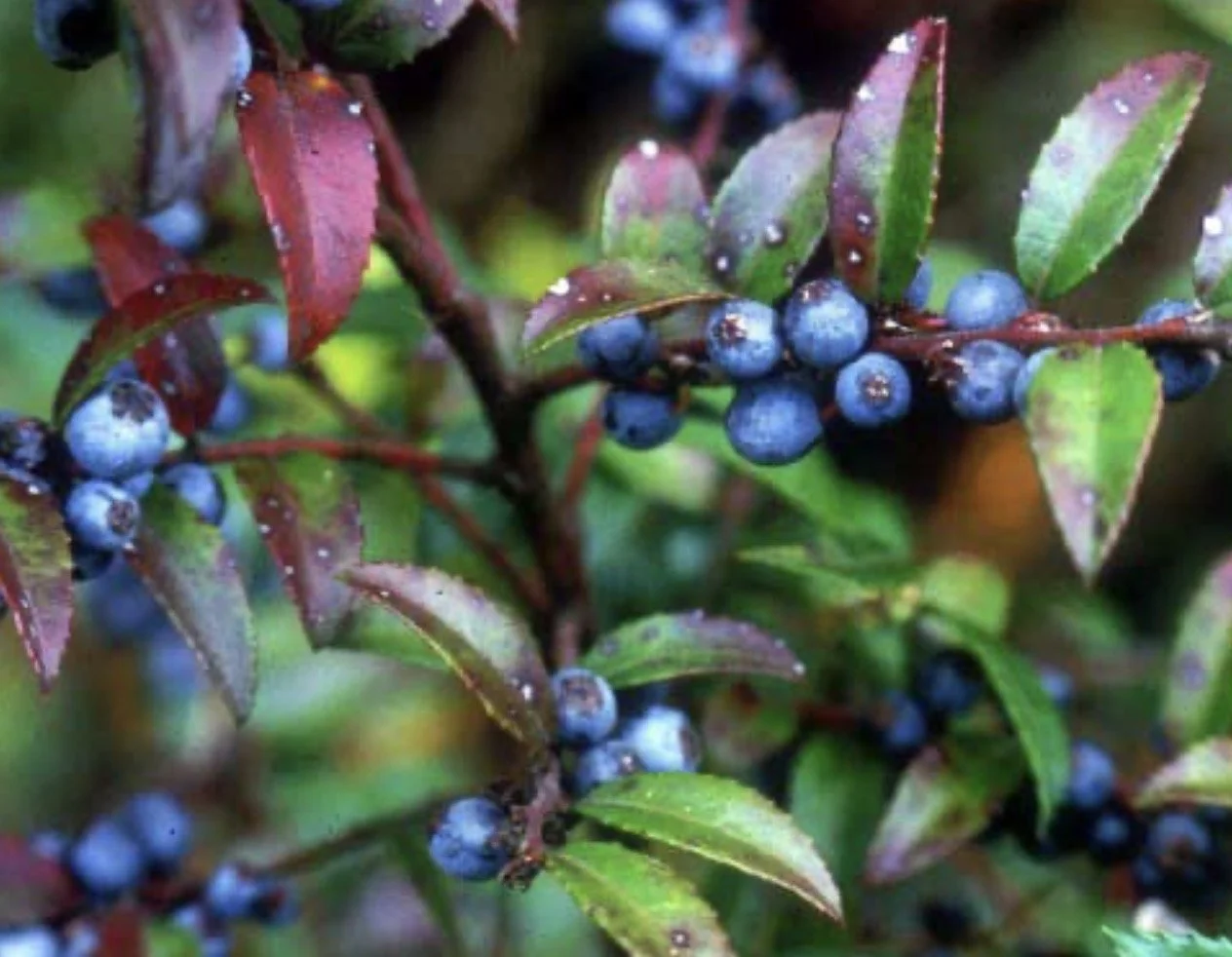
Evergreen Huckleberry (or cynamoka) is another local super fruit that becomes available in the Pacific Northwest from late summer to late fall (some even say the berries taste better after the first frost). They are known as the ya’ýaXbi (the bush) and ya’ýaX∂b (the fruit) to the Skokomish (Nile Thompson, undated, Skokomish Tribal Centre).
This sometimes dark and glossy or sometime cloudy and blue berry is my favourite berry to pick and preserve. I freeze them and love to have them with yogurt and homemade granola. They are also fantastic in baking, brightening up scones, muffins with their tangy flavor. Basically, anywhere you could use blueberries you can use these, but it will taste ten times better. Of course, my dad also like to make jelly of Evergreen Huckleberry too.
Like salal, Evergreen Huckleberry rates high on the healthy scale. According to Rossier’s survey of the literature around the healthfulness of Evergreen Huckleberry for her 2019 thesis documenting the traditional management and harvest of Evergreen Huckleberry amongst the Karuk, Yurok, and Hupa people of Northern California and Southern Oregon:
“Anthocyanins, a subclass of polyphenols that provides the blue, purple, and red pigments found particularly in dark berries such as V. ovatum, have been specifically researched regarding their ability to: 1) reduce Type II diabetes and associated issues (e.g. hyperglycemia, related kidney disorders, insulin resistance), obesity, and cardiovascular disease; 2) enhance vision; 3) be neuroprotective, 4) be antimicrobial against foodborne pathogens (e.g. Escherichia coli, Listeria monocytogenes, Salmonella enteritidis, among others) while preserving probiotic strains, and 5) be anti-inflammatory, anti-oxidant, and chemoprotective against a variety of cancers, including breast and colon cancers” (20-21, 2019).
Salal is a major food source for the Pacific Northwest people. The Makah of Northwestern tip of the Olympic (and possibly other Northwest tribes), were known to actively manage Evergreen Huckleberry bushes through pruning (also called by coppice) and by controlled burning (Turner 2014) to encourage berry productivity. Likewise, Evergreen Huckleberry is a popular cut green for floral arrangements commercially, though it is not as popular as salal.
Some people get fanatical about picking wild berries in season. They plan out their time off in terms of berry picking hours, make special berry picking buckets out of 8L ice cream buckets and rain pant bib straps, and drive dusty logging roads or hike out to find their special patch. I was raised valuing the berry-stained hands and the delicious taste of a sun warmed berry straight off the branch, I always travel with an empty bucket in the back of my car “just-in-case”, but the berry-picking process doesn’t have to be strenuous to be satisfying. It can be as easy as a walk in the park (literally). Not only is it a lovely way to spend your time, aside from a few bug bites and branch scratches, it’s a very healthy past time and people for millennia have been celebrating and enjoying these fruits of the earth.
Stella Wenstob is is historian and researcher residing on Vancouver Island's outer coast. She is a regular contributor to Tracing the Fjord.

Wild Coastal Cuisine from the Edge of the Pacific Northwest
Cooking Around the Sound is a visceral celebration of the Pacific Northwest, bringing elevated, regionally-inspired cuisine to the rugged fringes of the Washington coast. Led by creator/chef Daniel, each dish is a tribute to the landscape, crafted on driftwood-strewn beaches and islands accessible only by kayak.
Artist feature: Daniel Ferreira, Cooking Around the Sound
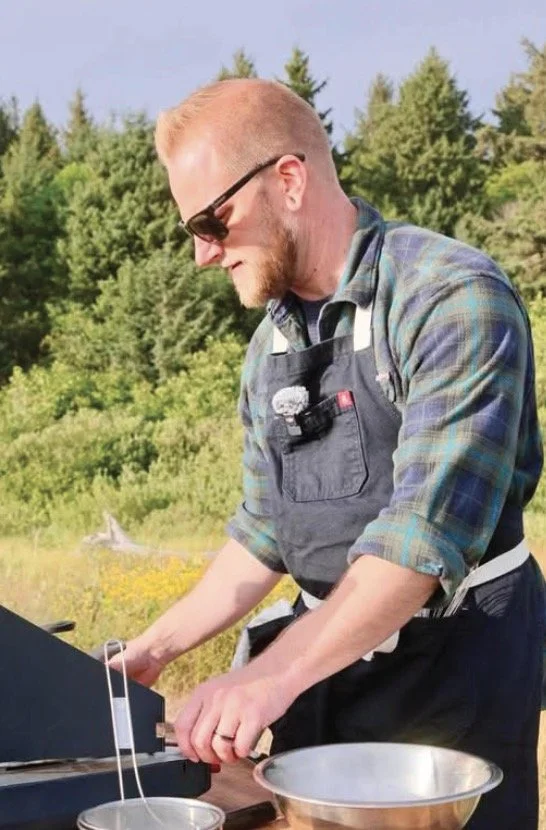
Cooking Around the Sound is a visceral celebration of the Pacific Northwest, bringing elevated, regionally-inspired cuisine to the rugged fringes of the Washington coast. Led by creator/chef Daniel, each dish is a tribute to the landscape, crafted on driftwood-strewn beaches and islands accessible only by kayak. From the mist-covered shores of the Hood Canal to the hidden inlets of the Puget Sound, the channel highlights the raw connection between the elements and the plate, featuring local treasures like Dungeness crab, Pacific oysters, and Beecher’s Handmade Cheese.
The experience is defined by a high energy, fast-paced aesthetic that trades dialogue for the rhythmic, mechanical sounds of the craft—the heavy clink of a skillet, the hiss of a searing pan, and the steady pull of the tide. Every shoot captures the grit of the Pacific Northwest, showcasing technical skill and the authentic beauty of preparing meals in the wild.
With the channel’s iconic mascots, Captain Pepper and Old Salty, standing watch over every meal, Cooking Around the Sound offers a gritty, authentic, and visually stunning look at the spirit of Pacific Northwest coastal cooking.
Smoked Wild Sockeye Salmon Dip
This recipe brings the bold, smoky flavors of the Pacific Northwest directly to your bowl. Perfectly balanced with a hint of citrus and the bite of fresh herbs, it’s a rugged yet refined dip designed to be prepared—and enjoyed—wherever your kayak takes you.

• 1 package (4oz) Smoked Wild Sockeye Salmon
• 1 block (8oz) Tillamook Cream Cheese
• 1/2 cup Tillamook Cultured Sour Cream
• 1/4 Red Onion, finely diced
• 2 tbsp Capers, drained
• 1 tbsp Fresh Dill, chopped
• 1 tbsp Fresh Chives, finely minced
• 1/2 Lemon, freshly squeezed
• To taste: Black Pepper (from Captain Pepper)
• For serving: Saltine or buttery crackers
Build the Base: In a mixing bowl, combine the cream cheese and sour cream. Fold them together until smooth and velvety. Prepare the Salmon: Gently break the smoked sockeye salmon into bite-sized flakes and add them to the base.
The Aromatics: Add the finely diced red onion, capers, fresh dill, and minced chives. These provide the color and sharp, herbal brightness that cut through the richness of the salmon. Season & Brighten: Squeeze in the fresh lemon juice and add a generous crack of black pepper. The Fold: Gently fold all ingredients together until well-incorporated, ensuring the salmon stays in distinct, flavorful pieces.
Serve: Transfer the dip to a bowl, garnish with extra chives and dill, and serve with plenty of crisp crackers.
Chef’s Note: This dip is best enjoyed on a driftwood strewn beach with the sound of the tide in the background.
Follow the journey: Instagram & TikTok @cookingaroundthesound.

Nature Tour on a Duckabush Trail
If you live in the Pacific Northwest you've probably entertained the fleeting dream of "living off the land." Last August our team was invited to attend Hood Canal Adventures' "Wild Edible & Medicinal Plants, Lichen and Fungi of the PNW" tour. The experience reignites the desire to learn more about foraging in the Pacific Northwest.
If you live in the Pacific Northwest you've probably entertained the fleeting dream of "living off the land." Last August Tracing the Fjord was invited to attend Hood Canal Adventures' "Wild Edible & Medicinal Plants, Lichen and Fungi of the PNW" tour. The experience reignites the desire to learn more about foraging in the Pacific Northwest.
The group gathered at the Hood Canal Adventure's Base Camp office located in Brinnon. Here we were met by owner and resident biologist, Christina Maloney. Christina also operates a successful kayaking rental and tour operation at the nearby Yelvik beach. In the last few years she has expanded the company's profile to include education marine and forest tours. Christina works with local naturalists and guides to lead her tours. Today our guide was herpetologist and professional forager, Jerry Novak. Growing up in southern California, Jerry cemented his fascination with edible and medicinal plants and fungi working Washington Department of Fish & Wildlife as a steward at an amphibian sanctuary near the Columbia River. The days connecting with the land fueled his infectious curiosity which is clearly a mantra of his current foraging tours.
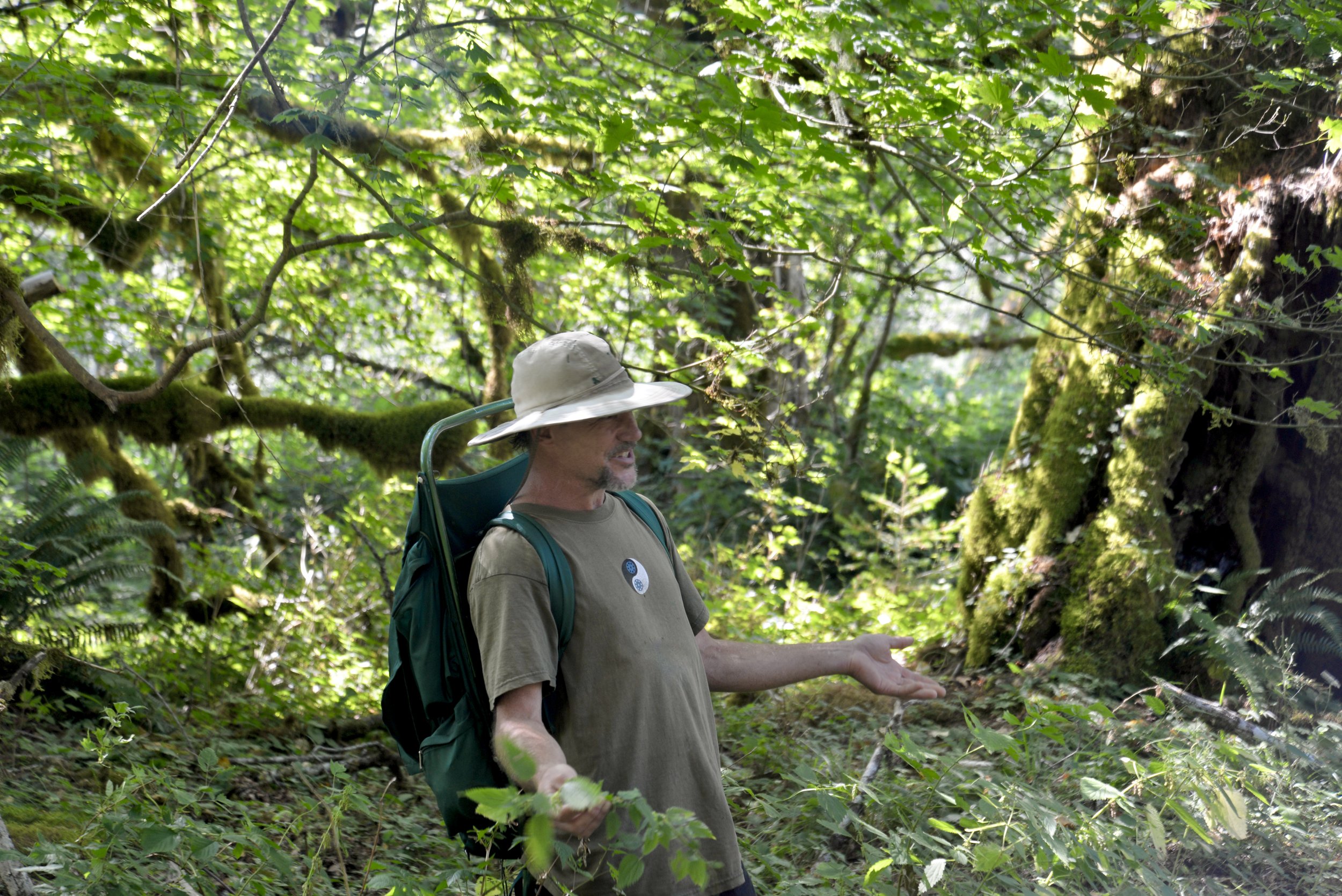
From the moment he pulled up in the dusty passenger van the tone was set with energy and anticipation.
After loading up (some participants chose the option to drive their own vehicles to the trailhead) Jerry drove us the 15-20 minutes to a Jefferson Land Trust preserve located on the Duckabush River. Literally under the power lines, we piled out in the hot August sun and surveyed the seemingly uninteresting logging slash around us.
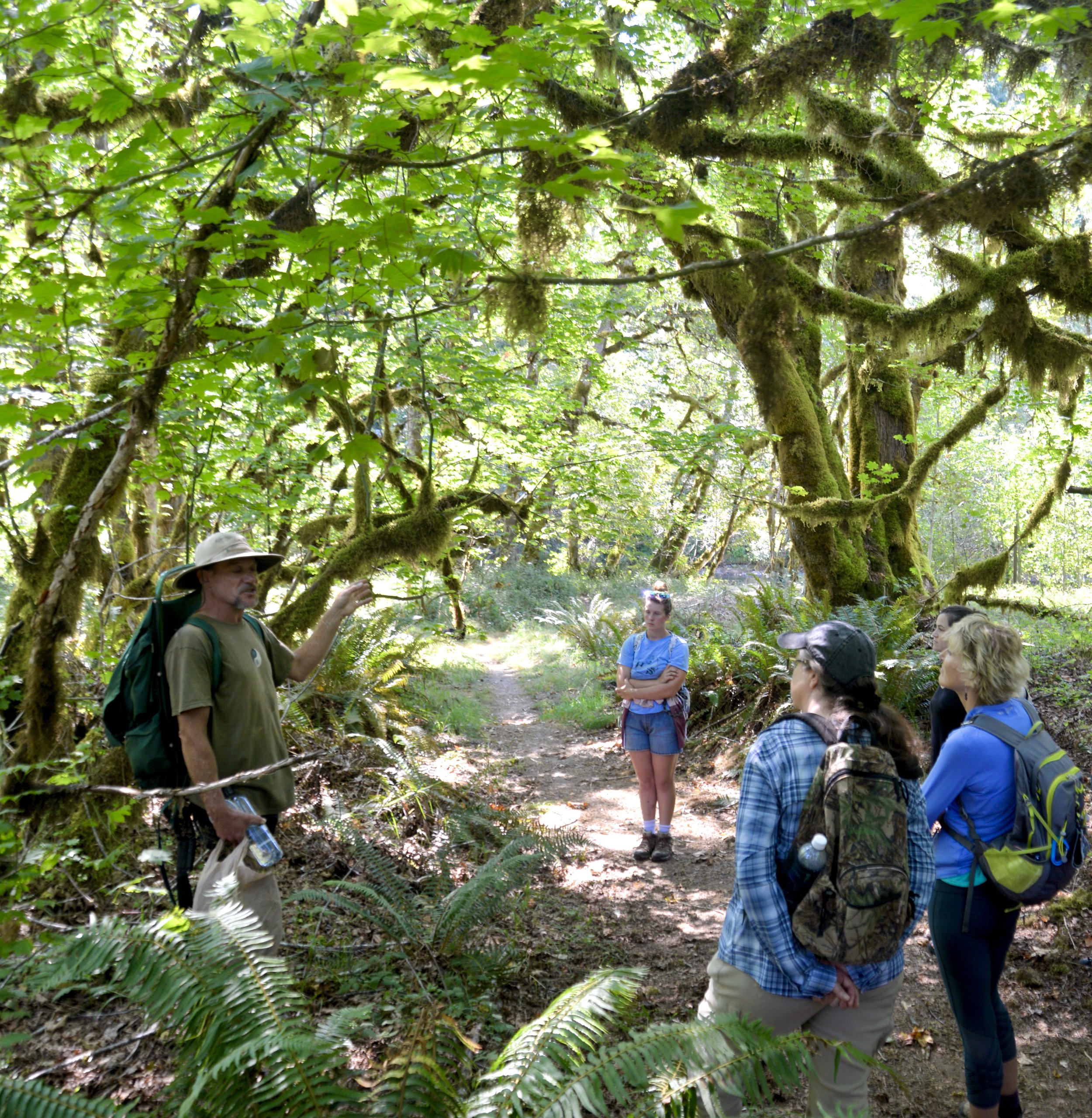
The unseen quickly became seen. Jerry reached down and grabbed a handful of dusty weeds with a head of purple flowers intertwined in the blackberry vines. His first plant was one that I had often overlooked as they are an ubiquitous on the forest floor. But never had I understood their varied healing properties. Some of which, Novak claimed, rivaled those bought over the counter.
Jerry shared the historical lore of each plant and his own personal experiences using the plants for their early medicinal uses.

He expressed a disregard for writers who reported on the benefits of flora without actually testing the methods themselves.
The tour descended into a sun dappled shady giant maple glen near the Skokomish River. Here we explored different fungi and trees and even sunk our teeth into a rhizome of licorice fern.
Despite it being mid-August and most of the plants past their prime and fungi still hidden beneath the soil, everywhere our guide stood, whether it be in an elk-trodden meadow or near the bank of the Duckabush River, there were countless opportunities to bring the "goodness" from the earth. You could do this walk anytime of the year and it would be an utterly different experience as the season changed.
As for poisonous plants and berries, he had some advice. "If they are too easy, don't eat them." Often times the plants that have no natural protection like thorns or "stings" are actually poisonous. I mulled over this later and could think of lots of plants that this rule doesn't apply to – like Huckle or Thimble berries for example, but unless you are sure, this is a good rule to adhere to. Nighshade and Snowberry (Ghostberry) definitely fit the definition.

The tour concluded with picnic lunch on the beach at the Duckabush River while Jerry prepared a hot wild foraged tea for the participants.
Hood Canal Adventures Fall Foraging & Fungi Tour Schedule:
Contact Christina directly, 360-301-6310, to reserve your spot or visit hoodcanaladventures.com to book online. Cost is $59/69 per person.
Mushrooms of the Olympic Peninsula - Walking Tour
September 24, 25 & 30; October 2, 7, 9, 14-16, 21- 23, 28- 30; November 4, 6, 11-13, 18-20, 26-27; December 2- 4
Edible & Medicinal Plant, Lichen & Fungi - Walking Tour
October 1; November 5
Mushrooms of the Olympic Peninsula - Walking Tour followed by Lecture with foraging author Langon Cook (sponsored by Jefferson County Libraries)
October 8:

An Autumn Trek to Black and White Lakes
Visit the Black and White Lakes in late September and discover a surrounding landscape far from black and white. Revel instead in an alpine world of living color. The lakes sit in a basin long burned of its forest cover and since carpeted in berry bushes, mountain ashes and other shrubs that burst with brilliant hues of red, orange and yellow.
Craig Romano | Story & Pictures
Craig Romano has written more than 25 outdoor guide books including "Day Hiking Olympic Peninsula."
Visit the Black and White Lakes in late September and discover a surrounding landscape far from black and white. Revel instead in an alpine world of living color. The lakes sit in a basin long burned of its forest cover and since carpeted in berry bushes, mountain ashes and other shrubs that burst with brilliant hues of red, orange and yellow come the autumn equinox. It’s a grunt to reach them, but chance are good you won’t have too much company — unless you count gregarious ground squirrels, docile deer, and inquisitive bears.

Craig Romano Photo
Hit the Trail
While the Black and White Lakes lie on the trail less traveled, you must first hike some well-trodden paths. Start your journey on the North Fork Skokomish River Trail, which begins on an old road that was decommissioned in the 1970s. Hike through wild country, much like what U.S. Army Second Lieutenant Joseph P. O’Neil saw in the 1880s on his exploratory trips into the Olympic Mountains. But something O’Neil saw that you won’t were legendary fish runs. Before the North Fork Skokomish’s flow was dammed by Tacoma Power in the 1920s, this river was one of the largest salmon-rearing waterways on the peninsula.
Hike upstream on a wide path and gentle grade crossing several side creeks. Traverse a luxuriant bottomland of big cedars, Douglas-firs, and moss-cloaked big-leaf maples. Pass the Staircase Rapids Loop Trail and consider taking it on the return for a slight variation. After passing Slide Camp, hike across the Beaver Fire of 1985, caused by an illegal campfire during a drought and resulting in 1400 acres of old growth going up in flames.

Craig Romano Photo
The trail then pulls away from the river. At 3.6 miles, reach a junction just before Spike Camp. Now head right on the Flapjack Lakes Trail and slowly climb out of the valley along the old burn line. After a few switchbacks, the trail turns northward on a fairly gentle course. Admire a big cedar grove along the way, then cross Madeline Creek on a sturdy bridge.
The creek cascades below through a narrow ravine. Now start heading up steeper and rockier terrain and follow alongside cascading Donahue Creek. At 7.1 miles comes to a junction. The way to the right is where most folks head—to the Flapjack Lakes and Gladys Divide. You want to head left instead on the less-traveled trail.
Cross a pair of creeks, and then steeply climb, rounding a ridge to emerge at a 1936 burn site, now blanketed in berry bushes and mountain ash. After passing the log foundation of an old cabin, come to a junction with the Black and White Way Trail at 8.2 miles.
The old cabin was once part of a long mining operation here at the lakes. By the mid-1970s it had collapsed leaving only the rotting foundation behind. As you continue to hike into the lake basin, look around for evidence of old mining operations in the form of tailings, pits and cuts.

Craig Romano Photo
Now continue straight another 0.2 mile to an unmarked junction. The trail continues for one mile dropping into a forested basin housing Smith Lake. You want to go right and immediately reach the largest of the trio of Black and White Lakes. The lake is small but pretty with a couple of primitive campsites nearby. The other two lakes are not much more than pothole ponds tucked a little higher in the surrounding basin.
While the lakes aren’t stunning, the views from the open basin are—especially of the surrounding wilderness. Particularly striking is Wonder Mountain and the Three Sisters to the south, Six Ridge to the southwest, and Mount Steel to the northwest.

Craig Romano Photo
In autumn, this basin transforms into a mosaic of dazzling reds, oranges, and yellows.
So where did the name Black and White come from? There are a handful of name origin theories that include the lakes being named after a brand of whiskey, the last names of the original prospectors, and a way of describing manganese found at the site.
In any case the mining history here goes back to claims made in 1907. Copper was the original mineral mined. Getting the copper to market from this remote and rugged location however proved to be a challenge. A proposed flume was never built to help get the ore to the North Fork Skokomish Valley from where it was transported to Tacoma via roads. The mine’s claims were sold several times over the years. In the 1940s the mine’s owners dug a 200 foot tunnel. By the 1960s however mining activity had pretty much ceased at the lakes.

Craig Romano Photo
When you are ready to leave this beautiful and interesting place, retrace your steps 0.2 mile back to the junction near the old cabin remains. Then return the way you came or consider hiking out via the Black and White Way Trail. It’s a shorter route, but a knee knocker dropping more than 2600 feet in 2.2 incredibly steep miles. While the way is knee-jarring, the tread is smooth and not rocky.
The way trail ends at the North Fork Skokomish Trail at the junction with the spur to Big Log Camp. From here it’s 5.4 miles back to the trailhead via the North Fork Skokomish Trail.
Black and White Lakes hike:
Distance: 16.8 miles roundtrip
Elevation Gain: 3,800 feet
High Point: 4,515 feet
Difficulty: moderately difficult
Snow free: mid-June – Oct
Trailhead Pass Needed: National park entrance fee.
Olympic NP wilderness camping permit required if backpacking.
Notes: Dogs prohibited. No campfires above 3500 feet.
GPS waypoints: Trailhead: N47 30.968 W123 19.691
Black and White Lakes: N47 34.493 W123 20.556
Features: magnificent old-growth forest, wildlife rich backcountry lake, exceptional autumn foliage, excellent alpine views, historic mining area.
Land Agency Contact:
Olympic National Park, Wilderness Information Center, Port Angeles, (360) 565-3100, www.nps.gov/olym;
Recommended Guidebooks:
Backpacking Washington 2nd edition (Romano, Mountaineers Books)
Trailhead directions:
From Shelton, travel north on US 101 for 15 miles to Hoodsport. Turn left onto State Route 119 and drive 9.3 miles to a T intersection with Forest Road 24. Turn left, continuing on SR 119 which becomes FR 24 for 5.4 miles. Then bear right, coming to the Staircase Ranger Station in 1.2 miles and the trailhead.

8 berries to be ATE on the trail
The Pacific Northwest with its lush temperate climate is home to some of the most mouth-watering berry bushes. The Native Americans have a long tradition of picking and preserving and promoting the growth of these “nature’s candy” and with long summer days ahead of us, why not try your hand at picking wild berries?
The Pacific Northwest with its lush temperate climate is home to some of the most mouth-watering berry bushes. The Native Americans have a long tradition of picking and preserving and promoting the growth of these “nature’s candy” and with long summer days ahead of us, why not try your hand at picking wild berries? Prepare yourself for a productive and palatable adventure.
1. Salmonberry
Hummingbirds happily proclaim the first opening of the salmonberries’ (Rubus spectablilis) early bright pink blossoms in late February. Salmonberries typically ripen in late April to mid-June making it the first berry of the season. The fresh shoots cleaned of its prickly outer layer are harvested by many Native American groups (as well as by foodie foragers) and are reported to taste similar to asparagus when steamed.

Salmonberry (Rubus Spectablilis)
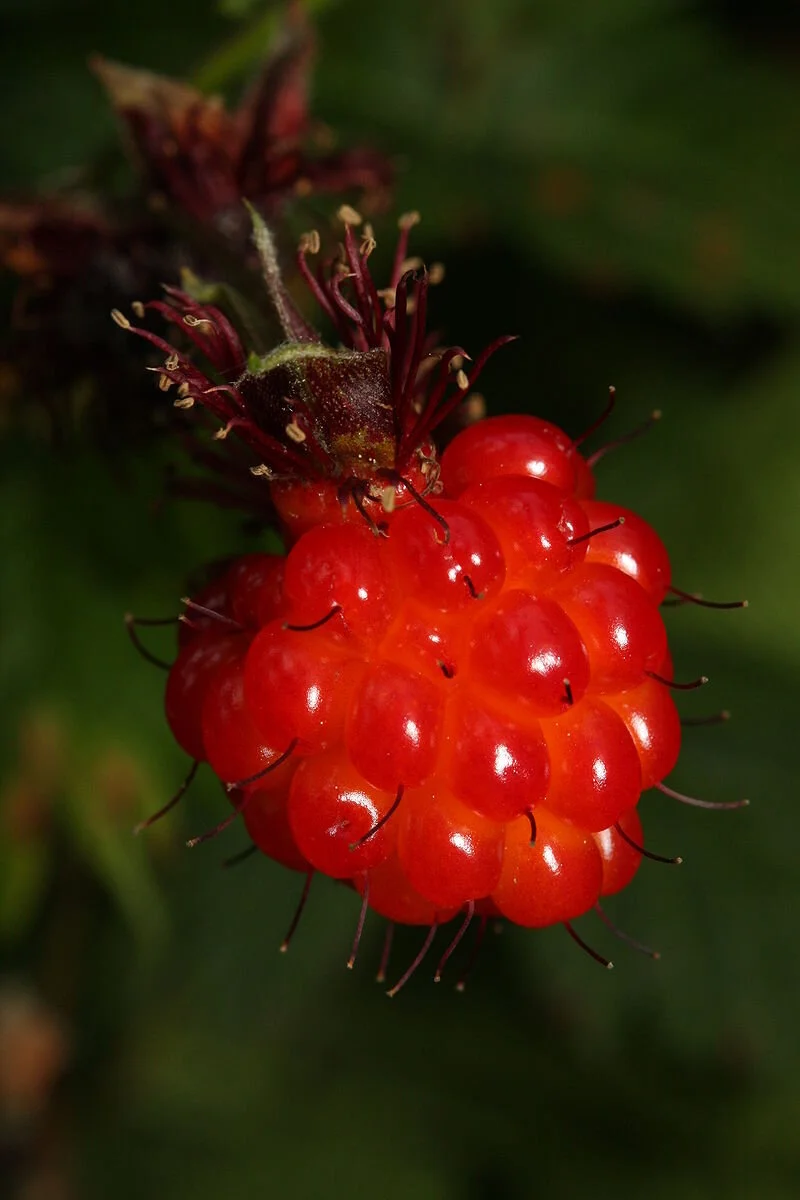
The berries are loved by bears, birds, and children. They vary in color from orange to a deep red reminiscent of salmon eggs, which is where some believe the name came from. The flavors can also vary depending on the bush but are generally sweet with a slightly acidic aftertaste that can make the uninitiated wince. The berries are a drupelet shape, similar to raspberries and blackberries, which is a composite berry made of lots of seeds. They make great jams, jellies, and sauces for the more savory taste buds looking to dress up pork roasts and duck.
Somewhere near the mouth of the Duckabush River, there is rumored to be a hybrid variety to this rose cousin with showy double blossoms.
Look for this tall, bushy berry in shady areas near streams. Berries are often located higher on branches so if you are vertically challenged be sure to bring a stick with a crooked end, something to stand on, or an obligingly tall friend. Gloves and long sleeves are recommended because salmonberry thorns don’t give up their berry bounty without a fight.
2. Thimbleberry

Thimbleberry flowers
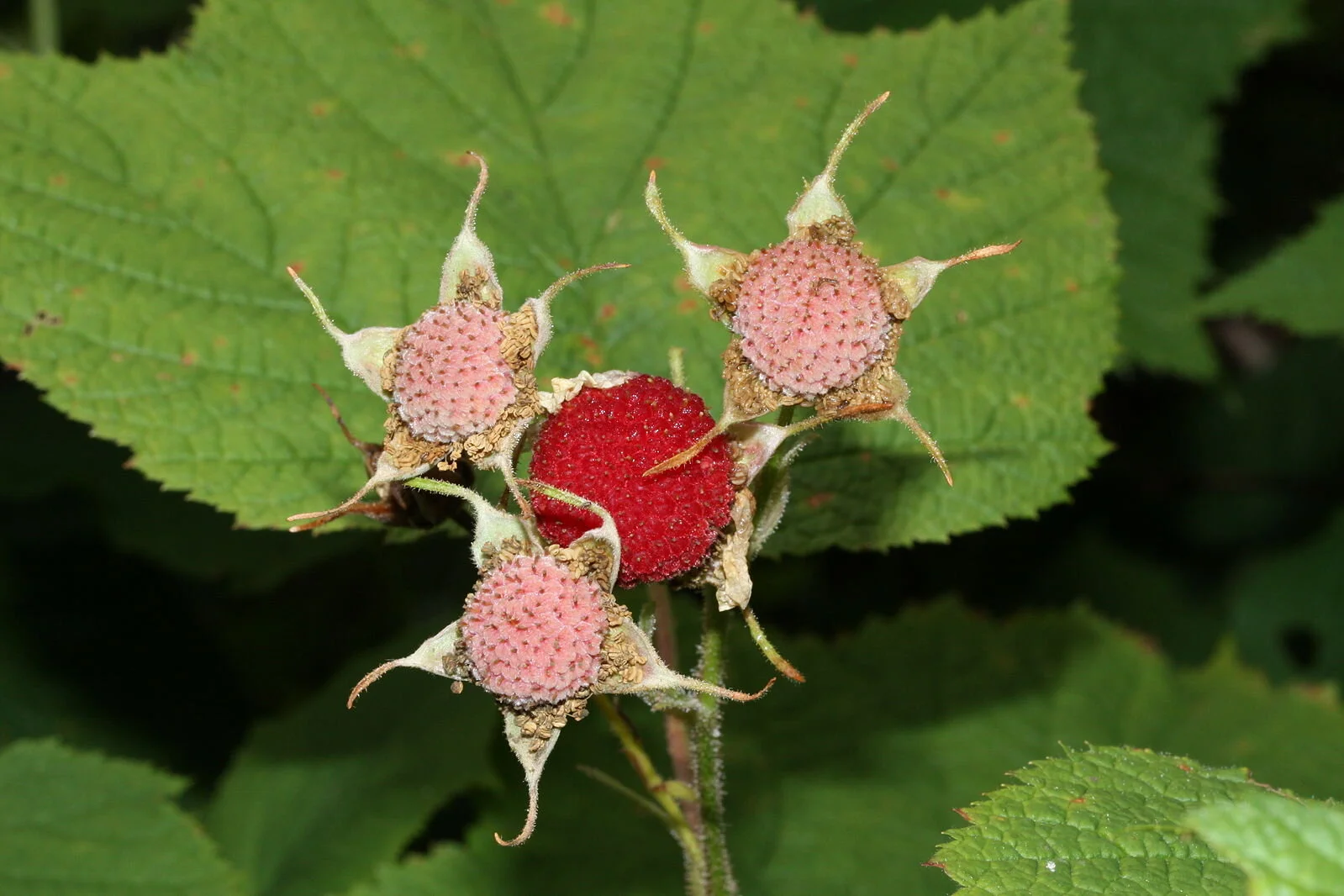
The next ripe berry on the west coast is the sweetly tangy Thimbleberry (Rubus parviflorus) which comes into fruit late June to early July. Thankfully thorn-less, this tall bush also has edible shoots in the early spring, adorned with delicate white flowers. The tender spring shoots are delicious peeled and dipped in sugar. Theses berries are also drupelet in shape, but the fleshy part is much thinner and the berry is hollow inside allowing the whole picked product to easily fit over the fingertip, just as a thimble would. The large soft maple-shaped leaves are covered in a fine hair and are known to be one of the best natural substitutes for toilet paper if you are ever stuck in the woods. Besides harvesting the stems, Native Americans would press and dry the berries into cakes for later use. These delicate berries are a little tricky to harvest since they have a tendency to fall off the branch when bumped, so be ready with your basket, bowl or baseball cap to catch the fruit.
3. Red Huckleberry

Although Red Huckleberries (Vaccinium parvifolium) start forming on the bush in early June, they don’t reach ambrosial ripeness until July, when the berry’s light blush changes to a tasty red. The bush and berry of the huckleberry are very similar to the domesticated blueberry. The Native American Salishan word for Red Huckleberry, t’əәxw (Twana dialect known amongst the Skokomish) or t’íxw(i) (Lushootseed dialect known amongst the Squaxin) both describe how it was traditionally picked with combs ‘to brush, sweep, [or] shake out’ the berries. Slightly sour to taste, these berries do well in jams and pies.
4. Salal

Facing warm sunny locations, along shorelines, roadsides and trails is the prolific Salal (Gaultheria Shallon). Popular amongst florists as a filler since the 1940s, this cut green is a huge industry and is actively gathered by permitted commercial harvesters in the Olympic National Forest. The dark-purpley/black berries ripen in August, once the sticky white bell-shaped flowers have been pollinated. The berries form on the branch in a way similar to grapes. Children find the berries fun to play with as their round shape can be squeezed to form a star. Packed with antioxidants, flavonoids, and up to five times more tannins than blueberries, these sweet, slightly mealy berries are a newly re-discovered superfood. A little goes a long way with these black beauties, as these berries are a natural hunger suppressant. Salal’s health benefits have long been reported by Native Americans up and down the coast who would traditionally press and dry these berries into cakes or fruit leathers. Jams and jellies are the most popular way to process salal berries now and it really does taste like a good medicine when you spread it on your toast. Salal berries aren’t guarded by nasty thorns, but they do release a dark pigment, that can be used as a natural dye, but also can irreparably stain clothes, so dress accordingly before harvesting. Another difficulty with salal is the way in which the berries firmly attach to their branch. I usually pick the whole branch and clean them when I get to a table or flat area.
Jelly and jam makers often combine the sweet flavour of the Salal with the tangy, sour of the Oregon Grape (Mahonia aquifolium) another August (to September) fruit.
5. Oregon Grape

Oregon Grape (Mahonia aquifolium)
You probably won’t be eating these on the trail because they are pretty unpalatable raw… but if you have the opportunity to gather and reduce over a stove, Oregon grape is a great addition to your jelly repertoire. Oregon Grape (Mahonia aquifolium), the state flower of Oregon, grows on a three-five-foot tall bush that has large sharply, serrated green to red leaves reminiscent of holly. The berry matures from a bright yellow flower, changing in color from green, yellow, red, purple before ripening to a pale chalky blue.
Oregon grape is a quintessential bitter plant that has the capacity to cleanse, clarify, and enliven body and spirit. The berries themselves, though perfectly edible are bitterly sour and don’t release their deliciousness until a sweetener is added and the berries are cooked into a syrup or jelly. Oregon Grape syrup makes a lovely addition to ice cream and vodka or gin cocktails.
6. Evergreen Huckleberry
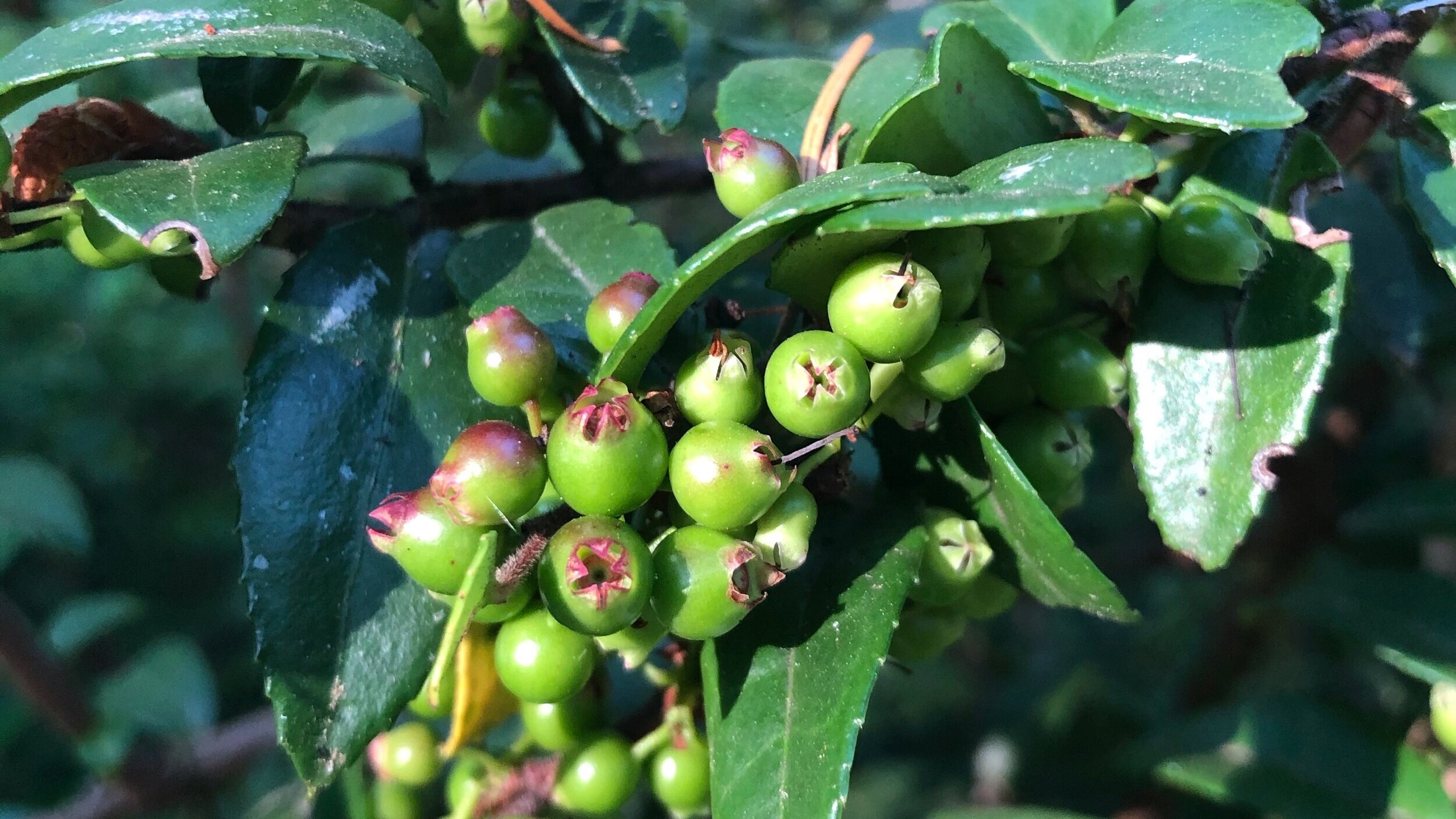
Evergreen Huckleberry ( Vaccinium ovatum)
This thick and bushy shrub can be found in gravelly sandy soils, nestled in coniferous forests.
The Evergreen Huckleberry (Vaccinium ovatum) begins to ripen in early autumn but they can still be seen on the bushes until December. You can spot the tight clusters of small flowers which are white to pink in color. As the small berry ripens it is a black and shiny or occasionally a dusty blue. Once you harvest your evergreen huckleberries expect a sweet and slightly dry taste. The berries are slightly seedy but have a unique refreshing flavor.
7. Oval-leaved Blueberry

Oval-leaved Blueberry (Vaccinium ovalifolium)
These berries can be found in moist coniferous forests and along shaded stream banks. Oval-leaved blueberries (Vaccinium ovalifolium) are around 4 feet tall shrubs with thin leaves which are oval in shape and are rounded at the ends. The pinkish flowers appear before the leaves mature and are solitary. The flavorful blueberries ripen in July and are of good size and very flavorful. Ova-leaved blueberries are dark blue and are covered in a waxy coating causing them to look gray and moldy in appearance.
8. Himalayan Blackberry
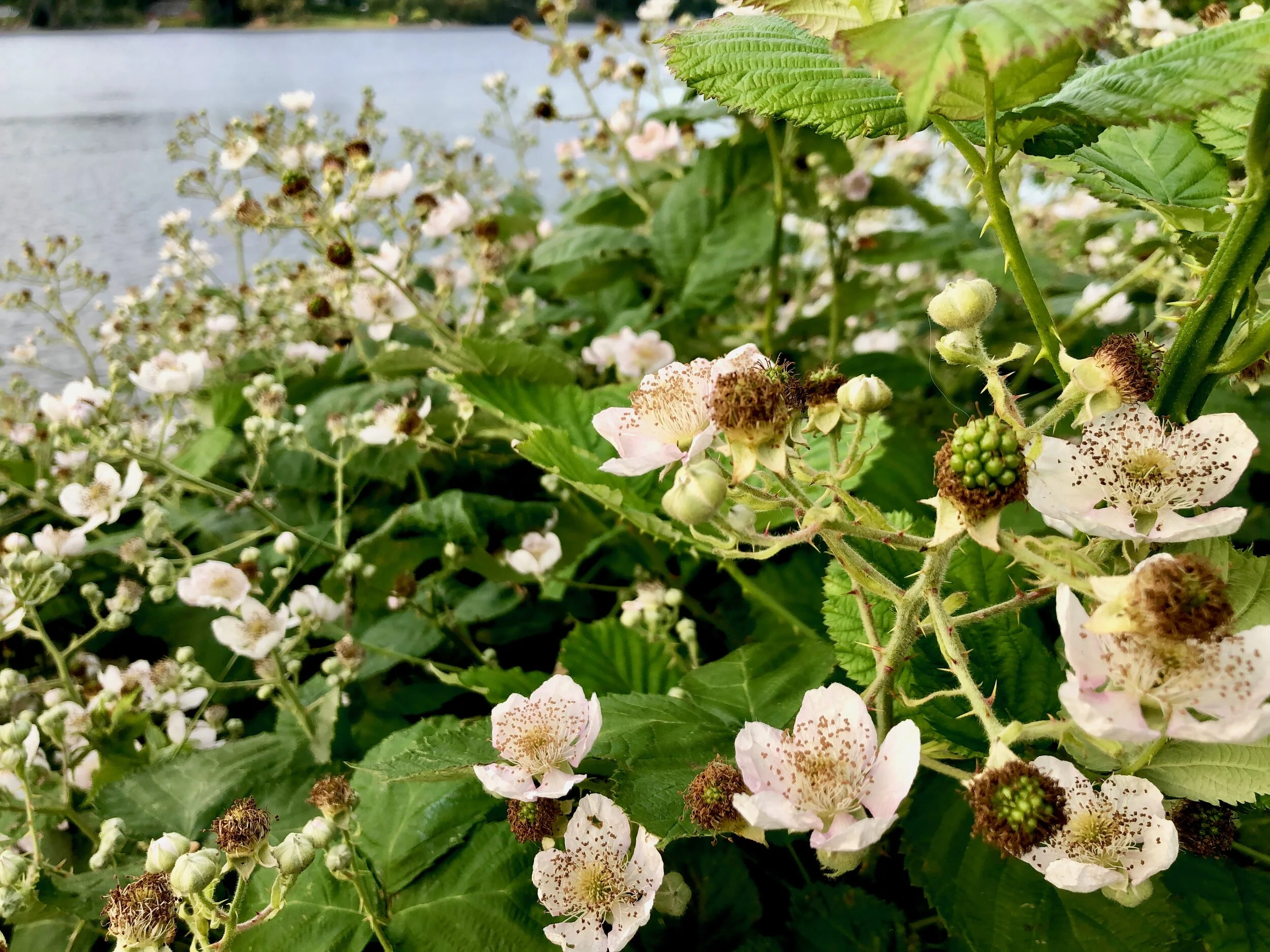
Himalayan Blackberry (Rubus armeniacus)
Himalayan blackberry is a semi-evergreen shrub that can grow nearly 10 feet high. The plump purple/blue berries ripen in late summer. Although Rubus armeniacus is an invasive species and is an aggressive contender against the natural species, it is a great berry to enjoy on the trail.

Himalayan blackberry plants can produce up to 13,000 seeds per square meter, and seeds can remain viable in the soil for several years. The plant creates dense thickets that are impassable and sprawls over surrounding vegetation.
Check out Pojar and Mackinnon’s definitive classic Plants of the Pacific Northwest (2004) to find out more. The internet also has many great sources, such as the Burke Herbarium Image Collection and Dana Kelley Bressette’s Pacific Northwest plant encyclopedia.