
Before You Head to the Beach: Hood Canal's Shellfish Scene, and What to Know Right Now
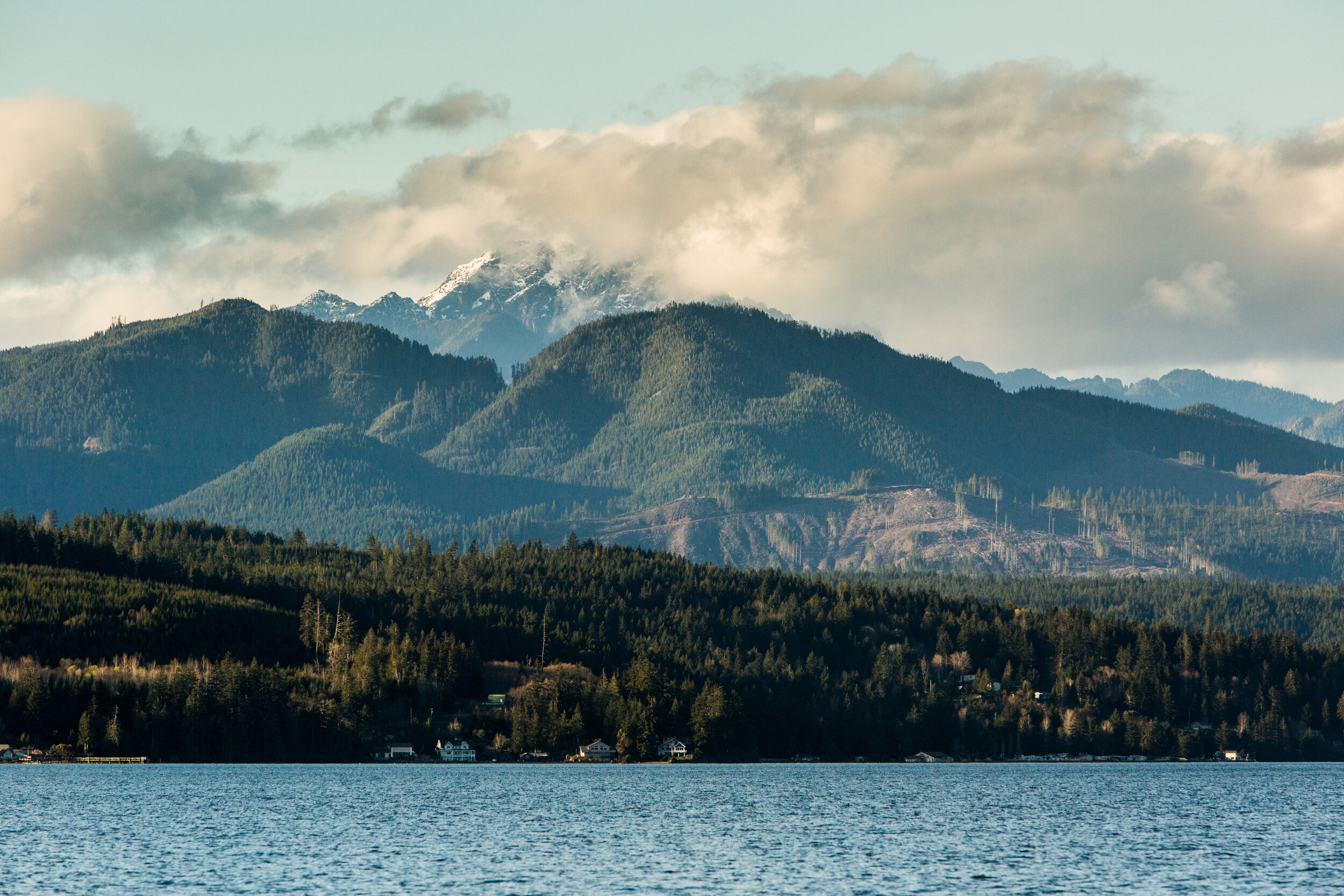
Hood Canal looks like a bay but it technically isn't. It's a fjord, which is a long, deep arm of saltwater carved out by glaciers during the last ice age. The water is cold and rich, the kind of cold that is very good for shellfish, which is why Mason County has become one of the best places in world to dig clams, eat oysters, mussels and geoduck. The farms and tideflats along the canal have supplied restaurants and raw bars for decades, and recreational harvesting has been a local tradition for even longer.
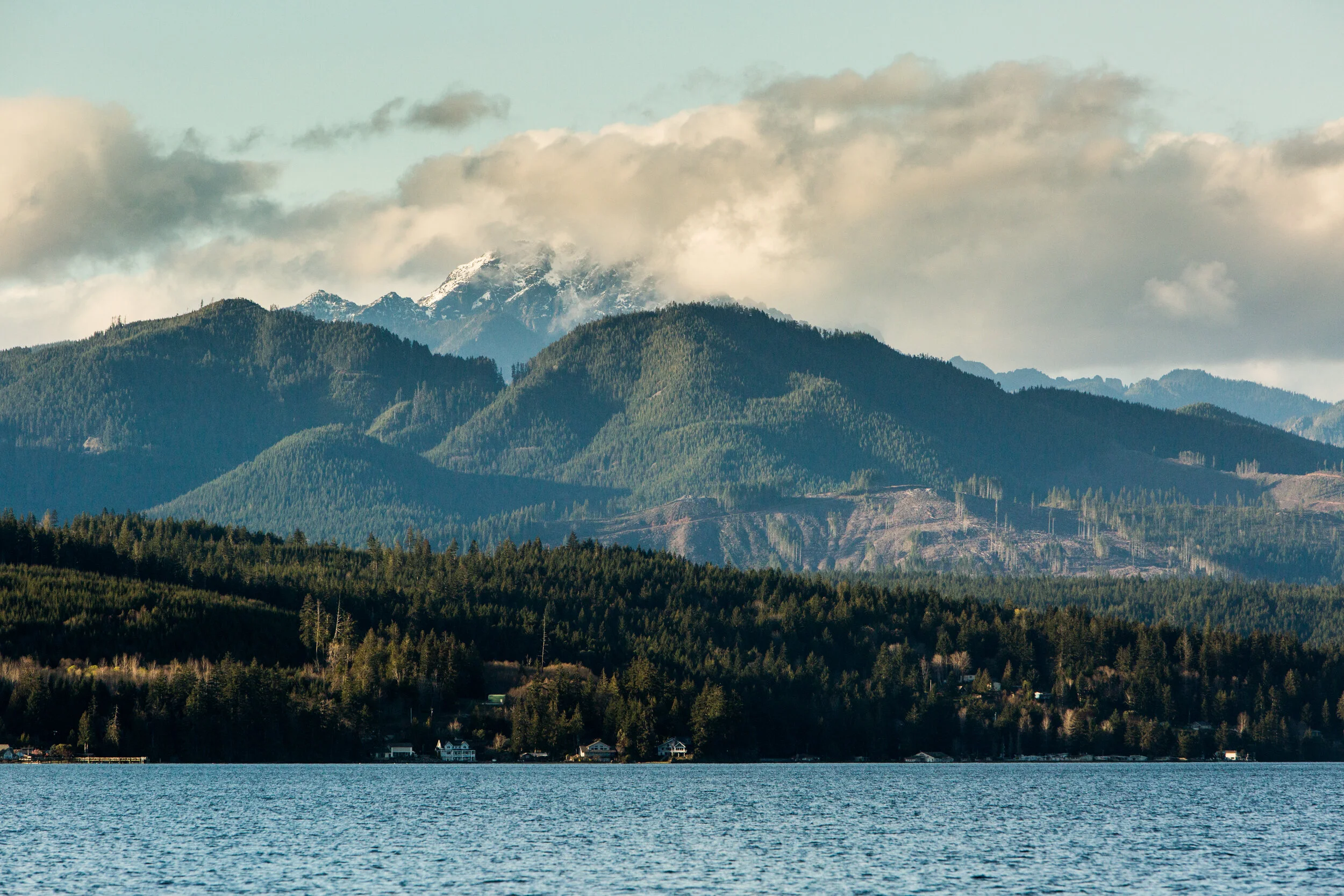
Hood Canal looks like a bay but it technically isn't. It's a fjord, which is a long, deep arm of saltwater carved out by glaciers during the last ice age. The water is cold and rich, the kind of cold that is very good for shellfish, which is why Mason County has become one of the best places in world to dig clams, eat oysters, mussels and geoduck. The farms and tideflats along the canal have supplied restaurants and raw bars for decades, and recreational harvesting has been a local tradition for even longer.
The Washington Shellfish Trail

If you want a guide to it all, shellfishtrail.org is where to start. The Washington Shellfish Trail is a statewide resource that maps out oyster farms, shellfish events, and self-harvest beaches across the state. The site includes links to WDFW licensing information if you're planning to harvest. To harvest shellfish or seaweed in Washington, everyone age 15 and older needs a Washington State Shellfish/Seaweed License. These are easy to get online through the Washington Department of Fish and Wildlife (WDFW) website or at sporting goods stores and many local shops. Be sure to bring your license along on your trip, it is required whenever you gather your own oysters or clams.
Check Before You Go: A New Beach Status Tool
The Shellfish Trail recently added a new feature at on its website. The live "beach status" page pulls daily harvest data from the Washington Department of Health and displays current open, conditional, or closed status for beaches across the state. It also includes a GPS-based tide tool that uses your location to provide upcoming tide predictions for the nearest NOAA station. It's a handy tool for anyone planning a harvesting trip. Conditions can change quickly, and having the current status makes planning easier.
Two Very Different Bodies of Water
Mason County is shellfish country, but not all of its water is the same, and if you're planning a harvesting trip, its important to learn the terrain. Hood Canal runs about 50 miles from its northern entrance near Foulweather Bluff all the way south and around the Great Bend to Lynch Cove near Belfair. It's deep, up to 600 feet in places, with an average depth of around 177 feet. That depth is a characteristic of a fjord. There's a shallow underwater ridge, called a sill, near the northern entrance that limits how freely deeper water can exchange with Puget Sound. The Skokomish River pours freshwater into the south end, creating a layer of lighter freshwater on top of denser saltwater below. Those two layers don't mix easily, so the deep water of Hood Canal can go a long time without being replenished with oxygen-rich water from the surface or from outside. That's a natural condition of a fjord. When algae blooms occur and produce toxins, those conditions can linger.

Hammersley Inlet and Oakland Bay, near Shelton, close to the canal as the crow flies, are almost entirely different bodies of water. Hammersley is a shallow, winding tidal channel -- about eight nautical miles of twisting waterway that connects Oakland Bay to the greater South Puget Sound. When the tide changes, all the water in Oakland Bay has to move through that single narrow passage, and it does so fast. Currents in Hammersley can run up to five knots. That tidal movement means the water flushes on every tide cycle, mixing and exchanging far more actively than the deep, stratified water of Hood Canal. Oakland Bay itself receives freshwater from Goldsborough Creek and several other smaller streams through Shelton, making it more of a true estuary, shallower and warmer with the tides.
That difference in water character is one reason these two areas can have different conditions at any given time. A closure on Hood Canal doesn't automatically mean Hammersley or Oakland Bay are affected, and vice versa. In fact, even when one area is closed, you might find that another nearby beach remains open for harvesting. The beach status tool mentioned above shows each growing area's status independently, so you can easily see which beaches are currently open. Checking by location lets you find alternative spots rather than assuming one closure covers everything.
Right Now: Hood Canal Is Closed for Recreational Harvest
On June 12, the Washington State Department of Health issued a warning after lab testing found lethal levels of Paralytic Shellfish Poison in shellfish samples collected near Union. As a result, all recreational shellfish harvesting in Hood Canal is currently closed, from Foulweather Bluff and Port Ludlow Bay south, including Port Gamble Bay, Quilcene Bay, Dabob Bay, and Mats Mats Bay. The closure covers clams, oysters, mussels, scallops, and other molluscan shellfish. Crab and shrimp are not included.

If someone has eaten shellfish from a closed area or starts having symptoms like tingling, numbness, dizziness, or trouble breathing after eating shellfish, call 911 right away. Paralytic Shellfish Poisoning can become serious very quickly, and it is important to get medical help immediately. Warning signs have been posted at public beaches in Mason, Kitsap, and Jefferson counties. PSP is caused by a naturally occurring marine toxin produced by certain algae. Shellfish accumulate it as they filter-feed, and there's no way to tell by looking, smelling, or tasting whether they are contaminated. Cooking doesn't destroy it either. Symptoms can come on within minutes to a few hours after eating affected shellfish and can be serious. The closure will stay in place until DOH testing confirms toxin levels have dropped to safe concentrations. Beach status is updated daily as new water and shellfish test results become available, so you can rely on recent information for planning your trip. The most current status is always available on the DOH Shellfish Safety Map (fortress.wa.gov/doh/biotoxin/biotoxin.html), or you can check the Shellfish Trail's beach status tool above. For the fastest updates, you can also sign up for email or text notifications on the DOH website to be alerted when conditions change.
Still Worth the Trip
A PSP closure is a sign that Hood Canal is a living, healthy ecosystem, and that the water quality here is monitored closely because people depend on it. The canal's fjord-like geography means it doesn't flush and refresh as shallower bays do, making it especially sensitive to conditions in the water column. That's also part of what makes it so productive when conditions are right. The beaches are still beautiful. The farms are still operating (commercial shellfish goes through a separate, federally supervised monitoring program). Kayaking, crab and shrimp fishing, swimming, and shoreline exploration are all unaffected. Keep an eye on the beach status page on shellfishtrail.org for updates -- and bookmark it for your next trip out to the water.

Fresh Shellfish from the Source
Want to visit the farmers that wake up on the night tides to bring you the perfect oyster, clam or geoduck? Check out these farms on and around Hood Canal!
You’ve heard it before – those dang months with the “r.” Well, technically local oyster farmers don’t agree, bivalves have a much longer season, Some of the best shucks are in May – but there is something to be said for a fall or spring oyster over a “peak of the summer” one. That’s why March and April are the perfect time to follow the shellfish trail and visit local farms that grow the food you love.
In Search of Perfection
Want to meet the farmers that wake up on the night tides to bring you the perfect oyster, clam or geoduck? Check out these farms on and around Hood Canal!
Capital Oysters & Seattle Shellfish
South Puget Sound | capitaloyster.com
5th generation oyster farmer, Tom Bloomfield, tide tumbles Capital oysters that are suspended off the ground. The growing process results in a smooth, super deep shell as each oyster captures the essence of the beautiful ocean waters, free of sand and zero muddy tastes.

Chelsea Farms & Olympia Oyster Bar
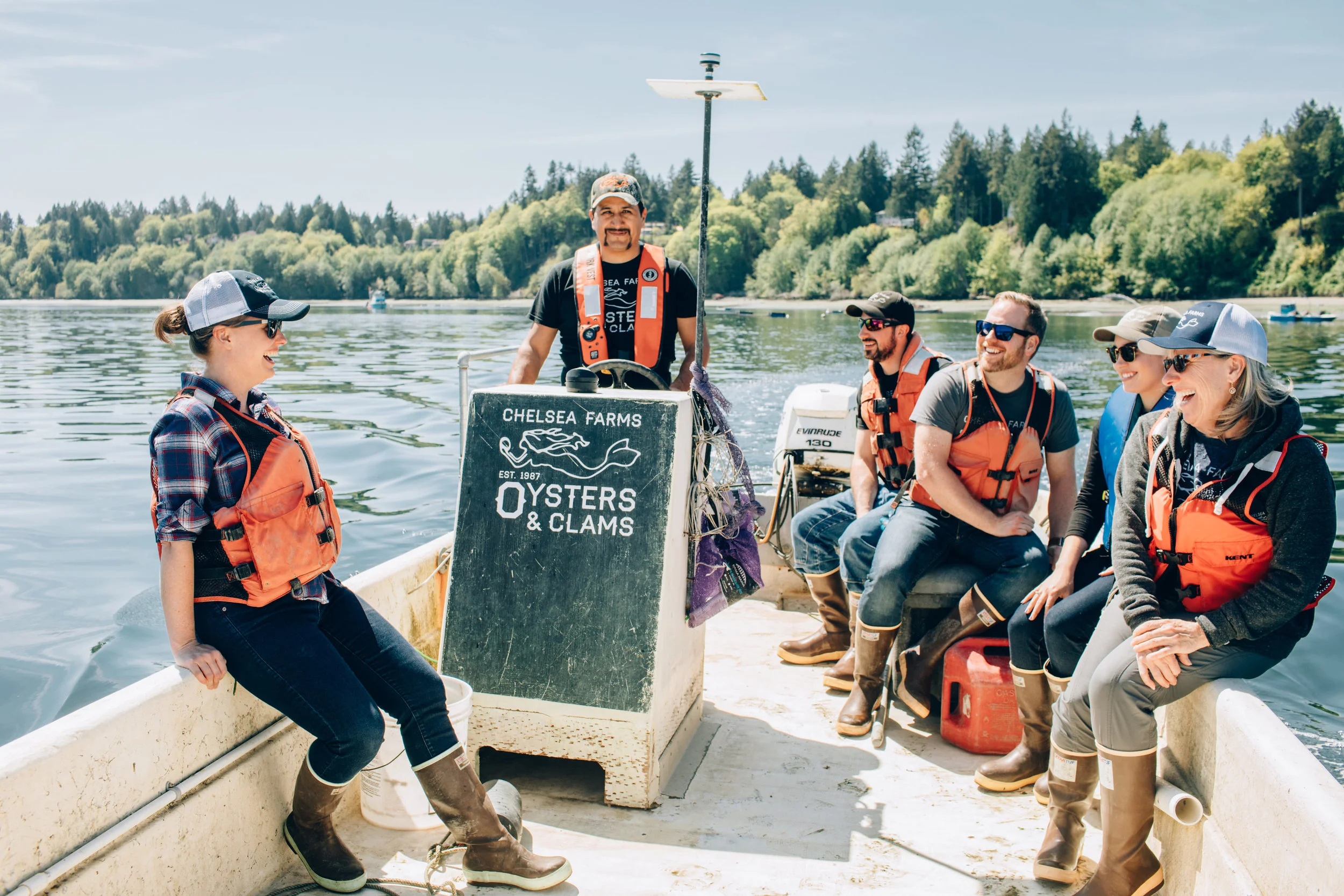
Chelsea Farms | photo:poppi photography
Eld & Totten Inlet
Chelsea Farms is a current working model of environmental sustainability. They have made a priority of farming the Olympia Oyster, a native oyster to Olympia, that was on it’s way to extinction. Specialties include their Chelsea Gem, Bonita, and Olympia Oysters, along with fresh clams and geoduck. Visit their Oyster bar in downtown Olympia to get the ultimate local seafood experience!
Let’s Go:
CHELSEA FARMS OYSTER BAR
222 CAPITOL WAY N, OLYMPIA, WA 98501
Phone: (360) 915-7784
Hours: TUES-FRI 11AM-9PM, SAT 10AM - 10PM | SUN 10AM - 9PM
menu
The Fjord Oyster Bank
Sea Nymph Oysters
Hoodsport & Hammersley | southsoundoysters.com
24341 N Hwy 101 Hoodsport | (360) 877-2102
For the last decade and a half the Hansen family has been raising oysters and clams on South Puget Sound's nutrient rich waterway, Hammersley Inlet. Through a tumble bag and a bag to beach process these oysters have distinct merrior as well as shape profiles resulting from their growth process despite being in the geographic. The tumble bag Hemingways have a sweet cucumber finish while the beach finished Sea Nymphs have a kelpy taste. Hemingway Sweets roll in deeper water and have a deep cup, sweet flavor and a full-body crunch. Hemingways (coined from Ernest Heminway's famous oyster quote) as well as Sea Nymphs, are available for raw and grilled preparation at their Hoodsport café and Oyster Bar, Fjord Oyster Bank.
Let’s Go:
Fjord Oyster Bank Oyster Bar
24341 N Hwy 101, Hoodsport
Phone: (360) 877-2102
Hours: THUR-SAT 10 AM-8PM, SUN10AM - 6PM | Closed MON-WED
menu
Hama Hama Oyster Farm

Lilliwaup, Hood Canal
A few years ago the Hama Hama Oyster Co opened their Oyster Saloon in Liliwaup. This high energy destination serves oysters pulled from the last tide and prepared to order with an ever changing menu of seasonal local ingredients. In their retail shop you can purchase a variety of their Hood Canal product including salmon and oysters smoked on site. Hama Hama is a 5th generation family run farm with a reputation for quality and environmental mindfulness.
Let’s Go:
HAMA HAMA OYSTER CO
35846 US-101, Lilliwaup, WA 98555
PHONE: (360) 877-5811
Spring Hours: Farm Store Daily 9:30 to 5:30
Oyster Saloon Check website for details
Shellfish is available in their retail store, Saloon and at parent restaurants throughout the Northwest. Product also available online and shipped directly to your home.
Olympic Oyster Co. & Mike’s Beach Resort

Eldon, Hood Canal
Third-generation farmers, Matthew and Sara are serious about producing some award winning oysters on site for market and available at restaurants as far away as New York. Guests staying on the active farm aka Mike’s Beach Resort have first dibs on some of the freshest oysters on the fjord!
Let’s Go:
Mike’s Beach Resort
38470 N US Highway 101, Lilliwaup, WA 98555
Phone (360) 877-5324
Waterfront cabins and rooms, with view of the canal.
Taylor Shellfish
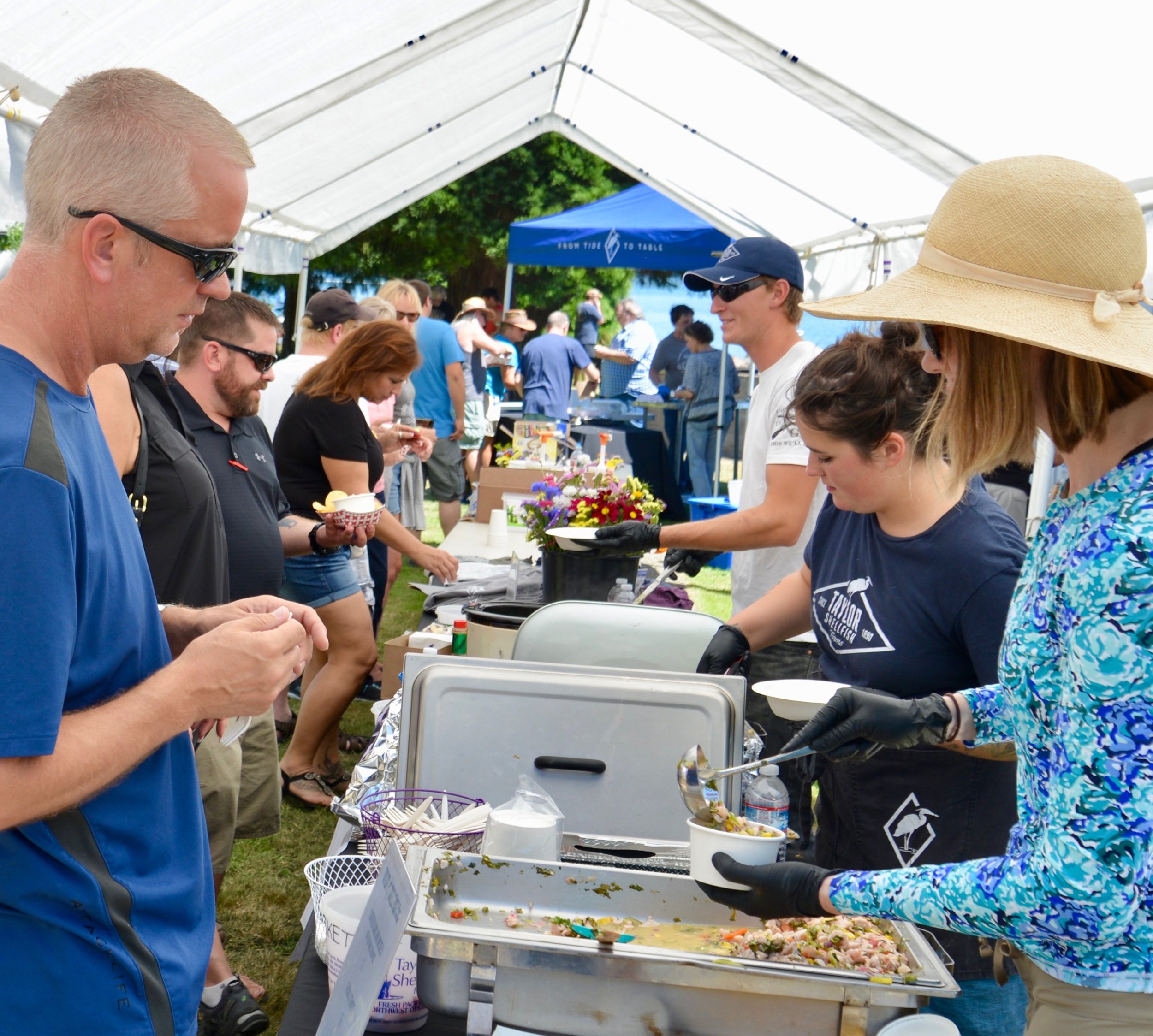
South Puget Sound and British Columbia
Stop in at Taylor Shellfish’s headquarters and visit their market near Shelton. Taylor’s specialties include the famed Kumamoto (sweet fruity flavor) and the Virginica (Crisp, briny, and buttery). The company has been farming oysters on Puget Sound since the 1890’s when great-grandfather Justin Taylor began farming Olympias. Five generations later, the company’s product line includes worldwide export of geoduck, clams, and mussels along with oysters.
Let’s Go:
TAYLOR SHELLFISH RETAIL STORE
130 SE Lynch RD Shelton WA, 98584
PHONE: (360) 432-3300
Hours: Open for Monday - Sunday: 10am - 6:00pm; Closed all major holidays
Shellfish is also available at one of their many locations throughout NW Washington. Product also available online and shipped directly to your home.

Loblolly Lavender Farm: A Peaceful Bloom in Shelton, Washington
Experience the sights, scents, and serenity of Loblolly Lavender Farm—a hidden gem in Shelton, Washington. With over 2,000 vibrant lavender plants, handmade products, and a charming on-site shop, this locally grown family farm is the perfect escape.
Experience the sights, scents, and serenity of Loblolly Lavender Farm—a hidden gem in Shelton, Washington. With over 2,000 vibrant lavender plants, handmade products, and a charming on-site shop, this locally grown family farm is the perfect escape.
In this video, Keith and Tracy Cook share the story behind Loblolly—from planting the first rows to welcoming over 1,000 guests at their first festival. Learn about the different lavender varieties, their calming and healing benefits, and how you can pick your own bouquet, sip lavender tea, and browse small-batch skincare and syrups all summer long.

The Elusive Geoduck : Reviled and Reveled
This large saltwater clam derives its common name, geoduck, from a Nisqually word which is said to loosely translate as “dig deep.” Don’t let their awkward looks deter you. Prepared right, this misunderstood bivalve is versatile and utterly delicious.
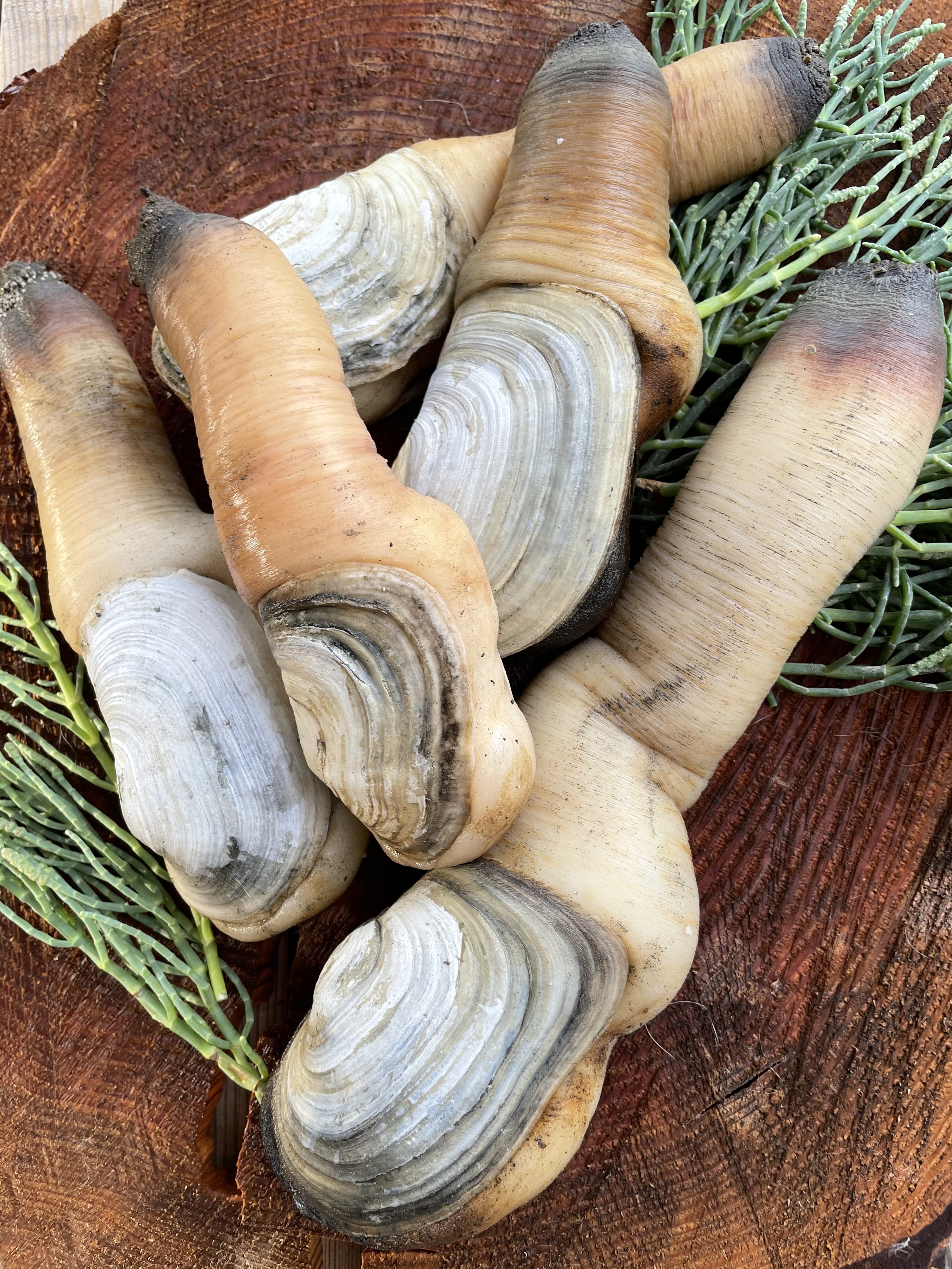
This large saltwater clam derives its common name, geoduck, from a Nisqually word which is said to loosely translate as “dig deep.” Don’t let their awkward looks deter you. Prepared right, this misunderstood bivalve is versatile and utterly delicious.

The geoduck is native to intertidal and sub-tidal waters from Alaska to California. With a shell that ranges from just 6 – 8 inches, the long siphon, or neck, makes it the largest burrowing clam in the world. In fact, a geoduck’s neck can be as long as three and a half feet in length. So large that even from when it is small as an inch, it cannot be withdrawn into the shell.
Geoduck attain maximum size at age fifteen, but are one of the longest living animals in the world. The typical lifespan of a wild geoduck can range to 140 years. The oldest being recorded at 168 years. Buried three feet deep in mud or sand, once they make it through their fragile adolescence, these giant clams do a fantastic job of keeping safe with their thick unpalatable skin.

Farmed geoduck
It takes about six years to raise a farmed geoduck to market. Beginning life in a hatchery tank, the small seed (about one inch long), are “planted” in the soft sand in the intertidal and protected with PVC tubes. The covered tube keeps them safe from predators until they are large enough to dig deeper.
Natural beds of geoducks grow on many of Washington’s public beaches with Puget Sound and Hood Canal containing the most abundant populations available for public digging. The best places to see experienced diggers capturing these big clams are at the Duckabush and Dosewallips State Park on Hood Canal. If you can’t harvest your own, head over to one of the restaurants and markets listed below or order fresh online.

Preparing Geoduck
Preparing a geoduck can seem overwhelming but it is surprisingly simple:
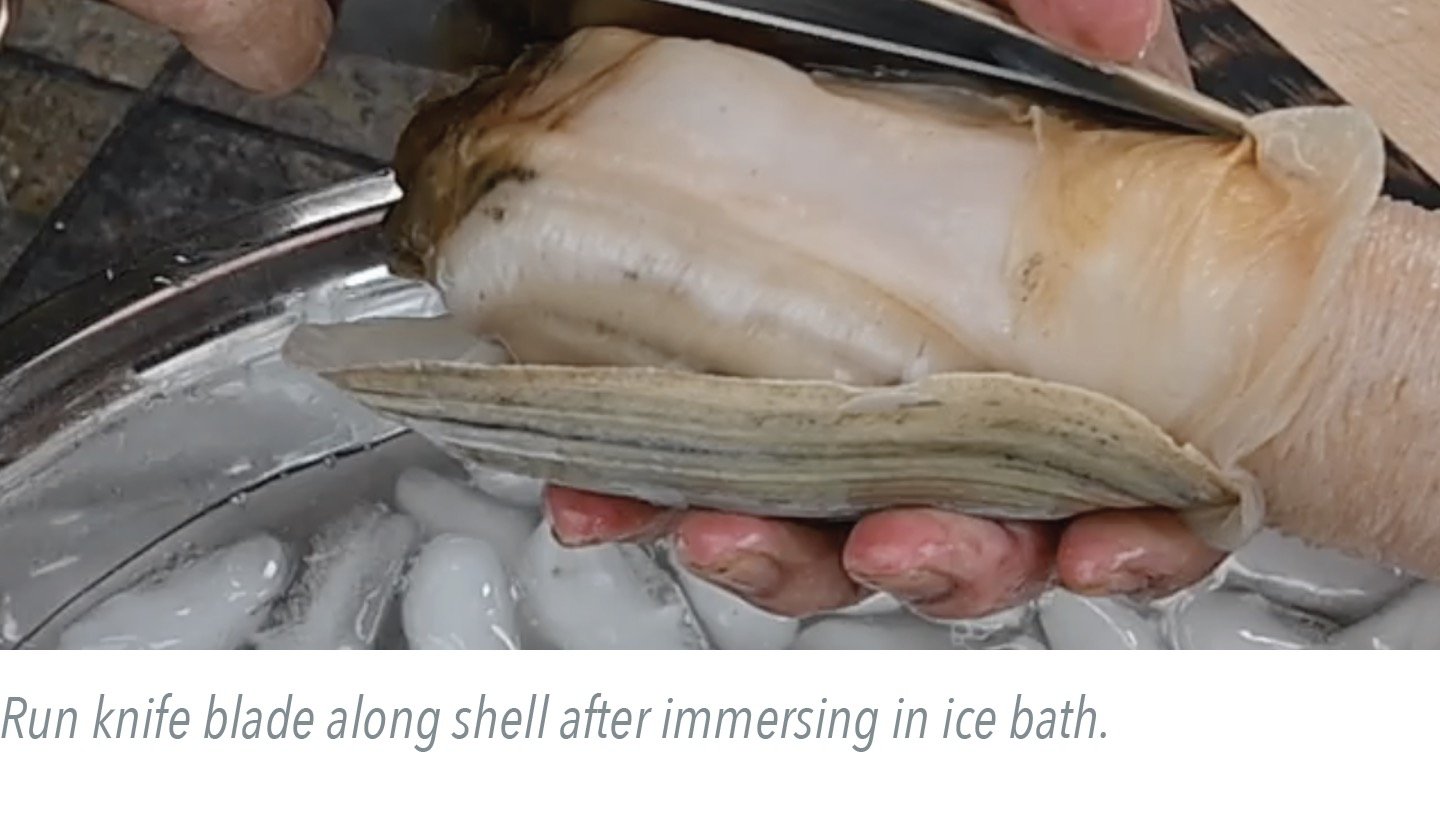
Boil a pot of water and prepare a bowl of ice water large enough to fit your geoduck. Using tongs, immerse the whole clam in the hot water for about six seconds.
Immerse it in the ice bath for about the same amount of time. Holding the shell with one hand, run the blade of your knife along the inside of the shell and extract the body from the shell.
Grasp the tough outer tube that surrounds the siphon meat and pull. The hot water and ice bath will have effectively separated the thick skin from the tender neck meat.
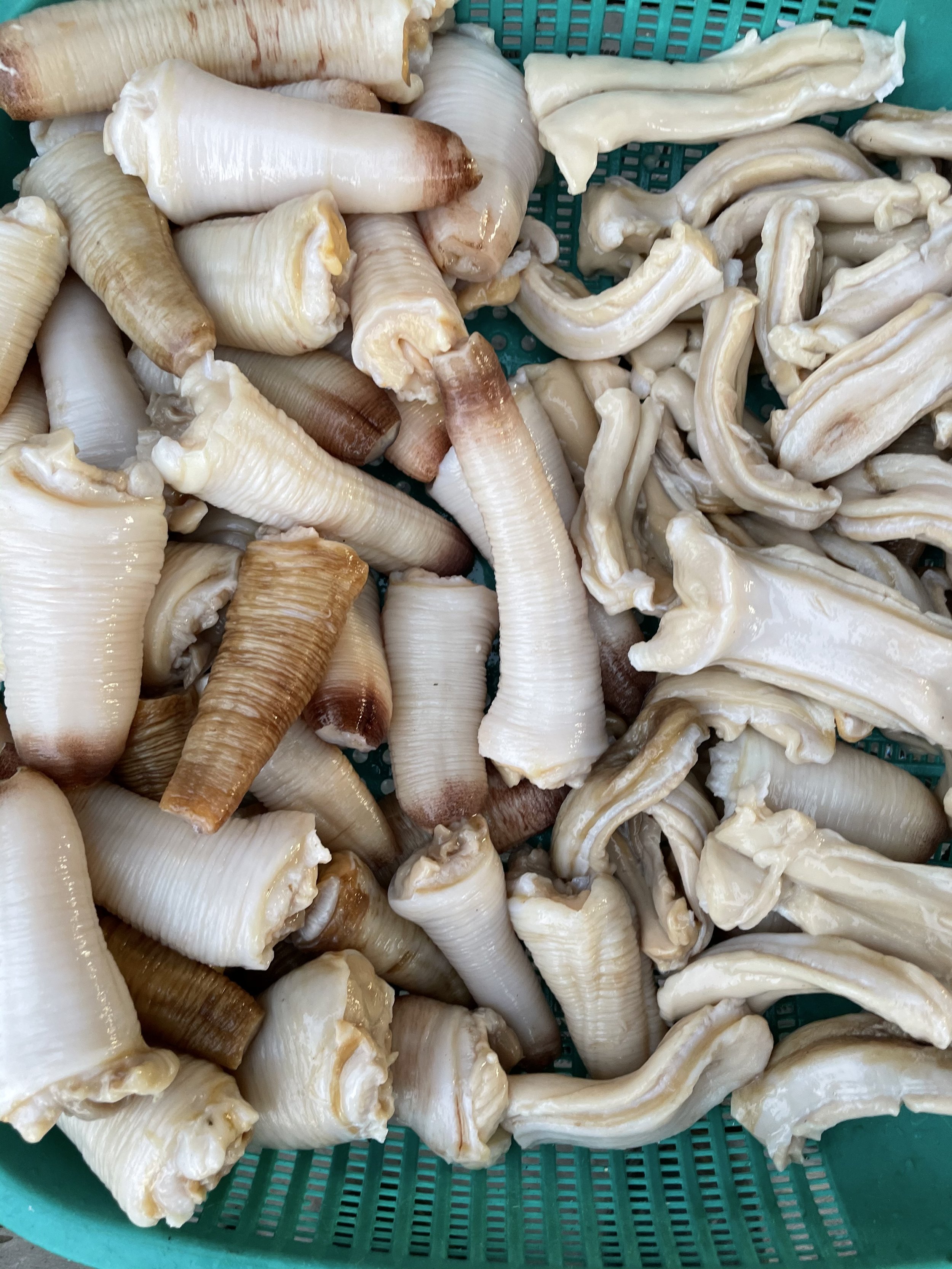
Discard the bulbous stomach and your efforts will be rewarded with tender meat from the body and the tougher but just as tasty meat from the siphon. The siphon meat is often ground to make chowder or patties.
Prepared Geoduck: tide to table
Just like being elusive to catch, geoduck can be difficult to find at restaurants. Fortunately in Washington some of the biggest producers of geoduck also have their own restaurants that they can supply this year round delicacy.
Here are a few South Puget Sound farmers that really know their Ducks:
Chelsea Farms and Oyster Bar
222 Capitol Way N
Olympia, WA 98501
Phone: (360) 915-7784
Chelsea Farms first made their mark on Olympia’s map in 1987 when Linda and John Lentz started their adventures in sustainable shellfish farming. Their legacy continues with the next generation, Shina and Kyle.
Taylor Shellfish Retail Store and Oyster Bars throughout WA
130 SE Lynch RD Shelton WA, 98584
PHONE: (360) 432-3300
Hours: Open for curbside pick up Monday - Sunday: 10am - 6:00pm; Closed all major holidays
Taylor Shellfish Farms harvests their own farmed geoduck from the Puget Sound. At their oyster bars across the state, diners can sample fresh geoduck sashimi with sesame ginger lime dressing. The giant clam is also used in Taylor Sheellfish Farms’ Northwest Chowder. Product also available online and shipped directly to your home.
Fjord Oyster Bank Restaurant
24341 N Hwy 101, Hoodsport
Phone: (360) 877-2102
Hours: THUR-FRI 5PM-8PM, SAT & SUN 1PM - 7PM | Closed MON-WED
The Fjord celebrates the recipes of Xinh Dwelley who was known for her acumen with geoduck. Available at the restaurant are sashimi, geoduck wontons, fritters, geoduck chowder, and ceviche. The Fjord sources their geoduck from commercial farmer on Harstine Island.


Hundreds of varieties yet only five species | Oysters explained
There are over 150 varieties of oysters harvested and sold in North America, yet they comprise a total of only 5 species of oysters.
How does your Oyster Grow?
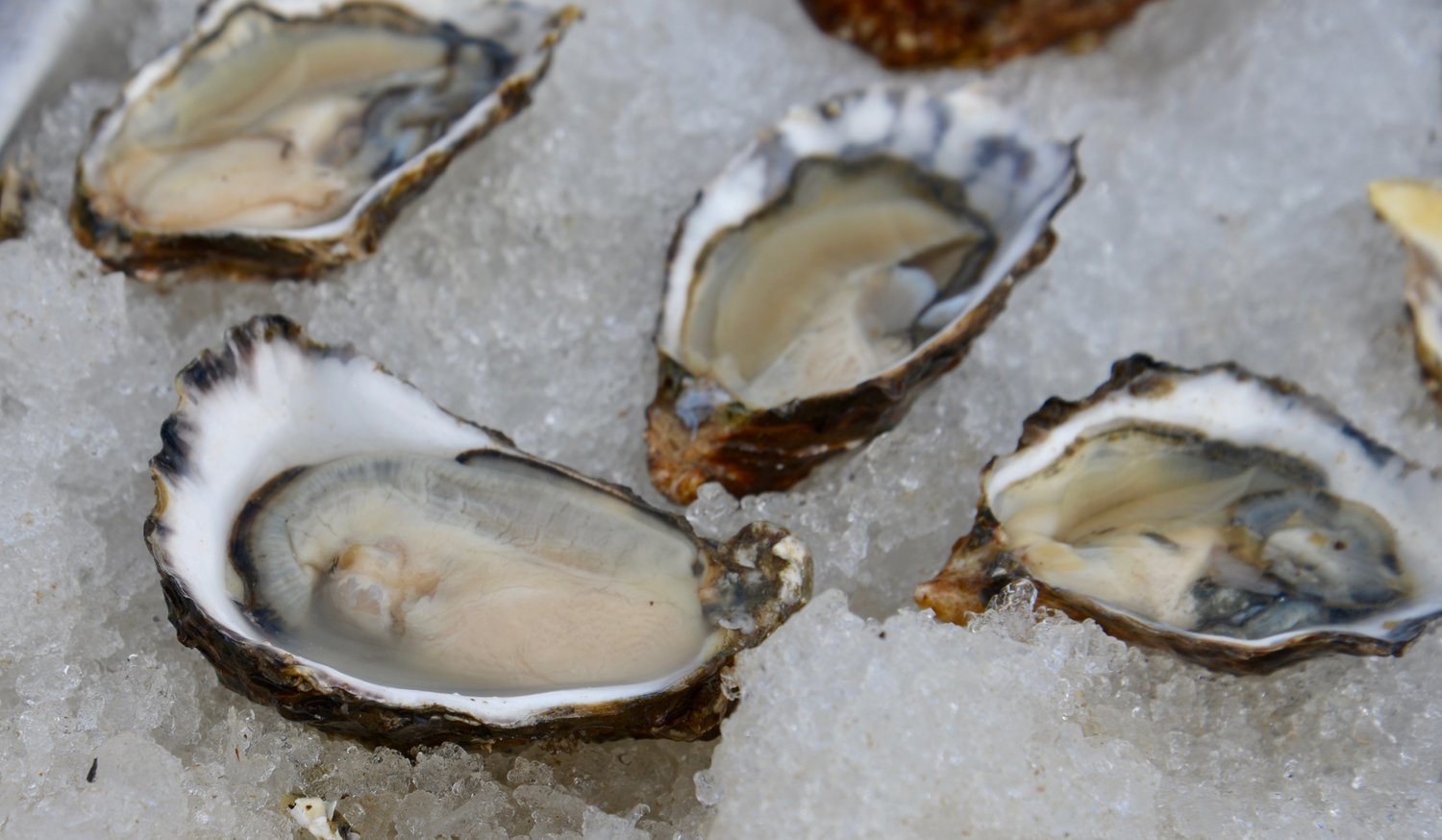
Have you ever wondered how the same species of oyster can have such varied flavors or textures? How does an oyster grown on Hood Canal taste brinier than one from South Puget Sound? The word to remember for your next oyster social occasion is “merrior.”
Like different wines with a “terrior,” oysters have a merrior, illustrating the fact that growing area and method make all the difference when it comes to flavor profile for your next Pacific oyster.
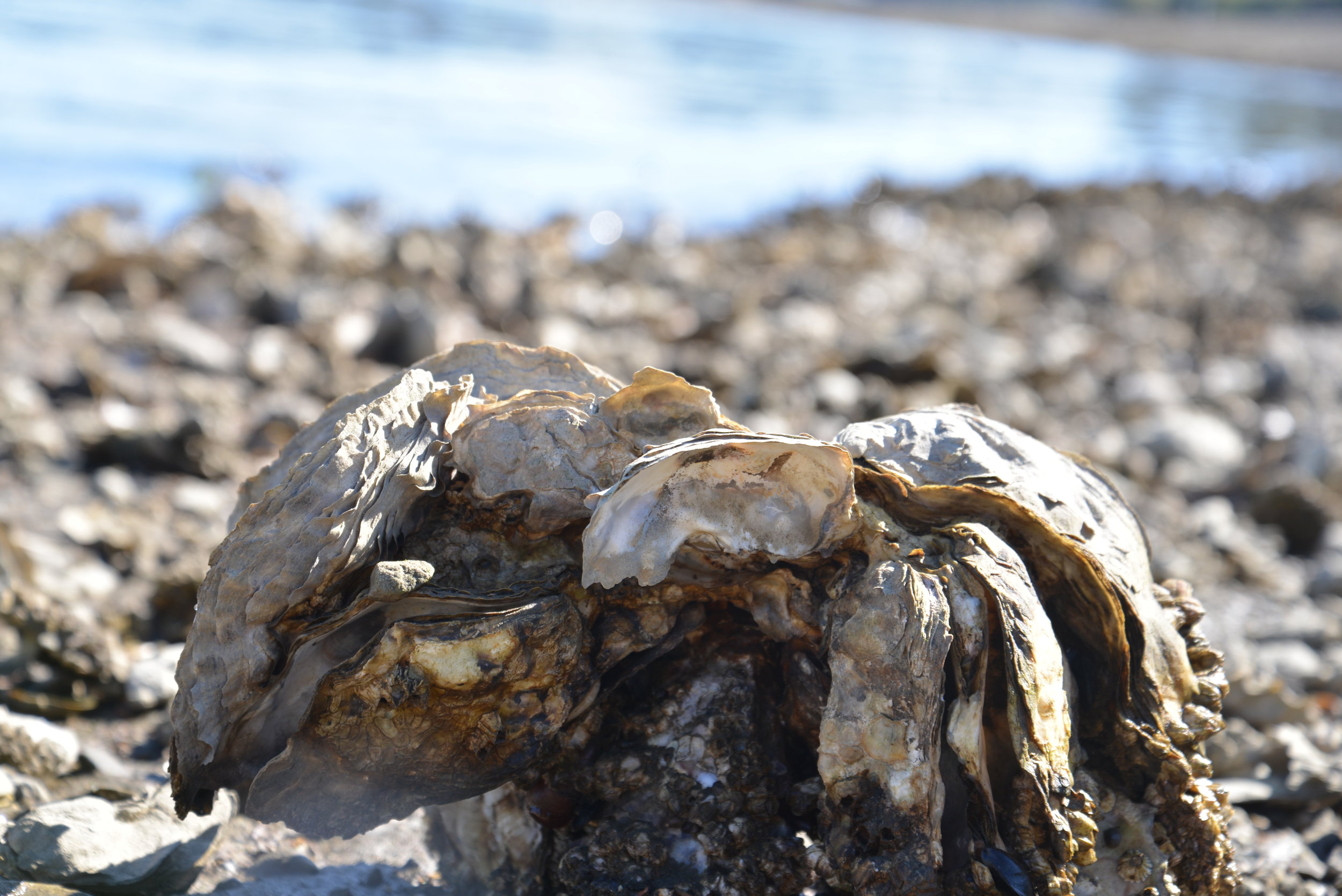
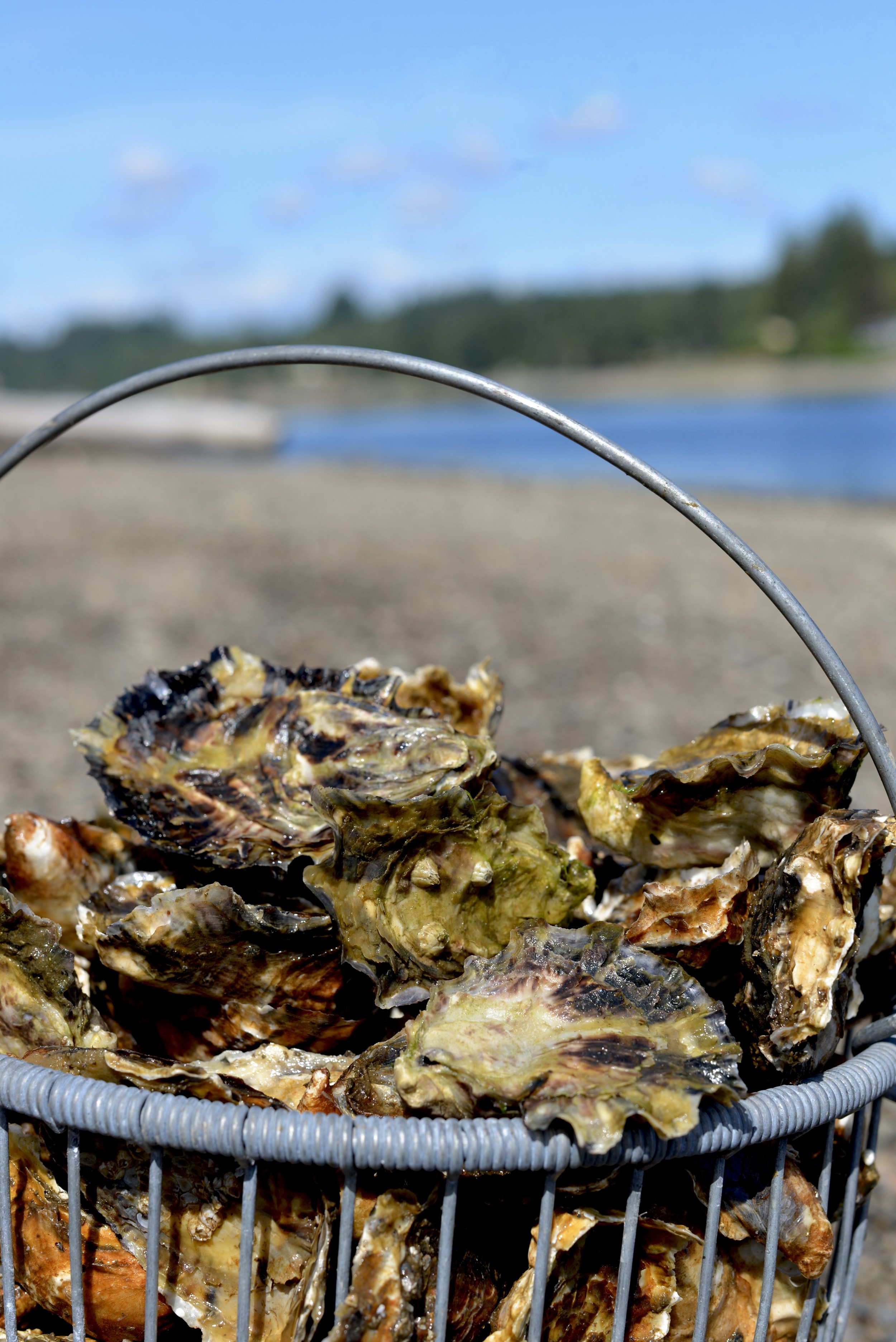
Not all beaches are created equal; some are muddy, some sandy, and some rocky. Each type of growing ground has opportunities and limitations for success. Muddy ground can inhibit the oysters’ ability to circulate water and food into their bodies. This had led to the adoption of culture techniques that suspend the oysters above the mud in long lines, stakes, nets or racks, and bags, while firm, sandy, or rocky bays allow for oysters to be grown right on the beach.
In addition to substrate type, location of the oysters on the beach will determine how long the oyster will take to achieve a marketable size. Oysters grown in the intertidal area are exposed to daily tidal inundation will have well developed adductor muscles and thicker shells thus being heartier for shipment. Oysters suspended in the water column for growing will have the benefit of a constant food source and thus grow quickly but will have delicate shells and be susceptible to the elements. Often times, suspended oysters are placed in the high energy intertidal environment for a few weeks prior to market to harden the shells for shipment and condition the oysters to hold their shells shut.
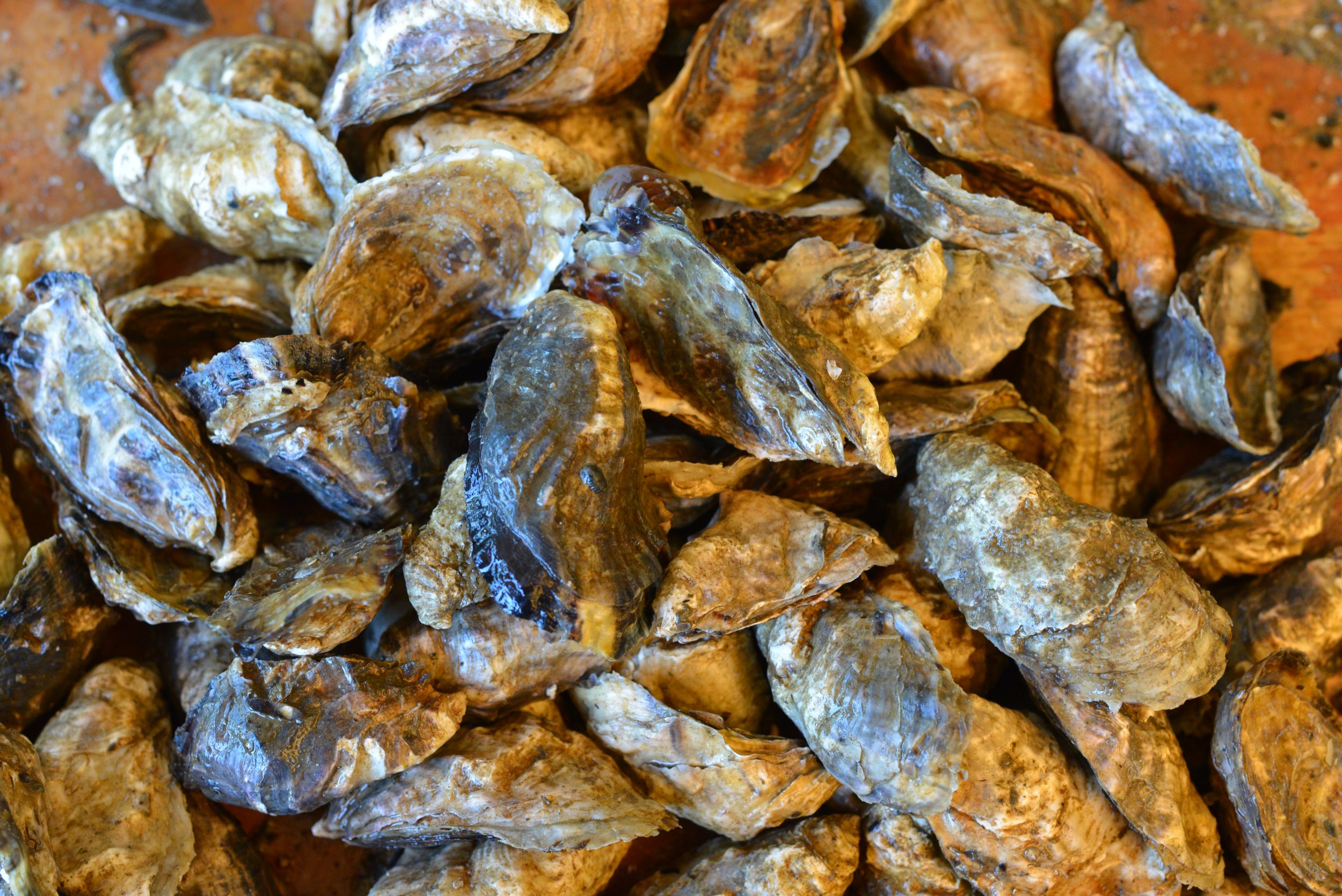
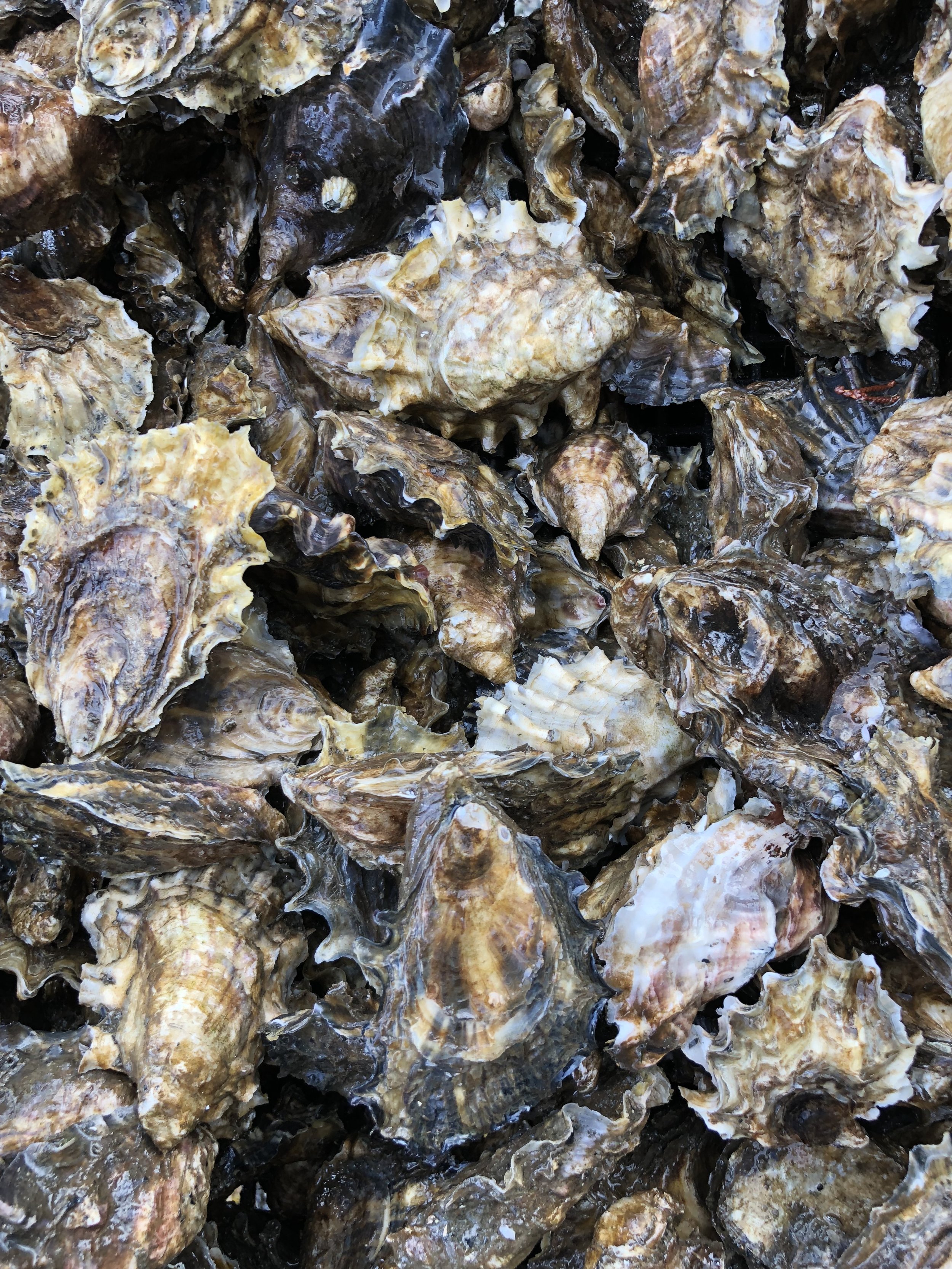
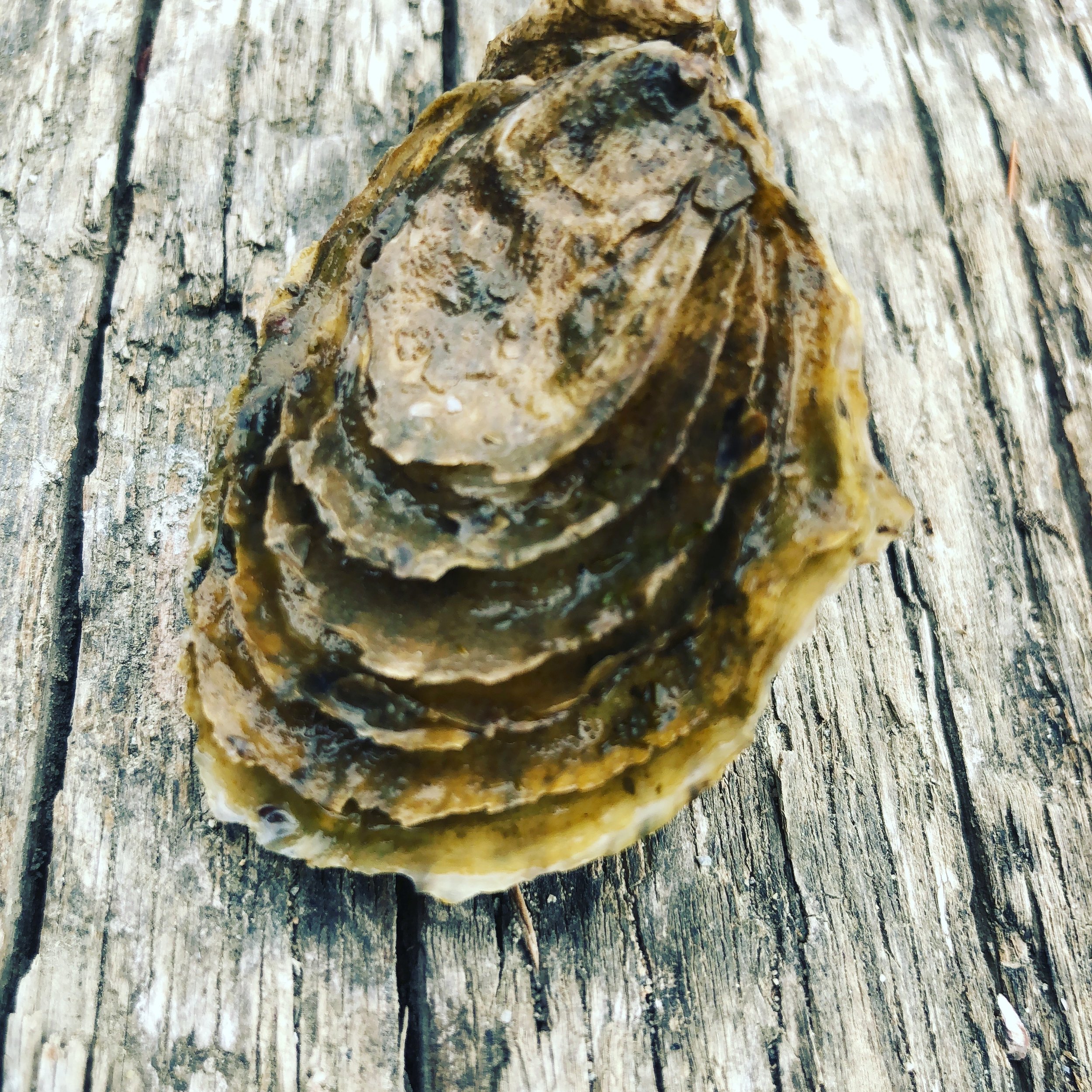
The method of growth can greatly change the shape of the oyster. A Pacific allowed to grow naturally on the beach will have a sturdy irregular shell with a great deal of frills. The regular exposure at low tide strengthens the shell protects the meat from heat and predators like sea stars and crabs. In Europe, where there is very limited tidal change, some farmers manually pull the oysters from the water for periods of time to mimic the tidal action.
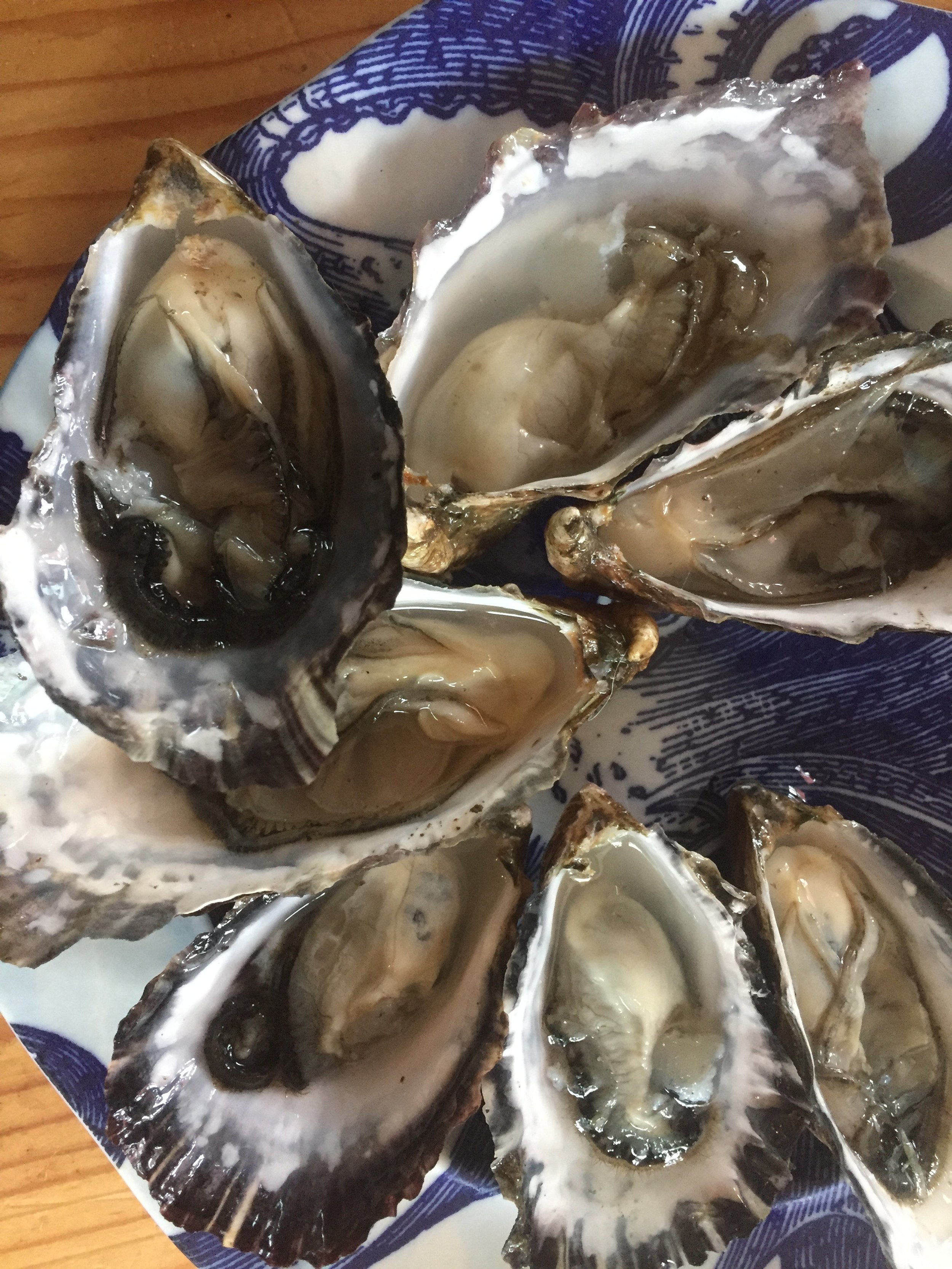
The tumble bag creates an altered but very marketable shape for cultured oysters. Oysters are placed in the bag as small seed and the tide does the rest. The tidal flip and roll chip off the fragile lips and force the oyster to curve. The result is a deep cup in its lower shell.
“Eat shellfish to provide a healthy diet. Shellfish are low in saturated fats, containing the essential omega-3 fatty acids; are excellent protein sources; and are good sources of iron, zinc, copper and vitamin B-12.”
wsg.washington.edu
Each bay has its own selection of phytoplankton yielding oysters with different meat colors and flavors. Pacific oysters grown in Willapa Bay have a different merrior from those grown in Samish Bay. Hood Canal oysters are claimed to be more briny than the sweeter cucumber flavored bivalves grown in Hammersley Inlet or South Puget Sound waterways. Just like the well attuned vintners of the Rhone Valley, oyster connoisseurs are able to detect the subtleties of each bay by tasting the meat and observing the shell.

Know your oysters
There are over 150 varieties of oysters harvested and sold in North America, yet they comprise a total of only 5 species of oysters.
1. Olympia
OSTREA LURIDA /OSTREA CONCHAPHILA
The native oyster to Washington State, the Olympia oyster is a half dollar size with a metallic finish. The Olympia oyster fishery ran from the mid-1800s until about 1915 supplying California’s demand for oysters. The oysters were harvested from shallow bays of southern Puget Sound and Willapa Bay until pollution and over harvesting caused a collapse of the wild fishery.
2. Pacific
CRASSOSTREA GIGAS
Native to Japan, farmers began experimenting with the Pacific in 1904. Washington began importing commercial seed in the 1930’s and now it is now the most important commercial species on the West Coast. Beginning in the 1950’s researchers began to study Pacific reproduction to reduce the dependence on seed imports. Since the 1970’s local shellfish growers have relied on hatcheries for the production to meet the demand for Northwest oysters.
3. Virginica
CRASSOSTREA VIRGINICA
The decline of the Olympia oyster opened the door for the import of the Virginica from the east coast in the early 1900’s. The eastern oysters did not adapt well to local waters and experienced large die off when transplanted. There are still beds of Virginicas raised by WA shellfish farmers.
4. European Flats
OSTREA EDULIS
European Flats have smooth, round, saucer-like, flat shells with a shallow cup and seaweed-green color. They have a bold flavor with a meaty, almost crunchy texture, and intense mineral bite with a long-lasting seaweed flavor and gamey finish. There are not many farmers cultivating Flats.
5. Kumamoto
CRASSOSTREA SIKAMEA
The Kumamoto has a small deep cup and a sweet meat. Brought from Japan’s Kumamoto Prefecture, they are unable to reproduce in our cold waters so growers rely on hatchery stock. The prized cup of the Kumamoto and its limited supply has growers working with Pacifics to meet half shell demands. Growers use tumble bags to force the Pacific into a deeper cup. Oysters with names such as Kusshi, Shigoku, Sea Cow, Blue Pools, Chelsea Gems, and Baywater Sweets, are the result.

Why is it required to shuck oysters on the beach at public tidelands?
Oysters taken on public tidelands must be shucked on the beach and the shells left behind for the following conservation-based reasons according to the Washington Dept of Fish & Wildlife website, wdfw.wa.gov:
Oyster shells provide the best growing substrate for juvenile oysters. Removing the shells from a beach reduces the overall amount of setting surface. In addition, Pacific oyster shell provides an excellent setting surface for the native Olympia oyster. This is especially true in places like southern Puget Sound where the natural setting surface - Olympia oyster shells - was eliminated years ago by overharvest.
Another concern is that removing large Pacific oyster shells removes tiny oysters which are attached to the larger shells. Thus, removing a legal limit of 18 oysters may actually remove three to five times that number of oysters - young oysters which would otherwise remain on the beach and grow to edible size.
Removing oyster shells from beaches containing Japanese oyster drills (an oyster predator) may result in the inadvertent spread of these predators. Sport harvesters are unlikely to recognize these tiny predatory snails - or their egg cases - which attach to oyster shells and can survive long periods away from water. Once shucked, these shells often end up being returned to a nearby beach by well-meaning harvesters, potentially increasing the spread of the Japanese oyster drill in Washington by depositing the “hitchhikers” on a new beach.
Many public beaches already have these tiny predators, but the goal is to minimize the spread to other uninfected beaches. The surest way to prevent oyster drills or their eggs leaving an infected beach is to require oyster shells to remain on the beach.
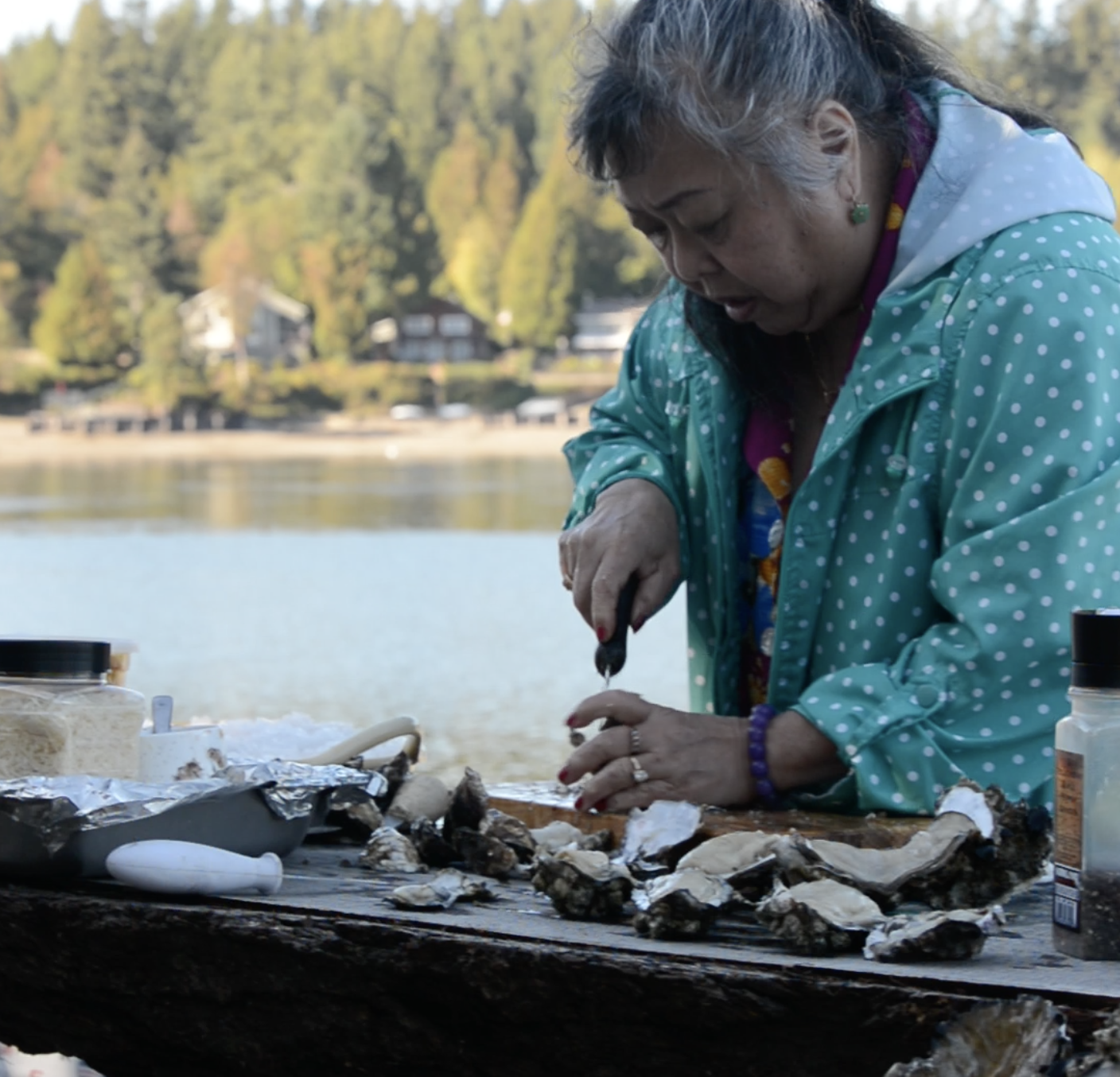
So head to the beach and get shucking! You will need a shellfish license, an oyster knife and gloves. Adults may shuck a child's daily limit so long as the child participates in some way in the gathering. For illustrated details on two popular shucking methods, visit wdfw.wa.gov/fishing/shellfish.
Must Stop On Hwy 101 - Hama Hama Oysters
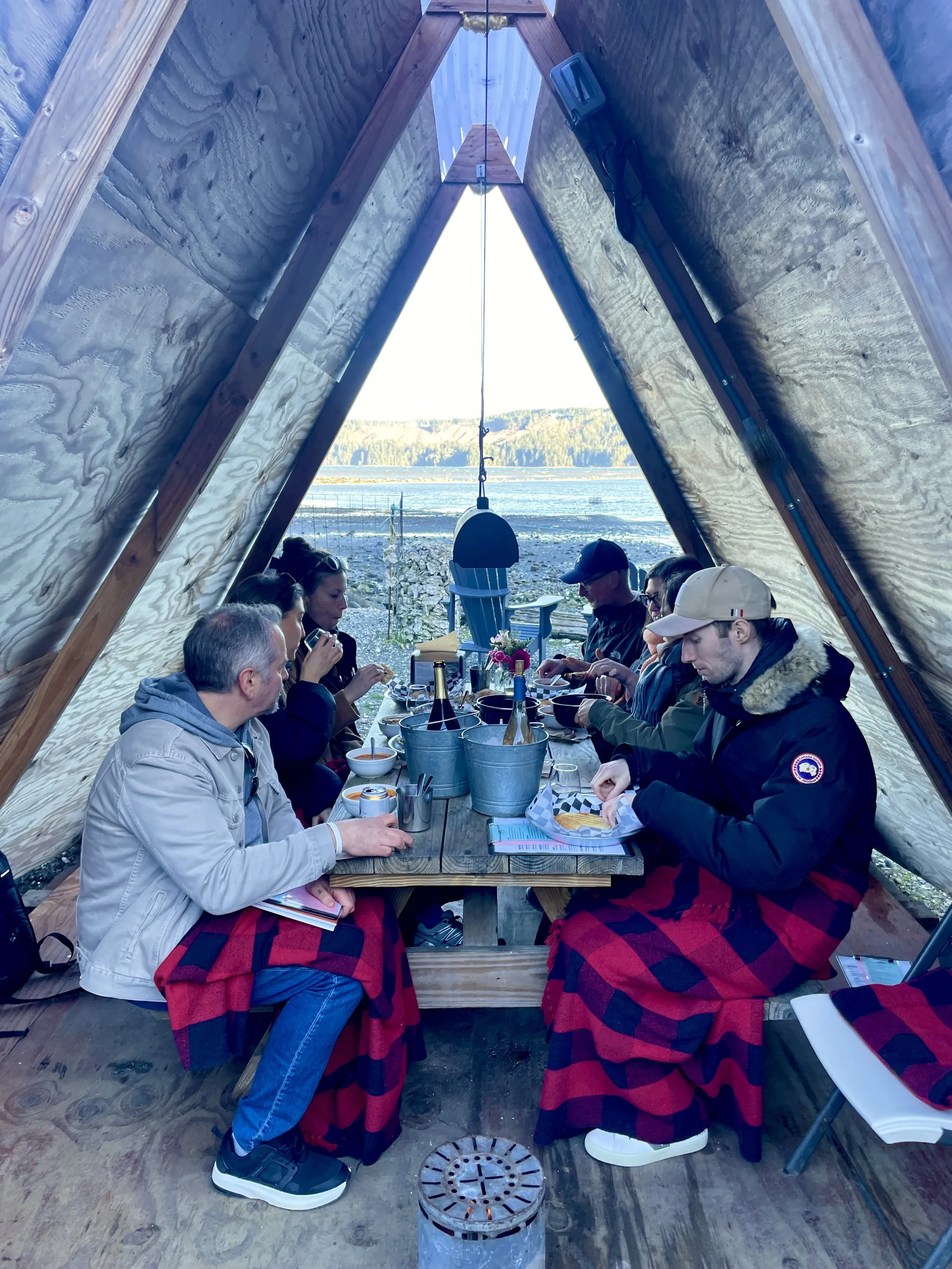
Hama Hama Oysters continues to provide high quality food and views with this oyster farm and seafood store along the shores of the Hood Canal in Mason County, Washington. One of the popular attractions is the A-Frame seating option. Borne out of social distancing, this unique feature has become the must-try for anyone making the stop.
Hama Hama Oysters continues to provide high quality food and views with this oyster farm and seafood store along the shores of the Hood Canal in Mason County, Washington. One of the popular attractions is the A-Frame seating option. Borne out of COVID and social distancing, this unique feature has become the must-try for anyone making the stop. With fresh seafood and wine plus apparel, their Seafood Store has all the ingredients for a perfect meal from the waters of the Hood Canal.
A Case Study of Islands in the Inlet
Case Inlet, at the mariner’s northeastern edge of Mason County, is home to many magical island getaways. Reach Island (AKA Treasure Island), verdant Stretch Island, secretive Herron Island, tiny McMicken Island, and Harstine Island all have interesting histories and unique characters.
Case Inlet, at the mariner’s northeastern edge of Mason County, is home to many magical island getaways. Reach Island (AKA Treasure Island), verdant Stretch Island, secretive Herron Island, tiny McMicken Island, and Harstine Island all have interesting histories and unique characters.
The water access provided by Case Inlet linked the early forestry and settlement farming of this area to Tacoma and Olympia. In the beginning Squaxin dugout canoes, row boats and temperamental sailboats were the main transportation. Small side-wheel freight ships (powered by coal, wood, and later diesel), known as the Mosquito Fleet, came to replace these early methods. They transported freight and passengers, shipped milled lumber, and even towed logs, connecting these remote communities and homesteads.
Reach Island
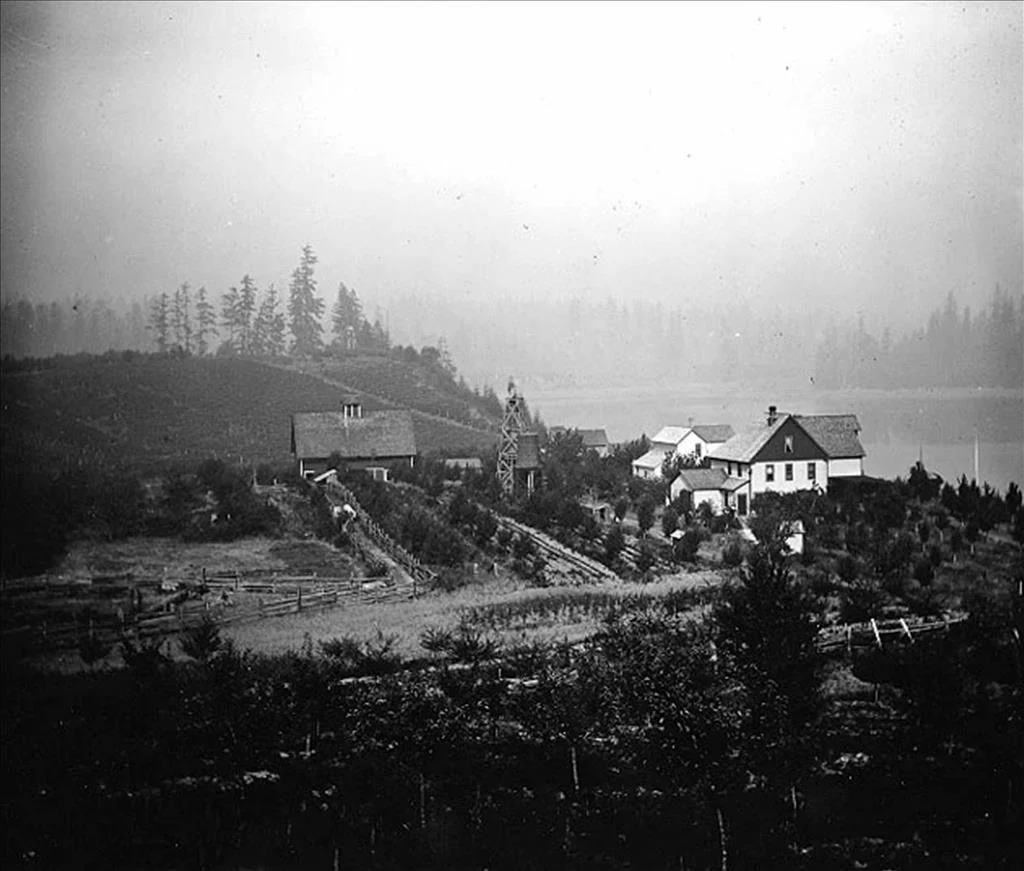
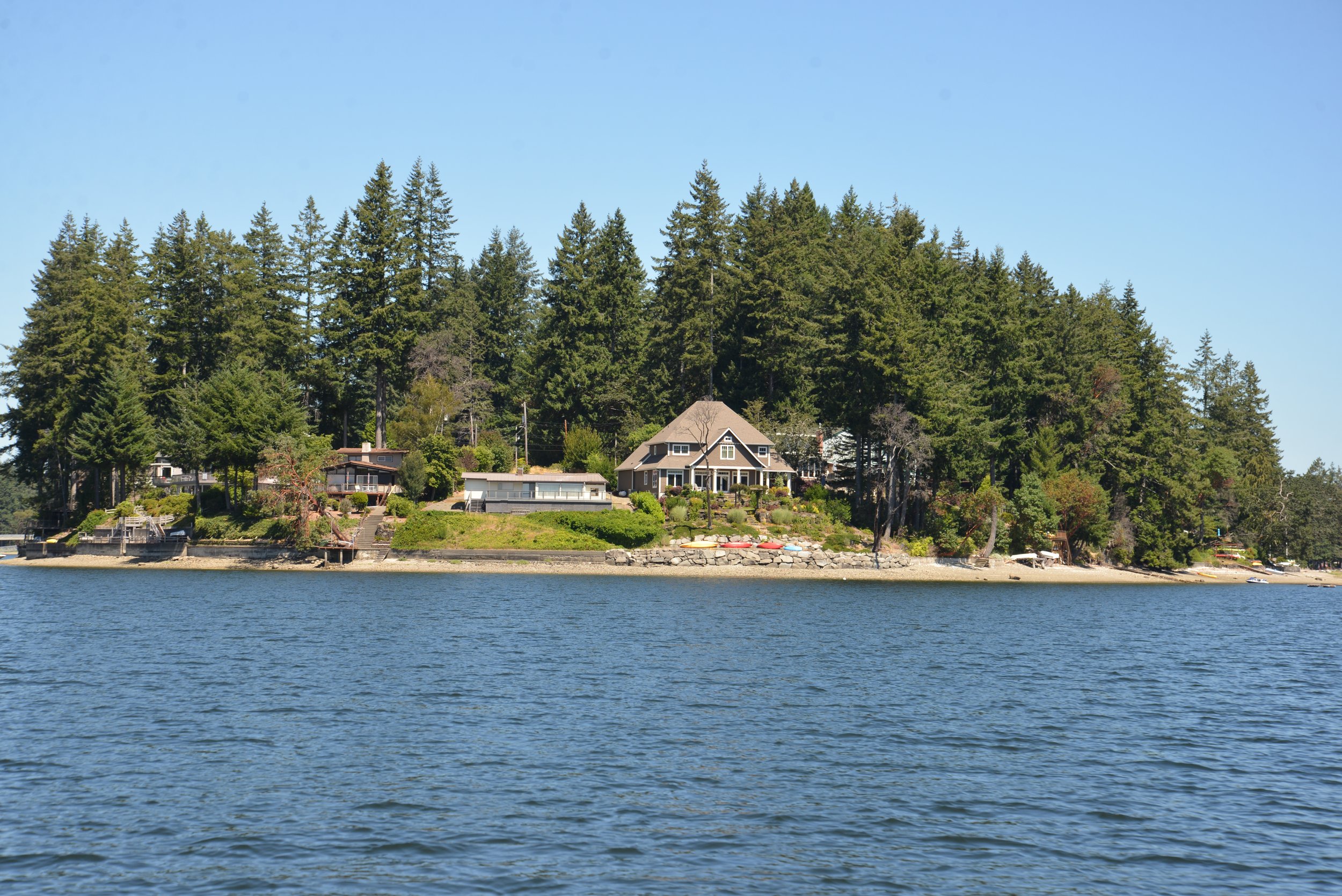
The first island we encounter heading from north to south down Case Inlet is Reach Island. The entirety of Reach Island was pre-empted and homesteaded by Joseph Pickford in 1885. By 1905, it was an established farm run by the Zizz family with cows, chickens, and fruit trees. Little farms like this were a major part of the Washington economy. Grapevines early on became important players in the agricultural scene of Case Inlet, or as it came to be known in the mid-1920s – the “grape belt of Washington.”
Stretch Island
Stretch Island saw the first efforts of grape growing on the inlet. Civil War veteran, Lambert Evans is credited with introducing the first concord grapevines to the island 150 years ago this year. Adam Eckert arriving in 1889 developed these into Washington’s own hybrid the Island Belle. This purply-red variety was hardier and ripened more successfully in the coastal climate.
Freight ships, such as the Skookum Chief would transport the Eckert Fruit Company’s fruit juice and grapes packed in round 6-pound wooden baskets to market in Shelton, Olympia, Tacoma, and Seattle.
After Adam Eckert passed away his lands and extensive grapevines were purchased by Charles Somers in 1918. Somers in partnership with his brother Frank expanded the business and began shipping to San Francisco. In 1922, the town of Detroit changed its name to Grapeview to reflect this growing resource.
In 1933, when the Federal laws known as Prohibition were lifted, Charles Somers was the very first applicant to be granted a winery permit in the 15th District (this included Washington, Oregon, Idaho, and Montana). St. Charles Winery started small with a French vintner overseeing the first casks of the only 3,000 gallons produced. Charles Somers’ sons Charles W. "Bill" Somers and Howard Somers joined the family business and by 1935 they were producing 38,000 gallons. Bill oversaw growing the fruit and harvesting and Howard (who specialized in chemical engineering at UW) took over the fermentation.

Charles Somers Vineyard
Vineyards throughout the area, especially on Harstine Island and along Pickering Passage added to their supply of grapes. In 1955, St. Charles processed over 500 tons of grapes from Mason County and another almost 300 tons from Yakima Valley. Although by 1965, the St. Charles winery had sold and the wine with it, there still exists on the Somers’ property on Stretch Island the original vine planted by Lambert Evans in 1872. Though not as popular, local vineyards still grow Island Belle and u-pick grape yards were a popular fall pastime until the 1980s. Hoodsport Winery still ferments Puget Sound Island Belle grapes. The wine is described as “a red wine bursting with flavors of fresh raspberries and cherries. A perfect wine for picnics and barbecues.”
Harstine Island
Just a little South of Stretch Island is Harstine Island. At over 18 squares miles it is the third largest island in the inland Puget Sound (after Bainbridge and Vashon), yet it is a sleepy wooded island with a population barely touching 1,500. Historically, residents were pioneer loggers (like Robert G. Jarrell of Jarrell Cove State Park fame), farmers, oystermen, fishermen and opportunistic captains (and many residents were all the above). Since the Island was only connected to the mainland in 1969 by bridge, traveling by water was very important to all aspects of life. Many famed Mosquito fleet captains lived here, building business and homes. The historic Community Hall was built in 1914.

According to the Harstine Island Community Club website, easy trees were harvested along the shores for lumber which was towed by Ed Cowan’s Levina and Raymond and John Haskell’s 40-foot launch the Marie to the sawmill at Taylor Bay.
The Community Hall held many popular dances and events with people coming by boat all the way from Agate, Stadium and Vaughn to attend. To this day it is a popular gathering spot for the Harstine community.
In 1922, the county established a ferry service crossing Pickering Passage. The 40-foot scow, the Island Belle (named for the popular grape) was their first ferry. She was built by Ira Libby of Hammersley Inlet with the help of Earl Harriman. She was designed from a ferry in operation on Lake Crescent.
With two load aprons she could carry three cars at a time, which would drive through on one end and unload on the other. She made the crossing in 30 minutes with her Fairbanks-Morse 10-horsepower engine, which drove by belt two side-paddle wheels.

She was replaced in 1929 by Earl Harriman who built his own log ferry to increase the capacity. Donette Glaser remembers that “ Earl was a pioneer of ferries. In those days, whenever we needed a new ferry Earl would tow a few logs and start building a new conveyance.” (Shelton Mason County Journal, March 26, 1959). This was soon replaced by the County’s Harstine I , and then the Harstine II in 1945 (eight car capacity).
Earl Harriman and his wife Mabel (daughter of Captain John Haskell above) were a staple of the community. Earl drove the ferry for 27 years and Mabel assisted him deck-handing when necessary. Mabel was also the chief local correspondent of Harstine Island, Pickering and Agate for the Shelton Mason County Journal for many years.
Captain Glenn Yates ran the Harstine II on her last crossing on Sunday, June 22, 1969 at 2 PM as the new Harstine bridge opening was celebrated with a parade, boat flotilla, and punch at the Harstine Community Hall. The traffic lined up on the mainland side of the bridge was further than any local had ever seen at a ferry wait. As the Captain’s wife, Carmen Yates, remarked at the time:
“The Island… saw its first major traffic jam that day. If anyone would have told me 25 years ago when I came to the island that one day I’d be involved in a traffic snarl that would take three deputies to unravel I would have just laughed at such an idea….And talk about waiting in line for a ferry How about that line that formed to go across the bridge? It extended from the bridge all the way past the ferry-landing as far as any of the longest ferry lines ever reached.” (Shelton Mason County Journal June 26, 1969).
With the new bridge, development on the island picked up as new residents and vacationers were attracted to the island life. This coincided with a popular developmental trend during the late 50s to 60s for logging companies such as Talbot & Sons Ltd. and Weyerhaeuser to revitalize their unique land holdings into private residential gated communities.
The entirety of Reach and Herron Island and the northern tip of Harstine Island experienced such development. Herron Island is only accessible by a private ferry from the Kitsap Peninsula, and you must be endorsed by a community member to visit. The development on Treasure (Reach) and Harstine Islands, however, are much more public as both are connected to the mainland by bridge and many cabins and houses in the community are available for short term rental. Much of Harstine Island offer excellent island diversions for a dat trip.
A Day on the Islands
Harstine Island is home to the Wild Felid Advocacy Center. Scheduled tours gets you right you right up close with about 50 wild cats from 13 species including a pair of tigers named Suri and Tabbi, a cougar, different leopards, and many others from five continents around the world. Visit wildfelids.org for more information on the different tours you can reserve.
On Harstine Island Jarrell Cove State Park is popular with boaters and campers alike; less developed Harstine Island Park offers tranquil beach time; and McMicken Island Marine Park offers a unique low tide hike across a tidal land bridge.
Not to be forgotten, Stretch Island has one state park which is accessible only by water. Community, history, great enterprises, and the importance of bridges all make up the waters of this meandering "Case" study on an Inlet’s islands.
Events Around Case Inlet


Celebrate Oysters on Hood Canal
It's ok to be "shellfish" when your on Hood Canal. How about waking up to spectacular canal views for days filled with walks and beach treasure hunts? With spring weather on its way and the water warming up -t’s a great time to hit the Hood – and we’ve prepared a jam-packed customizable seafood itinerary for you.
It’s a great time to head to Hood Canal and South Puget Sound and start enjoying fresh oysters on the beach.
We’ve got a few ideas to get you “shell-e-brating” as well as a recipe from Xinh Dwelley to make your mouth water for some oyster love!
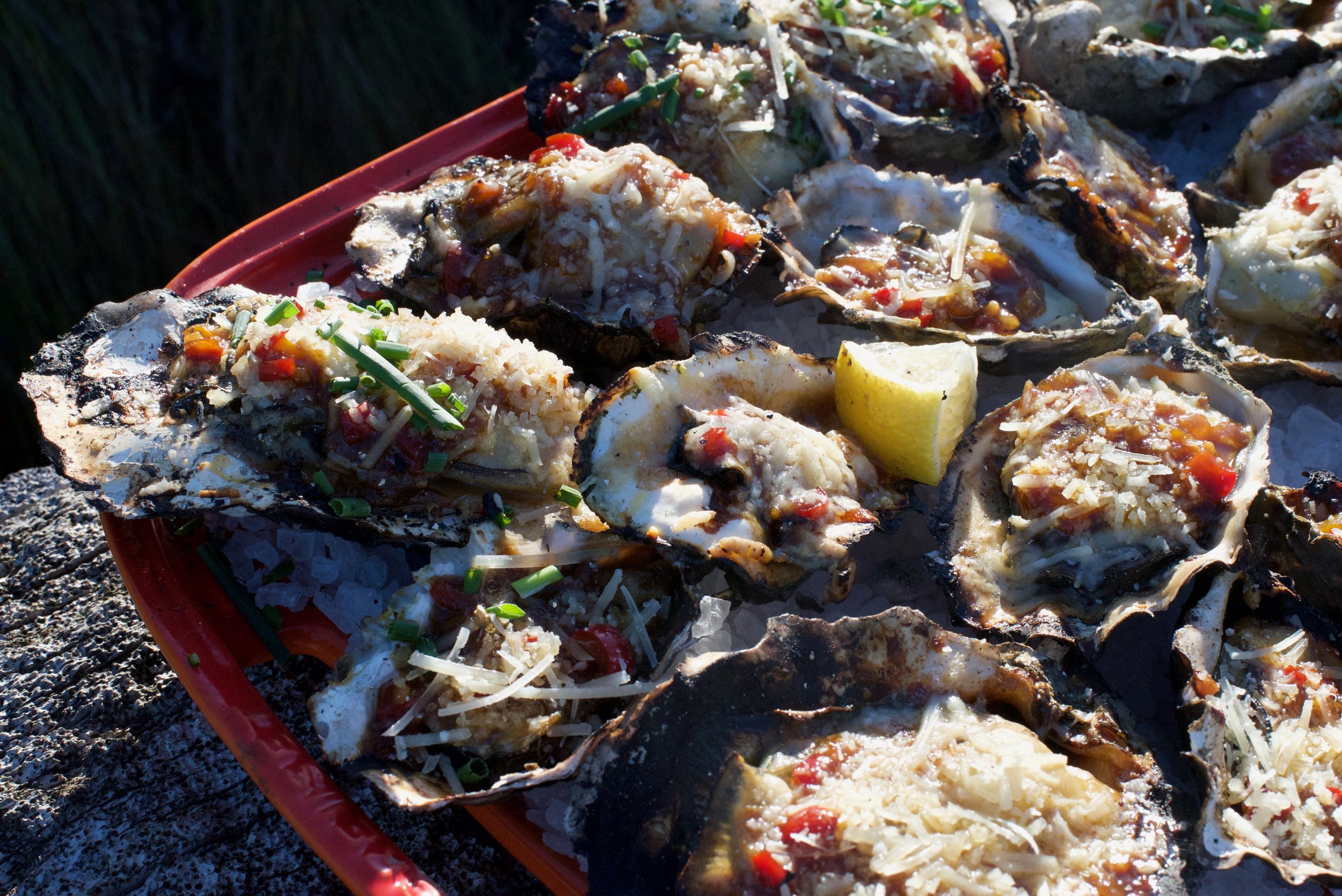
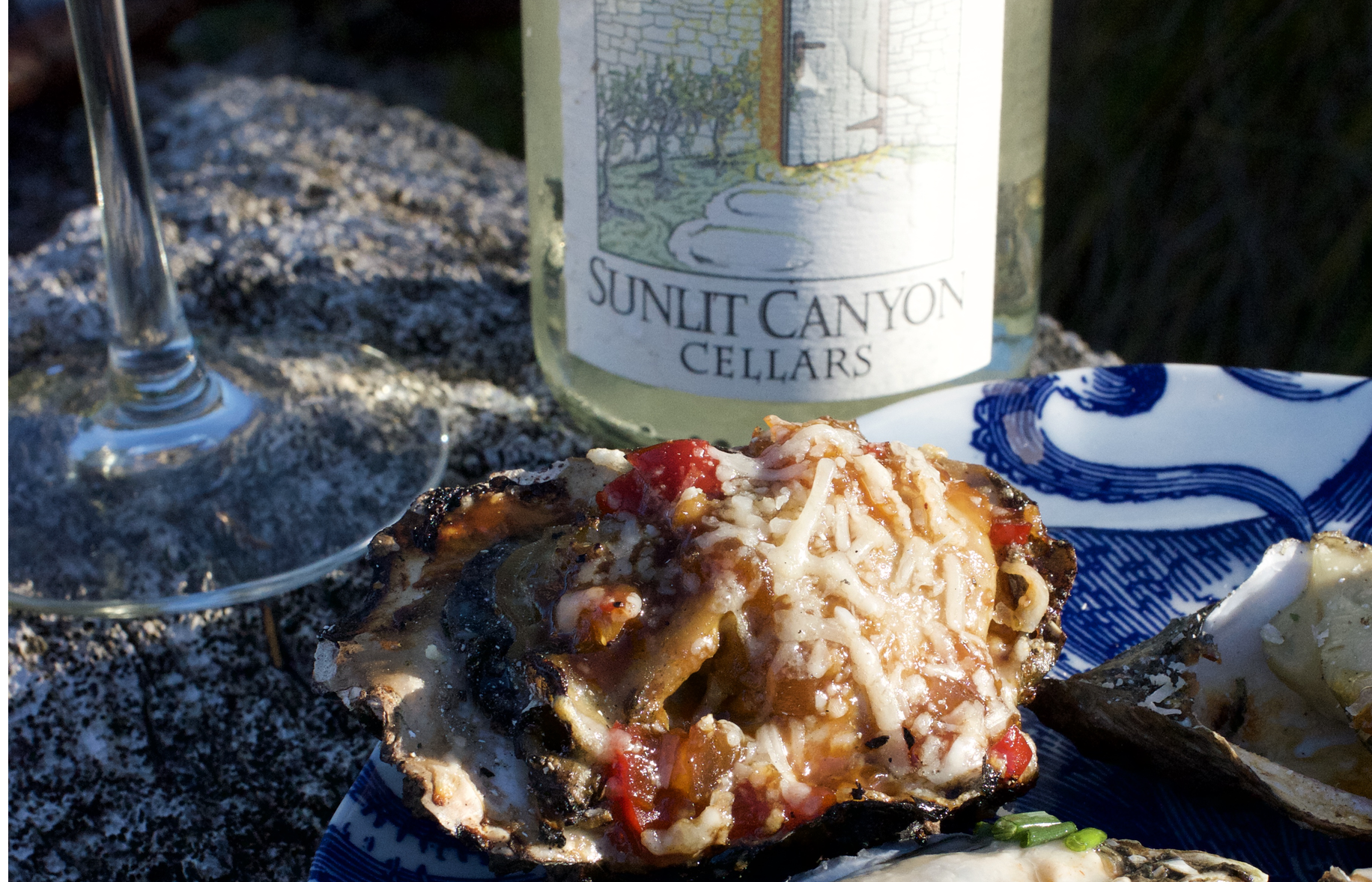
Xinh’s Grilled Oysters on the Half Shell
Recipe courtesy of Xinh Dwelley, celebrated seafood chef, Shelton, WA
(even the non-oyster eaters love these)
Prepare sauce in advance:
1/2 chopped red pepper, chopped
1/4 cup softened butter
1/2 cup chopped onion
Juice of 1 lemon
Salt and pepper to taste
2 tsp garlic, chopped
2 tsp soy sauce
1 tbsp hoisin sauce
1 tsp sugar
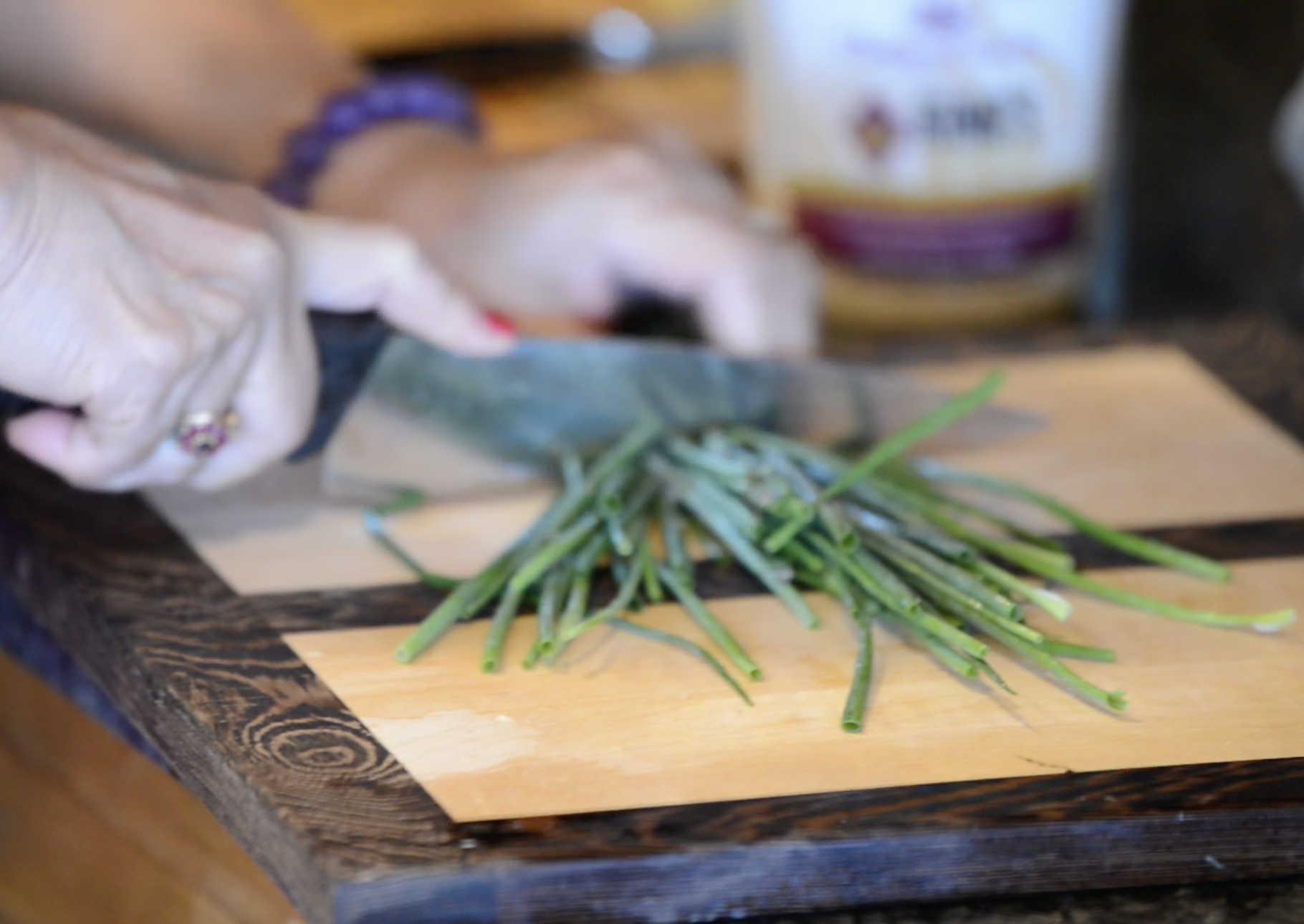
1/2 cup chopped chives
1/2 cup grated parmesan cheese
Combine ingredients in a blender and blend. Store in fridge until ready to prepare grilled oysters.
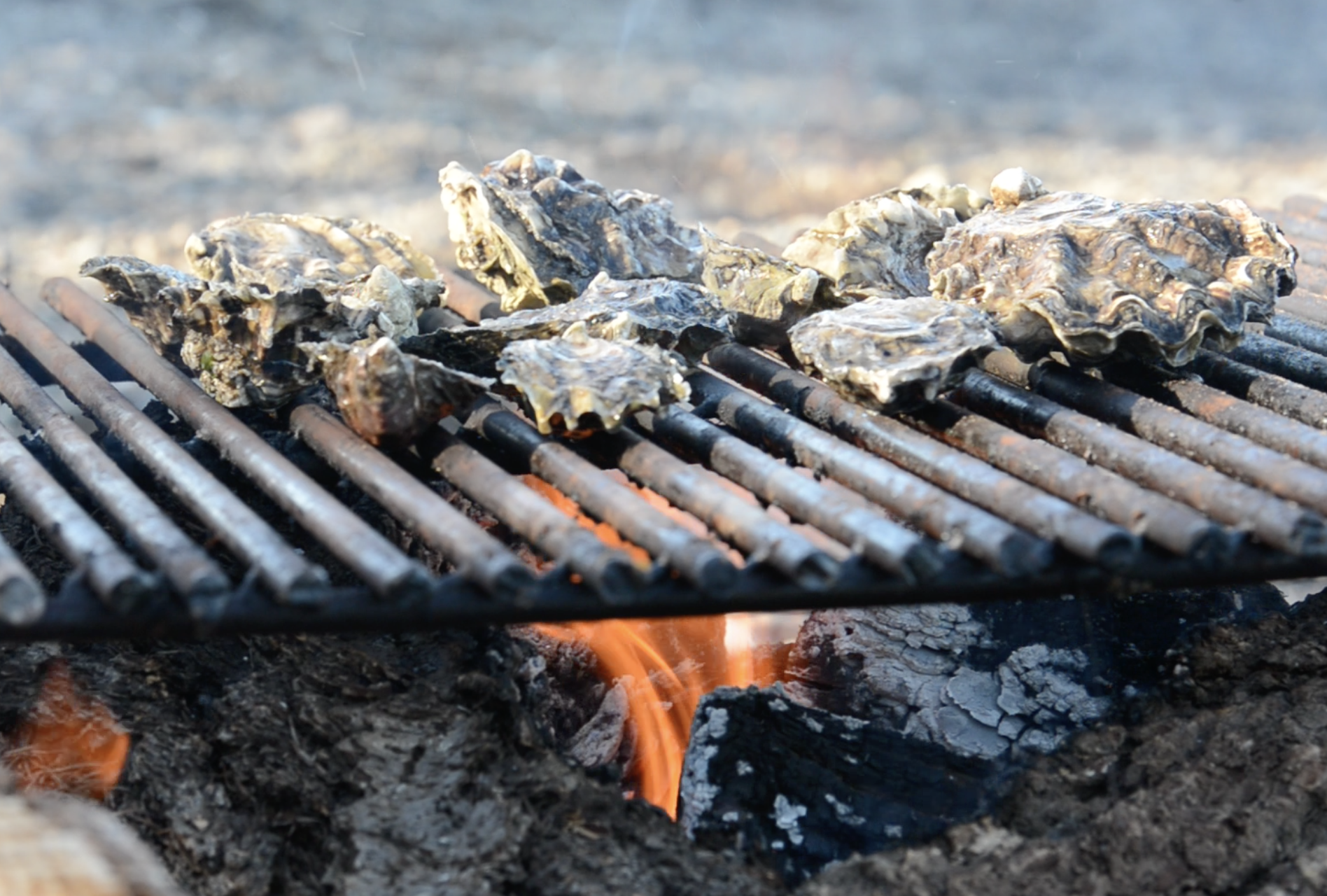
Place oysters on hot grill( 24-36 in shell). When shells begin to “pop” remove top with a heat-safe glove and top each with one teaspoon of mixture. Garnish with sprinkling of grated parmesan cheese ( about ½ cup total). Cook oysters are light brown and cheese has melted, 5-10 minutes. Serve hot.
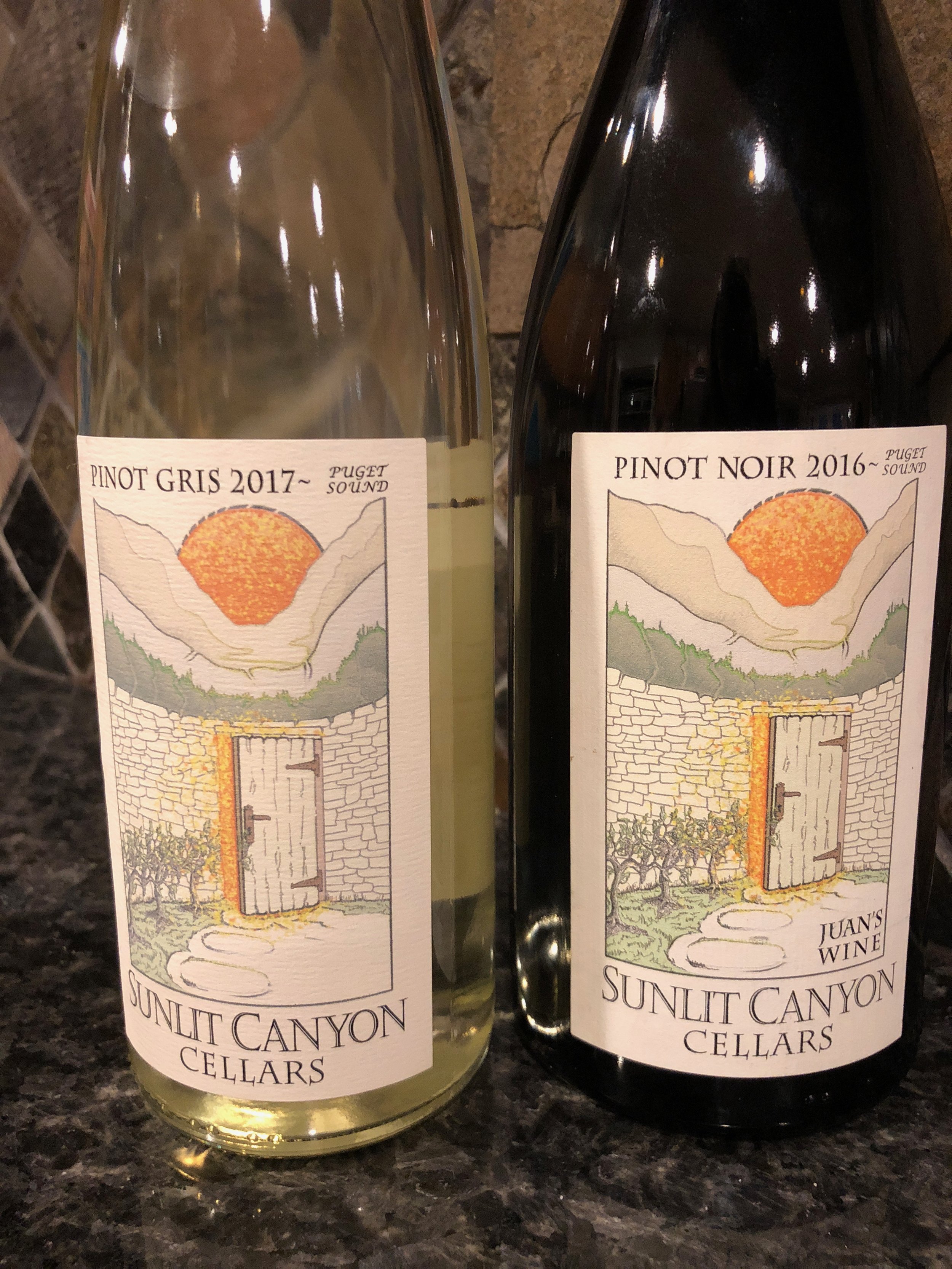
Oyster Pairing: Serve with Sunlit Canyon Cellars’s Pinot Gris ($22) available at Cameo Boutique in Union. Sunlit Canyon small batch wines are grown and bottled in Belfair WA overlooking Hood Canal.
Save some Clams & Visit Mid-week
Perhaps a few oysters will suffer, but who doesn't like to save a little money?
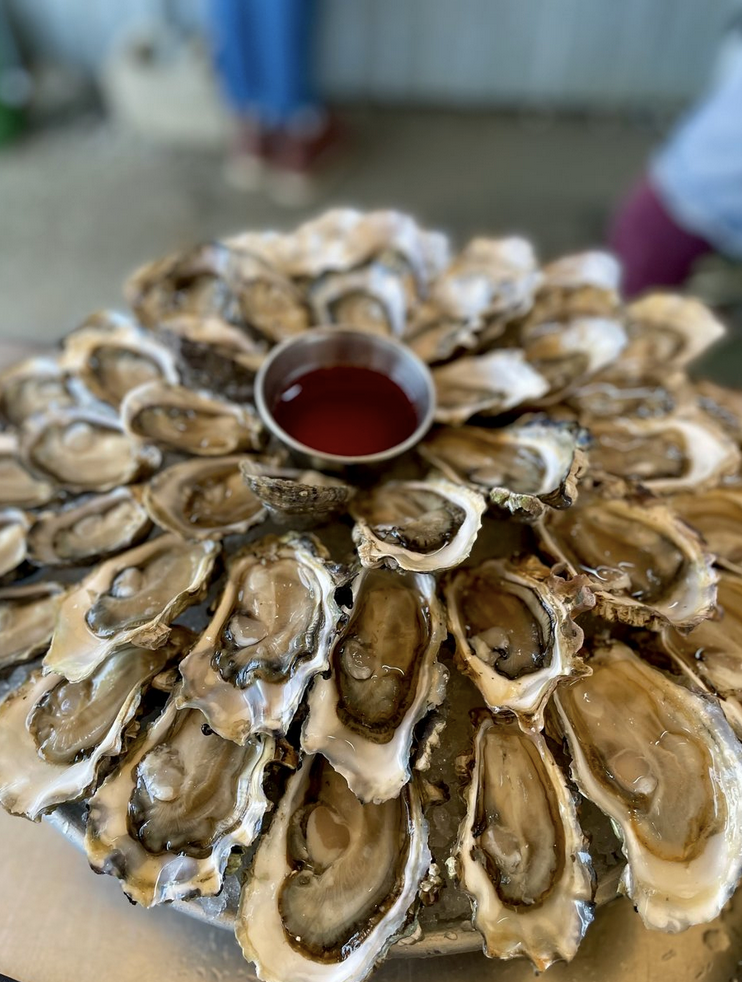
For great deals on lodging, not to mention more selection, consider heading to the Canal mid-week to enjoy activities you will not find anywhere else. Pack up boots, buckets and license and head to parks and DNR beaches that are regularly stocked with shellfish for the taking. Yes, taking! Check the tides before you head out. Another advantage to mid-week shellfish-gathering is you'll have the beach to yourself! Visit the DFO Shellfish Safety Map as seasons are beach specific. Always Check BEFORE you dig. We've prepared a handy list of area harvesting beaches here.
Alderbrook Resort & Spa is a great place to start a Oyster tradition - especially since April is their official Oyster Month! Not only can they harvest oysters right on their beach, serve some great Hood Canal oyster dishes on their daily menu in the restaurant.

Alderbrook Resort, view from the dock (left); view from 2 Margaritas' patio seating (top middle); Robin Hood Village Resort onsite restaurant (top right); Cedar Hill Cottage, Union (bottom middle); Hood Canal Marina & location of the Canal Cookout in Union (bottom right)
Want the house all to yourself? Consider snagging one of the great rentals that pepper coastal communities and woodland oases in the area. One of our favorites is the Cedar Hill Cottage in Union. This spacious shake home (two bedrooms) is perched on the hill above Union, and although it is technically not waterfront and nestled in the woods, there are glimpses of the Canal and the snow laden Olympics. Location is everything here. A short drive to Alderbrook Resort and just a quick walk to the heart of Union with coffee and bakery items at the Union Country Store, boutique shops, and waterfront dining at 2 Margaritas.
Farm visits
Heading into Shelton, stop in off Hwy 101 past Little Creek Casino & Resort at Taylor Shellfish's Retail Facility to take a look at their headquarter facility and visit their retail store. Taylor Shellfish is a huge supporter of the annual West Coast Oyster Shucking Championship (OysterFest) by supplying over 1200 oysters to the competition!

Hama Hama Oyster Company in Lilliwaup serves farm fresh oysters and clams in their streetside Saloon off Hwy 101. Check out the Oyster Saloon, an outdoor farm dining experience, Thursday through Sunday. The retail store is open daily.
One of the area’s most popular oyster growers is located just 30 minutes away in Lilliwaup, WA. Hama Hama Oyster Company's Store and Oyster Saloon (an outdoor restaurant) are located a shell’s-throw from the tideflats. Visit during the week to see the shucking crew in action, and ask for one of their self-guided tour maps to better explore the farm. Stop by the Saloon (Thursday though Sunday) for some great shellfish but don't miss the divine hand-packed Dungeness crab cakes. And we mean PACKED with crab! The crab cakes are also available the farm store where you can buy them to cook at home.
How ever you choose to Shell-e-brate oysters we know that you will have a blast exploring Hood Canal. Be sure to share your adventures with the bivalves with us at #wildsidewa!
See you on the beach!

Need some Color? This weekend is the Dahlia Days Event!
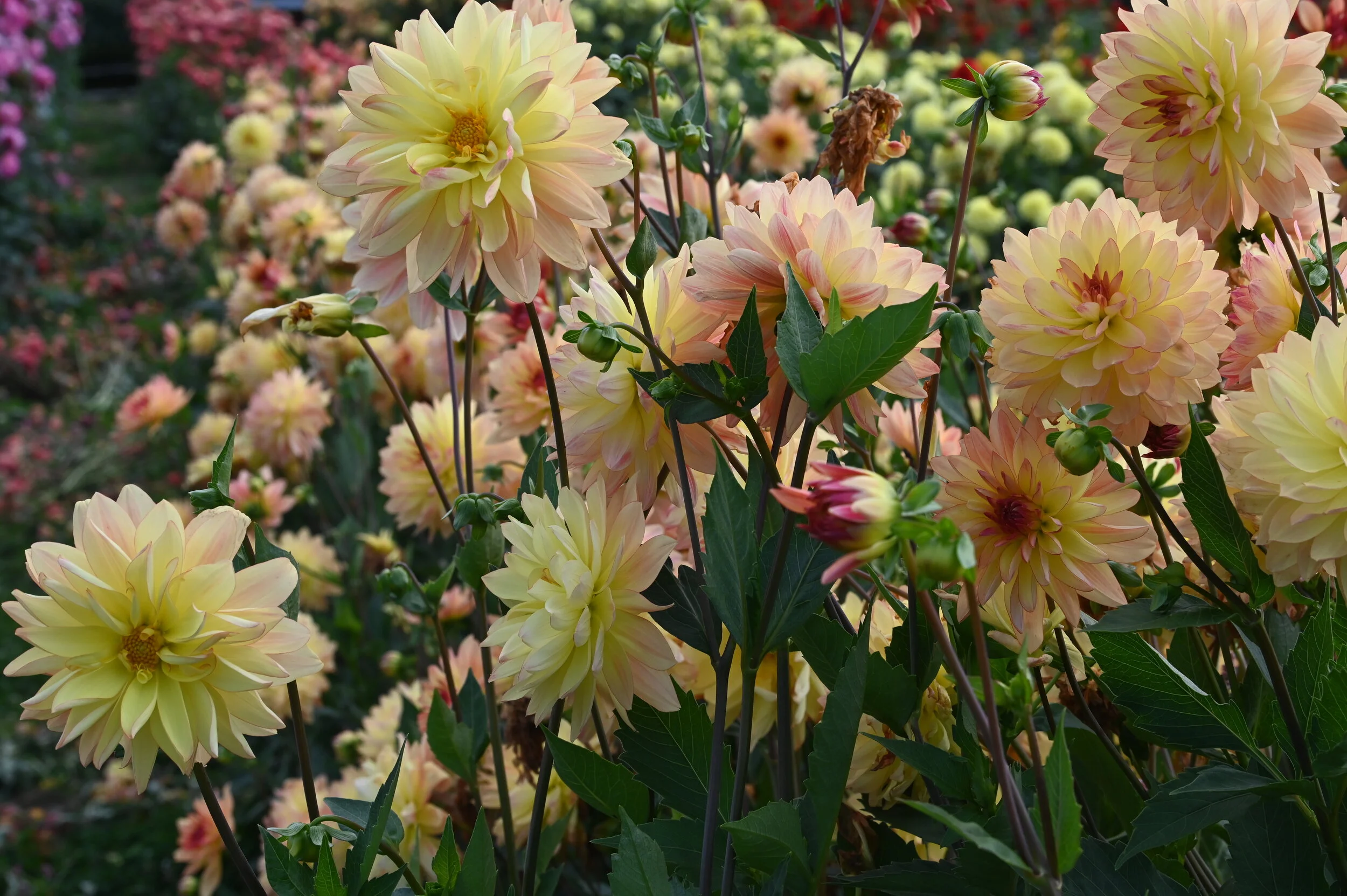
Need some color in your life? Then head over to Lynch Creek's Dahlia Farm where the blooms are bursting with a rainbow of shades and shapes!
Need some color in your life? Then head over to Lynch Creek's Dahlia Farm where the blooms are bursting with a rainbow of shades and shapes!
Lynch Creek Farm has been growing dahlias for well over 20 years. In 2018 owner, Andy Hunter, decided to open the dahlia fields to the public as a u-pick – and ever since it has been a much anticpated annual attraction.
Many locals photographers and families have been bringing the kids, cameras, and even dogs for some spectacular photos in a beautiful setting.

With three acres of dahlias to plant and prepare, it's a family affair with three generations of the Hunter family making sure their are plenty of blooms to go around. Arranged in giant rows, it's a rainbow so large that small planes overhead do a fly over.
The flowers are at their peak in the fall - like right now! – so make a day out of it with your friends and family. This makes a great annual tradition with the bonus of beautiful hand-picked bouquets, special pictures, and a fun adventure.

LCF Dahlia Days
On Saturday, August 28th, head over to the Bouquet Making Masterclass with renowned Mason County florist Colleen Hunter. They’ll also have games, concessions, and a local food truck out at the field! There will be something for every member of the family to enjoy! If you are interested in the Bouquet Making Masterclass, click the link below. They have limited space and are expecting the spots for this section of our Dahlias Day event to go fast! https://lynchcreekdahlias.com/lcf-dahlia-days/

The farm is open dawn until dusk every day until the first frost (late October) and the stand is often manned with helpful staff. Certain days during the summer a local non-profit groups take over the farm and all proceeds for that day are donated to their cause. When it’s not staffed there are signs, buckets, clippers, pre-made bouquets, and a drop box to help offset weeding expense.
More information is available at lynchcreekdahlias.com. See you in the flowers!


Fresh Shellfish from the Source
Want to visit the farmers that wake up on the night tides to bring you the perfect oyster, clam or geoduck? Check out these farms on and around Hood Canal!
In Search of Perfection
Want to meet the farmers that wake up on the night tides to bring you the perfect oyster, clam or geoduck? Check out these farms on and around Hood Canal!
Chelsea Farms & Olympia Oyster Bar
Chelsea Farms | photo:poppi photography
Eld & Totten Inlet
Chelsea Farms is a current working model of environmental sustainability. They have made a priority of farming the Olympia Oyster, a native oyster to Olympia, that was on it’s way to extinction. Specialties include their Chelsea Gem, Bonita, and Olympia Oysters, along with fresh clams and geoduck. Visit their Oyster bar in downtown Olympia to get the ultimate local seafood experience!
Let’s Go:
CHELSEA FARMS OYSTER BAR
222 CAPITOL WAY N, OLYMPIA, WA 98501
Phone: (360) 915-7784
Hours: TUES-FRI 11AM-9PM, SAT 10AM - 10PM | SUN 10AM - 9PM
menu
Hama Hama Oyster Farm
Lilliwaup, Hood Canal
A few years ago the Hama Hama Oyster Co opened their Oyster Saloon in Liliwaup. This high energy destination serves oysters pulled from the last tide and prepared to order with an ever changing menu of seasonal local ingredients. In their retail shop you can purchase a variety of their Hood Canal product including salmon and oysters smoked on site. Hama Hama is a 5th generation family run farm with a reputation for quality and environmental mindfulness.
Let’s Go:
HAMA HAMA OYSTER CO
35846 US-101, Lilliwaup, WA 98555
PHONE: (360) 877-5811
FALL Hours: Farm Store Daily 9:30 to 5:30
Oyster Saloon Thurs - Mon 12:00 - 5:30 (Closed Tuesday & Wednesday Starting 9/5)
Shellfish is available in their retail store, Saloon and at parent restaurants throughout the Northwest.. Product also available online and shipped directly to your home.
Olympic Oyster Co. & Mike’s Beach Resort
Eldon, Hood Canal
Third-generation farmers, Matthew and Sara are serious about producing some award winning oysters on site for market and available at restaurants as far away as New York. Guests staying on the active farm aka Mike’s Beach Resort have first dibs on some of the freshest oysters on the fjord!
Let’s Go:
Mike’s Beach Resort
38470 N US Highway 101, Lilliwaup, WA 98555
Phone (360) 877-5324
Waterfront cabins and rooms, with view of the canal.
Taylor Shellfish
South Puget Sound and British Columbia
Stop in at Taylor Shellfish’s headquarters and visit their market near Shelton. Taylor’s specialties include the famed Kumamoto (sweet fruity flavor) and the Virginica (Crisp, briny, and buttery). The company has been farming oysters on Puget Sound since the 1890’s when great-grandfather Justin Taylor began farming Olympias. Five generations later, the company’s product line includes worldwide export of geoduck, clams, and mussels along with oysters.
Let’s Go:
TAYLOR SHELLFISH RETAIL STORE
130 SE Lynch RD Shelton WA, 98584
PHONE: (360) 432-3300
Hours: Monday - Sunday: 10am - 6:00pm; Closed all major holidays
Shellfish is also available at one of their many locations throughout NW Washington. Product also available online and shipped directly to your home.