
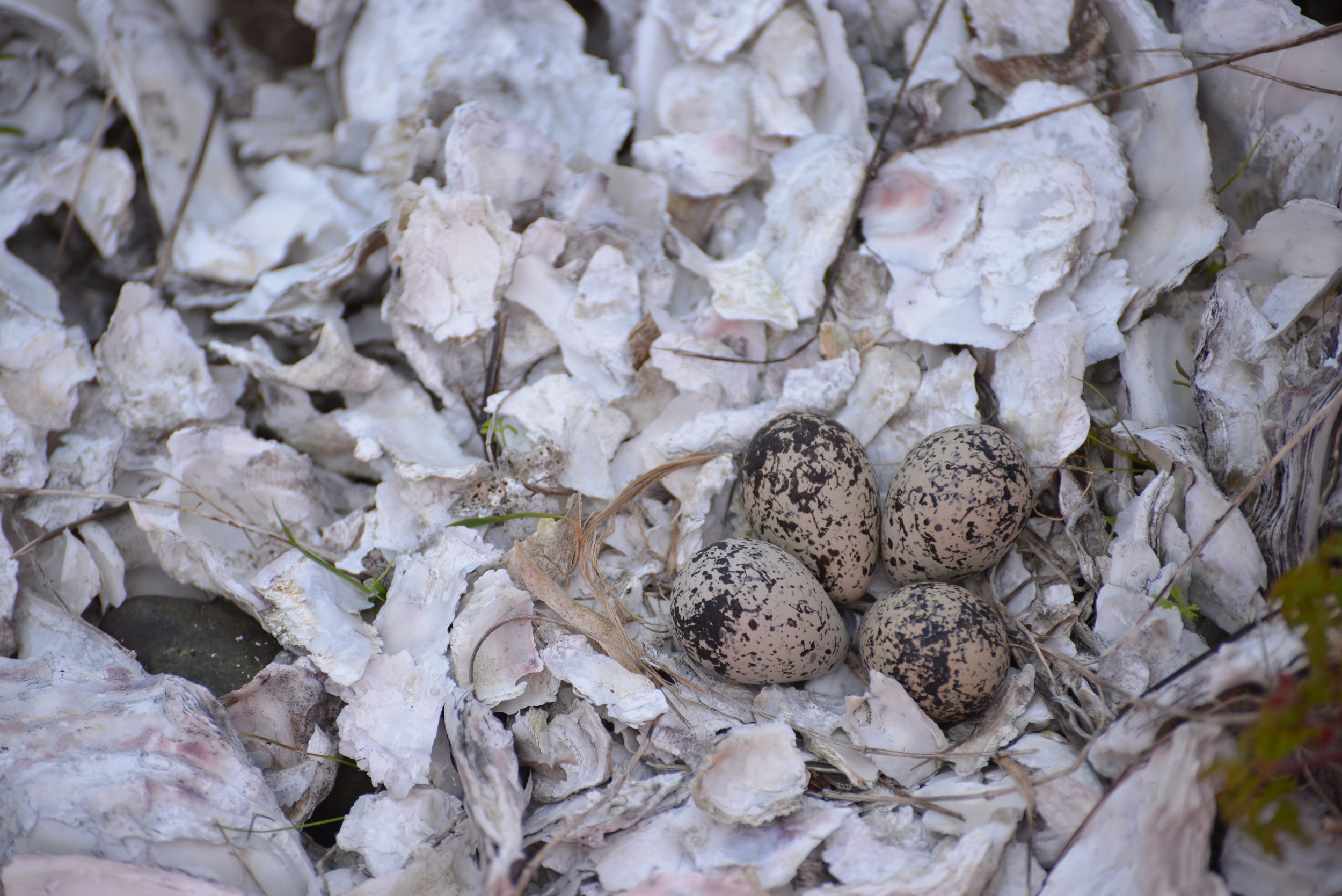

Feast your eyes on a face with personality to spare!
Get any group of divers together in the Pacific Northwest and ask them what makes for a great dive. Everyone will agree that a wolf eel was somehow involved. There is something unique about the supremely ugly faces of an adult wolf eel staring at you from its den.
Story & Pictures, Thom Robbins
Get any group of divers together in the Pacific Northwest and ask them what makes for a great dive. Everyone will agree that a wolf eel was somehow involved. There is something unique about the supremely ugly faces of an adult wolf eel staring at you from its den.

Hood Canal Wolf Eel | Photo credit: Thom Robbins
This can turn an ordinary dive into a great one. The conditions don’t matter – cold, terrible visibility or strong currents are forgotten once a wolfie (as we call them locally) appears publicly. It’s not surprising why divers worldwide travel to places like the Hood Canal to catch a glimpse of these fantastic creatures.
Meet wolfie

Hood Canal Wolf Eel | Photo credit: Thom Robbins
Throughout history, the peoples of the northern Pacific have held wolf eels in deep respect. Many of the native tribes in the area viewed the wolf eel as a creature of strength and resilience, symbolizing protection due to its robust and intimidating appearance. This belief often extended to the spiritual realm, where the wolf eel was thought to embody protective spirits. In Washington, the wolf eel is now a protected species in the Puget Sound and Hood Canal.
This is not because they are endangered but because their value as a living resource to divers and photographers far exceeds whatever commercial value the species could provide as a food source. Some dive sites, like Sund Rock in the Hood Canal, are well-known locations where wolf eels interact with divers and provide unique photo opportunities.
Wolfies are not related to eels. Instead, they are part of a family known as the wolf fishes.

Hood Canal Wolf Eel | Photo credit: Thom Robbins
They belong to an even larger group of fish known as Perciform, generally considered perch-like fish. But their long-bodied, eel-like appearance is unique in this group of fishes. The wolf eel can be found as far south as San Diego in southern California, then northward up the Pacific coast to the Aleutian Islands in Alaska. The popular term “wolf eel” comes from the large frontal canine-like teeth used to seize their favorite meals, mainly hard-shelled crustaceans and invertebrates. The typical menu includes crabs like Dungeness, Red Rock, and Green Urchins.
Most wolf eels can grow to about six feet long and weigh almost thirty pounds, although they can grow to eight feet. These massive fish are speculated to live up to 10 years in the wild, though no research is available on their longevity. Scientists have found that they can begin reproducing between four to seven years, suggesting they may be long-living fish. One fact that I find fascinating is that they lack a swim bladder, a feature commonly found in most fish species. The swim bladder is an internal gas-filled organ that helps fish regulate their buoyancy and control their vertical position in the water column. However, the wolf eel has evolved without this organ, relying on its muscular body and strong pectoral fins to maneuver and maintain its position in the water. The lack of a swim bladder allows wolf eels to lounge around on the bottom or lay in their home lairs. Like snakes, they swim by making S shapes with their bodies and use their pectoral fins to steer. This unique adaptation allows the wolf eel to thrive in rocky coastal habitats, where it can navigate through crevices and caves with exceptional agility. By forgoing the swim bladder, the wolf eel has developed a specialized set of skills, making it an expert hunter and a master of its underwater domain.
Additionally, wolf eels have a slimy coating on their bodies, which serves several important purposes for their survival and protection in their marine environment. First, it acts as a natural defense against infections. The slime contains antibacterial and antimicrobial properties that help prevent the growth of harmful bacteria and parasites on their skin, reducing risk of infection.
The slimy coating makes it difficult for predators to grip or hold onto a wolf eel.
When threatened or attacked, a wolf eel can release more slime from its skin, making it slippery and challenging for predators to maintain a firm grip. This slippery defense mechanism allows the wolf eel to escape from potential threats. The slimy layer reduces friction when the wolf eel moves through the water, allowing them to easily pass through tight spaces and narrow cracks without getting stuck.
Lifecycle of a Wolf Eel
Approximately 24 hours before mating, the female wolf eel’s abdomen becomes noticeably distended. When this happens, the male will butt his head against the back of her abdominal region. This action appears to stimulate physiological activity. A series of waves move through the female's body from her head to her tail, particularly pronounced in her abdominal area. The male will then wrap himself around the female so that their heads will be side by side and their genital regions adjacent. In this position, the female releases the eggs, usually between 5,000 and 10,000, and the male fertilizes them as they appear. After fertilization, the female will coil about the eggs, molding them into a ball-like cluster. The eggs are adhesive to each other but not to the rocky walls of the den. Both parents will then coil themselves about the egg mass, sometimes together and at other times individually, tending the eggs and ensuring they are rotated so that a good flow of water passes through them.
After about 16 weeks, the eggs hatch, and the larvae float towards the upper part of the ocean or the sea, where they spend nearly two years of their lives. The tiny fish are born brownish pink, about 1 1/2 inches long. They turn dark gray within a day and start snacking on small shrimp after a few days. The larvae that emerge are left on their own to swim with the plankton in the ocean. From birth, they are voracious predators and will strike at their planktonic prey, much like a coiled snake will strike at a mouse. Constantly searching for prey, the larval wolf eels will lead a pelagic existence. Eventually, the maturing youngsters settle on the ground and enter a den. Denning will typically occur in the Puget Sound area from February through April.

Juveniles wolf eels exhibit a more vibrant and striking appearance. | Photo credit: Thom Robbins
The change from a pelagic to a bottom-dwelling existence spawns physical changes in the juvenile wolf eel. Juveniles exhibit a more vibrant and striking appearance. A vivid orange or reddish-orange color with darker markings often characterizes their appearance. This vibrant coloration helps juveniles blend in with their surroundings, such as rocky reefs or kelp forests. As they mature into adults, their coloration becomes more subdued brown or reddish-brown. The skin often has spots of a darker color, which may be outlined in a lighter color. The males will also develop a puffy face, enlarged jaws, huge bulbous lips, and a powerful sagittal crest at the top of their heads to support the increased muscle mass required for the jaws.
Friends & enemies
There is no fairness in the realm of a Salish Sea rocky reef. A fierce battle for ownership unfolds around the most desirable den sites. The key contenders are the Giant Pacific Octopus (GPO), and the formidable wolf eel.
Both species vie for control over these coveted shelters, which serve as their sanctuary in a harsh underwater world. This struggle is fueled by their shared habitat, prey, and an unyielding desire for the same type of den sites.
With its unmatched dexterity and cunning, the octopus poses a formidable challenge to the wolf eel. I have watched the battle when a GPO ruthlessly evicts a wolf eel, sometimes even targeting mated pairs, and claims the den as its own. Despite the wolf eel's valiant efforts, there is little it can do once an octopus of even modest size has set its sights on a particular den.
Ask any diver, and they can attest to the futility of trying to dislodge an entrenched octopus from its chosen abode.
Submerging into the chilly embrace of the Salish Sea transforms the ordinary into the sublime. A serene quietness wraps around you as you descend below the waves, echoing the solitude of an explorer charting new frontiers. Gripping your camera firmly, you traverse this alien landscape, feeling every inch an astronaut on an oceanic planet.
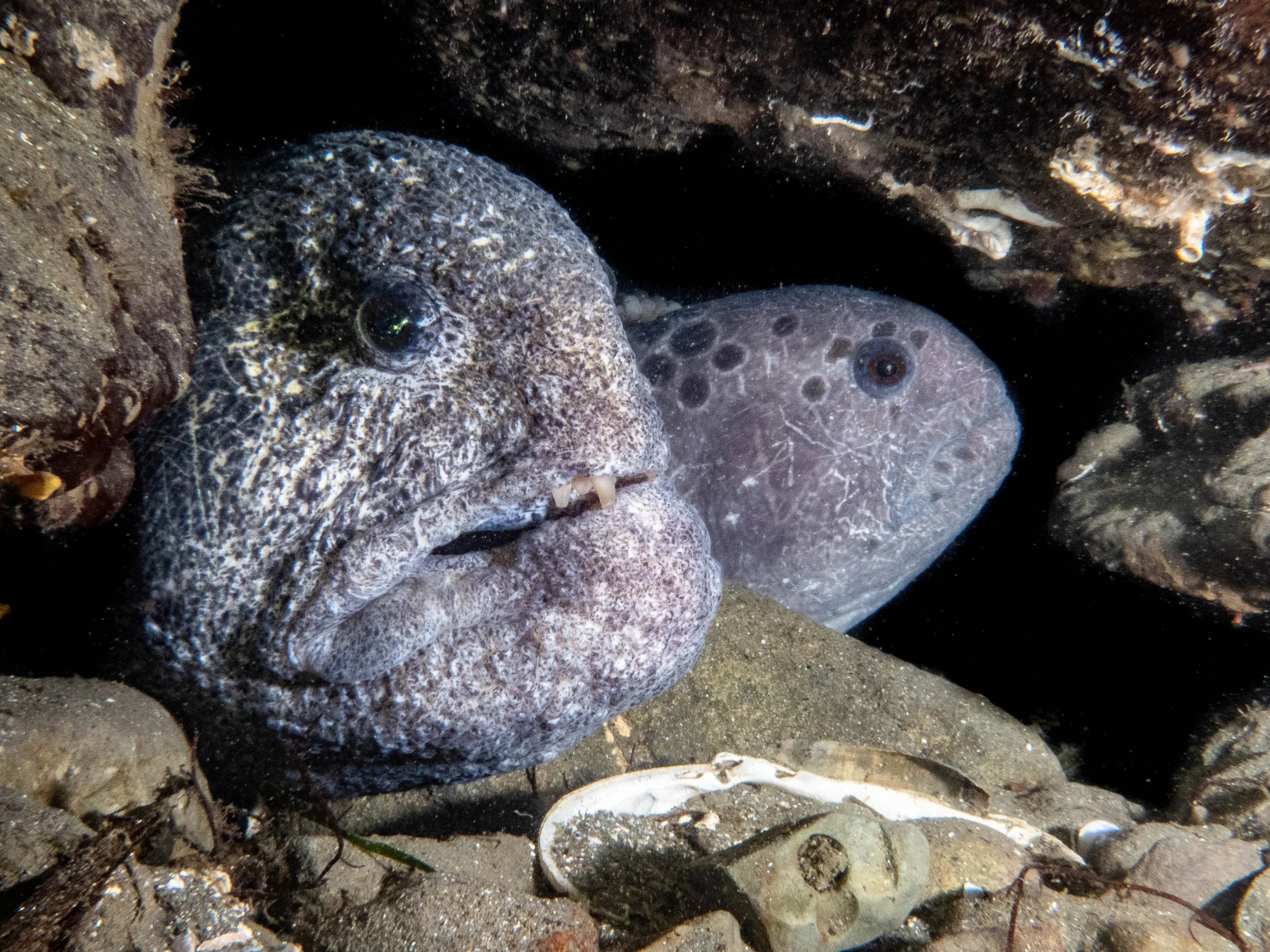
Hood Canal Wolf Eel | Photo credit: Thom Robbins
Before long, you approach a wall, its vastness urging you to uncover. You glide along its face, examining each nook, cranny, and boulder with a mix of awe and curiosity. The vividly colored marine life enchants you, each organism a stroke of brilliance from nature’s palette. In this marine maze, your adventure takes a thrilling turn.
From the periphery, a wolf eel appears, locking eyes with you. There’s a mutual recognition, a shared wonder between you and the creature, silently communicating in this mesmerizing undersea world. The thrill of the encounter sharpens your focus, and with camera in hand, you ready yourself to document this surreal moment. You aim and capture the scene, forever preserving your encounter with the wolf eel.
Hood Canal Diving:
Sund Rock Marine Preserve
26472 US-101, Hoodsport
sundrock.com
YSS Dive Charters
24080 N US-101, Hoodsport
yssdive.com/charters
About the Author: Thom Robbins

"Fascinated with the underwater world in the Pacific Northwest,I have been a diver for over thirty years and have never been happier than underwater with a camera. I spend as much time underwater as possible, shooting pictures or teaching diving and photography. You can see and purchase my photo collections at robbinsunderwater.com. If you want to learn about diving or photography, reach me at thomrobbins@gmail.com.
When not diving, I spend time with my wonderful, patient wife, Barb. We have just relocated to Shelton to enjoy a more relaxed life. Without Barb, I wouldn’t have continued my passion for diving. She is my best and often harshest critic, pushing me to explore better photos. I also have a 21-year-old son who makes me want to be a better person daily. Last but certainly not least are my two English Bulldogs, essential to my family's life."

Landscape Photography with George Stenberg
Though there are many factors that come together to make a good photographer—gear, dedication, understanding of theory, etc.—the one elusive quality that boosts George Stenberg’s craft into the upper echelon is timing.
Though there are many factors that come together to make a good photographer—gear, dedication, understanding of theory, etc.—the one elusive quality that boosts George Stenberg’s craft into the upper echelon is timing. This is often translated to photographers terms as patience.
Although many assume that being in the right place at the right time is happenstance, one look at Stenberg’s extensive collection suggests there’s something more sophisticated at play. Time and time again, he publishes jaw-dropping creations that not only make us fall even more in love with our own DSLRs, but with Hood Canal that continually provides these glorious moments.

Note: all photos featured in this post belong to George Stenberg.
Meet George Stenberg
He’s the man behind the image that makes you say, “whoa.” And rightfully so—his mission is simply in the right place. “The world is a wonderful, amazingly beautiful place,” he says, “look around and see for yourself. Let’s cherish it and take good care of it for those who come after us."
We caught up with him for a little Q + A.
What makes shooting around Hood Canal and on the Olympic Peninsula special?
The simplest answer is because I love the Hood Canal and the Olympic Peninsula. I grew up in a small community along the Puget Sound called Dash Point. I always love to being by the water.
As a youngster, my folks would take us on weekend trips to my Grandparents' cabin at Maggie Lake, near Tahuya. We would also spend a lot time with friends who had a cabin nearby on Hood Canal. My earliest memories of the fjord are the warm waters, oysters, and a rocky beach. This was way different from our cold water and sandy beach in Dash Point.
Swimming in warm water was much nicer. Also, just about every summer we would take a trip around the Olympic Peninsula on beautiful Hwy 101. We called it a trip "around the loop." So I developed this love for Hood Canal and the Olympic Peninsula in my early years and as they say, "shoot what you love," applies to me.

What camera gear do you use to keep focused on what you do best as a photographer?
My equipment is very modest. I use an Olympus E-3 DSLR with two Zuiko lenses, 12-60 f2.8 and 40-150 f3.5. I shoot in RAW files and develop the images in Photomatix and/or Smart Photo Editor.
The Photomatix works well when I use HDR (High Dynamic Range) photography to help me capture the scene as I remember it. The Editor software is for basic editing and enhancing to suit the image and my taste.

Which photographers influence your work?
Port Angeles landscape photographer Pat O'Hara has been a big influence. I purchased his book Washington—Images of the Landscape almost thirty years ago, and I still refer to it and am inspired.
The late great Galen Rowell has been another huge influence. Mountain Light is a must read for any inspiring photographer. If only I could emulate his technical understanding of light and his passion for photography.
Also, Jim Brandenburg is an environmentalist and nature photographer and filmmaker based near Ely, Minnesota. Jim's work is nothing but spectacular in many ways. One of his books, White Wolf, is also a must read everyone who enjoys nature and particularly wolves.
Lastly, my Mom, Bonnie Stenberg, is another huge influence. I remember growing up with her taking pictures of us at all of our family events. Her photographs have accumulated in tons of scrapbooks and in frames filling the walls. She bought me my first camera when I went off to college. If only I had had the money for film and processing during those days.

Where is your favorite place to shoot around Hood Canal?
Every place on the Hood Canal is a favorite. It all depends the on time of year, the time of day, and many other factors. The view of the Olympics and the Big Bend is beautiful from the Union.
Lake Cushman, Skokomish Valley, and all the estuaries of the Skokomish, Hamma Hamma, Duckabush and Dosewallips Rivers are wonderful places to visit, explore, and take photos. I love to shoot from a special 3000' ridge top with a sweeping 360 degree view of the Cascades and Olympics. And there are many places that I have yet to find. But if I were to narrow my answer to one favorite place, it would be paddling in a kayak anywhere on Hood Canal on a warm summer evening.
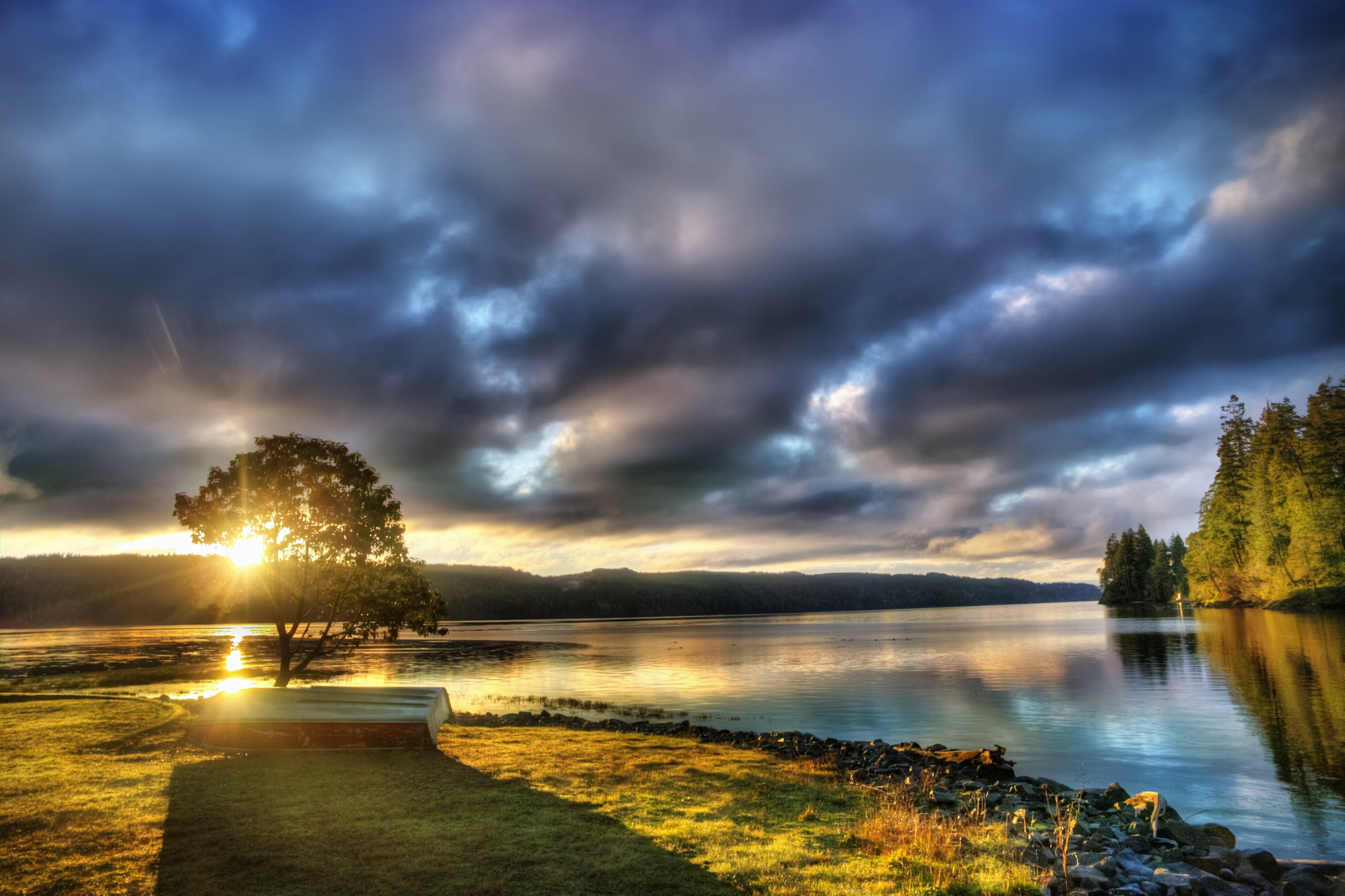
Do you know someone who delights in shooting the under-trodden nooks of Hood Canal? Someone who sleeps with a tripod and welcomes the sunrise DSLR-in-hand? Is this person you? We’re on the hunt for those who love to shoot the Hood Canal. Get in touch with us, and you might be featured as next month’s Spotlight Photographer.
Until then, keep an eye out for photographic inspiration on Facebook, Twitter, Instagram, and Pinterest, and be sure to tag your creations with #wildsideWA so we can keep tabs on your travels about the Olympic Peninsula.