

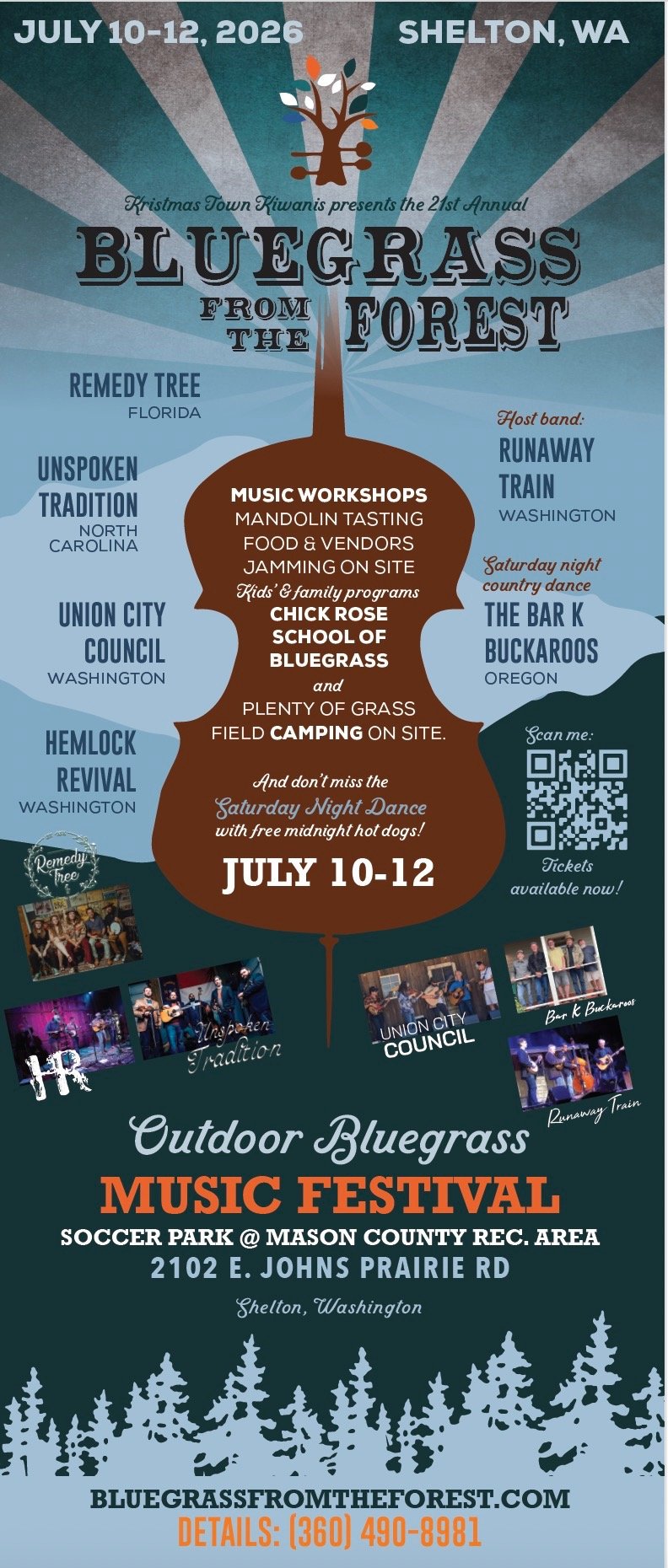
Bluegrass from the Forest celebrates 21 years!
Bluegrass From the Forest returns for its 21st year bringing another weekend of national bands campground picking circles, late-night jams, and family celebration to Shelton. Book now, early bird ticket pricing is available until June 20.
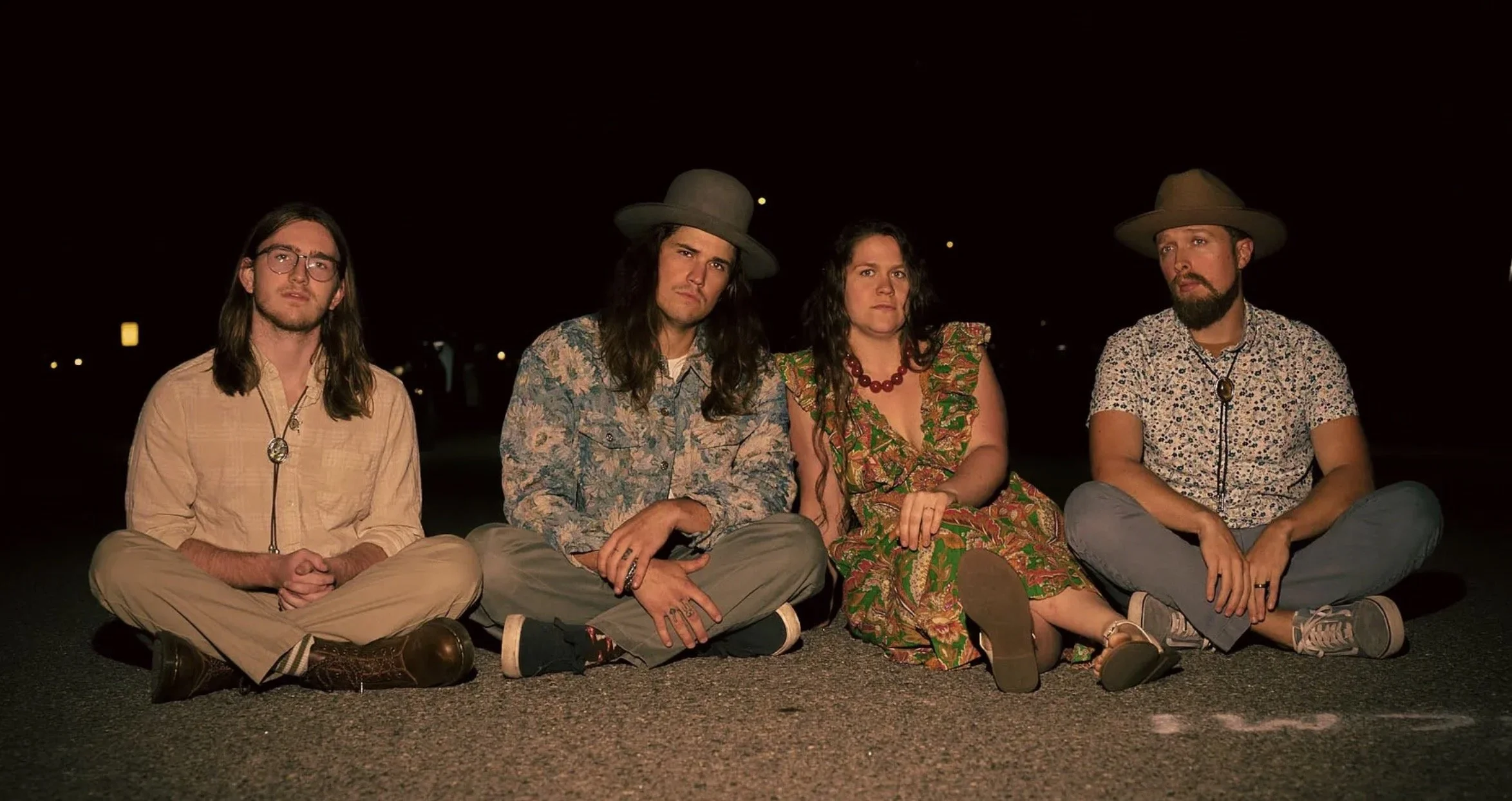
Florida-based Remedy Tree brings an Americana sound rooted in bluegrass, indie folk, and Appalachian old-time traditzions.
Bluegrass From the Forest returns for its 21st year this summer, bringing another long weekend of high-lonesome harmonies, campground picking circles, late-night jams, and community celebration to Shelton’s South Mason Youth Soccer Park. What began as a grassroots gathering has become one of the Pacific Northwest’s most beloved bluegrass traditions — equal parts music festival, family reunion, and all-night jam session beneath the fir trees.
Powered entirely by volunteers, the festival raises funds for the philanthropic efforts of Kristmas Town Kiwanis while drawing musicians and fans from across the country to the Hood Canal region. Alongside nationally touring acts, the festival continues its tradition of spotlighting Northwest talent, hands-on workshops, youth programs, open mics, and impromptu collaborations that often become the heart of the weekend.
The 2026 lineup promises a rich mix of tradition and forward-thinking string music. Florida-based Remedy Tree brings an Americana sound rooted in bluegrass, indie folk, and Appalachian old-time traditzions. Founded by husband-and-wife duo Gabriel and Abigail Acevedo, the band has evolved into one of the more distinctive young voices in modern bluegrass. Gabriel’s Puerto Rican heritage and rural Florida upbringing lend the music an outsider’s perspective, while Abigail’s roots in folk and old-time circles anchor the band in tradition. Together with Isaac Taylor and Nathan Beaumont, Remedy Tree delivers emotionally rich songwriting, driving instrumentation, and a fresh vision for where bluegrass can go next.
From North Carolina, Unspoken Tradition channels the spirit of Appalachian storytelling through hard-driving newgrass energy and deeply felt harmonies. Their sound balances nostalgia and momentum, blending reverence for traditional roots music with a contemporary edge that has made them a standout on the national bluegrass scene.

Unspoken Tradition sound balances nostalgia and momentum, blending reverence for traditional roots music with a contemporary edge.
Representing the South Puget Sound and Hood Canal region, Union City Council Band draws from old-time mountain music, blues, jazz, gospel, and folk traditions to create a lively, high-energy bluegrass experience. Featuring Guy Demartino, Greg Linder, Donald Strand, Martin Strand, and Gwendolyn Taylor, the quintet combines virtuosic instrumentation with rich vocal harmonies and a deep appreciation for traditional forms.
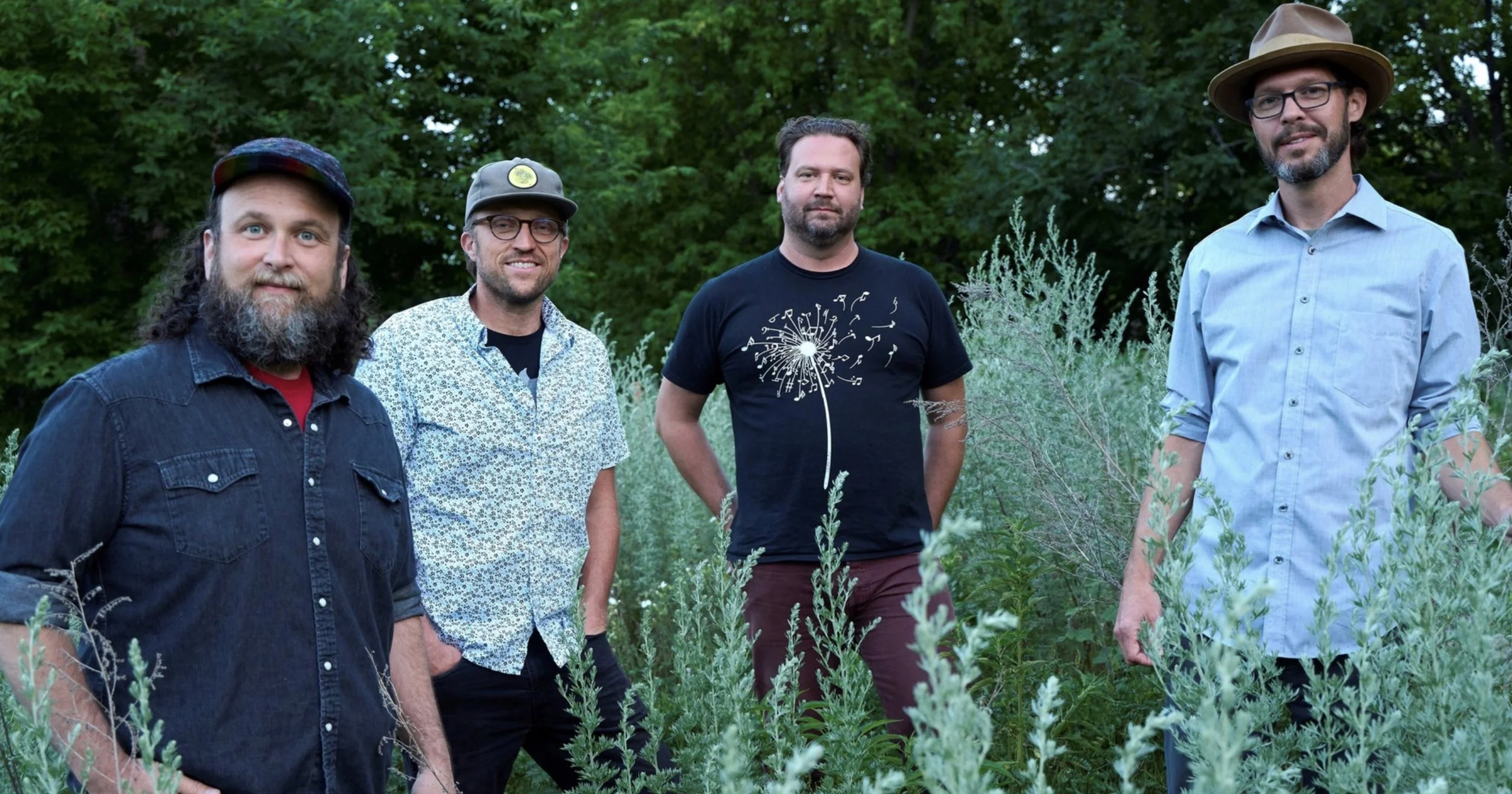
Seattle-based Hemlock Revival arrives as one of the Pacific Northwest’s most exciting emerging bluegrass acts. Formed through late-night jam sessions among friends, the six-piece group blends progressive influences from bands like Mighty Poplar and East Nash Grass with the timeless drive of classic bluegrass pioneers. Their dynamic performances and mountain-high harmonies have already earned attention at venues across the region, including Wintergrass showcases.
Like strong traditional bluegrass with an edge to it? Then you'll like Runaway Train Bluegrass! This band is known for tight harmonies and clean pickin'. A Pacific Northwest mainstay, they are the host band for Bluegrass from the Forest festival and they also play an important role in helping to get the festival going every year.
The Host Band for the Saturday Night Country Dance, The Bar-K Buckaroos play traditional western swing dance music in the style of Bob Wills and his Texas Playboys. They bring their love of Bluegrass, Country and Swing, Jazz, Blues and Raggae' to form a great evening of western swing and 20-40's era swing music.
Beyond the performances, Bluegrass From the Forest remains deeply rooted in participation and community. The Chick Rose School of Bluegrass returns Saturday morning with an intensive youth workshop led by Stacey Harnew, Jered Wildman, and crew. Designed for kids eager to learn bluegrass music in a supportive setting, the program has become one of the festival’s most cherished traditions.
The popular Band Scramble returns Saturday afternoon, giving attendees the chance to sign up, form impromptu bands, and perform together after just 30 minutes of rehearsal time — often resulting in some of the festival’s most memorable moments. And for those inspired by the campground jams and collaborative spirit of the weekend, the Open Mic offers a welcoming stage for original songs, spontaneous arrangements, and shared musical discoveries.
More than two decades in, Bluegrass From the Forest continues to embody what makes roots music festivals special: world-class musicianship paired with generosity, spontaneity, and a deep sense of belonging. Whether you come for the headline acts, the late-night picking circles, the kids’ programs, or simply the feeling of hearing banjos echo through the trees, the festival remains one of the Pacific Northwest’s most heartfelt summer traditions.
For additional details on band bios, ticket and camping reservations, visit bluegrassfromtheforest.com.
Early Bird ticket pricing is available until June 20.

Escape to Jarrell Cove State Park | Harstine Island, WA
Located on the northwest tip of Harstine Island in Mason County, Washington, Jarrell Cove State Park is a peaceful, saltwater playground with forested campsites, moorage for boaters, and plenty of space to kayak, paddleboard, or unwind by the water.
Located on the northwest tip of Harstine Island in Mason County, Washington, Jarrell Cove State Park is a peaceful, saltwater playground with forested campsites, moorage for boaters, and plenty of space to kayak, paddleboard, or unwind by the water.
In this video, Jeff Slakey from Explore Hood Canal explores the park with Ranger Liesl Plomski and Park Aid Lucas Marin to uncover its hidden history, local wildlife, and everything that makes Jarrell Cove one of the South Sound’s best-kept secrets.

From Logging Legacy to Natural Escape – Discover Schafer State Park
Take a journey through time and trees at Schafer State Park — one of Washington’s original state parks, founded in 1924 by the Schafer Logging family. Set along the beautiful Satsop River near Elma, this park blends rustic WPA-era craftsmanship with brand-new campgrounds and cabins.
Take a journey through time and trees at Schafer State Park — one of Washington’s original state parks, founded in 1924 by the Schafer Logging family. Set along the beautiful Satsop River near Elma, this park blends rustic WPA-era craftsmanship with brand-new campgrounds and cabins. In this feature, we explore the park’s rich logging legacy, the flowing Satsop, modern upgrades, and the peaceful recreation that keeps visitors coming back year after year.

Tips for taking your dog to The park
For dog families, it’s not a hike, camp out or road trip unless your four-legged trail buddy comes with you. While embarking on the adventure is optional, getting back healthy and whole is mandatory! Washington State Parks has some tips to leave you with only good memories when you visit.

For dog families, it’s not a hike, camp out or road trip unless your four-legged trail buddy comes with you. While embarking on the adventure is optional, getting back healthy and whole is mandatory! Washington State Parks has some tips to leave you with only good memories when you visit.
Trail tips
We know your dog wants to run free, but leash rules are not a punishment – they’re there for everyone’s safety. Your pup may be a big softie, but even saying, “It’s okay, they're friendly,” won’t assuage some peoples’ fear. Keep your dog from approaching people unless someone asks to pet him or her. Conversely, if your dog is not dog or people-friendly, please warn folks – especially children, before they get close.
Predator or prey?

In the natural pecking order, a dog can be seen as prey to some wildlife (raptors, big cats, coyotes, black bears) and a predator to others (deer, rabbits, marmot, turkey, horses). Leashing your pet can be the thing that keeps them from dinner – both eating and becoming.
Keep in mind that most prey will fight back, and getting gored by a deer is not how you want your pup to end their vacation. Also, when dogs chase wildlife – or something they see or smell – they can get lost or into deep water. Even if your dog is behaved at home, parks are abnormal environments that might be tempting for an off-leash dog to ignore. Tricky whales, seals and waterfowl have been known to lure dogs out into the water and exhaust them.
Trail hazard?

On mixed-use trails, heel or pick up your pooch if a horse or a mountain bike comes by. A horse can easily spook and injure itself, its rider or your party. Mountain bikes zip downhill at high speeds, and you don’t want your dog to chase and get in an accident.
Be my neighbor?
Camping with dogs is just fun. Pups provide warm cuddles and a feeling of safety for solo campers. And dogs + kids + snuggles in the tent go together like chocolate, graham crackers and marshmallows around the campfire.
But dogs hear and smell things we don’t, and they often feel the need to alert us. Your neighbors, however, may not appreciate Fido howling a warning at 2 a.m.
Consider booking a campsite on the end and/or outside part of the campground loop. One Parks staffer says she parks her car between her site and her neighbors’ to minimize stimuli.
Most parks welcome dogs, but we do have a few culturally or environmentally sensitive areas where they’re not allowed. Look up your destination on parks.wa.gov to make sure bud can accompany you on all parts of your state park getaway.
6 Tips for Hike Savvy Canines
Like house-bound humans, dogs need a little prep time to get ready for the trail. Here are six tips to help you and Fido have a safe and fun adventure.
#1 Take it Easy : Start with easy trails and slowly build up stamina & strength.
#2 Care for Tender Paws: Make sure your dog's pads are toughened or purchase hiking booties and let him get used to them before heading into the wild.
#3 Yield to oncoming traffic: No matter how sweet Fido appears, its good practice to verbalize how friendly he is. Step off the trail when hikers pass and heel your dog.
#4 Leash Control: If the trail requires leashes or if if your dog might run into other hikers, keep him on a short leash (-6') since a long leash is more likely to get tangled on brush. Your dog should not be allowed to roam freely.
#5 Leave no trace: Bring bags to collect and carry out your dog’s poop. If you’ll be backpacking overnight, bury it at least 6” deep and at least 200 ' from walkways, camps, and water sources.
#6 Command Ready: Hazards in the woods differ than the cul de sac. Don’t let your dog stray. Some plants are poisonous, and some creatures bite and may host diseases. Irressistable smells will lure pooch away in a flash. Make sure your obedience training is on track.
Visit backpacker.com for more ideas on a safe and rewarding journey!

The Top 5 | Camping on and around Hood Canal
Whether you prefer the simplicity of tent camping or the comfort of RVs there are plenty of campgrounds on and around the Hood Canal to choose from. From your campsite you can take day trips to explore surrounding forests, rivers, and beaches or just relax under the trees and listen to the birds.

Whether you prefer the simplicity of tent camping or the comfort of RVs there are plenty of campgrounds on and around the Hood Canal to choose from. From your campsite you can take day trips to explore surrounding forests, rivers, and beaches or just relax under the trees and listen to the birds. For some inspiration to plan your Summer trip to the Hood Canal the staff at Hood Canal Adventures have made up their list of top 5 favorite drive-in campgrounds.
The Top 5
#1 Collins Campground
Collins Campground is located within the U.S. National Forest in the Brinnon area. Nestled under giant Bigleaf Maple trees and directly on the Duckabush River, it contains only 16 sites with no-hook ups: and this is why we love it! From here you are within only a few miles from some of the areas most popular hiking trails including Murhut Falls, Ranger Hole and Duckabush Trail. Shellfish can be gathered nearby at the Duckabush or Dosewallips tidelands when the season is open for clam and oyster recreational harvests. The campground is first come / first served and is open mid-May through September. Visit fs.usda.gov or call the USFS Hood Canal Ranger District (360) 765-2200 for details.
#2 Seal Rock Campground

Seal Rock is another U.S. Forest Service campground in the Brinnon area, however this one is located directly on the Hood Canal with beach access. Forty-one tent and RV campsites are shaded beneath the evergreen trees, some with water views. There are no RV hook-ups but the campground does have fresh water, flush toilets and electricity in the restrooms. Oysters litter the beach at low tide for you to harvest and cook up over your campfire. The campground has an area to walk-in your small boat or kayak for exploring the Hood Canal or harvesting Dungeness and Red Rock crab. Hood Canal Adventures of Brinnon will deliver your kayaks, paddle boards, and crab pots if you choose to rent. Seal Rock Campground is first come / first served and open April through late September. Visit fs.usda.gov for details.
#3 Twanoh State Park
Twanoh State Park really has it all! Located on the southern end of the Hood Canal just outside Belfair, you’ll enjoy 22 full hook-up campsites and 25 tent sites, a pump-out station, boat launches and a dock, showers, covered picnic areas, group sites, a staffed park office and store, and even kayak rentals. Over 3,000 ft. of marine shoreline offers shell fishing opportunities and warm summer waters are perfect for swimming and water play. A few campsites are open all year but the beachfront area is open April through mid-October only. Twanoh State Park is first come / first served. Visit parks.state.wa.us or call 360-275-2222 for details.
#4 Potlatch State Park
Potlatch State Park is a 57-acre camping park with 9,570 feet of saltwater shoreline on Hood Canal. The park's beautiful grounds are home to a variety of activities, from interpretive programs for kids to boating and shellfish harvesting. The park has 19 tent spaces, 18 utility spaces, one dump station, one restroom and two showers. Sites have no hook-ups. Maximum site length is 60 feet (may have limited availability). Two of the tent sites are for primitive use (hikers and bicyclers) only. The Park is divided by Hwy 101 so choose sites that are further away from the road if possible.
#5 Lake Cushman
OK, this isn’t actually a campground but the Lake Cushman area is stunning and well worth exploring. Lake Cushman is located near Hoodsport between the Hood Canal and the Olympic Mountains. Its clear blue waters are framed by beautiful forests and snowy mountain peaks. Popular activities include fishing, hiking, climbing, boating, kayaking, and swimming. There are several campgrounds at the lake but we couldn’t agree as to which is our favorite. Therefore, here's a short list to start you off: Skokomish Park Lake Cushman with 80 RV, tent sites, boat launch, and lake access; Staircase Campground with 49 tent and RV sites on the Skokomish River at the Olympic National Park’s most southern access point; and Big Creek Campground, a 64 site U.S.F.S. Campground which also serves as the trail head to several hiking trails.
The Hood Canal area offers opportunities for camping whether they be county, state, federal, or private campgrounds. There are many back-country and boat-in only camping areas to explore. Come find your favorite! To discover more campgrounds in the area click here.
Christina Maloney is owner of Hood Canal Adventures in Brinnon, a Fisheries and Marine Biologist, and a local outdoor enthusiast.

Do the Dosewallips
Well-known for its year-round family-friendly campground (complete with yurts) and excellent fishing and shell fishing opportunities, the park also contains a wonderful network of year round accessible hiking trails.
Craig Romano, author
Dosewallips State Park consists of more than 1000 acres of prime wildlife habitat along the Dosewallips River at its delta on Hood Canal. Well-known for its year-round family-friendly campground (complete with yurts) and excellent fishing and shell fishing opportunities, the park also contains a wonderful network of hiking trails. Saunter out to wildlife rich tidal wetlands on Hood Canal or explore quiet groves of mature forest graced with thickets of rhododendrons and cascading creeks. Hike along the glacier-fed Dosewallips River too. And retrace the route of an old railroad grade while sleuthing for relics of the area’s bygone logging days.
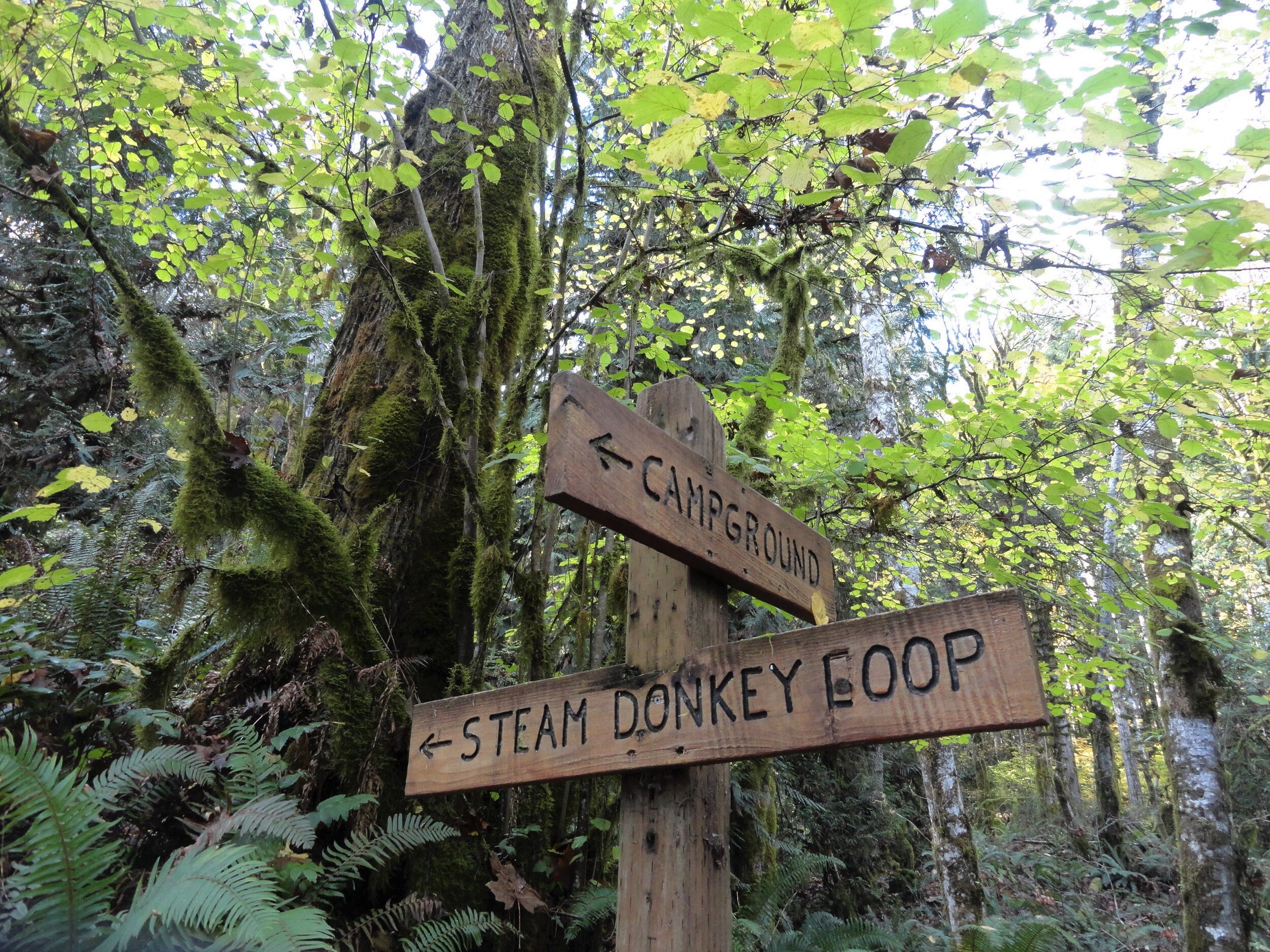
Photo credit: Craig Romano
Hit the Trail
There are nearly five miles of trails in Dosewallips Park to explore with your family. Most of them are interconnected allowing for some loop options. An excellent 3.6 mile loop around a good portion of the park’s periphery can be made by following the Maple Valley and Steam Donkey Trails.

Start this loop hike from the ranger station by walking a short distance northwest up the dirt road signed for the Maple Valley Trail. After passing through the Meadow Group Camp, reach the Maple Valley Trailhead. Now head up the trail and soon come along the Dosewallips River.
Legend has it that Dos-wail-opsh was a Twana Indian who was turned into a mountain, forming the source of the Dosewallips River. From his lofty position in the Olympic Mountain wilderness, this transformed Native American did well by creating one of the peninsula’s most wild and scenic rivers.
The Twana once had a village at the mouth of the river on Hood Canal. In 1855 the Treaty of Point No Point resulted in many of the Twana people being relocated to the small Skokomish Reservation located at the mouth of the South Fork of the Skokomish River.
Hike along the river through a forest of cedars, cottonwoods and of course—maples, both bigleaf and vine. In fall the maples add touches of gold to the forest. Scan the forest for elk. They are prolific in this area and are frequently sighted in the state park. If you don’t see any of this hike, you’ll probably see plenty of signs of their presence.
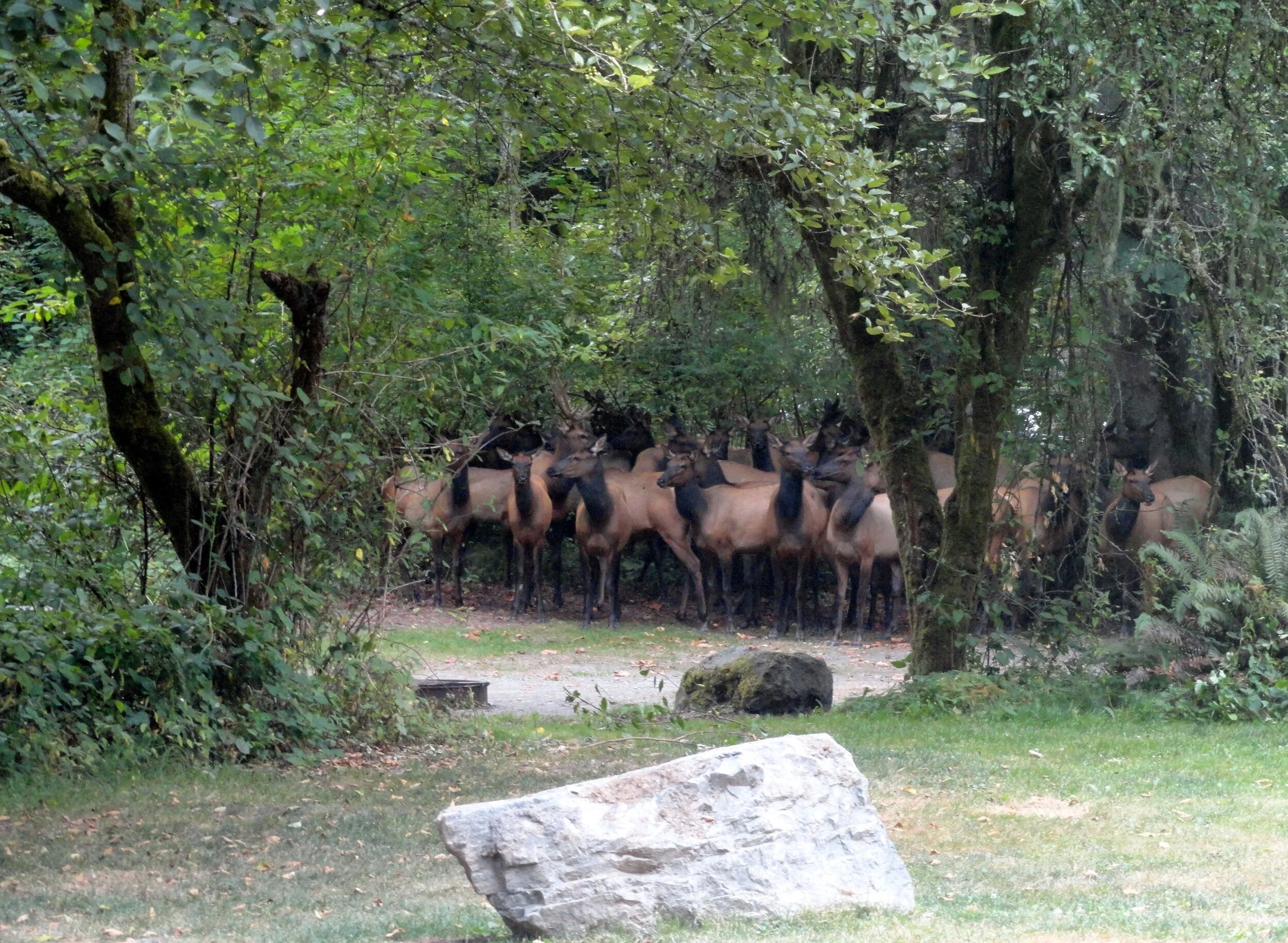
Photo Credit: Craig Romano
Continue along the trail hugging a steep slope above a river channel. The way then reaches a junction with the Rhody Cut-off Trail. You’ll be returning on that trail for this loop—so continue right. The way now gently descends to a bridged crossing of cascading Phantom Creek.
Then it’s time to climb again as the trail ascends a steep bluff and moves away from the river. Washington State Parks has been working with several agencies to greatly increase the size of this park to protect more riverfront. Once public access can be secured, there are plans to construct a trail along the river from the state park to national forest land about five miles upriver. Much of the new protected river corridor will be included in the state park.
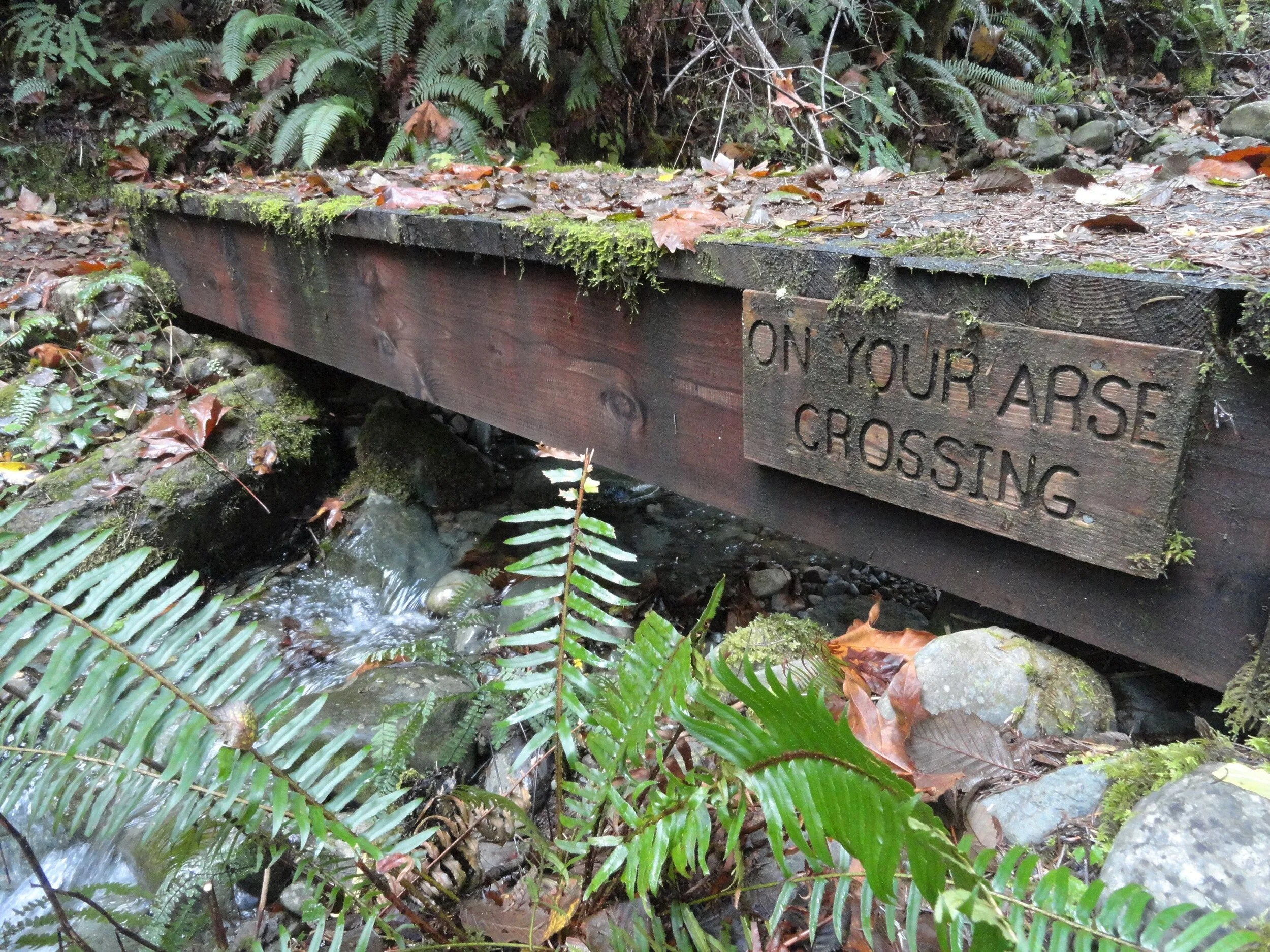
Photo Credit: Craig Romano
The Maple Valley Trail now bends southward skirting an old cut along the park’s current boundary. At about one mile from your start it reaches a fire road. The road can be used as a short-cut back to the campground.
To continue the loop proceed straight on the Steam Donkey Trail. Steam donkeys were steam powered winches used by loggers in the early twentieth century for yarding and loading downed timber.
Here as well as throughout much of the region timber was transported by rail to sawmills or to docks where it was floated to mills
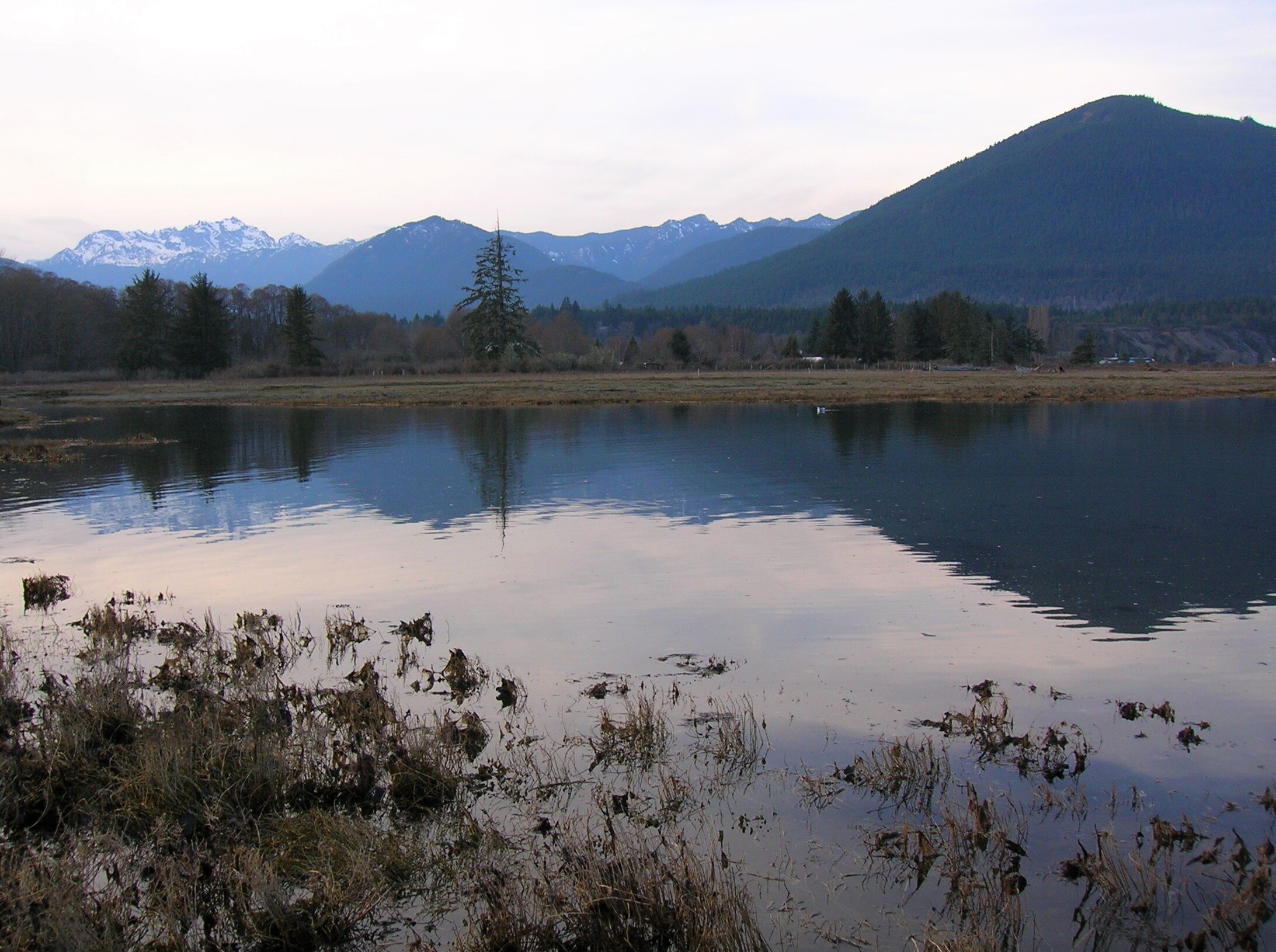
Photo Credit: Craig Romano
Running parallel to the Steam Donkey Trail and reached by walking just a short distance east on the Fire Road is the Izett Grade Trail. This trail follows a half mile stretch of an old railroad grade. The Izett Logging Company had constructed five miles of railroad in this area in the late 1890s. Logs were then transported to Hood Canal and floated to a mill in Seabeck. The Izett Grade Trail eventually reconnects with the Steam Donkey Trail and shortens the loop by only 0.1 mile.
The Steam Donkey trail continues south along the state park boundary gently climbing through maturing second growth. The trail passes a large fir struck by lightning in 2001 before crossing Phantom Creek. It then comes to a small bridge whimsically named the On Your Arse Crossing. The way then spans another cascading creek before cresting a ridge. It then begins a long gentle descent following an old road grade through maturing timber. After passing the southern end of the Izett Grade Trail the loop reaches a small dammed pool that once provided water to power the Izett Logging Company’s steam donkeys.

Photo Credit: Craig Romano
The trail then once again comes to the Fire Road. Cross the road and continue straight passing part of another stretch of old railroad bed. The logging railroads here were decommissioned in 1913 shortly after the logging company’s founder James Izett passed away. The trail next descends into a gulch coming to a junction. You can shorten the loop by heading right reaching the park road after crossing the short metal bridge
The recommended loop heads left now following the Rhody Cut-off Trail. It soon makes a bridged crossing of a creek shaded by attractive cedars; then veers left at a junction where a spur trail heads to a group camp. The trail then climbs a low ridge draped with rhododendrons. You’ll want to return to this stretch of trail in May or June. The Rhody-Cut-off Trail then loses elevation returning to the Maple Valley Trail. Return to your start by retracing a short stretch of trail to your right.
If you’ve got time and energy leftover, head over to the park’s North Tidal Trail. Follow this 0.3 mile trail to an observation deck near where the Dosewallips River drains into Hood Canal, creating a productive delta and estuary. Scan this ecologically rich ecosystem for seals and a wide array of birds.
Additional Details
Dog welcome but must be leashed while on the trail.
Land Agency Contact:
Dosewallips State Park
Recommended Map: Green Trails Olympic Mountains East 168S; State park map available at park ranger station.
Recommended Guidebooks: Day Hiking Olympic Peninsula 2nd edition (Romano, Mountaineers Books)
Trailhead Directions: From Shelton, drive US 101 north for 40 miles (From Quilcene drive US 101 south for 12 miles) to Dosewallips State Park entrance at milepost 307. Turn left (west) into camping entrance and proceed .3 mile to parking near ranger station.
Day-use parking is also available at picnic area and North Tidal Area Trailhead, trailhead facilities here include: privy, picnic area, ranger station, campground, and potable water.


Big Loop Creek Hike - for all seasons and abilities
Guidebook writer, Craig Romano, takes us on an illustrated journey around Ellinor. Churning Big Creek and its tributaries will charm you with their frothy displays and soothe you with their flowing melodies.
Craig Romano is an author of more than twenty hiking guidebooks including the bestselling Day Hiking Olympic Peninsula 2nd Edition (Mountaineers Books), which includes detailed descriptions for 136 hikes throughout the Olympic Peninsula. He is a featured columnist for the Fjord and Explore Hood Canal.
Jeff and his mom hiked the Big Creek Trail loop in mid August — check out their review of this hike marked moderate.
“Poets need not go to Niagara to write about the force of falling water,” wrote Robert Frost. Indeed. Amble along this circuitous route within the shadows of Mount Ellinor and see the forces of water all around you. Be continuously captivated by cascading creeks. Churning Big Creek and its tributaries will charm you with their frothy displays and soothe you with their flowing melodies.
Big Creek Loop
Distance: 4.2 miles roundtrip Elevation Gain: 850 feet High Point: 1850 feet Difficulty Loop: moderate Snow free: year round Trailhead Pass Needed: Northwest Forest Pass or Interagency Pass GPS waypoints: Trailhead: N47 29.599, W123 12.66 Features: cascading creeks, attractive bridges, rhododendrons, snow-free winter hike; kid and dog friendly,

photo: Craig Romano
Hit the Trail
The 4.2 mile Big Creek Loop doesn’t go to a lake, high point, significant landmark or through groves of primeval forest. It just goes around the Big Creek basin crossing that banally named waterway and a handful of its tributaries. This hike is all about the journey—not the destination. The trail winds along forested slopes above Lake Cushman crossing tumbling creeks on a series of beautifully-constructed bridges.
" This hike is all about the journey—not the destination."
A couple of side trails branch off of the main loop to hidden cascades crashing among jumbled boulders. Hike this trail without an agenda—just set your mind free—and pause frequently to admire the show. Generally snow-free in the winter and with easy accessibility, Big Creek can be hiked year round.
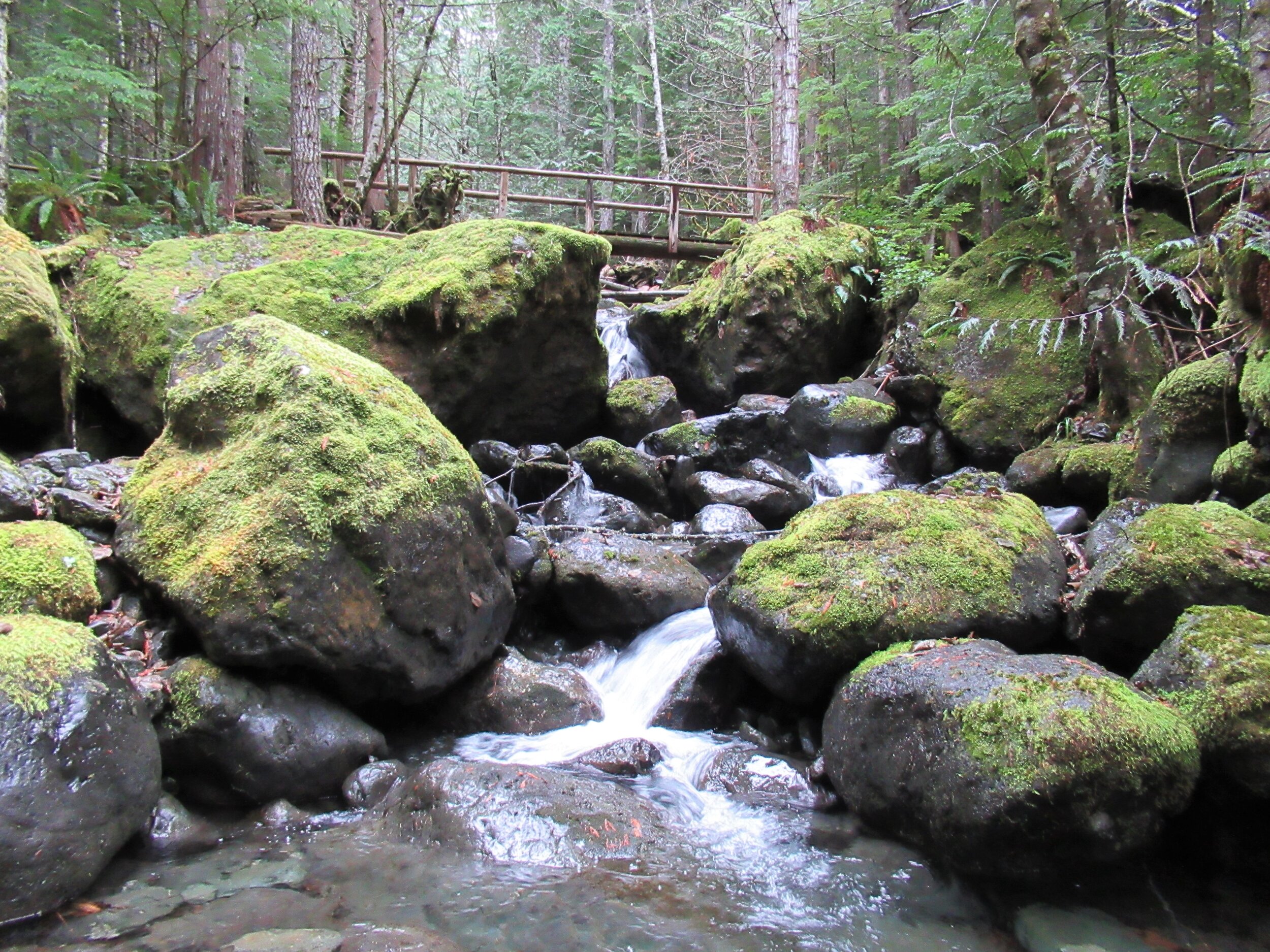
photo: Craig Romano
While it makes for a nice walk on a hot summer day with its shaded glens offering respite from midday rays—autumn through spring are best. Forested all the way, and always within earshot of tumbling water, the Big Creek Trail makes an excellent rainy day hike. Try to plan it after a period of prolonged rainfall for intense water shows that roar through the forest.

photo: Craig Romano
Utilizing old logging roads and newer tread, the all-volunteer Mount Rose Trail Crew built this delightful loop twenty year ago. “We have existed since 1985,” states Mount Rose Trail crewmember John Jurgens. The crew began as a group of Shelton area climbers who grew concerned over the increasing popularity of the old Mount Ellinor Trail. The old trail contained a section known as the “Chute” which was a hazardous rock and snow-filled gully. With the Forest Service’s blessing the crew constructed a new trail bypassing the chute allowing hikers a much safer passage on this popular trail.
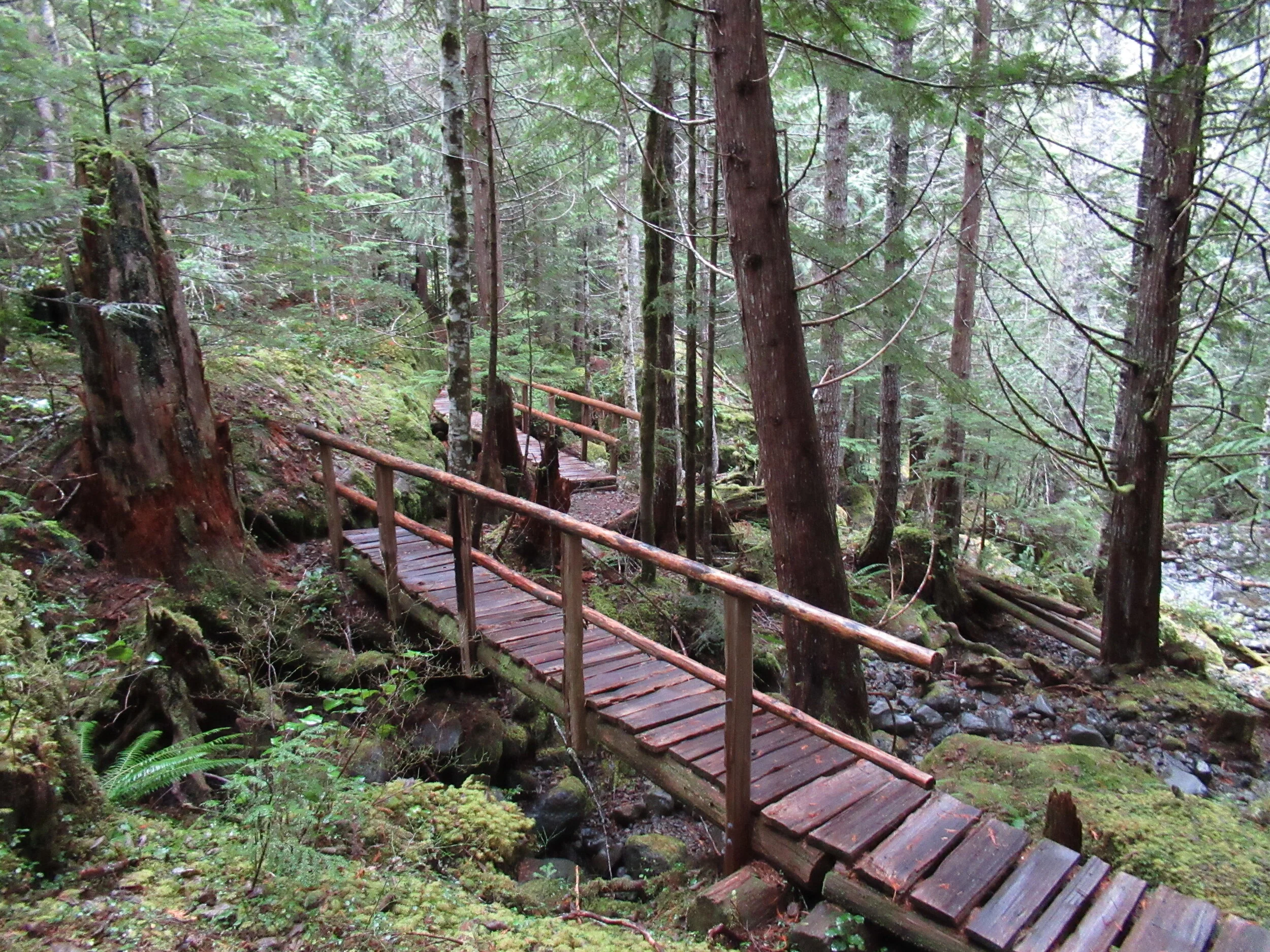
photo: Craig Romano
The crew took their name however from nearby Mount Rose. They worked on re-establishing the upper Mt Rose Trail when snow cover on Mount Ellinor didn’t permit them to work there.
From an original group of about 5, the crew now boast a half dozen members who hail from around the Hood Canal Region. They currently maintain 16 trails in the Olympic National Forest. The Big Creek Loop showcases their topnotch bridge building skills. Robust and built to last as Jurgens puts it, I find the bridges works of art that fit in well with their surrounding natural environment.
"The bridges for many hikers are the highlights of this hike. And children will find them especially appealing."
The trail starts from the recently rebuilt and expanded Big Creek Campground. Here follow what is officially called the Upper Big Creek Loop Trail. Most folks however just refer to it as the Big Creek Loop. The recommended direction is clockwise to take advantage of a gentler descent that will be easier on the knees. The trail immediately crosses Big Creek on a sturdy bridge—one of two provided by contractors and not the trail crew whom built bridges on site with area materials. You’ll immediately recognize the craftsmanship upon reaching them.

photo: Craig Romano
The trail briefly heads down stream along the creek before making a U-turn to begin ascending above it. Signed features and resting benches grace the way. After about a mile the grade gets steeper. Catch glimpses through gaps in the forest canopy of Mount Washington hovering above. At 1.8 miles you’ll come to a junction. You can take an interesting short side trip here on the Creek Confluence Trail which drops to the confluence of Big and Branch Creeks before looping back to the main trail. Here you’ll find good lunch rocks among the two tumbling waterways.
The Big Creek Loop continues straight coming to a junction with the Mount Ellinor Connector Trail just before reaching Branch Creek. The Connector Trail leads left 1.4 miles to the Mount Ellinor Trail and allows for a long and challenging ascent of that popular peak. If you’ve got some energy head one mile up it to a good viewpoint overlooking Lake Cushman,

photo: Craig Romano
The loop continues straight crossing Branch Creek on a good bridge. Just beyond it reaches Big Creek above a gorgeous cascade. Here a new well-constructed bridge spans the tumbling waterway.
The loop now begins descending, skirting some big mossy boulders and passing good views of roaring Big Creek. A short side trail—once part of the Creek Confluence Trail drops back down to where Big and Branch Creeks meet. The main trail now follows an old road, coming to bridged crossings of scenic Skinwood and No Name Creeks. Continue descending passing a few giant firs that loggers forgot. Notice the forest change here. The west half of the loop was dominated by hemlocks—while the eastern half is made up more of Douglas-firs and lodgepole pines. The understory is different too—cloaked here in salal.
Be sure to look up through the trees for a glimpse of Mount Ellinor rising above the watershed. At 4.0 miles come to a junction with the Campground Loop Trail which loops around the campground for 0.8 mile if you want to extend your hike. Otherwise continue right a short distance to return to the trailhead.
Notes:
Land Agency Contact: Olympic National Forest, Hood Canal Ranger District, Quilcene, (360) 765-2200; fs.usda.gov/olympic
Recommended Map: Green Trails Olympic Mountains East 168S
Guidebooks: Day Hiking Olympic Peninsula 2nd edition (Romano, Mountaineers Books)
Trailhead directions: From Shelton, travel north on US 101 for 15 miles to Hoodsport. Turn left onto SR 119, and proceed 9.3 miles west to a T intersection with FR 24. Turn left and then immediately turn right into the Big Creek Campground continuing a short distance to the Day Use Area and trailhead. When campground is closed, park at gate, but do not block it.
Trailhead facilities: privy, picnic area, campground, water.
Dogs welcome but must be leashed.

Twanoh State Park Trails -- Day hiking around Alderbrook Resort & Union
Number #2 on our best hikes around Hood Canal according to Craig Romano is Twanoh State Park’s hiking trails. Famous for its large beach on Hood Canal with some of the warmest salt water in the state, many who flock to this park, go straight to the beach or the campground, leaving the 182-acre park’s hiking trails pretty quiet.

Craig Romano
Famous for its large beach on Hood Canal with some of the warmest salt water in the state, many who flock to this park, go straight to the beach or the campground, leaving the 182-acre park’s hiking trails pretty quiet.
Locate the trailhead and start hiking on a wide trail through a cluster of rhododendrons. The way parallels gurgling Twanoh Creek which forms a small delta on the park’s beach. The trail soon comes to a junction.
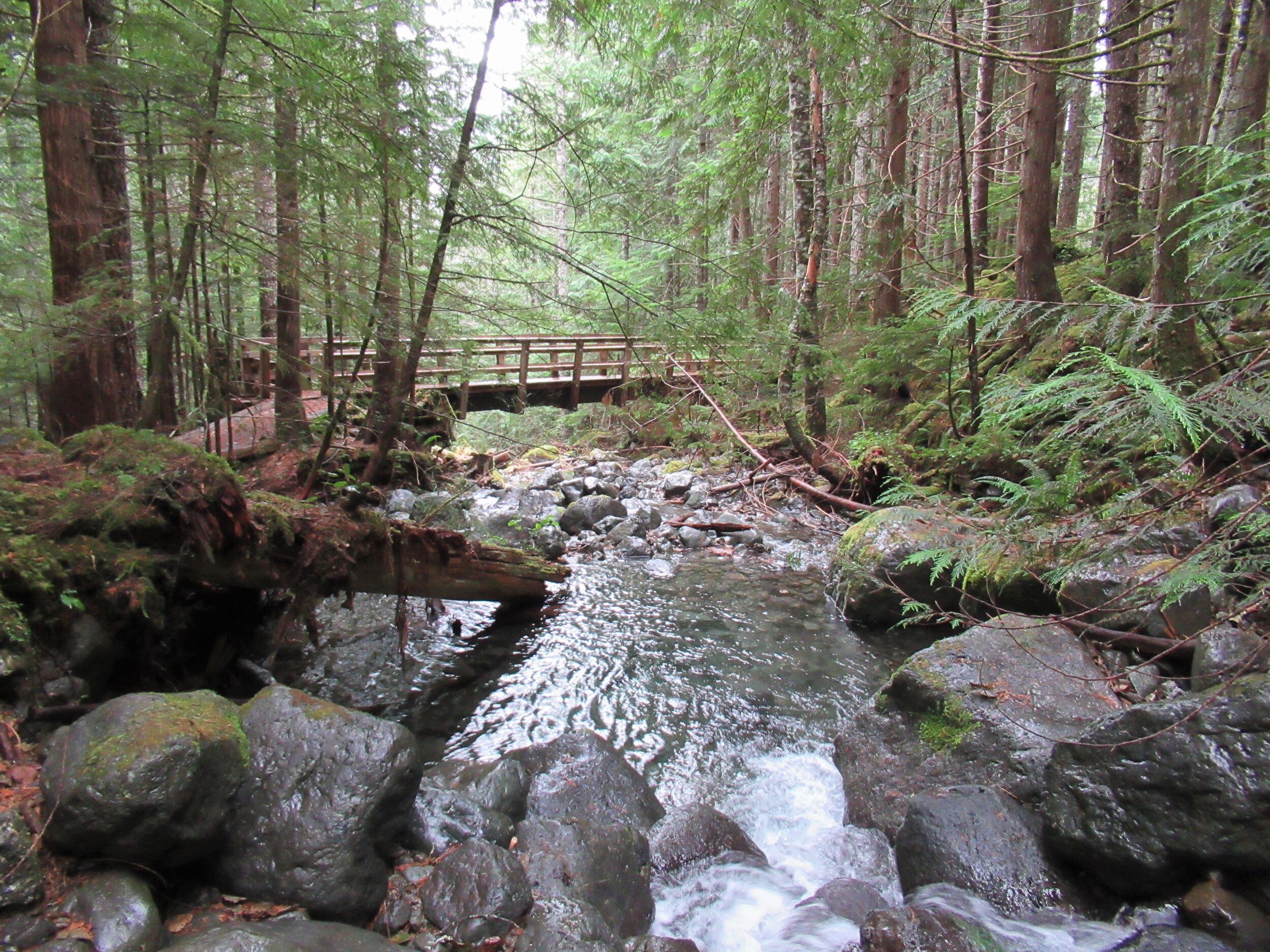
Here a side trail crosses the creek on an attractive bridge and reaches the campground—an alternative start if you’re camping in the park.
The main trail continues straight through a tunnel of rhododendrons and a grove of big cedars. It then begins working its way up a small ravine cradling the small creek. While this ravine was logged in the past, the second growth forest here is now quite mature.
At .3 mile come to a junction for the loop.
While you can go either way, head left for a clockwise loop and a gradual ascent and transition out of the ravine. As you ascend out of the tight draw, the salal and evergreen huckleberries thin out.
It’s much drier on the ridge above the ravine. After two switchbacks, the trail reaches the head of the ravine. Now head right following an old woods road.
The walking is easy going. Slowly descending come to a group campsite. Then come to another junction. The old road continues straight leading back to the Day Use Parking Area and can be used as an alternative return.
The loop continues right on a switchback descent back into the ravine. Take it passing by a few big old Douglas firs and clusters of leathery-leaved rhododendrons. Reach the loop junction and head left back to the trailhead—and perhaps a trip to the beach.


Mountain Biking Lower South Fork Skokomish
The fall colors on Hood Canal are heralding the close of summer. Time to head to the hills to embrace the much needed rains in the Olympic National Park as the hills and valleys go back to the Technicolor spectrum of green.
Whenever the impending rains approach Olympic National Park, they turn our hills and valleys back into the spectrum of green that makes home feel like home.

Photo Credit: Bike List
For some of us, that means misty morning walks up our favorite mountains (like Mt. Ellinor), for others, that means relaxing indoors with a good book, but for those of us that feel best while we are two-wheeling, that means tacky dirt and flowy mountain biking trails!
Grab your elbow pads and helmets, and tune up your metal steeds as we embark on our newest in the Hood Canal Travel guide.
Fuel Your Fire | 9AM
Serious riders (or pure-and-simple fun-seekers like us) need a belly full of goodness to fuel a full day of thrill-seeking. If you’re an early bird and a breakfast fiend, stop into Blondie’s for down home from-scratch diner food. The biscuits and gravy take the cake at this friendly local joint.
Hit the trail | 11AM
After meandering down some forest roads underneath the towering Olympics, come to the Lower South Fork Skokomish River Trail #873. Characterized by its intermediate single track riding through some of the finest ancient forests in the Northwest, this ride serves up a bit of everything. Doable as a 20.9 mile loop, if you care to climb the road and ride trail down although most prefer to ride single track up the trail and then back down.
Olympic elk still roam the hillsides, and as you are slashing short, quick ascents and sending sometimes rocky and rooted descents, take in the uncontested beauty of the river valley sliced by the surging Skokomish River.

"I love this fun, flowy cross-country trail that parallels the South Fork of the Skokomish River. It has a bit of everything!" - Jaime, local bike shredder
Before embarking, be sure to check trail conditions here, and prepare to be without cell service by having a good map and a USFS Rec Guide. Keep in mind that, like most USFS land, a Recreation Pass is required, which you can find here, or at a number of local businesses like Verle’s Sports Center and Marine in Shelton.
Treat yourself to a view | 2pm
Before that plastered grin that characterizes a good ride fades away, get yourself to one of the most recognized historical relics of Hood Canal. From the trailhead, a short 20 minute drive takes you to the High Steel Bridge. The highest railway arch ever built in the United States spans the South Fork of the Skokomish (a river that you are already quite familiar with) a dizzying 365 feet above the forest floor. Originally constructed in 1929 by the Simpson Logging Company, the bridge was converted to road use in 1950.

As you flip through the memories of a day well spent, remember that we love keeping up with you! Tag your photos and thoughts on social media with #explorehoodcanal #wildsideWA #hoodcanal. Be sure to check in with us on Facebook, Twitter, Instagram, and Pinterest for more ideas on how to get the most out of your road trip to Hood Canal. Happy trails.
Daily: 5am-9pm
360.432.2777
Lower South Fork Skokomish River Trail #873

Two ways to "glamp" hood canal
The scenic stretch of Hood Canal between Hoodsport and Brinnon has recently seen the additions of some unique accommodations – glamping platform tents. Sund Rock’s platform tent at Sund Rock diving preserve is simpler than the newly opened Iliana’s Glamping village — but both elevate the camp experience and have spectacular scenery.
The scenic stretch of Hood Canal between Hoodsport and Brinnon has recently seen the additions of some unique accommodations – glamping platform tents. Near Hoodsport, the Sund family hosts couples at their private glamp tent at the Sund Rock Marine Preserve and this summer Mike’s Beach Resort in Lilliwaup converted their traditional campground into Iliana’s Glamping Village.

Sund Rock glamping tent open from May through September is perfect for couples looking for a unique Northwest experience.
What is glamping?
To many of us glamping sounds a little over the top. Even the word root – glamor – is decadent. Especially when combined with the most basic of accommodations – camping. But these places are anything but “basic.”
There are plenty of definitions of glamping. Some feel that cooking on anything beyond an open campfire is glamping. Or sleeping in a bed off the ground, or in a basic cabin or RV. Whatever your definition, glamping it is bringing a whole new level of interest to the camping scene. And with the pandemic, the idea of sleeping in a "tent" over a hotel has brought a certain attraction.
""During Covid some guests expressed hesitancy with coming even to a cabin even though we're not a traditional hotel with a lobby or elevator. Our tents are a great option for those who are interested in getting back out into the world but maybe not wanting to be in a building like a hotel. Everybody is able to get to their own private facility and there's plenty of moving air."

Iliana’s Glamping Village
Sara and her family recently opened the tent glamping village at their resort on Hood Canal. The traditional Mike's Beach Resort included guest rooms and cabins but this network of ten glamping tents and all their amenities tucked into the woods below shadow of the Olympics creates a whole new vibe.
Mike’s Beach Resort converted their 70+ year old campground area to accommodate the ten platform tents complete with fire-pits, showers and flushing toilets, and affectionately coined it Iliana's Glamping Village.

The private recreation at Sund Rock
Further down the Canal the Sund family has found a way to share the experience of their property to more people. Most of the year The Sund Rock Marine Preserve is clamoring with scuba divers hoping to catch an encounter with Giant Pacific Octopus or wolf eels. As the water warms, July through September, plankton and algae blooms make the visibility nil for divers. This is a perfect time to open the area up to visitors to the glamping tent. A little simpler than Iliana's Glamping Village (no chandeliers hanging from the ridge pole and you need to bring your own linens) at Sund Rock you’ll find a queen-sized bed, heat, power, and the views from this private beach getaway are unparalleled.
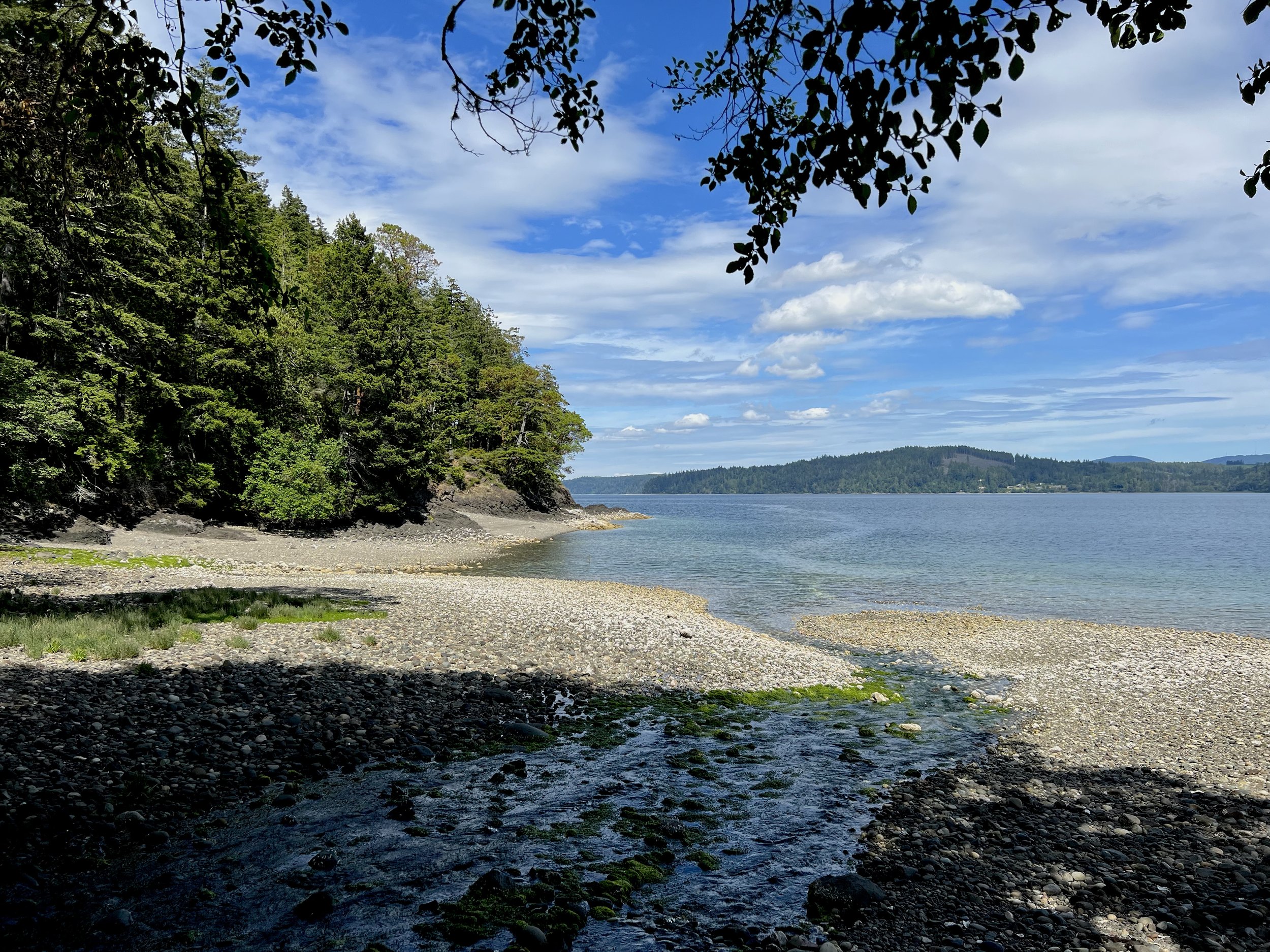
The view from Mike’s Beach Resort overlooking the Canal and oyster beaches
Lodging Profile #1:
Iliana’s Glamping Village
Lilliwaup, WA
For nearly seven decades, the Shultz family has owned and operated their waterfront rustic and welcoming Canal getaway, Mike’s Beach Resort. Mike and Iliana have recently passed on some duties to daughter, Sara, and her husband, Matt, who also raise oysters on the Resort’s tidelands. We recently caught up with Sara to learn a little about the history of Mike’s and their expansion into the glamor-camping market.
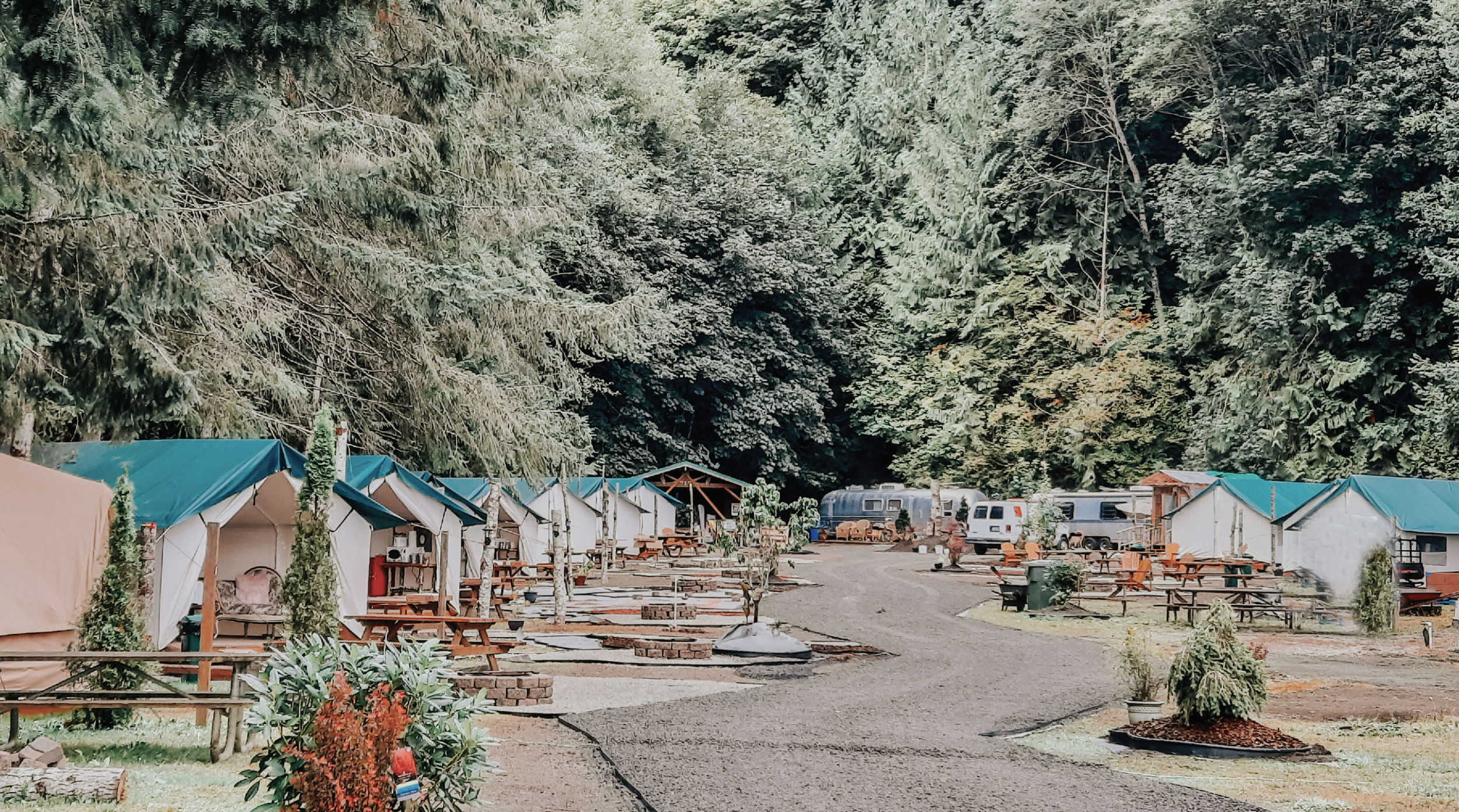
“Mike's Beach Resort was built by my grandparents in 1951,” recounts Sara in the tour of the facility, “they named it after my father, Mike. They started off with a few cabins on the Hood Canal and kept building more every few years.” Along with the recent addition of the glamping village the resort features fully equipped cabins and even a 1969 Airstream trailer with outdoor hot tub. Many of the units are pet-friendly and, along with the beach providing hours of distraction, there are walking trails and a playground. The resort also hosts a launch, dock, moorage, kayaks and paddle boards for rent, and air for scuba visitors. Mike’s is very popular with dive groups with numerous famous cold water dive sites in the area. Many guests return annually to enjoy the shrimp, crab, and salmon seasons on the Canal.
Following the curve of the valley and arranged to provide privacy and views of the Canal below the road, the cluster of platform tents at Iliana’s Glamping Village offer a unique experience that rivals the amenities of a luxury hotel. Each tent is elevated and lined to protect guests from the elements and include electricity, comfortable queen- and king-sized beds, dining areas, coffee makers, toasters, outdoor BBQs, lawn chairs, fire pits as well as access to warm showers and flushable toilets.
Many of the units include fold out futons for additional guests and all the units are custom furnished with a theme. And yes, there are even chandeliers and fans!

Each cabin at the glamping village is custom themed
"As a bonus-bonus," Sara states proudly as she gestures to the bay below, "we have an oyster farm right in front." Their oyster farm is open during low tide for harvest and guests can grill fresh from the beach at their private tent.
During the summer Mike's Beach Resort plans to feature live music and outdoor grill with oysters and burgers on Saturday nights – but any night will be an experience!
Visit mikesbeachresort.com for details and reservations.
Lodging Profile #2:
Sund Rock gets you close to nature
Sund Rock Marine Preserve Glamp Tent | Hoodsport, WA
Colbein John Sund, a young seafarer from Scandanvia staked his homestead claim on Hood Canal in 1888, ten months before Washington became a state. It was while sailing through Puget Sound and seeing the narrow inlet of Hood Canal that he was reminded of the fjords at home in Norway. He explored the shores of Hood Canal and found an abandoned cabin in a quiet valley. He decided that this was the perfect place to start his family’s history on Hood Canal.
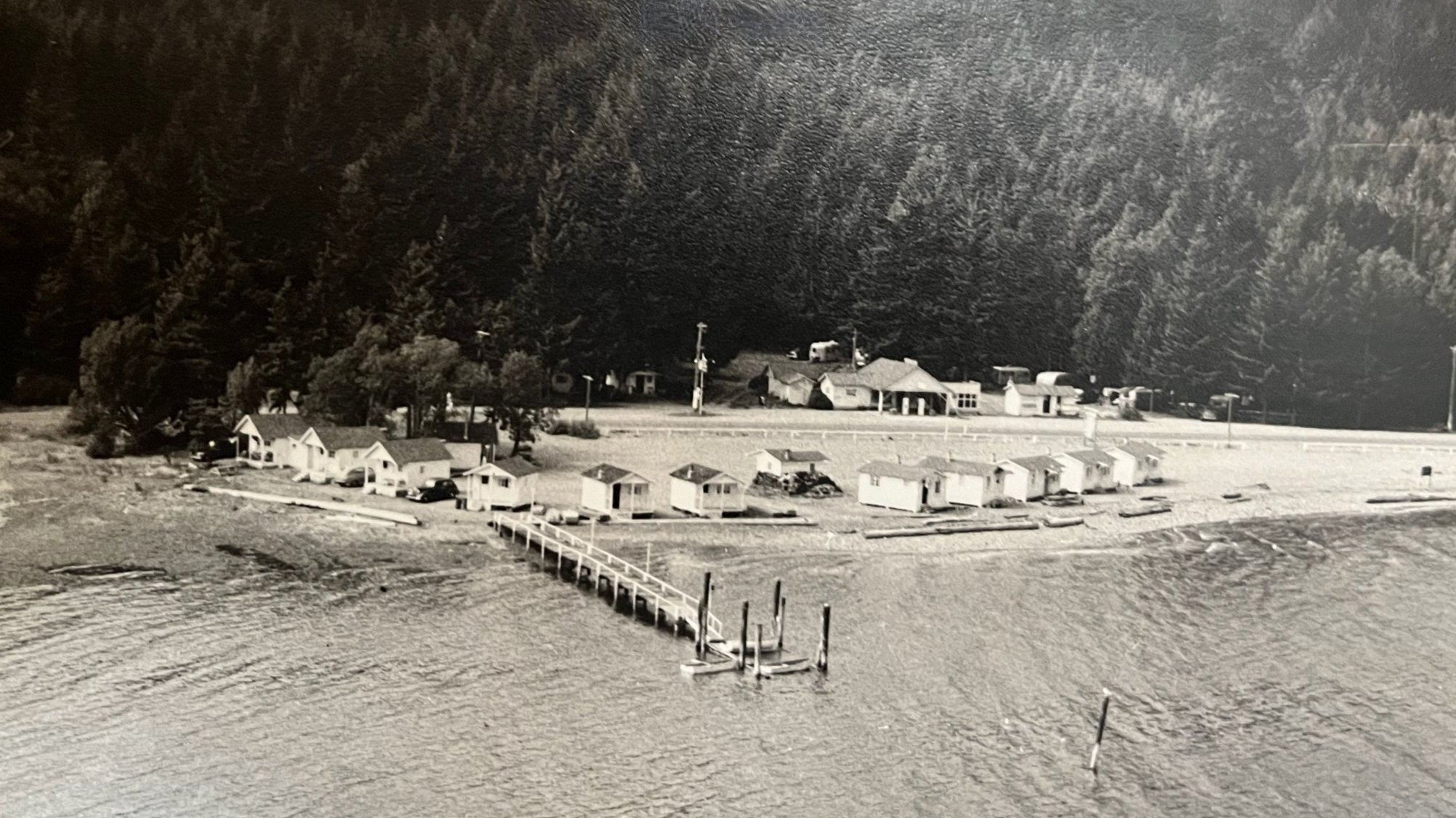
Sund Resort (circa 1930) - Mason County Historical Museum photo
Sund had no idea that his decision would help shape the path of Hood Canal. On that very special and remarkable point lies the present day marine preserve beloved by scuba divers, Sund Rock. Here Colbein built Sund Resort with his wife. It is here too, where his grandson, Robert, eventually managed to establish the marine preserve, Sund Rock, famous for its giant ling cod, Great Pacific Octopus and wolf eels.
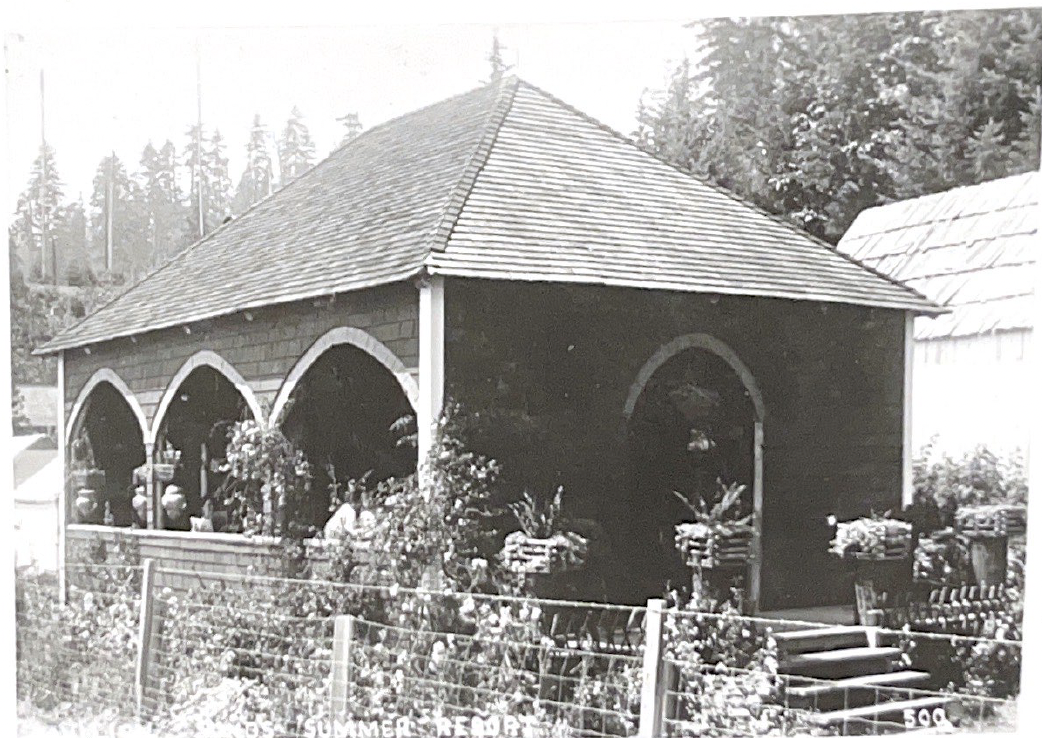
Former Dance Pavilion at Sund Resort (MCHM)
The original Sund Resort was a series of platform tents and included a dance hall. Today the resort and dance pavilion are long gone (present site of Rest-A-While RV Resort) but adventurers can celebrate, because once again there is a platform tent for guests to continue to enjoy this special place.
Colbein John Sund’s great-granddaughter, Cindy Sund, shared the experience and a little bit more about her family’s connection to the Canal. “I love being able to maintain it for family as well as we've really developed a kind of clientele that comes to the glamping and diving that respect the property. it's an underwater preserve with organisms that are unique and special. The Giant Pacific Octopus is a big draw. The wolf eel, ling and rock cod population are coming back. It's really a diverse area. I feel honored to be a steward.”
The generations who have enjoyed this property have developed a strong sense of place and a fierce desire to protect it for future generations to continue to create memories and share this special place with all who wish to visit. For the last four years, Cindy Sund has opened the glamping tent for guests to enjoy. “My parents wish,” she continues, “is that this property remain in the family for as long as possible. So when they moved into assisted-living, it was sort of my responsibility to make sure that that happened. I started the diving and glamping business to help subsidize property taxes and all the expenses that go along with owning a piece of property, and also help with my parents assisted-living. It's working out really well so far.”

Sund Rock glamping tent
Sund’s glamping tent has composting toilets and, since COVID, guests are required to bring their own bedding. However, a soft queen-sized bed, lights, heat, small refrigerator, propane bbq, propane fire pit, and a shower by the privy definitely set this beyond sleeping in an REI tent. And you’ll appreciate the phone charging ports by the bed for the hundreds of photos you’ll be taking because despite its small environmental footprint, this experience will leave a lasting experience on all who visit.
Beach access to Sund Rock dive site below is shared with scuba divers who are allowed limited access by the Sund family. Glamping guests are encouraged to bring their own beach towels, swim floats or kayaks to enhance the beach experience. There is also plenty of hiking in the area and amenities like groceries or restaurants available in nearby Hoodsport. Cindy meets each guest upon arrival, providing a tour of the property and instructions on how to use the facility. Members of the Sund family are available if needed as they also live on the property, but allow guests their privacy to enjoy the space.

Mid-September the tent is removed and stored indoors until May. “The diving operation goes year-round,” reflects Cindy, “we're busier in the winter than we are in the summer because the temperature of the water drops and you get less plankton bloom so your visibility is better.” November is often the busiest month for Sund Rock with the glamping in the summer providing opportunities for other adventurers to Hood Canal.
To reserve the Sund Rock glamping tent, learn more about the preserve and the family history, visit sundrock.com. There is a minimum stay of two night and most of the weekends are booked through September although there is plenty of mid-week availability (which honestly, is a much better time to visit Hood Canal in the summer). This site is not designed for children (more suited to a couple), but pets are allowed. Rates begin at $114/night and every guest that left a review, yes 100%, gave the experience a 5 star rating.

Lake Sundown
There are four ways to reach Lake Sundown, a pretty little body of water in the rugged and isolated southwestern corner of Olympic National Park. All of these routes are difficult and each contains their own charms and challenges. The route via the South Fork Skokomish River Valley includes miles of primeval cathedral forest along a wilderness waterway and an ascent of a 4,125-foot pass offering sweeping views of this wild landscape. If the trek to the lake is too daunting, a stroll just through the groves of ancient trees will provide a satisfying hike.
Pictures & Story by Craig Romano
There are four ways to reach Lake Sundown, a pretty little body of water in the rugged and isolated southwestern corner of Olympic National Park. All of these routes are difficult and each contains their own charms and challenges. The route via the South Fork Skokomish River Valley includes miles of primeval cathedral forest along a wilderness waterway and an ascent of a 4,125-foot pass offering sweeping views of this wild landscape. If the trek to the lake is too daunting, a stroll just through the groves of ancient trees will provide a satisfying hike.

Hit the Trail
Lake Sundown is one of the few backcountry lakes in the southern Olympic Mountains. Remote and difficult to get to, it’s also lightly visited. The shortest approach is via rugged Wynoochee Pass. The easiest (but not easy) approach is via Graves Creek requiring a long drive to the trailhead in the Quinault River Valley.
The approach via Six Ridge is the longest and most difficult, but also stunning when it comes to scenery and a wilderness experience.
The approach described here via the South Fork Skokomish River is challenging but includes varied terrain, excellent views, and an easier to access trailhead from Hood Canal.
While strong hikers can do this hike out and back in a day, it’s ideal for a one night backpack trip. Be sure to secure an Olympic National Park wilderness camping permit before heading out—unless you plan on camping in the national forest before reaching the park. There are two creek fords on this hike which can only safely be done in late summer and early fall. During this period the crossings are not much more than ankle deep. And finally, while the lake and its surrounding high country generally remain snow free through October, FR 2361 is gated on October 1st. So if you plan on doing this hike during October you’ll need to walk an additional 5.1 miles each way or mountain bike to the trailhead.

From the trailhead, head north on the Upper South Fork Skokomish River following an old roadbed. Soon reach the old trailhead and continue on single track coming to a narrow shelf. Carefully wander to the edge of the trail and stare straight down at the South Fork careening through a tight chasm.

At a little past a mile, cross Rule Creek on a big log bridge. Shortly after come to your first crossing of the South Fork Skokomish River. Fortunately a large fallen cedar can be used here to cross the river. Now climb above the wild waterway weaving through groves of primordial giants that’ll have you staring up to the lofty forest canopy. Conservationists were disheartened when this incredible tract of old-growth forest (one of the largest remaining expanses of old growth forest in the southern reaches of the Olympic National Park) was excluded from the 1984 Washington State Wilderness Act.

Continue hiking, crossing copious side creeks before coming to camps and the second crossing of the South Fork Skokomish River. By late summer the ford here is usually a mere rock hop. But if it looks tricky, this is a great turning around spot for a nice 5.2 mile hike. Otherwise carry on and upon reaching the far bank of the river, continue up the valley through mossy flats alongside the river bed—but not always along the river as sections of it often flow underground late in the season.
The trail eventually pulls away from the river and begins climbing. And what had so far been a fairly easy hike begins to get tougher.
At 4.4 miles reach Startup Creek which can be tricky to cross early in the summer. Now prepare to start climbing reaching the Olympic National Park boundary (dogs prohibited beyond) just past 5.0 miles. The trail soon afterward traverses a couple of wet meadows that showcase a myriad of flowers early in the season. Tread is absent here and navigating can be tricky. Angle to the northwest where good tread can be found again at forest edge. Don’t be led astray by elk trails. And do stay alert for these large members of the deer family. A large herd calls this valley home.
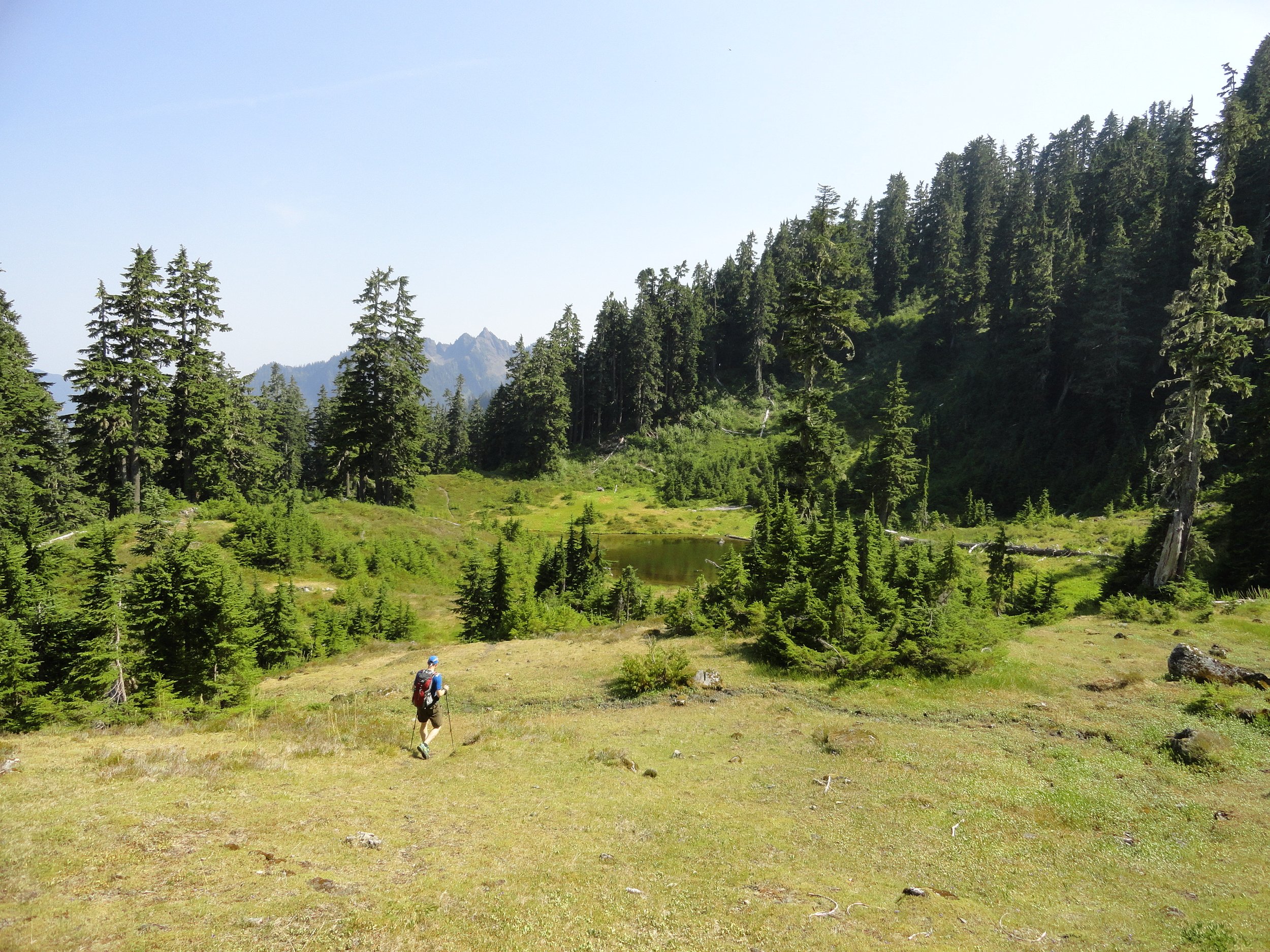
Continue deeper into the wilderness. After crossing a small creek, the trail steeply climbs reaching a small open basin graced with wildflowers in early summer and sparkling tarns providing the headwaters of the South Fork Skokomish River. Now reenter forest and steeply climb once more reaching forested 4,124-foot Sundown Pass. A short descent awaits you next through meadows providing good views of Wynoochee Pass and the Graves Creek drainage. Mount Olympus can be seen in the distance. At 7.8 miles, come to a junction. Left leads to Wynoochee Pass and the North Fork Quinault River.

You want to go right here through a pretty basin reaching Lake Sundown (elev. 3810 feet) in 0.4 mile.
Situated in a semi-open emerald basin on the western flank of Six Ridge, the lake is a pretty sight. A couple of campsites can be found at the old shelter site near the lake’s outlet. To catch the sunset, you’ll need to work your way to the eastern shore to look west across the lake to peaks and ridges beyond. On a warm day the lake’s refreshing waters make for a good dip. Savor the solitude and serenity of this remote backcountry lake. You worked hard to experience it!


More Details
Distance: 16.4 miles roundtrip
Elevation Gain: 3700 feet
High Point: 4125 feet
Difficulty: difficult
Snow free: July—October
Trailhead Pass Needed: None
Notes: FR 2361 closed Oct 1–Apr 30 to protect wildlife. Hike involves two fords safe only in low flow; dogs prohibited at national park boundary. Camping at Lake Sundown and in Olympic National Park requires an Olympic NP wilderness camping permit. No fires above 3500'.
GPS waypoints:
Trailhead: N 47 28.765, W 123 27.125
Lake Sundown: N47 32.170 W123 30.691
Land Agency Contact: Olympic National Forest, Hood Canal Ranger District, Quilcene, (360) 765-2200, http://www.fs.usda.gov/olympic; and Olympic National Park, Wilderness Information Center, (360) 565-3100, www.nps.gov/olym
Recommended Guidebook: Day Hiking Olympic Peninsula 2nd edition (Romano, Mountaineers Books)
Trailhead directions: From Shelton, travel north on US 101 for 7 miles, turning left at milepost 340 onto the Skokomish Valley Road (signed “Skokomish Recreation Area”). Follow for 5.6 miles, bearing right at a V intersection onto Forest Road 23. Continue for 9.3 miles bearing left at Y-junction with FR 2353. Then continue on FR 23, following this good gravel road for 4.3 miles and bearing right onto FR 2361. Then proceed 5.1 miles to trailhead at road’s end.

Hamma Hamma's Living Legacy Trail
Take a leisurely hike back into time on this delightful trail along the Hamma Hamma River to the historic Hamma Hamma Cabin.
By Craig Romano, feature columnist
Craig Romano, is an author of more than twenty hiking guidebooks including the bestselling Day Hiking Olympic Peninsula 2nd Edition (Mountaineers Books), which includes detailed descriptions for 136 hikes throughout the Olympic Peninsula. Visit CraigRomano.com for more information.
Take a leisurely hike back into time on this delightful trail along the Hamma Hamma River to the historic Hamma Hamma Cabin. Constructed by the Depression-era Civilian Conservation Corp (CCC), the cabin was used as a guard station in Olympic National Forest. Today it stands as a testament to the craftsmanship and hard work of the CCC. Learn more about “Roosevelt’s Tree Army” and their legacy on this family friendly interpretive trail.

Photo: Craig Romano
In April of 1933 in the midst of the Great Depression, newly inaugurated president Franklin D Roosevelt established the CCC through an executive order. Roosevelt’s aim was more than just putting young men to work and allowing them to provide for their families.
"Roosevelt strongly believed in the spiritual and physical values of working in nature, and in the importance of conservation of our natural resources for the nation’s health and prosperity."
At its height in 1935, more than 500,000 young men were stationed in more than 2900 CCC camps in every state as well as Puerto Rico and the Virgin Islands. At the program’s close in 1942, more than 3 million men (nearly 5% of the country’s male population) had served in the CCC. This trail sheds some light on what life was like for these men during their time in the Corp—and highlight some of their achievements and legacy.

Photo: Craig Romano
Among their many projects, CCC recruits were responsible for building vast amounts of infrastructure within parks and forests throughout the country—including both the Olympic National Park and Forest.
They also fought fires, reforested large tracts of land and worked on flood control projects. There were camps established right within Olympic National Park and Olympic National Forest, including one in the nearby Staircase Region. Nearby Twanoh State Park on Hood Canal also was the site of a large CCC camp.
Hit the Trail
Start your hike east on a wide and level path through a riparian forest of large mossy maples and speckled barked alders. The first quarter mile of this recently refurbished trail is ADA compliant. While this trail emphasizes the historic role the CCC played in this corner of Olympic National Forest, there is plenty of natural beauty to be enjoyed long the way as well. It is the only trail (albeit just for a short stretch) that runs along the Hamma Hamma River.

Photo: Craig Romano
The river’s name come from the Twana (whose ancestral lands included much of the Hood Canal region) word Hab’hab, which refers to a reed along the river’s banks. The name means big stink, or literally stinky, stinky in reference to the aroma the reeds emitted. The trail hugs a bank above the river allowing for some excellent views of the pretty waterway.
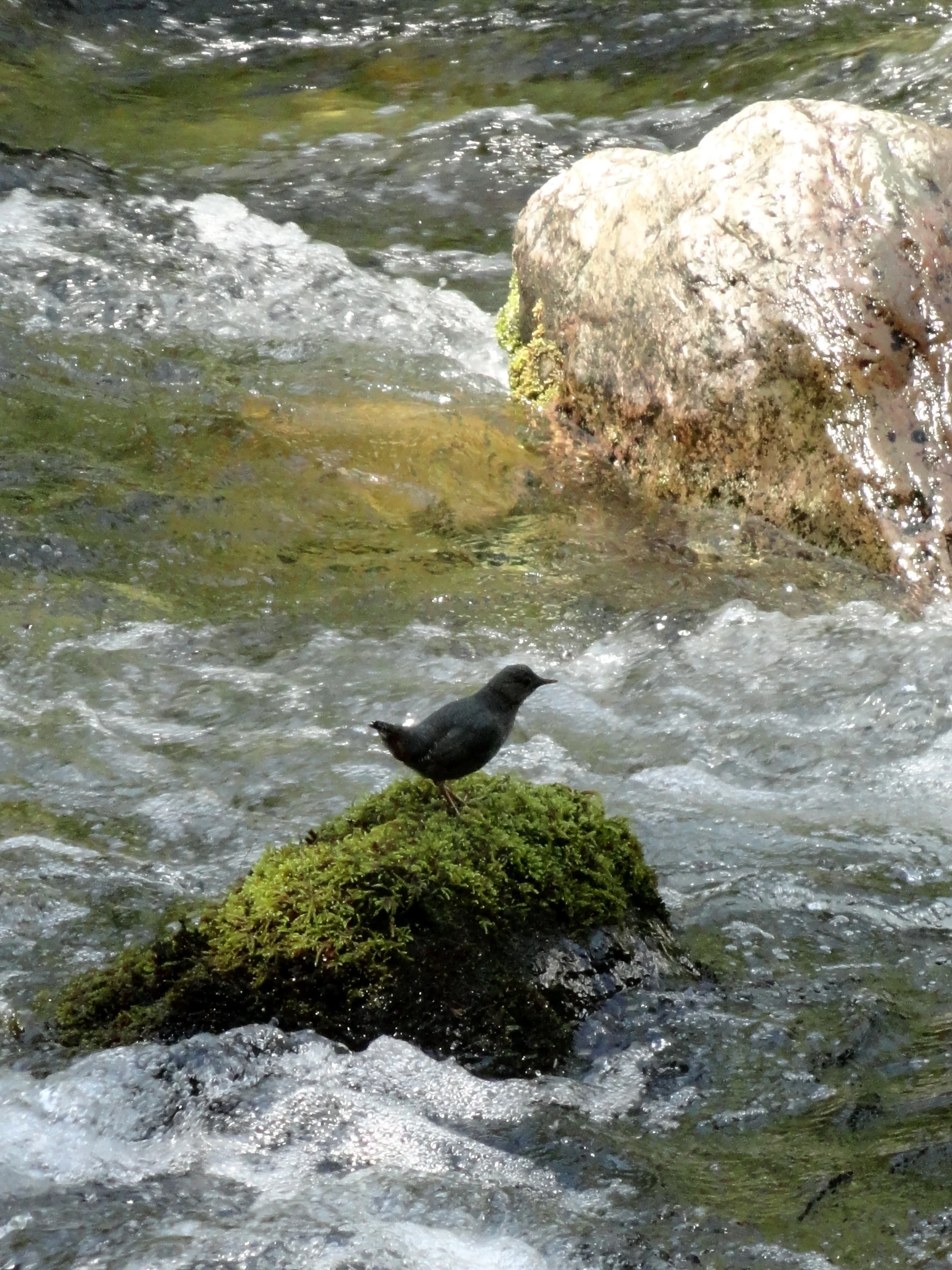
Photo: Craig Romano
Stop and look for dippers—robin sized birds that feed on aquatic insects and nest along the shorelines of rushing water. In spring look for Harlequin ducks returning from the Salish Sea. One of the prettiest sea ducks, they build hidden nests along rapid moving creeks and rivers.
The trail climbs a small bluff granting an excellent view of the pretty waterway, before leaving the river for forest. At 0.5 mile the trail turns north to cross Forest Road 25. Now walk along cascading Watson Creek climbing about 100 feet to a wooden bench on a perch overlooking the creek. It’s a great spot to sit and enjoy the sound of nature’s water music. By late spring nesting thrushes and other songbirds add a wide range of melodies.
The trail now turns west to soon reach the historic Hamma Hamma Guard Station. Built by the CCC from 1936 to 1937, it was used for administrative purposes for forest fire and trail crews. Today this eloquently rustic structure with its hexagonal bay window can be rented out for an overnight stay recreation.gov. Please respect the privacy of any guests staying at the cabin by not walking on the grounds. Otherwise wander around the structure. Note the landscaping too, especially the rhododendrons which will be in bloom come May.
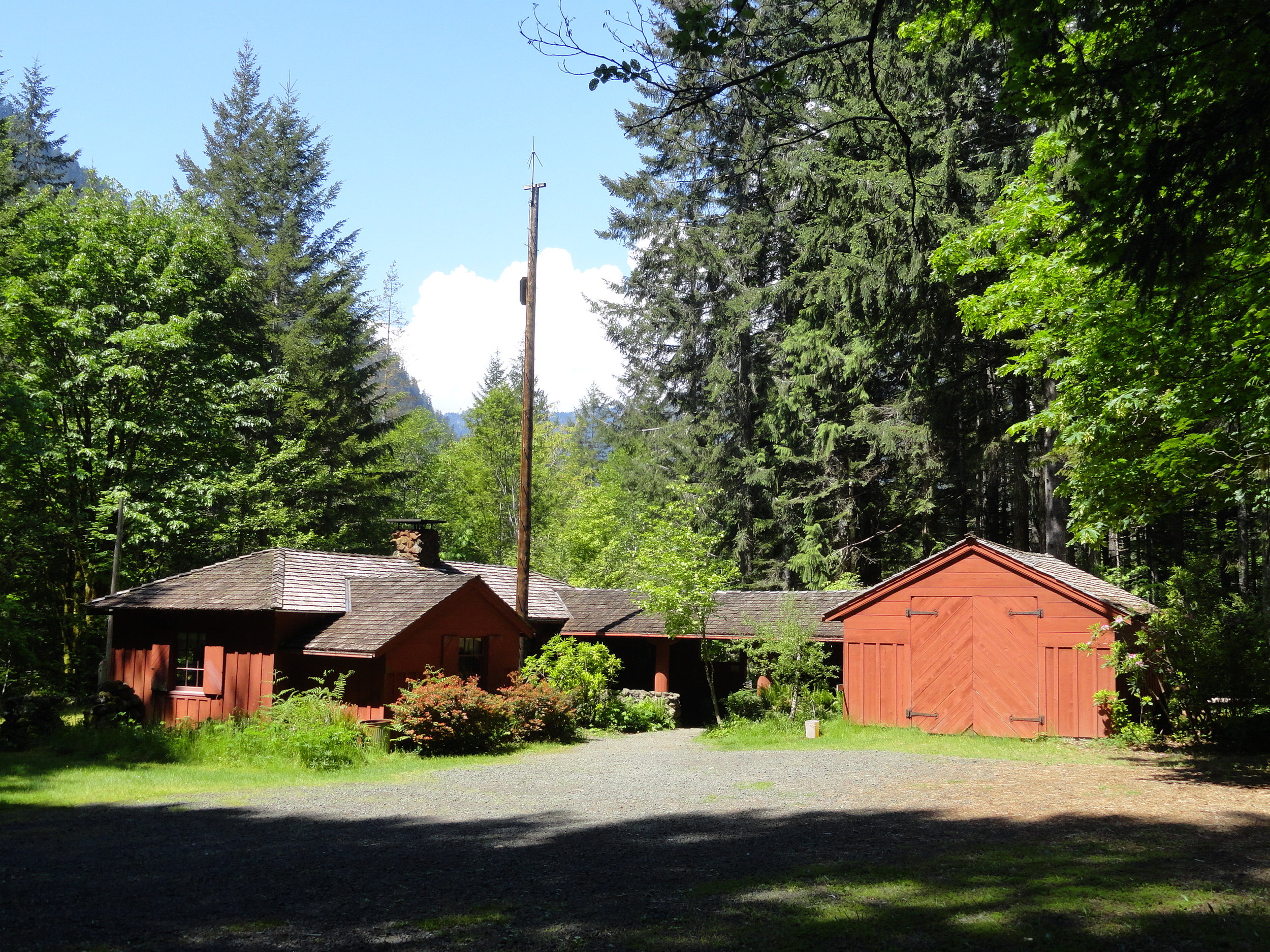
Photo: Craig Romano
After admiring the historic structure continue west on the loop crossing a small creek and traversing a grove of mature second growth firs. The way then descends into a ravine before re-crossing FR 25. Continue hiking passing some big beautiful old trees before reaching the campground loop road near campsite no. 6. Now turn right and walk the loop road a short distance back to your start closing your loop hike at 1.8 miles. Reflect on some of the achievements of the Corp including the thousands of miles of trails they built, more than 3400 fire towers constructed, nearly 3 billion trees planted, and the development of amenities and infrastructure in more than 800 parks across the nation. Many of their works are still standing and in use in Olympic National Park and Olympic National Forest as well as at several nearby state parks. The Corp’s legacy continues to live on for the next generation of outdoorsmen and women.

Getting Here
First .25 mile ADA; Leave No Trace Principles
Land Agency Contact: Olympic National Forest, Hood Canal Ranger District, www.fs.usda.gov/olympic
Recommended Map: Green Trails Olympic Mountains East 168S
Trailhead directions: From Hoodsport travel north on US 101 north for 13.7 miles turning left at milepost 318 turn onto FR 25 (Hamma Hamma River Road). Then continue west for 6.0 miles turning left into the Hamma Hamma Campground. Proceed for 0.1 mile to trailhead located near site no. 12.
Trailhead facilities: campsites (fee), privy

Lena Lakes Hiking Destinations
Gracing the Hamma Hamma Valley are two lakes sharing the name, “Lena.” But aside from the name, they are strikingly different from each other. Renown guidebook writer, Craig Romano, takes us on a trip to visit both these lakes.
Craig Romano | Craigromano.com
Gracing the Hamma Hamma Valley are two lakes sharing the name Lena. But aside from the name, they are strikingly different from each other.
The hike to Lower Lena is an easy kid and dog friendly jaunt through old growth forest. The hike to Upper Lena is a grueling and demanding grunt to a stunning high basin within Olympic National Park. Seasoned backpackers take to the upper lake and often set out afterward to scramble surrounding craggy peaks or head out on a rugged high country route. Lower Lena entertains first time hikers and newbie backpackers often testing their gear and skills for the first time. Expect plenty of company at the lower lake and a good chance for solitude at the Upper Lena.
Hit the Trail
Both lakes use the same approach. On a very well-trodden path head off in second-growth forest. The way immediately climbs, but the grade is gentle. Lena Creek can be heard crashing in the distance.
Lena Lake
Continue up the trail and eventually enter groves of beautiful old growth forest. The trail nears Lena Creek and then crosses it on a solid bridge. You might be dismayed however to be standing on a bridge spanning a dry rocky draw. What happened to the creek? It often makes a subterranean passage beneath all of those mossy rocks.
Now continue hiking working your way around and below a ledge. The trail then continues to climb coming to a junction at 3.0 miles. If you’re lower lake bound, bear right and within no time come to an inviting ledge granting a wonderful view of Lena Lake 100 feet below.
To reach the shoreline continue and descend passing busy campsites. You’ll eventually come to a junction with a trail leading back to the trail heading for the upper lake. Head right and reach the shoreline. The trail crosses Lena Creek and continues towards The Brothers—but that’s more of interest to climbers. You’ll figure out in no time that Lena Lake is one of the most popular hikes in the Olympics. Be sure to treat this heavily visited place with care and to practice Leave No Trace ethics.

Upper Lena Lake
If you’re more interested in a wilder setting, skip the trip to Lower Lena and from that first junction, head left. Immediately notice how much lighter the tread is now. Bear left at the next junction and begin following Lena Creek through spectacular primeval forest. At just over 4.0 miles the trail enters Olympic National Park. Dogs are prohibited from this point on—and if you plan to camp at Upper Lena you must have a backcountry permit (issued at Hoodsport Visitor Center and other Olympic National Park ranger stations). Until this point the climbing has been fairly moderate, but that is all about to radically change.
The trail continues alongside Lena Creek heading up an increasingly tighter valley. After crossing a tributary creek on a log bridge the trail gets downright nasty! Prepare yourself for an insanely steep climb up a rocky, rooty, and at times brushy course. It’s arduous and physically taxing, and when soaked by rainfall it can be treacherous. A good set of trekking poles will come in handy. The climbing eases after you carefully negotiate a ledge and clamber up a steep rocky bed of big rocks,
Once again come to and cross Lena Creek, which may be following a subterranean passage here as well.
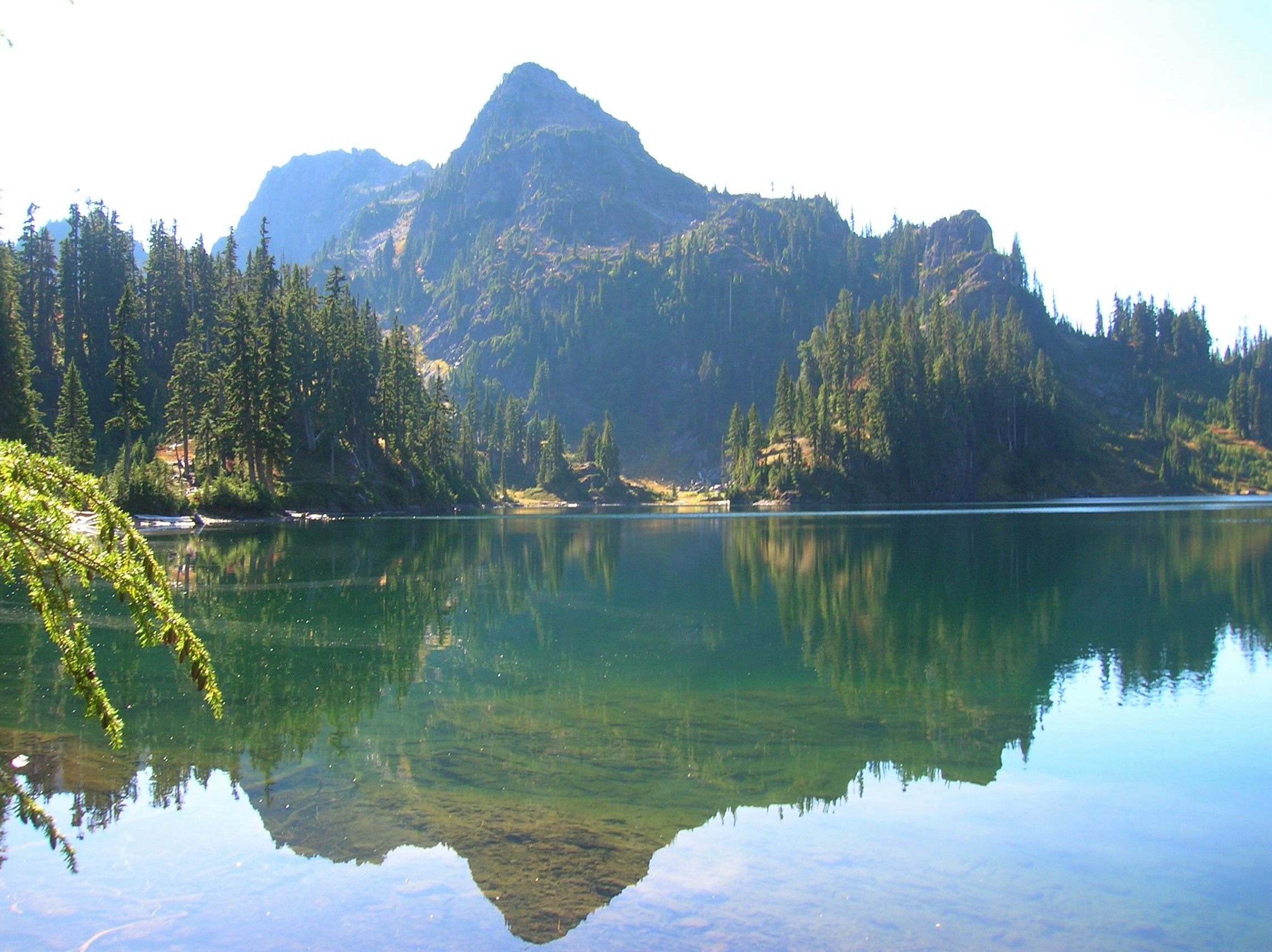
Continue through open attractive old-growth forest groves. Make one more steep climb before cresting a ridge cradling Upper Lena Lake. Before bolting for the lake, turn around and look back at Mount Rainier in the distance. Now charge for the lake. Enjoy a breathtakingly beautiful backdrop view of 5960-foot Mount Bretherton rising above and reflecting in the lake. Camps (permits required) are along the lake’s eastern shore, and by a short path, on the lake’s western shore.

If you’re up for the day, stay awhile and soak up the beauty. In autumn the surrounding hills colorfully reflect in the lake’s placid waters. Look for critters big and small frolicking in those hills looking for berries. Feel free to help yourself to a handful as well. If you have any energy left consider following a half mile side trail to beautiful Milk Lake set beneath a small glacier on Mount Bretherton. Then rest up and prepare your knees for the brutal and jarring descent back to your vehicle. The beauty and solitude are definitely worth the grind.
Craig Romano
Award winning author and outdoors writer who has authored and co-authored of more than 20 books including Day Hiking Olympic Peninsula 2nd Edition (Mountaineers Books), which features 136 hikes on the Olympic Peninsula. craigromano.com
Lena Lakes Details
Distance:
Lower Lake: 6.0 miles roundtrip; Upper Lake: 14.0 miles roundtrip
Elevation Gain: Lower Lake: 1225 feet; Upper Lake: 4100 feet
High Point: Lower Lake: 1900 feet; Upper Lake: 4600 feet
Difficulty: Lower Lake: moderate; Upper Lake: strenuous
Snow free: Lower Lake: March—Dec; Upper Lake: July—November
Trailhead Pass Needed: Northwest Forest Pass or Interagency
GPS waypoints:
Trailhead: N47 35.984 W123 09.055
Lower Lake: N47 36.994 W123 09.789
Upper Lake: N47 38.068 W123 12.329
Dogs are ok at Lower Lena but prohibited at Upper Lena Lake.
Camping (no fires) at Upper Lake requires National Park Wilderness Camping Permit (contact Olympic National Park, Wilderness Information Center (360) 565-3100)
Land Agency Contact: Olympic National Forest, Hood Canal Ranger District, Quilcene, fs.usda.gov/olympic and Olympic National Park, nps.gov/olym
Recommended Map: Green Trails Olympic Mountains East 168S
Recommended Guidebooks: Day Hiking Olympic Peninsula 2nd edition and Backpacking Washington (Romano, Mountaineers Books)
Trailhead directions: From Hoodsport travel north on US 101 north for 13.7 miles turning left at milepost 318 onto FR 25 (Hamma Hamma River Road). Continue for 7.5 paved miles to the trailhead.
Trailhead facilities: privy

Easy and Delicious Wintertime Campfire Recipes
There’s hardly anything better than friends gathered around a campfire. Throw some tasty, warm drinks in the mix and a meal prepared over an open flame, and you have the formula for a winning winter dinner.
There’s hardly anything better than friends gathered around a campfire. Throw some tasty, warm drinks in the mix and a meal prepared over an open flame, and we contest that there’s a formula for winning winter.

Break out your cast iron, throw some dry wood into the back of your car, gather your friends, and try one of our favorite campfire treats! Oh, you may notice that there’s a distinct bourbon theme that runs through our favorite campfire recipes. That’s no coincidence. And we know you’ll probably already have a bottle in tow anyways.

1. Chipotle Bourbon & Garlic Oysters
This drool-worthy decadence is surprisingly easy, amazingly Instagram worthy, and the perfect warm-up for the rest of your campfire meal. This recipe is courtesy of Hog Island Oysters out of California, but comes recommended by Lilliwaup’s own Hama Hama Oysters. We trust those guys. If you’re a newbie, check out Hama Hama’s general tips for grilling oysters.
Ingredients:
2 dozen Hama Hama oysters
½ lb (two sticks) unsalted butter
½ cup brown sugar
½ cup bourbon
¾ cup finely chopped garlic
Half a can of 10 oz. chopped chipotle chilis in adobo sauce
How to make chipotle butter:
We love this recipe because you can prep the butter at home and bust it out when you’re ready to throw the oysters on the grill. The butter requires at least an hour to chill so be sure to plan ahead.
Dissolve the brown sugar into the bourbon. Combine all ingredients in a medium bowl and mix well until a lumpy texture is achieved and all ingredients are thoroughly combined. Lay out a piece of parchment paper, pile butter into the center and wrap into a ‘log’. When finished, it should be just shorter than a foot and about two inches in diameter. Refrigerate.
How to cook oysters on the grill:
This one requires a pit fire with a grill. The good news is that there are a number of quaint and quiet campsites with fire pits. Build your fire so that the flames don’t quite reach all the way up to the grate. Shuck your oysters, and place them on the grill with a ¼ inch pat of your chipotle butter. Once the oysters and butter are bubbling, remove them from the grill, let them cool for a hot second, cheers and enjoy.
2. Bourbon Glazed Chicken
This recipe is from one of our favorite road trip read-throughs: “Campfire Cuisine: Gourmet Recipes for the Great Outdoors” by Robin Donovan. If you’re looking for a tasty side to go with your bourbon-infused campfire feast, we recommend the White Beans with Chanterelles, or the Maple-Glazed Yams from her book. Mmm.
Ingredients:
4 boneless, skinless chicken breast halves
1/3 cup bourbon
3 tbs. brown sugar
2 tbs soy sauce
1 tbs sesame oil
1 clove garlic, chopped
juice of ½ lemon
salt & pepper
How to:
This recipe is easy to prepare from home as well, but for theatrics’ sake, it’s pretty fun to pound the chicken breast with your bottle of bourbon at the campsite. All that’s required on the front end is to mix all the ingredients well, pound the chicken breasts in a separate bag, and marinade all together for at least an hour.
When you’re ready to grill (this requires a campfire with a grate as well), remove the chicken from the marinade and place on the grill, cooking for 5 to 7 minutes on each side. While the chicken is cooking, put the rest of the marinade into a cast iron skillet and boil for at least 5 minutes. Allow for it to thicken. Spoon bourbon glaze over the top, and serve immediately.
Shorter days and colder weather are no excuses for not taking advantage of the year-round glory that is the Olympic National Park. We’ll see you out there. And until then, see you on Facebook, Twitter, Pinterest and Instagram.

Hood Canal Hike: Duckabush River Trail
The Duckabush River starts in the heart of the Olympic Mountains. Fed by glaciers, snowfields, and a myriad of springs and alpine lakes; this major Olympic Peninsula river provides excellent wildlife habitat and makes for some stunning scenery. Explore this valley in the winter for the added bonus of solitude, a chance to observe elk, and to witness a rain-swollen river careening through clefts and over boulders.
Craig Romano | author Day Hiking Olympic Peninsula 2nd Edition

The Duckabush River starts in the heart of the Olympic Mountains. Fed by glaciers, snowfields, and a myriad of springs and alpine lakes; this major Olympic Peninsula river provides excellent wildlife habitat and makes for some stunning scenery. Explore this valley in the winter for the added bonus of solitude, a chance to observe elk, and to witness a rain-swollen river careening through clefts and over boulders.
Hit the Trail
The Duckabush River Trail is a portal into the wild interior of the Olympic Peninsula. A well-maintained trail travels along a good portion of the waterway allowing you to experience its grandeur. The trail travels a verdant valley for more than 20 miles terminating at Marmot Lake in the heart of Olympic National Park.
That’s a long journey primarily reserved for multi-day backpackers who often continue farther from there to cross historic O’Neil Pass. Day hikers however will be content to head up this trail for just a few miles.
An objective for many hikers and one that includes a good day’s worth of mileage and a little climbing too is to an imposing riverside knoll known as the Big Hump.
If the 7.8 mile distance and more than 1400 feet of elevation gain to reach this destination is too much, a satisfying turnaround spot is a nice stretch of river just prior to the climb.
The Duckabush River Trail like many of the trails leading along rivers into the Olympic interior begins as an old roadbed. Park officials, foresters and others once sought to punch roads deeper into the Olympics. However, over time, changing attitudes that emphasized preservation of areas free of roads and dwindling budgets that couldn’t maintain many miles of backcountry byways led to miles of roadway being converted to trails. In almost all of these cases this has meant miles of gentle hiking as the old roadways were often well graded. That is the case for the beginning of this trail.
Head off down the trail gently climbing through a uniform forest of second-growth fir. This part of the Duckabush River valley was logged—but it was many decades ago. The real old and impressive trees are yet to come. At 1.2 miles the trail enters The Brothers Wilderness, a 16,000-plus acre federally protected section of the Olympic National Forest. Wilderness designation means that this rugged and ecologically important tract of land bordering the national park will never be logged, developed or have a road traverse it. Bicycles and machinery are not permitted either, allowing folks who come to explore this area by foot or horseback a true wilderness experience.
The trail continues through a low gap near Little Hump and then begins a descent of 250 feet, following an old logging railroad grade on an almost perfectly level trajectory. Loggers here didn’t take all of the big timber as a few standing giants attest.
While this part of the Olympics is in a rainshadow, receiving around 70-80 inches of rain a year compared to two to three times that on the other sides of the mountains, mossy limbs and a thick understory makes it feel somewhat like a rainforest.
After passing a campsite the trail finally comes upon the Duckabush River. At 2.6 miles, you’ll reach a spectacular spot where giant cedars and firs hang over the churning, crashing river. This is a great spot to turn around and perfect for a good half day hike or one with young adventurers.
Go Farther
If you’re intent on tackling the Big Hump, continue up the trail preparing yourself for a stiff 1,000 foot climb. The way steadily and steeply at times climbs. Old-growth greenery is soon replaced with fire-scarred trees and burnt and downed timber. Here in 2011 a careless camper started a wildfire that scorched a large patch of old-growth on the Big Hump. Hardy fire-scarred trees stand among stands of fire-ravaged timber. While trail crews have since rehabilitated the tread here, avoid this section of trail during periods of high wind, as burnt snags are prone to toppling.

At a little over 3 miles come to a ledge with a spectacular view east down the river valley.
On a clear day you can see all the way to the Cascades. To the south, impressive St. Peters Dome hovers—often catching swirling low clouds. Return to this spot later in the spring and you’ll have an array of wildflowers enhancing the views. Keep hiking and come to another outcropping before finally cresting 1700-foot Big Hump at 3.9 miles.
For most day hikers, this is far enough. But if you still feel like hiking, continue through a mosaic of old growth and fire scorched trees and descend 600 feet back to the river. Here at 5.3 miles from the trailhead is a camping area near a series of impressive rapids. During periods of heavy rain the river can be deafening here. Watch for darting dippers in the rapids as you rest up for your return to your start.

And if you are a strong hiker or are out on a several day backpacking adventure, the trail generally remains snow-free through the winter for many more miles. Note that at 6.7 miles from the trailhead it enters the national park—meaning dogs are not allowed to continue—and if you are planning on camping, you’ll need to secure a backcountry permit beforehand.

Hood Canal Travel Guide: Hike + Campfire
Itinerary #8: Spring Adventuring
There is a host of romantic notions about staying inside all winter, putting on fuzzy socks against the cold, and hibernating beneath a blanket. Instead of letting a little rain stop us from getting after it, we choose adventures that are even better with a little atmosphere!
There is a host of romantic notions about staying inside all winter, putting on fuzzy socks against the cold, and hibernating beneath a blanket. For some, rain grants permission for hours-long Netflix binges. But that’s not what we’re known for in the Pacific Northwest. Instead of letting a little rain stop us from getting after it, we choose adventures that are even better with a little atmosphere!
Now that the fear of forest fire has lessened, taking a break midway for a festive campfire makes any hike extra memorable. Enjoy having a popular trail all to yourself, and treat yourself for a job well done with dinner in town and a cozy cabin stay.

Lena Lake | 12pm
Lena Lake is a large gem nestled in the hills of the Olympic National Forest. This area was closed for much of the August because of an area forest fire. A wide and relatively accessible trail makes the journey to the lakeshore a family-friendly, but satisfyingly challenging day trip. From Highway 101, turn onto North Hamma Hamma Road/Forest Service Road 25 at milepost #318. Follow it for 7.5 miles to the trailhead, which offers plenty of parking alongside the road.
The 3.5 mile trail to the lake parallels and then crosses Lena Creek. Especially during the rainy season, the trail can be wet and slippery, so be sure you’re packing waterproof boots and other winter hiking essentials.
At the fork in the trail approximately three miles in, the trail to the right will take you directly to the lakeshore. If you’d prefer a brief scenic detour, a quarter-mile jaunt along the left path will provide you with an overlook that’s perfect for photo-ops or simply soaking in the view.

Campfire | 3pm
Nothing makes a hiking outing extra special like a crackling campfire to warm the hands and maybe even roast up a snack. With a set of homemade fire-starters, even damp wood won’t ruin your fun. Making them couldn’t be easier, either. Before you leave home, throw a dozen 100% cotton balls into a sealable plastic bag with a blob of Vaseline pure petroleum jelly. With the bag sealed, knead the Vaseline into the balls. When you’re ready to start your fire, pull one of the balls apart a bit to expose the dry fibers, apply a flame or spark, and you’re on your way.
The code of the wilderness is to Leave No Trace, so keep your fire small and practice good fire safety in addition to packing out all of your trash. Fire danger is generally very low in the Olympic Peninsula during winter and spring, but double-check that no burn bans are in effect.
Once you’re sufficiently warmed and pleasantly smoke-scented, pack up and retrace your steps to the trailhead.
Wash it down | 5pm
Even if you enjoyed a snack with your campfire, the hike back to your car and drive into civilization will have you craving a hearty meal. Hoodsport is the closest town, and offers a range of tempting options. Whether you choose fried chicken at Model T Pub & Eatery, fish and chips at Eagle Creek Saloon, or fajitas at El Puerto de Angeles, you won’t be disappointed.
If you’re heading farther south, Union offers a few more options. We’ve said it before, but it’s hard to beat Robin Hood Village Resort for a satisfying dinner in a cozy, intimate setting. It’s the perfect transition from wooded wonderland to creature comforts. And speaking of creature comforts…

Soak the day away | 8pm
A campfire is a great way to warm the hands, but to really warm up after a wintery hiking adventure, nothing tops a hot tub. Ten of the cottages at Robin Hood Village Resort have their own private hot tubs. Whether you hiked all six miles of the Lena Lake loop, did an even more extensive adventure, or simply strolled around downtown, you deserve to treat yourself. Reserve your cottage now—or explore other great local lodging options.
What’s your most memorable hiking or campfire experience? We’d love to hear about it—and see pictures! Reach us on Facebook, Twitter, Instagram, and Pinterest.

Hood Canal Travel Guide: Outdoor Yoga
Picture this: the full moon slowly rises over the placid Hood Canal, illuminating the rugged Olympic Mountains as you slowly exhale and relax into your tree pose.
Outdoor Yoga Near Lake Cushman
Picture this: the full moon slowly rises over the placid Hood Canal, illuminating the rugged Olympic Mountains as you slowly exhale and relax into your dancer's pose.
Outdoor yoga is something we can get excited about. Leaving all the electronics in the dust and taking our poses into new terrain is a welcome challenge and highly recommended for anyone who owns a mat (or doesn’t yet!).

Although there are a number of yoga classes offered in Hood Canal, we find that it’s just as exciting to find a serene spot in the woods or on the shore. The rich, misty woods smell amazing when you slow down enough to appreciate them, as does the salty, bracing shoreline. Read on for tips and tricks for taking your practice to the next level.
Have a Game Plan
At the risk of sounding counterintuitive to the free-flowing nature of outdoor yoga, it’s important to hone a few of your favorite poses under the guidance of a certified instructor. This can help reduce the risk of injury when you’re on your own.
There are several yoga classes offered in Hood Canal, and our favorites are at Joonbug Yoga in Shelton and Alderbrook Resort & Spa in Union. Joonbug Yoga offers a number of weekly classes, which Alderbrook supplements with weekly and monthly classes. We recommend planning a trip to coincide with both!
Every Tuesday in November and December, a certified yoga instructor from Joonbug Yoga guides a stretching and exercise-focused practice in the heated indoor saltwater pool at Alderbrook. It’s free for resort guests, but there is a fee for non-resort guests. As if you needed another reason to swing by Alderbrook!

Image courtesy of Alderbrook Resort & Spa
Take Om Into Your Own Hands in Union, Washington
There’s an amazingly satisfying and curiously primal aspect to practicing yoga on your own, outside a studio. Break loose from the structure of a guided practice, step onto uneven ground, grab a beach towel and enjoy!
Just as a traditional mat doesn’t translate too well outside of the studio, neither does music. Unplug: leave the noisemakers in the car and embrace the nature-sounds. Though it might be a bit harder to concentrate with the unpredictable bustle of the woods or the shore, welcome the challenge and adapt accordingly.

Focus on balancing poses rather than down dog holds or vinyasa flows. The uneven ground can be hard on wrists, but an engaging challenge for the fast-twitch muscles in your legs.
Above all, be open-minded and allow yourself to explore your yoga practice in a new environment. Be sure to prepare well for a session outside with plenty of warm clothing if you choose to practice in colder temperatures, and sunscreen during the sunnier months.

We can’t wait to see what awesome poses you get into in our glorious backyard! Please share with us using #wildsideWA for a chance to be featured on our social media pages, and sign up for our newsletter to receive email exclusives and special lodging discounts.
Until then, catch you on Facebook, Twitter, Instagram, and Pinterest. Namaste!

Wild Side Explorer Series: VanLife
When the plans are set, the coolers are full, and the phones lose cell phone service, that’s where the good, quality livin’ happens. Watch as two families take on VanLife at Lake Cushman.
Raising wild ones: it’s an art form, really. Keeping kids’ curiosity satiated, making sure each day brings something new and exciting, and, of course, maintaining your own sanity all the while is a massive undertaking. And there’s no perfect formula. But after the plans are set, coolers are full, and the phones lose cell phone service, that’s where the good, quality livin’ happens.
When most Seattle families pack up the van and zip out of town for a long weekend in the woods, hightailing it westward to Olympic National Park’s misty beaches is a no-brainer. Just outside the eastern entrance to the national park, you’ll discover a world of hidden gems, quiet nooks, and kid-friendly, no-holds-barred adventure in the fjord of the Puget Sound that is Hood Canal.
Watch two families discover VanLife magic at Lake Cushman:
Day 1: Bremerton Ferry > Bent Bine Brew Co. > Skokomish Park
1:30 PM | Ferry Departure at Pier 52
Sure, I-5 to WA-16 W saves a bit of time (though you’ll have to weather the always-ungodly traffic in Tacoma), but there are not many things that enchant little ones like a ferry ride. Sweeping views of downtown Seattle and the iconic Space Needle slowly fall away as the Olympic Mountains rise in the foreground. Hello, sensory overload.

3 PM | Beers & Games at Bent Bine
“Hop for the better, hope for the bitter!” this freshly minted brewery proclaims as you stride through the door. But if you’re like us, you’ll hope for light and drinkable which is just what their pale ales and their Bavarian-style Weissbier serves up. Taste your way through them all as the kids stay effectively entertained with corn hole.

6 PM | Set up Camp at Skokomish Park
Bring your mountain bikes, swimsuits, and lounge chairs—Skokomish Park offers a bit of just about everything. Each tent site (or in our case, VanLife site) has a fire pit, picnic table, tent space, and parking for two vehicles. Plus, each loop has restrooms and showers. If you forget anything or feel like renting a kayak, extra SUP, or the like, the welcome center at the day use area has you covered.
Day 2: Lake Cushman
We operate on the conviction that the best days are lake days (second only, perhaps, to days spent on Hood Canal). With the sandy shoreline of Lake Cushman, a fly rod, kayaks ir SUPs, and super fresh crab over the fire for dinner, and cheers to a day well spent.

Day 3: Lake Cushman > Twanoh State Park > Home
11 AM | Hightail it to Twanoh State Park
Situated on the eastern shores of Hood Canal, Twanoh State Park is the perfect place for beachcombing and breathing in the ocean air before you board the ferry for home. As an added bonus: it’s one of the warmest saltwater beaches in the state! If you fancy yourself a seafood connoisseur, harvest a handful of oysters and shuck then eat them right on the beach! (State law mandates that you harvest no more than 18 oysters measuring over 2 ½ inches and shuck and eat them on the beach, leaving behind the shells). For complete up-to-date oyster information, click here.
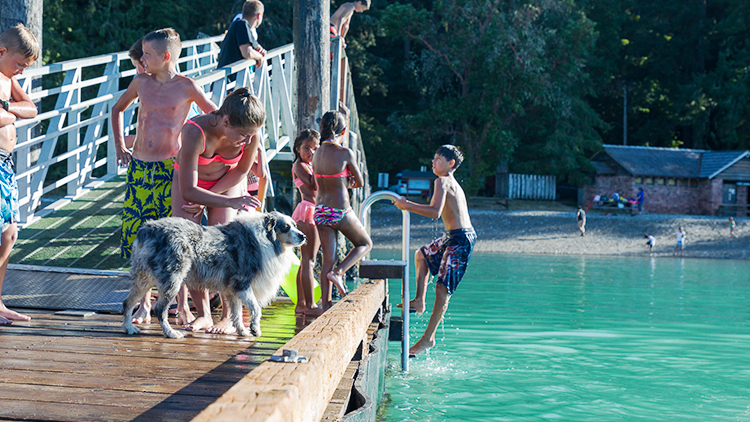


Hood Canal "Glamping"
If your idea of a camping excursion is freeze dried food and dry shampoo – and luxury to you is a bed of moss under your sleep sack or a solar-powered lamp – "glamping" may not hold much interest for you. Glamping or "glamor-camping" as the name suggest, goes WAY beyond the coleman stove and solar shower upgrade. If you crave a star-studded forest canopy while enjoying gourmet camp cuisine and all the comforts of home – bed, pillows, duvet, light switches– glamping may be a great compromise to get outdoors!
If your idea of a camping excursion is freeze dried food and dry shampoo – and luxury to you is a bed of moss under your sleep sack or a solar-powered lamp – "glamping" may not hold much interest for you. Glamping or "glamor-camping" as the name suggest, goes WAY beyond the coleman stove and solar shower upgrade. If you crave a star-studded forest canopy while enjoying gourmet camp cuisine and all the comforts of home – bed, pillows, duvet, light switches– glamping may be a great compromise to get outdoors!
Header Image credit: Poppi Photo
One of the best thing about "camping" is relaxing with a final roasted marshmallow and a steaming mug of hot chocolate. Wrapped in a cozy blanket, the tall trees keep you close in the inky darkness beyond the glow of the fire. Far from the glow and clatter of the city, the sky displays a covering of unrealistically bright stars. Good conversation and the people you love surrounding you. Who wants to consider the uncomfortable night ahead? Rocks in your lumbar. Slick "high performance" sleeping cocoons that tangle and suffocate. Never mind the 3:00 AM Call of Nature. Stumbling through the dark stubbing toes and tripping over roots.

Trailer camping is technically considered in the "glamping" category, above the waterfront view and tall trees at Twanoh State Park, Hood Canal definitely set the standards high.
Enter glamping. A purist would say if you want the experience of camping you need to embrace the whole experience, not cherry-pick the best parts. Galen Patterson, a journalist with Arcadia Weekly, remarks in a recent article, "in its luxury, comfortable camping (glamping) loses what makes the experience worth the discomfort in the first place." He goes on to say that, "instead of connecting with nature and all of its uncomfortable facets, people are bringing the comforts of home with them, and, in doing so, are sapping the spirit of what it means to connect to the outdoors." Patterson advocates that through discomfort and deprivation, he "finds appreciation and, with it, follows a new zest for life."
Hmmmm. So unless you are suffering you will not appreciate the wilderness? Good riddance. Rough camping has its place – when space is limited in your kayak or you are pack/wilderness camping and every extra ounce needs to be "weighed" in necessity. However, if you can enhance the joy of spending time outdoors by increasing the comfort level – there is no shame in that!
There are plenty of definitions of glamping. Some feel that cooking on anything beyond an open campfire is glamping. Others consider having cell service a mark of glamor camping. Perhaps it's sleeping in a bed off the ground, in a cabin or RV. Whatever the case, glamping is a more glamorous spin on camping and it is bringing a whole new level of interest to the camping scene. Love it or hate it, glamping is a thriving trend that continues to grow.
Give it A Try....
Belfair State Park is a 65 acre, year-round camping park on 3,720 feet of saltwater at the southern end of Hood Canal. It is noted for its saltwater tide flats, wetlands with wind-blown grasses and pleasant beach walking and swimming. Cabins sleep five and are furnished with tables and chairs. Outside is a picnic table and fire pit. Bathrooms and showers are nearby. All cabins are heated, but visitors should take along blankets and warm clothing as evenings can be cool. Belfair cabin rates range from $40 (off-season) to $69(peak). Reserve
Dosewallips State Park offers canvas platform tents for rent. Situated in a maple forest near the Dosewallips River, the tent sleeps up to five people. Made of white canvas on wooden platforms, they are light inside, even on cloudy days. Each tent has three bunks, a futon, lights, table and heater. Outside is a deck, picnic table, fire grill and utility hookup. Bathrooms nearby. All platform tents are heated but campers must bring their own bed linens. Cabins at Dosewallips are situated among evergreen trees looking towards the Olympic Mountains. Each cabin features a covered porch, electric heat, lights and locking doors. Bathrooms are nearby. Tent and cabin rates range from $40 (off-season) to $69 (peak). Reserve

Hamma Hamma cabin is available through the Olympic National Forest
The Hamma Hamma Cabin in the Olympic National Forest is a historic cabin that offers guests a tranquil setting. Formerly a guard station, the cabin was built in 1937 by the Civilian Conservation Corps. The site is nominated to the National Register of Historic Places for the skill and craftsmanship that went into its construction and architecture. The cabin is open year-round. Accommodating up to six guests, the single-story cabin features a living room with a hexagonal bay window overlooking the Hamma Hamma River drainage. There are two bedrooms, one with a double bed and one with bunk beds. The bathroom has a flush toilet. The cabin is equipped with a propane heater and propane lights. An outdoor picnic table, fire ring and pedestal barbecue grill are available for cooking and campfires. Guests provide their own bedding, linens, towels, dish soap, matches, first aid kit, toilet paper and garbage bags. Reserve
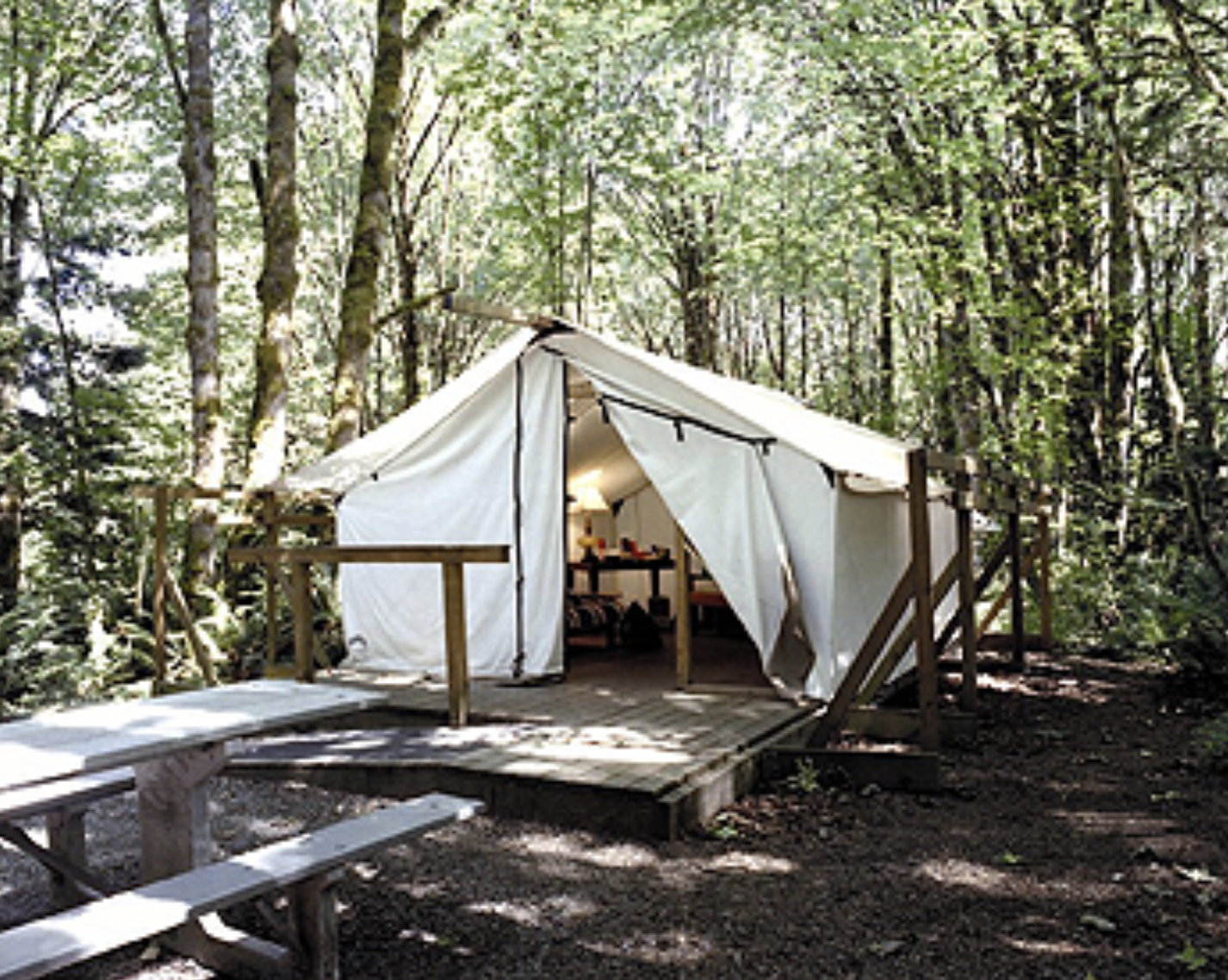
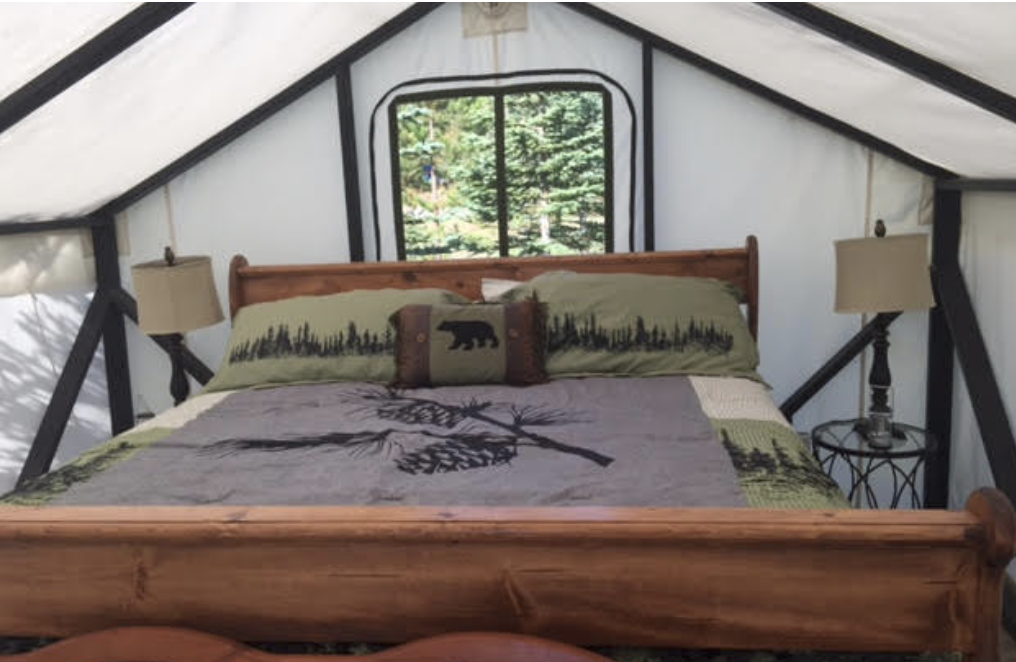
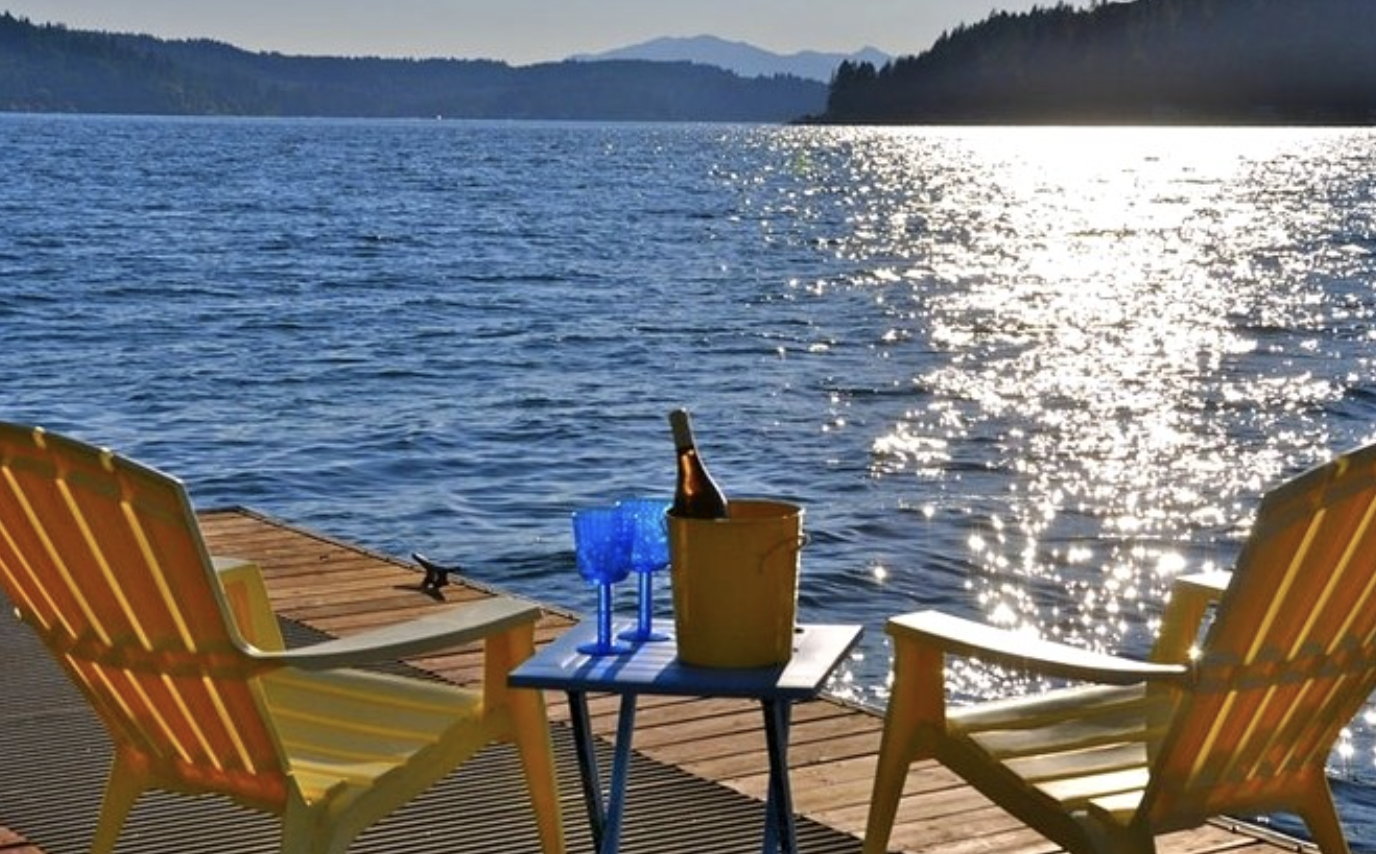
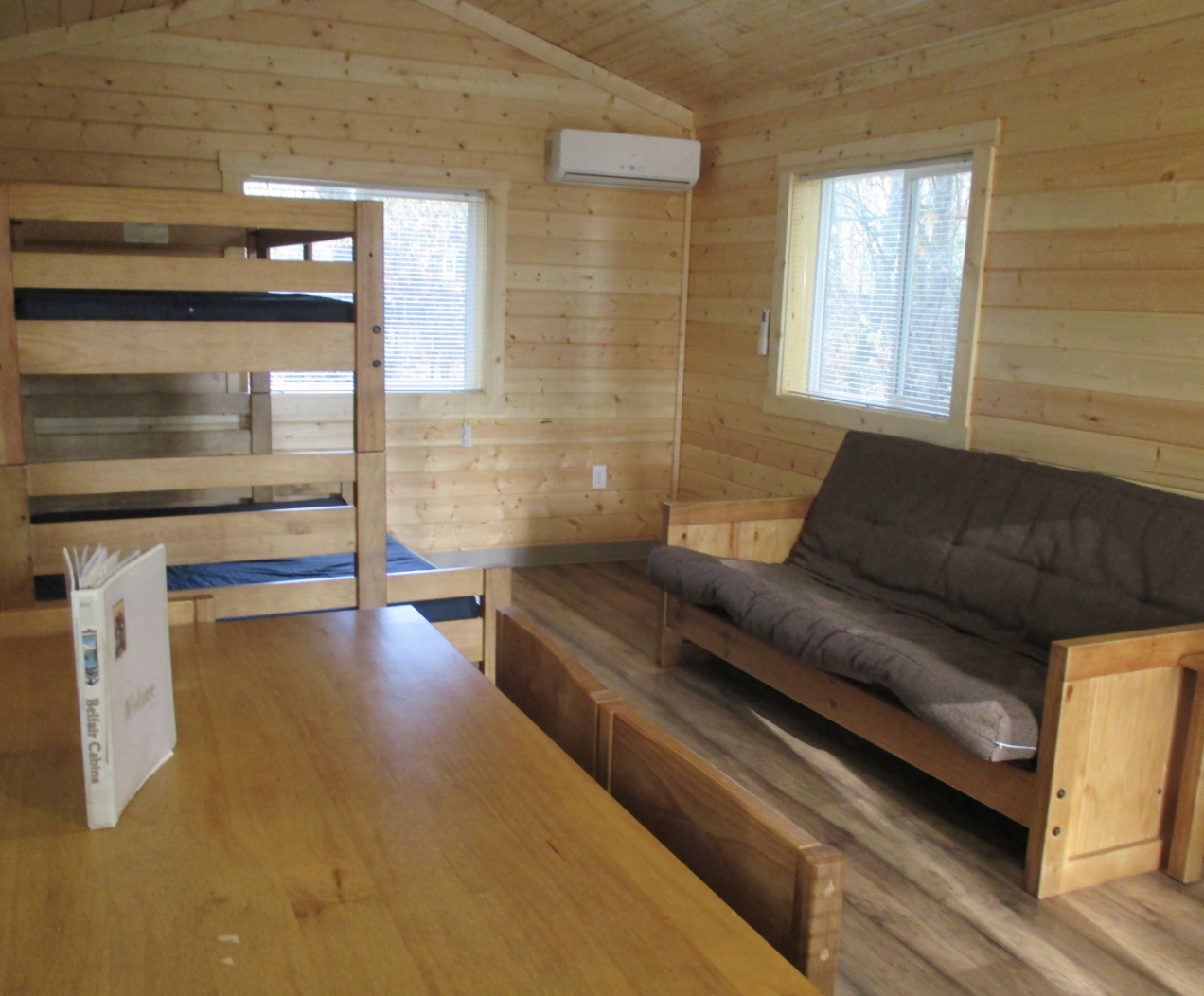
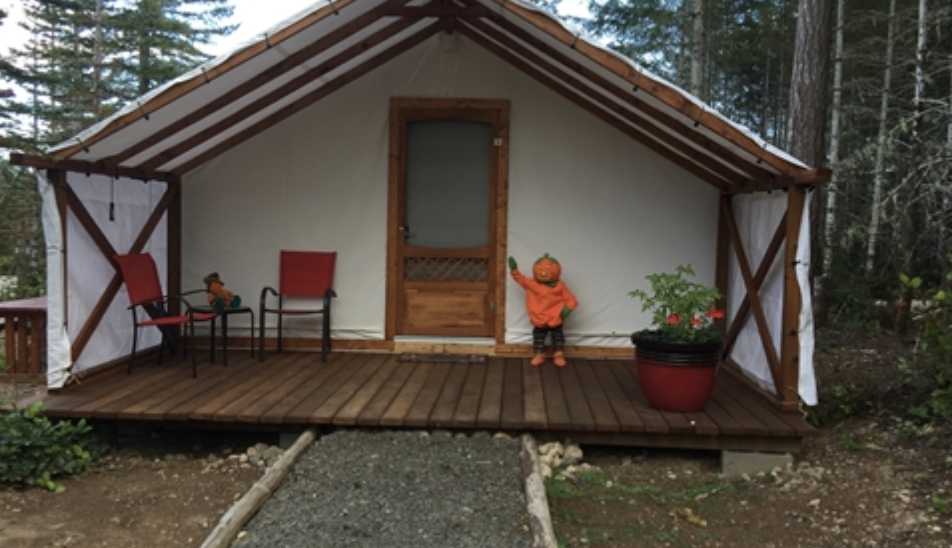
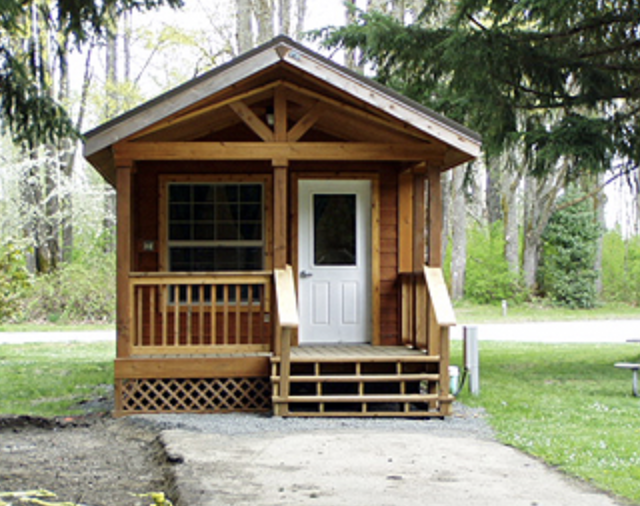
Located in Union, the Pebble Beach Cottage has two beds, one bathroom and can sleep up to 5-6 guests. Sitting approx. 75 feet from the water it has a beautiful view of the canal, and surrounded by a cedar forest. This carriage house is a bed and breakfast style stay with a part-time caretaker on sight. Guests enjoy privacy of a vacation home, (as this property is completely separate from the main house), yet access to concierge services. (Rate $195) Reserve at glampinghub.com.
The Tahuya Adventure Resort is located in the heart of the Tahuya Forest past Belfair. Featuring campsites with hook-ups and luxury platform tents, this is glamping heaven! The Log Cabin tent features a king size log bed, bunk-beds, oversized chairs and tables, pellet stove, carpet, refrigerator, microwave, and a coffee pot. Each site has an outdoor picnic table and fire ring or you are welcome to use their covered kitchen. (Rate $500/2 nights) Reserve at tahuyaresort.com.

The ultimate "glamping" experience can be provided by Hood Canal Events located in Union, WA. For a fee they can arrange the perfect getaway for you and your signifigant other – or the whole family. From setting up the camp & tent (pictured above) in a spectacular location, arranging tours, hikes or kayaking expeditions, to chef prepared gourmet meals in your camp – Jeff and Kerry can take care of it all for you. Call them directly at (360) 710-7452 or visit hoodcanalevents.org. Photo Poppi Photography
Hood Canal Events, based in Union, can provide unique glamping experiences. Offering everything from a Hood Canal beach glamor picnic (great for intimate gatherings, family picnicking, lounging, or celebrations) to a fully catered overnight trip, they can arrange special requests your group may have. Hood Canal Event's packages include furnishings, amenities, activities (kayaking to mushroom foraging or live music) and a chef for locally prepared food and beverages. Overnight glamping packages are available. For information on rates or customizing an experience, call (360) 710-7452, or visit hoodcanalevents.org.
Above are just a few ways you can elevate your "glamping" experience on Hood Canal. There is no wrong way to do it. If you prefer backcountry camping, with your home on your back and no connection to civilization, the Olympic National Park has that too. Camp for days and never see another soul in the backcountry areas. Talk about "finding appreciation."
If camping or glamping is not your thing thats cool too. Hood Canal and South Puget Sound have wonderful guest lodging and rentals right on the beach – with power and flush toilets. Visit explorehoodcanal.com/lodging for a complete list that is updated weekly.
Whatever you choose, just get out there and create some great memories – stubbed toes or not!

5 Reasons Why Olympic National Park Should Top Your To-Do List
Even someone as determined as John Muir couldn’t have poked around every nook in the 876,447 acres of this boundless wilderness haven. Here are our 5 reasons why you can’t afford to miss it—especially if you’re a Seattleite.
This mystical winter wonderland, full of a wildly varied flora and fauna, occupies a behemoth slice of our favorite state. The Olympic National Park, with its 3,000 miles of twisting, cascading rivers and streams (some even frozen in the heart of winter), its 611 miles of switchbacking, lesser-trodden trails, and only 168 miles of road, may be more enchanting and alluring than any other place we know. Even someone as determined as John Muir couldn’t have poked around every nook in the 876,447 acres of this boundless wilderness haven. Here are our 5 reasons why you can’t afford to miss it—especially if you’re a Seattleite.
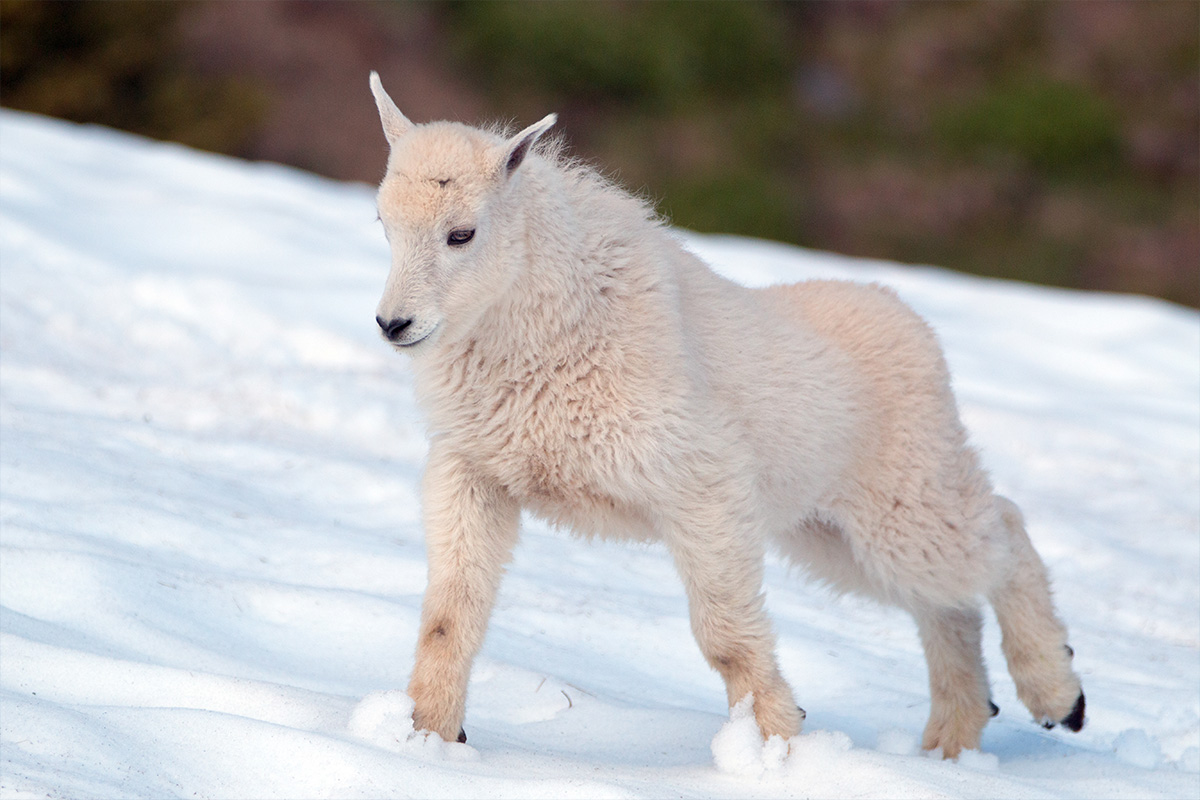
1. Meet the locals (The furry ones!)
Massive bugling elk roam the dense and snowy woods while mountain goats own the craggy peaks. Over 300 species of birds soar through the skies (Washington Audubon has sketched out the perfect birder’s road trip map), and the ancient salmon runs are completing their runs as the first snow falls. That’s not to mention the infamous and somewhat legendary giant Pacific octopi that inhabit the Hood Canal–yes you heard us right.
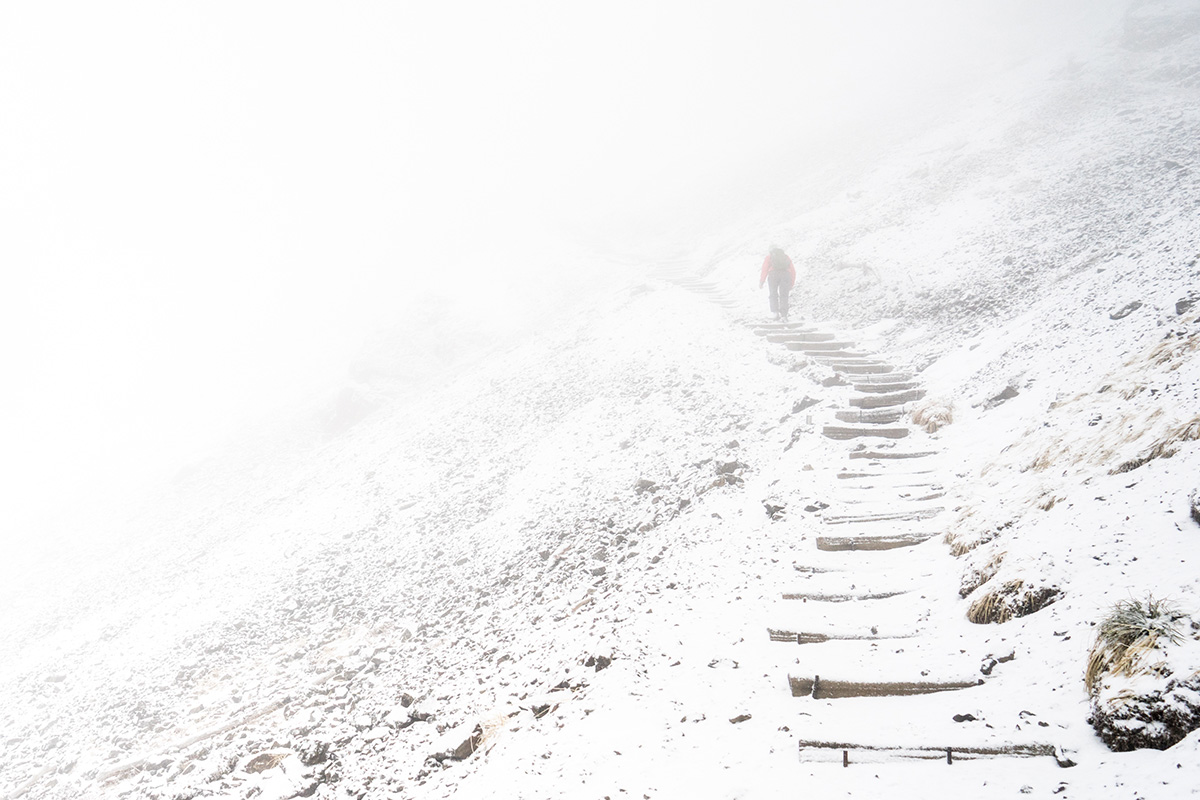
2. Climb Mt. Ellinor in the snow
Going for the summit of Mt. Ellinor in the snow is a staggeringly beautiful experience. Meandering through quiet old growth forests and alongside craggy peaks, this hike serves up some serious views. A strenuous 6.2 miles round trip earns access to some seriously picturesque views of Hood Canal and beyond (assuming you're lucky enough to catch it on a clear day). Doable for all those with proper gear and plenty of time, it’s a must-not-miss. And that’s only one tiny slice of the 3,000 miles of beautiful trail contained within the park.
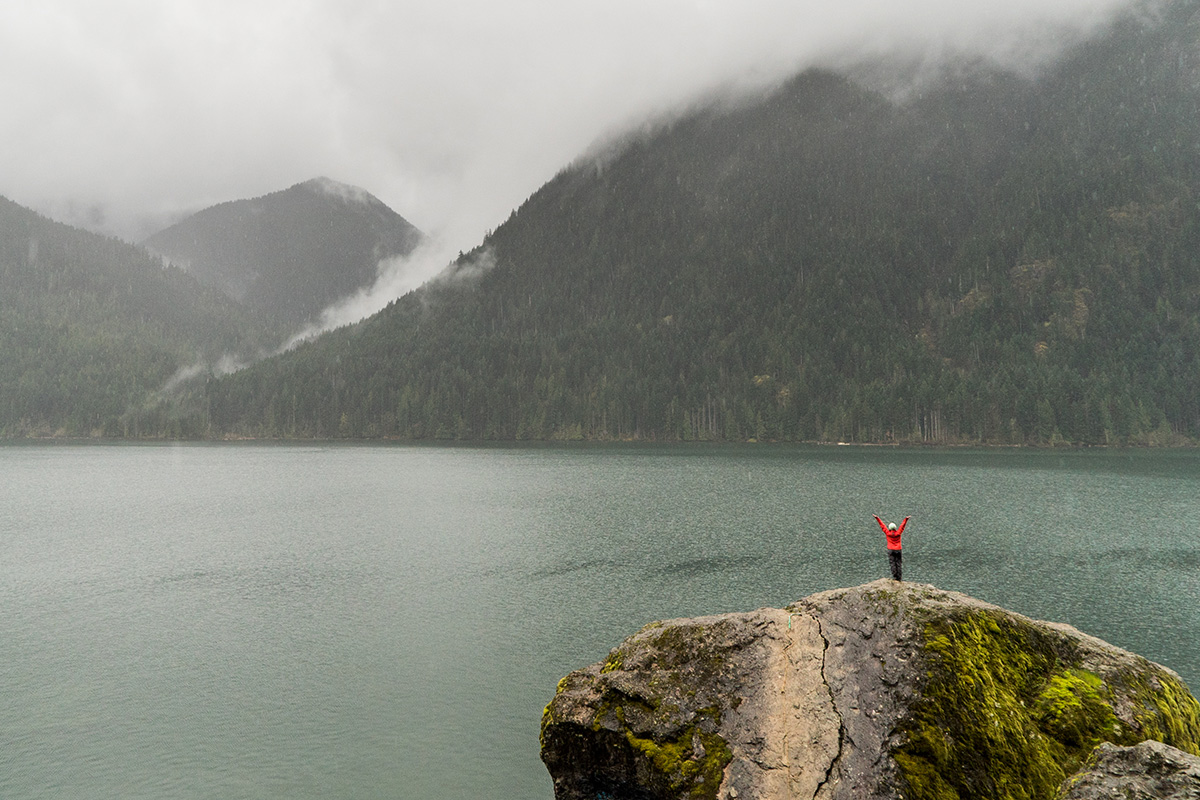
3. Climb The Big Rock at Lake Cushman
Lake Cushman, just outside the Staircase entrance to the park is host to kokanee salmon and cutthroat trout fishing in the summertime, and stunning views in the wintertime. A slew of other cold-weather activities like kayaking (with ALL of the proper gear) with Blue Horizons Paddlesports or climbing up the famed Big Rock and swearing to yourself that you'll be back during the summertime to jump off.
4. Stop for a warm up at Alderbrook Resort in Union, Washington
With all of the boundless opportunities for adventure in the Olympic National Park, face it: you’re going to be pooped (and probably cold). Lucky for you, there are a myriad places to rest your weary explorer’s head. If you’re hankering for a sojourn in a relaxing spa and a hot beverage afterwards, then Alderbrook Resort & Spa is for you! Though, if you’re feeling a quaint VRBO-style rent-a-home on a back road in the woods is up your alley then we have just the place. Click here for an extensive list of options.

5. Geting to Hoodsport is so easy
Staircase, one of the grandest entrances to the southeastern corner of the park is situated just outside of Shelton, a 45 minute drive from Olympia and two hours from Seattle. Hood Canal’s Hoodsport is an ideal launching point for an adventure in the park by way of Staircase, and the intrepid adventurers can hit the Staircase Rapids or snowshoe along the river after the snow starts to fall. With Hoodsport Coffee to properly fuel a morning’s adventure and Hardware Distillery’s handcrafted libations to cheers after a successful day tromping around the forested nooks, it’s worth checking out.
We’re convinced: life is about creating yourself. We choose to do it in one of the most beautiful places on earth. Adventure is spilling out of every nook. Plan your trip to come visit Hood Canal and the Olympic National Park.
For more adventuresome inspiration and ideas, keep up with us on Facebook, Twitter, Pinterest and Instagram.